AI in customer experience means using AI to answer customers, help agents, and understand every conversation a company has with its customers. The results are measurable. In its first month, Klarna's AI assistant handled 2.3 million conversations, two-thirds of its customer service chats, with customer satisfaction on par with human agents. In a study of support agents, AI assistance raised the issues resolved per hour by 14% on average, and by 34% for novice and low-skilled agents.
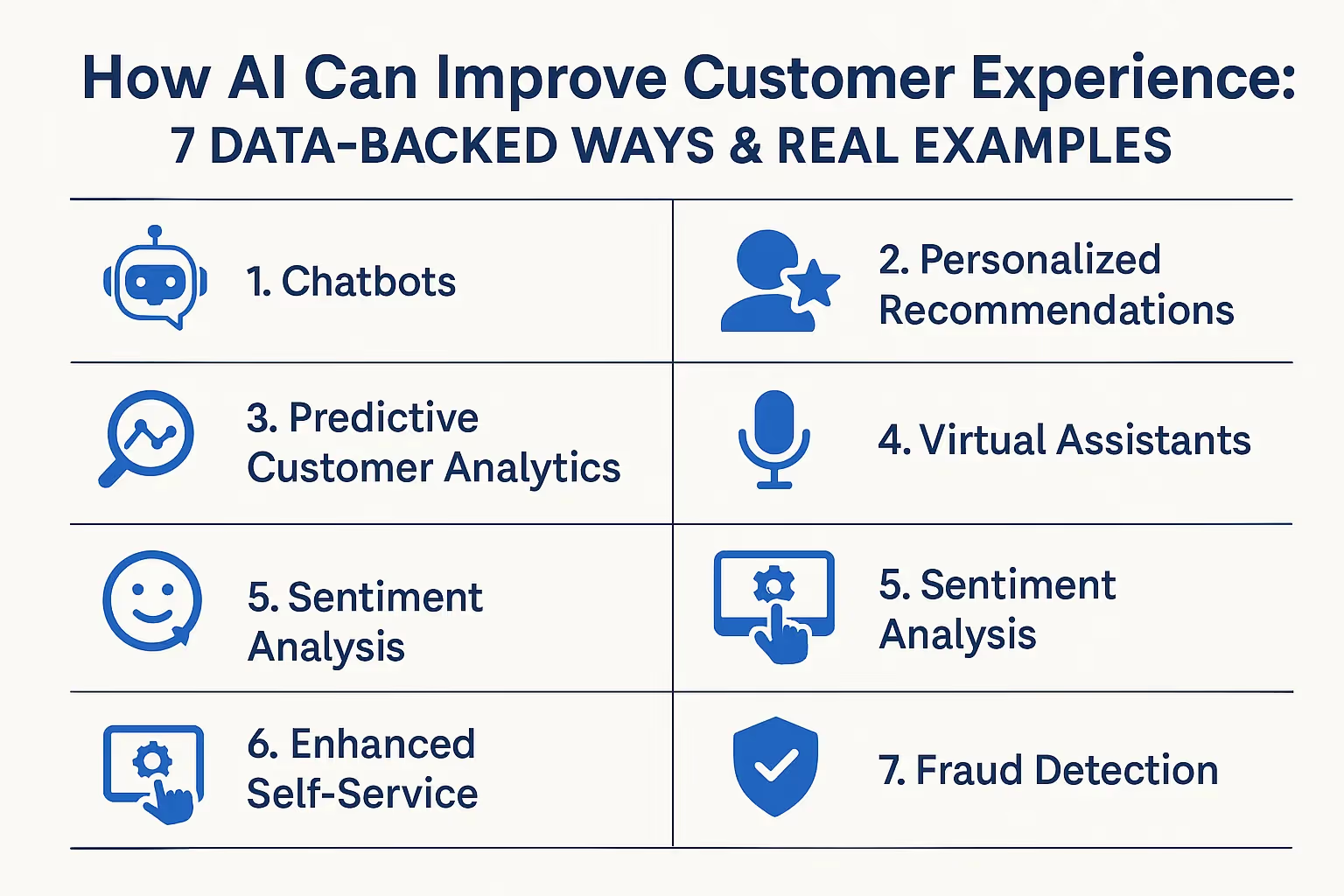
Below are eight ways AI improves customer experience, each with what it changes for the customer, then generative and agentic AI, where to start, and the questions people ask.
How AI improves customer experience: 8 ways
1. It answers routine questions, around the clock
AI assistants take the questions that come up thousands of times: order status, password resets, balance and delivery questions. Customers get an answer at 3 a.m. without waiting in a queue.
Klarna's assistant, announced on February 27, 2024, did the equivalent work of 700 full-time agents in its first month. Customers resolved their errands in under 2 minutes instead of 11, and repeat inquiries dropped by 25%, according to Klarna's announcement.
The rule that keeps it working: routine questions go to the assistant, and a person is one step away for everything else.
2. It helps agents during the conversation
AI can suggest the next answer, find the right knowledge-base article, or flag a missed step while the customer is still on the line. The NBER study "Generative AI at Work" found that AI assistance improves customer sentiment and increases employee retention, on top of the productivity gain. The biggest lift went to newer, less experienced agents.
3. It writes the notes after the call
After-call work, the notes, CRM updates and follow-ups, can take minutes per call. Generated summaries turn that typing into a short review, so agents return to customers sooner and the records say what actually happened. Here is why after-call work matters more than it looks.
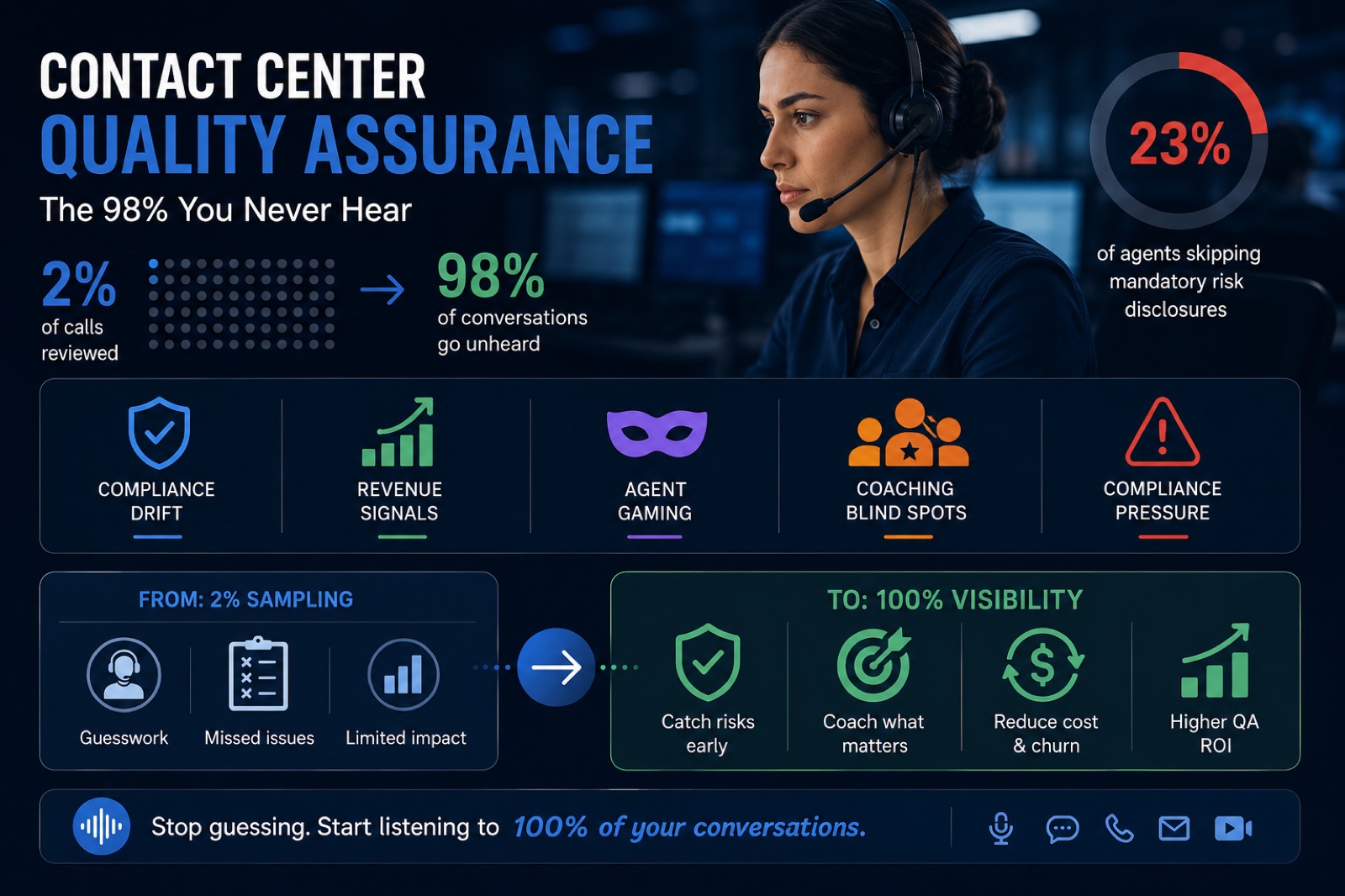
4. It hears every conversation, not a sample
A hand review covers a handful of calls and survey replies. AI analysis covers all of them: every call, chat and email, sorted by the reason the customer got in touch.
OTP Bank's contact center used to rely on agents picking a wrap-up category, and reports came back with half the calls marked "Other". Now every call is categorized automatically, so the head of the contact center sees why customers call (OTP Bank case study).
5. It scores the quality of every conversation
Instead of a QA specialist listening to a few calls per agent each month, AI scores every conversation against the company's own scorecard. Ender Turing's AutoQA does this typically in 95%+ agreement with the customer's own reviewers, and the accuracy can be checked and improved against human scores. People then focus on the critical calls, disputes, calibration and coaching. Here is how call center quality assurance works with it.
6. It measures satisfaction without a survey
Surveys reach the few customers who answer them. AI can estimate satisfaction from the conversation itself, at its start and at its end, for every customer. One contact center's CSAT Dynamics board for September scored 39,554 conversations at entry and exit. OTP Bank, Dila Med Labs and Fozzy Group report doing marketing analysis and NPS 20 times faster and 50 times cheaper with Ender Turing.
7. It sends each customer to the right place
AI can read the intent of a call or message and route it to the queue or agent that can solve it. Each transfer avoided removes a second greeting, a second explanation and often a hold, which shortens the average handle time and spares the customer.
8. It personalizes the next step
With the history of a customer's orders, contacts and products, AI can suggest the next best action: the offer that fits, the reminder that prevents a problem, the answer to the question the customer is about to ask. Personalization works when it is based on what the customer actually did and said, not on a guess about a segment.
Generative AI and agentic AI in customer experience
Generative AI writes: answers for an assistant, replies an agent can send, summaries of a call, explanations of a policy. It needs a company's own knowledge and a human check where the stakes are high.
Agentic AI acts: it completes a task across systems, such as changing a delivery address, issuing a refund within a limit, or booking a callback. It needs clear limits, an audit trail and a person who takes over when the case falls outside them.
Both depend on the same base: knowing what customers actually ask, which comes from the conversations themselves.
What is SI (super intelligence) in customer experience?
SI (super intelligence) is a newer name some organizations use for AI, so SI in customer experience covers the same uses described above. For a contact center the most direct one is listening to every conversation: Ender Turing analyzes each call in seconds, finds the topics behind complaints and lets you ask it anything about them.
Where to start
- Start with the conversations you already have. Find the top reasons customers contact you, and which of them repeat.
- Pick one use with one number. Repeat contacts, average handle time or satisfaction: choose the number the use should move, and measure it before you start.
- Keep a person one step away. Routine contacts go to AI; complex, emotional and regulated ones stay with people.
- Measure every conversation, before and after. A sample can hide what the change did.
Ender Turing listens to every call, chat and meeting, in any language your customers speak, analyzes each one in seconds and lets you ask it anything, with EnderGPT and topics. Averages across 50+ contact-center deployments: 100% of calls automatically scored versus a 3–5% manual baseline, +19% customer satisfaction, −15% average handle time, and 68 QA hours saved per specialist per month (case studies). It is rated 4.8/5 on G2, the Team plan is $39 per agent per month, and the free plan covers up to 5 agents with no expiry. See the platform or start free.
AI in customer experience FAQ
How is AI used in customer experience?
To answer routine questions, help agents during conversations, write call notes, analyze every conversation, score quality, measure satisfaction without surveys, route contacts and personalize the next step.
How can AI be used in customer service?
The most common uses are assistants that answer routine questions, suggestions for agents during calls and chats, and automatic summaries after them. Behind the scenes, AI analyzes every conversation to show why customers call and how each one went.
Will AI replace customer service agents?
AI takes over routine contacts: Klarna's assistant did the work of 700 full-time agents in its first month. In the NBER study, AI assistance made agents more productive and raised employee retention, with the largest gains for newer agents. The complex and sensitive contacts stay with people.
What is generative AI in customer experience?
Generative AI writes text and speech for customer interactions: answers, replies, summaries and explanations, based on a company's own knowledge.