You hear 2% of the calls
Quality reviewers can listen to a handful of calls per agent per month. The other 98% — the complaints, the missed upsells, the script that was skipped — happen unheard.
Listening to a sample tells you what happened to a sample. Ender Turing turns every call, chat and email into a transcript, a topic, a score and a set of metrics the moment it ends — so the reasons customers call, the words that lose them and the lines agents skip are on one dashboard, and the week can be asked a question in plain language.
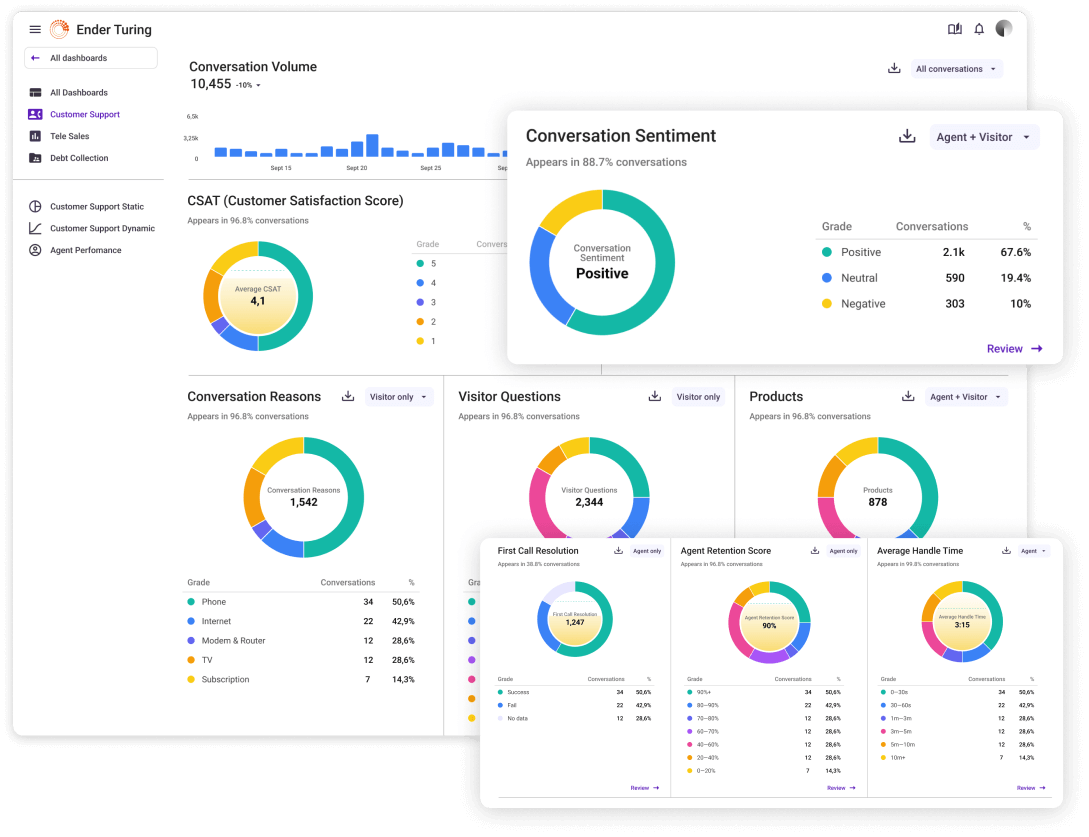
Quality reviewers can listen to a handful of calls per agent per month. The other 98% — the complaints, the missed upsells, the script that was skipped — happen unheard.
Why did volume spike on Tuesday? Which product drives repeat calls? The answers exist in thousands of recordings nobody can search.
By the time a trend reaches a slide, the campaign is over and the agent has moved on. Managers need the numbers the same day, not the same quarter.
Standard templates for your case are installed on sign-up; everything here works on the free plan.
Calls, chats and emails become transcripts with speaker labels. Discovery searches every transcript for a word or phrase and opens the conversation at the moment it was said; a custom vocabulary corrects the names speech recognition gets wrong, so product and agent names read correctly everywhere.
Group conversations into themes with generative AI, filter rules or human labels. Gen AI topics are tuned by reviewing samples, and their accuracy is checked and calibrated against your reviewers, so "complaint", "cancellation" or "upsell" mean what your team means.
Tags find the keywords and phrases that matter, split by speaker. Compliance rules define the lines that must be said and produce a per-call script-adherence score you can highlight in the transcript, filter on and report against.
Silence share, longest monologue, holds and hold time, waiting and response time, call direction, repetitive calls from the same customer, CSAT and NPS where your platform supplies them — all filters on the conversation list, all dimensions on the charts.
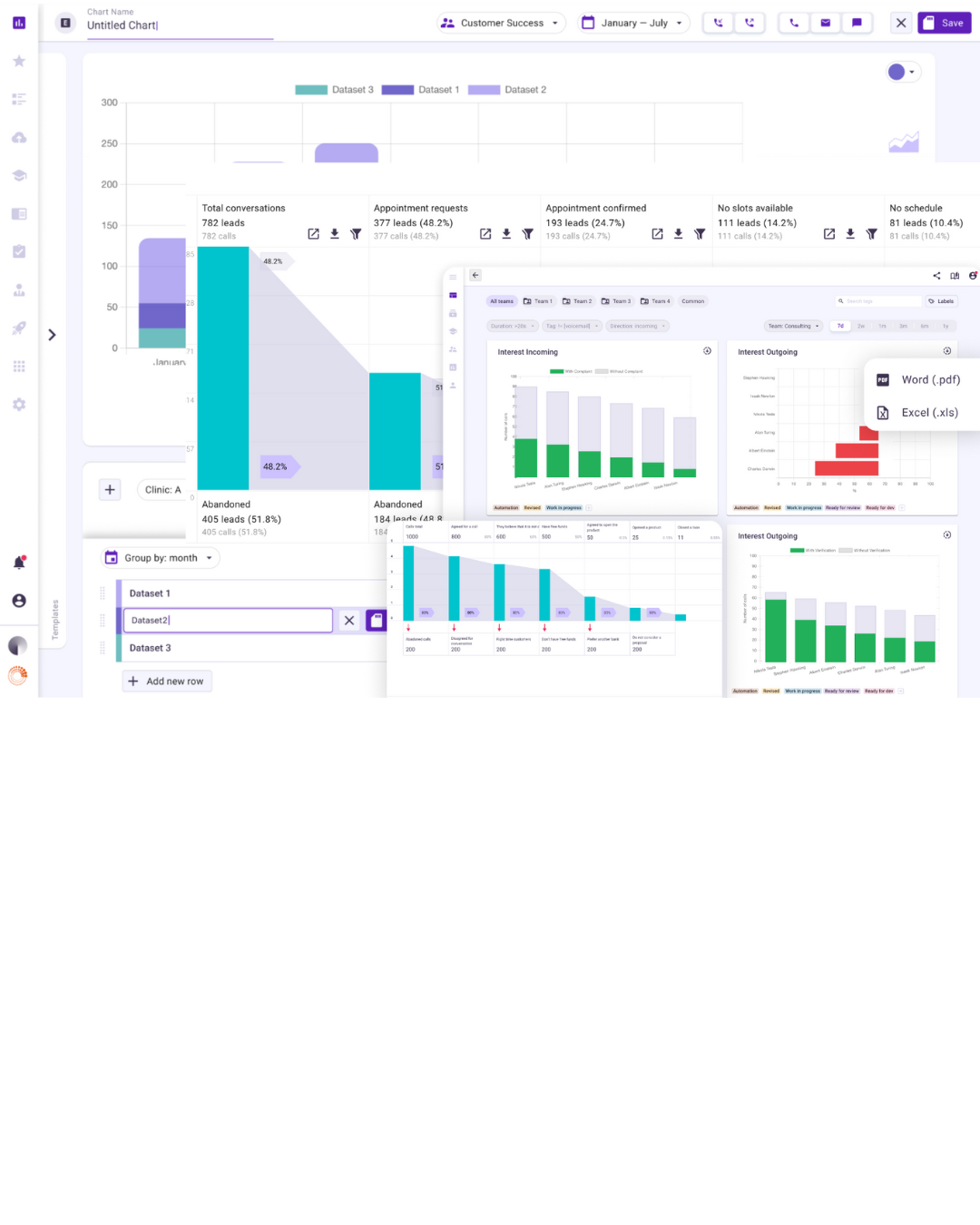
Funnels track how conversations move through stages and where they drop; charts cut volume, duration, cost and customer metrics by agent, team, topic and time; dashboards carry the team view; C-level boards consolidate it for the executive, with built-in CSAT Dynamics and Interaction Intensity analyses.
Chat with EnderGPT answers questions about your conversations with citations to the calls; scheduled chats run the same question every day, week or month — for the team, or as a separate report per agent; email reports deliver dashboards on a schedule; Enders turn a finding into an action — notify a manager, set a topic, run a review.
Averages across our contact-center deployments — each customer's own numbers are in the case studies. Case studies →
Product screenshots — dashboards and analyses from the platform, not illustrations.
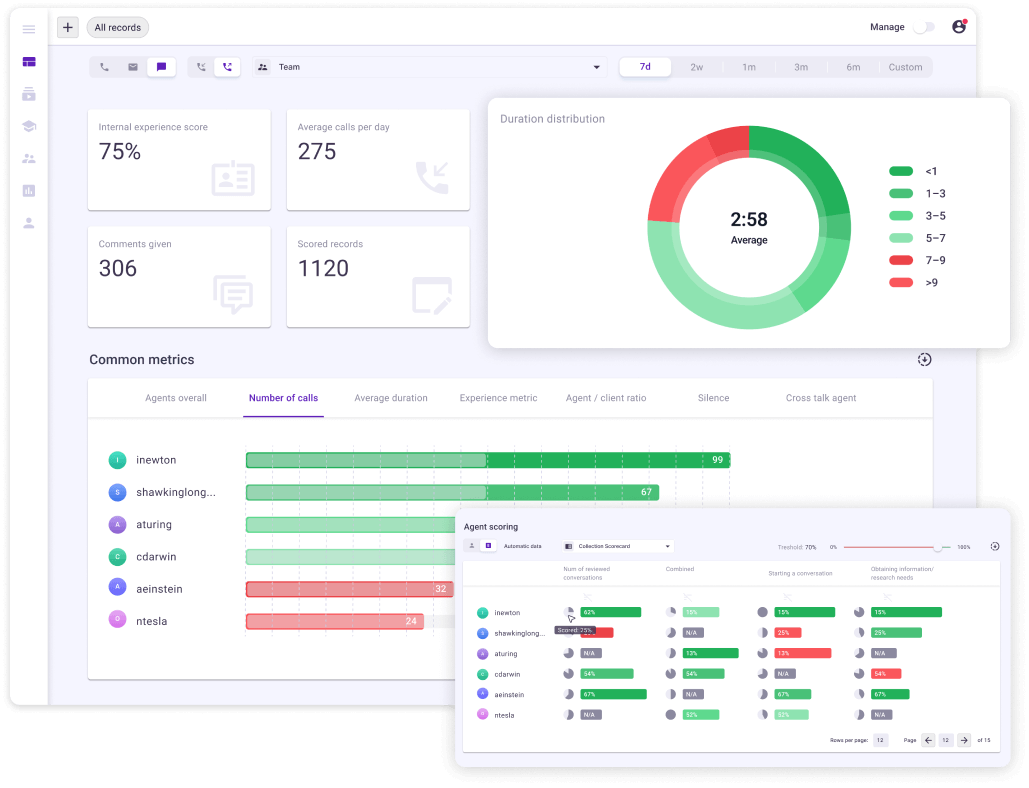
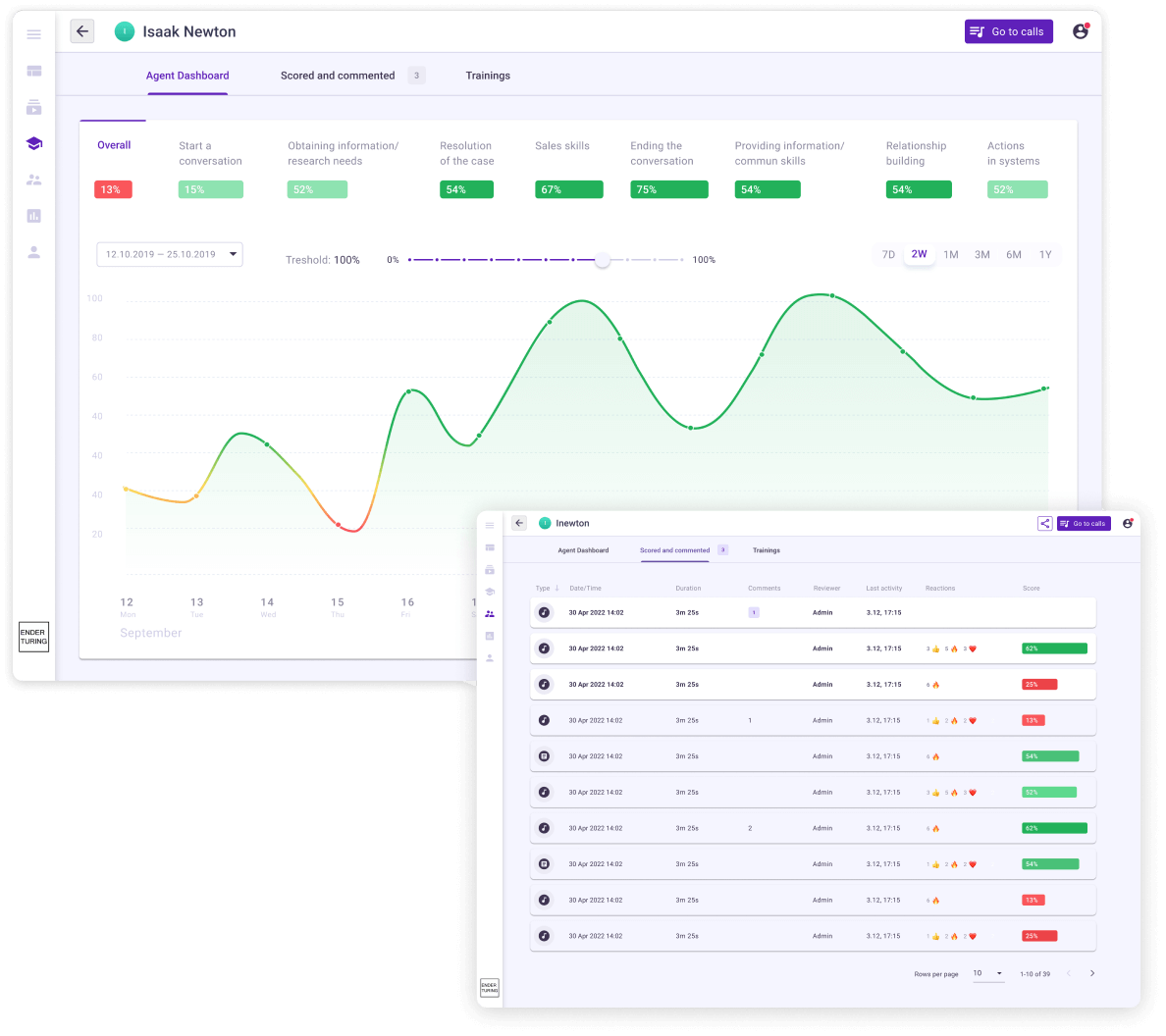
Speech analytics tells you what happened; AutoQA scores it on your scorecard, on 100% of calls, with its accuracy against your reviewers shown.
Playlists, training plans and each agent's own dashboard turn the findings into the next week's behavior.
Genesys Cloud, Five9, NICE CXone, Talkdesk, Amazon Connect, Zendesk, GoHighLevel — or the browser extension on 18 platforms.
Largely the same thing under two names. Speech analytics is the contact-center term: recorded calls turned into transcripts, topics, keywords and metrics such as silence and talk time, so the team sees what happens across all calls instead of the few someone listens to. Conversation intelligence is the same idea named by the sales world — calls and meetings, coaching, deal context. Ender Turing does both on one set of conversations; this page describes what it makes of the words that were said.
Yes, on both sides of the call. The analytics runs in real time: each conversation is transcribed, summarized, categorized and scored seconds after it ends, and dashboards, funnels and boards update as it arrives — on 100% of calls, not a sample. During the call, a separate Ender Turing product gives agents real-time suggestions; ask us about it when you sign up.
Yes. Topics classify what each conversation was about and what stage it reached — including intent categories you define, learned by generative AI from your own samples. The built-in CSAT Dynamics and Interaction Intensity analyses read how the customer's satisfaction and the intensity of the exchange moved from the start of the call to its end, and appear as boards when the data is there.
Any language. English, Spanish, Portuguese, French, German, Polish, Ukrainian, Arabic, Chinese, Japanese and more run in production; any other is added on request or connected through your own speech-recognition engine. Custom vocabulary corrects the product, company and agent names speech recognition tends to get wrong.
Three things you can check rather than take on trust: a free plan and transparent per-seat pricing instead of an enterprise quote; generative answers — you ask the week a question and get an answer with the calls cited — instead of building queries; and topics and scorecards whose accuracy is measured against your own reviewers and improved from their reviews. The connections are read-only, so it sits next to the platform you have.
Both, on the same conversations. The analytics layer on this page — transcripts, topics, tags, metrics, funnels — describes what happened. The quality layer scores it: AutoQA answers your scorecard on every call, with its accuracy shown per criterion. One workspace, one set of conversations, two views on them.
Yes. Conversations are calls, chats, emails and web records, on the same filters, topics, scorecards and dashboards, so a customer who called and then wrote appears as one story rather than two systems.
Through a documented app or connector — Genesys Cloud, Five9, Zendesk, Fireflies, GoHighLevel — through the Ender Turing browser extension that records browser-based calls on 18 platforms, or through the REST API, an SFTP export or upload. Nothing is written back into your platform.
The platform is built to run without an analyst: standard templates for your case are installed on sign-up, topics learn from samples, dashboards and reports arrive on a schedule, and the Business plan adds implementation engineers who set up connectors and scorecards with you. If you want a partner to run the whole analysis for you, write to us and we introduce one.
Ender Turing has completed a SOC 2 Type II examination and handles data in a GDPR-compliant way on every plan; Enterprise adds private cloud or on-premise deployment. Anonymization redacts configured sensitive words in transcripts and masks the matching audio; Roles decide who can open which team's conversations.
Security, hosting regions, sub-processors and response times are documented on the Data Security page; SOC 2 Type II examination completed.
Sign up, connect your platform or upload recordings, and the first conversations come back transcribed, categorized and scored the same day.