Speech analytics turns recorded customer calls into data. It transcribes every conversation, then finds the topics, the sentiment, the lines that were said and the ones that were missed. For a bank, a card issuer or an insurer, that changes one thing above all: the quality and compliance teams stop judging the contact center by the few calls they had time to hear, and start from all of them.
This guide explains what speech analytics does in financial services, the seven uses that matter most in a bank's contact center, what it measures, and how to roll it out when the data is sensitive.
What is speech analytics in banking?
Speech analytics is software that converts recorded calls into text and analyzes every conversation for topics, sentiment, script adherence and outcomes. In banking and financial services it is used to check that the required statements were made on every call, to find out why customers call and complain, and to coach agents from evidence instead of a sample.
It is not the same as call recording. A recording system stores calls so that someone can find one and play it back. Speech analytics works across all of them: it tells you which calls to open, and it answers questions nobody could answer by listening.
Why financial services use it
Three things make a bank's contact center a natural fit:
- The rules are specific. Identification, consent, fee and rate disclosures, the wording of a collections call: a conversation either contained the required lines or it did not, and software can check that.
- A sample hides the exceptions. Manual quality review covers only a small share of calls, so a missed disclosure or a mishandled complaint surfaces weeks later, if at all.
- The same questions come in every day. Blocked cards, missing payments, loan status, fees. Knowing which of them drive volume and repeat calls is an operations decision, not a guess.
7 speech analytics use cases in banking and financial services
1. Required disclosures and consent, checked on every call
This is the most common use. You define the lines a conversation must contain: an identification step, a consent question, a fee or rate disclosure, a closing statement. The software checks every call for them, with the tolerance for wording you set, and flags each call where a line is missing, linked to the exact moment. The compliance team reviews the exceptions instead of a random sample.
2. Complaints, found even when nobody says "complaint"
Customers rarely use the word. Speech analytics finds dissatisfaction in what is said and how: a request to speak to a manager, an explanation repeated three times, a negative tone at the end of the call. Grouping those calls by topic shows the product, fee or process behind them, so the fix happens upstream instead of one call at a time.
3. Collections: promises to pay and how the call was handled
In collections, speech analytics records the outcome of each call, such as a promise to pay, a payment plan or a callback. It checks that the agent made the required statements and kept a respectful tone. It also shows which approaches lead to promises that are kept, so the whole team can learn them.
4. Sales and retention conversations, measured
When the contact center sells cards, loans or insurance, or tries to keep a customer who wants to leave, analytics shows the offer that was made, the objection that followed and the outcome. Comparing the calls that converted with the calls that did not turns the habits of the best agents into coaching material.
5. Customers who need extra care, flagged
Customers in financial difficulty, bereaved or confused often say so only indirectly. Topic rules can flag these conversations, so that a specialist follows up and the agent gets feedback on how the call was handled.
6. Social-engineering patterns, surfaced for review
Speech analytics can flag conversations that follow a known social-engineering pattern, such as a caller who changes the contact details on an account and then asks for a transfer, so the fraud team can review them. It complements dedicated fraud-detection and voice-authentication systems, which act during the call; it does not replace them.
7. Quality assurance and coaching on 100% of calls
Automated scoring applies the same scorecard to every conversation, in every language the contact center works in. Managers see each agent's score per skill, the trend and the calls behind it, and coach with the exact moment in hand instead of an anecdote.
What speech analytics measures in a bank's contact center
| Area | What gets measured |
|---|---|
| Compliance | Required lines said or missed, script adherence per call, exceptions per agent and team |
| Customer experience | Sentiment at the start and end of the call, estimated satisfaction, complaints, repeat calls |
| Operations | Reasons for calling, handle time, silence and hold, transfers |
| Sales and collections | Offers made and accepted, objections, promises to pay, callbacks |
| Agent performance | Score per skill, trend over time, calls to learn from |
How to roll it out when the data is sensitive
- Start from the recordings you already have. Most tools connect to the contact center platform or the recording archive. Stereo recordings, with the agent and the customer on separate channels, give the most accurate transcripts.
- Mask personal data. Account and card numbers, names and identifiers should be masked in transcripts, and roles should decide who can open which conversations.
- Decide where the data lives. If your policy requires it, ask for private-cloud or on-premise deployment.
- Measure accuracy on your own calls. Before you rely on automated scores, ask the vendor to show how often they agree with your own reviewers, point by point.
- Cover every language you serve. A bank with customers in several languages needs one scorecard that works in all of them, or its quality numbers cannot be compared.
- Begin with one queue and one question. A single use case, such as disclosures on card calls, proves its value faster than a rollout across every team.
Speech analytics for banks: Ender Turing
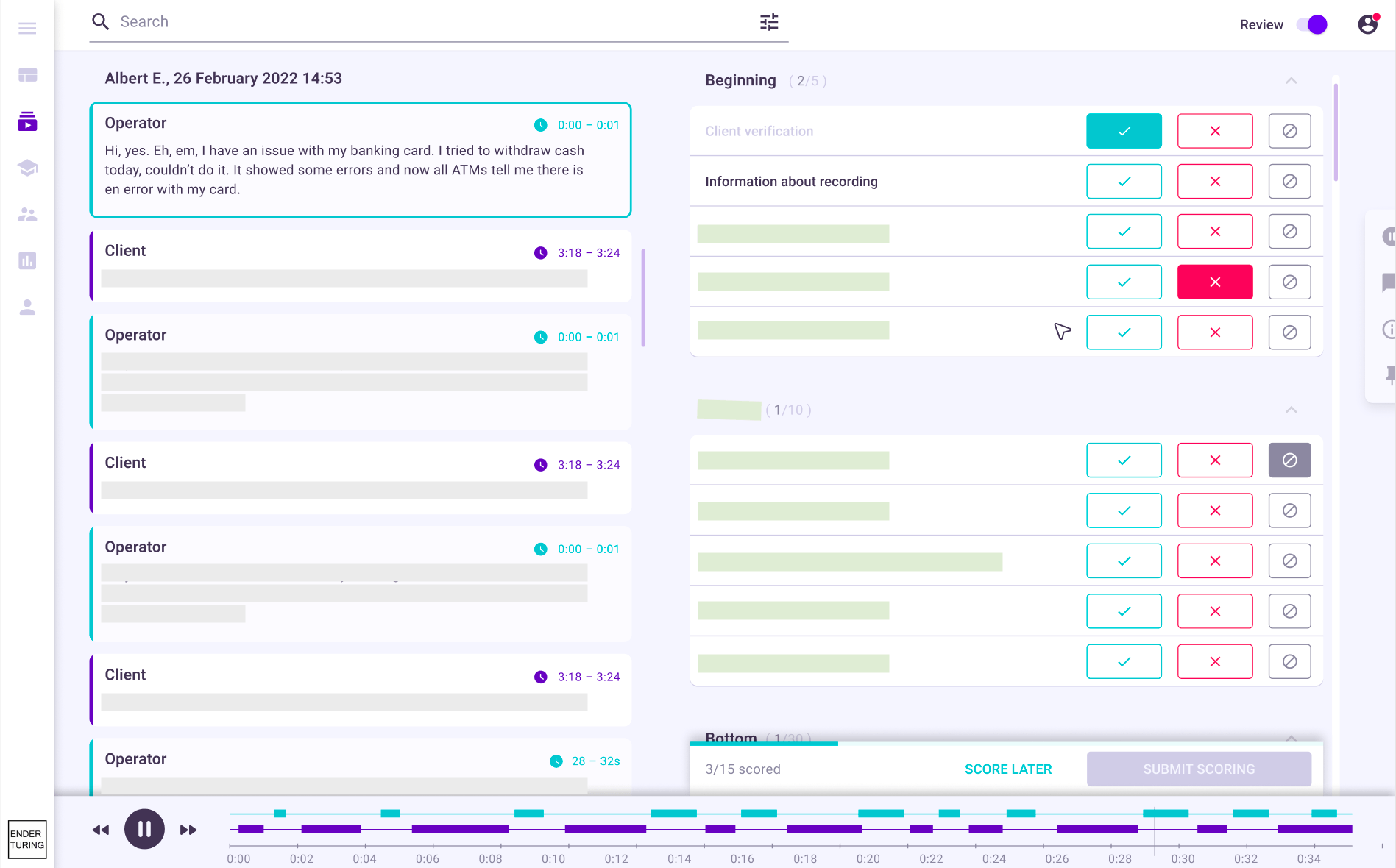
Every disclosure checked, every reason counted, every repeat call seen. Banks run their contact centers on Ender Turing because a customer call is where compliance, revenue and satisfaction meet, and a 3% sample never showed them. Every call, chat and email is transcribed, scored against your scorecard and categorized the moment it ends (speech analytics), in every language your subsidiaries speak; personal data is masked; the exceptions reach compliance the same day.
- Every required line, on every call. Compliance rules score whether identification, consent, the product's mandatory disclosures and the closing lines were said, on 100% of calls, chats and emails, with the exact moment linked. An automation escalates the misses to compliance the same day (compliance rules).
- One scorecard across every subsidiary and language. AutoQA scores the same scorecard in every language your customers speak and shows its accuracy against your reviewers, point by point (scorecard accuracy).
- Why customers call, and which calls come back. Topics categorize each conversation (card blocked, payment not received, loan status, fee complaint), and repeat calls are linked to the customer's previous one (topics).
- Sales, retention and collections, measured. Funnels follow each conversation to its outcome: offer accepted, customer retained, promise to pay (funnels).
- Ask the contact center a question. "Why did calls about blocked cards rise last week, and which branches drove it?" EnderGPT answers from the conversations, with the calls cited (EnderGPT).
- Your data, your cloud. Account numbers, names and identifiers are masked in transcripts per language; roles decide who opens which conversations; SOC 2 Type II and GDPR-compliant handling on every plan; private cloud or on-premise deployment on Enterprise (data security).
The results. OTP Bank moved from sampling calls to analyzing every conversation with Ender Turing and improved customer satisfaction from 6.8 to 8.0 on a 10-point scale (OTP Bank case study). Averages across 50+ contact-center deployments: 100% of calls automatically scored versus a 3–5% manual baseline, +19% customer satisfaction, −15% average handle time, and 68 QA hours saved per specialist per month (case studies). Rated 4.8/5 on G2.
The price. Free for up to 5 agents and 100 calls per agent a month, with no expiry; Team is $39 and Business $79 per agent per month (pricing). See Ender Turing for banks, or book a demo with your own recordings.
FAQ
What does speech analytics do in banking?
It transcribes every customer call and analyzes it: whether the required disclosures and consent were given, why the customer called, how satisfied they sounded and how the call ended. Compliance and quality teams then review the exceptions instead of a random sample.
What is the role of speech analytics in collections?
It records the outcome of each collections call (a promise to pay, a payment plan, a callback), checks that the required statements were made and that the tone stayed respectful, and shows which approaches lead to promises that are kept.
Is speech analytics the same as call recording?
No. Call recording stores calls so they can be played back. Speech analytics analyzes all of them, so you know which calls to open and can answer questions across thousands of conversations.
Can speech analytics detect fraud?
It can flag conversations that match known social-engineering patterns for the fraud team to review. Stopping fraud during the call is the job of dedicated fraud-detection and voice-authentication systems.
How do you choose speech analytics software for a bank?
Compare four things on your own recordings: whether it checks every call or a sample, how often its scores agree with your reviewers, whether it covers every language you serve, and whether it can run where your data policy requires, in your private cloud or on-premise.