First call resolution (FCR) is the share of customer calls resolved on the first contact, so the customer does not need to call back about the same issue. A call counts as resolved when the question is answered or the problem is fixed before the call ends, and no repeat contact about it follows.
Customers notice FCR directly: in SQM Group's research, 93% of customers expect their call to be resolved on the first call. Below: the formula with a worked example, what a good FCR rate is, how to measure it, and how to raise it.
The first call resolution formula
FCR rate = calls resolved on the first contact ÷ eligible calls × 100
A worked example: a call center takes 1,000 calls in a month. 100 of them are wrong numbers, abandoned calls or calls cut off before the issue was clear, which leaves 900 eligible calls. 630 of those are not followed by a repeat contact about the same issue. FCR = 630 ÷ 900 × 100 = 70%.
Three decisions keep the number honest:
- Which calls are eligible. Leave out calls the agent had no fair chance to resolve: wrong numbers, abandoned and test calls, and calls disconnected before the issue was understood. SQM Group's FCR guide excludes the same calls.
- What "resolved" means. The customer says so in a survey, no repeat contact follows, or the agent's disposition code says closed. Choose one definition and keep it, or the trend means nothing.
- The repeat window. A second contact about the same issue inside the window, for example 48 hours or 7 days, marks the first call unresolved. A short window misses late callbacks; a long one counts new questions as repeats.
First call resolution vs first contact resolution
The two names describe one metric. First call resolution counts phone calls. First contact resolution counts every channel the customer uses, such as chat, email and messaging, with the same formula.
One contact resolution (OCR) is stricter: it asks whether the customer needed only one touchpoint across all channels, including the website and self-service. SQM Group found call center FCR at 70% but one contact resolution at 59%, so 41% of customers had to contact the organization more than once.
How to measure first call resolution
Four sources are common, and each sees resolution from a different side:
- Post-call surveys. The customer says whether the issue was resolved, which is the view that matters most. Only the customers who answer are counted.
- Repeat-contact tracking. A contact from the same customer about the same issue within the repeat window marks the first one unresolved. It covers every call, but it needs the customer identified and the issue matched.
- AI evaluation of call recordings. Every recorded call is checked for resolution. In SQM's benchmark, an AI model predicted 72% FCR from call recordings where post-call surveys showed 71%.
- Agent dispositions or CRM status. The cheapest source and the weakest, because the agent who closes the call also decides whether it was resolved.
Use one as the main measure and check it against another, for example repeat contacts against survey answers.
What is a good first call resolution rate?
SQM Group, which benchmarks more than 500 North American call centers a year, puts the call center average at 71% FCR, a good rate at 70% to 79%, and world-class at 80% or higher. Only 5% of call centers reach 80%.
FCR depends on the industry. In SQM's 2026 benchmark, retail averages 77%, insurance 75% and not-for-profit 73%, while telecom averages 56% and technical support 64%.
It depends on the call type even more. In SQM's 2024 benchmark, general inquiries were resolved on the first call 73% of the time, billing calls 69%, technical support calls 60% and complaints 48%.
So compare each queue and call reason with its own history, not with the center's average.
Why first call resolution matters
- Cost. SQM Group finds that every 1% improvement in FCR reduces operating costs by 1%. An unresolved call comes back as a second call, with its own handle time.
- Satisfaction. In the same research, every 1% improvement in FCR improves customer satisfaction by 1% and raises transactional Net Promoter Score by 1.4 points.
- Agents. SQM also links every 1% improvement in FCR to a 2.5% improvement in employee satisfaction.
Why calls go unresolved
SQM's 2024 benchmark traced the causes of unresolved calls: 49% lie with the organization, 38% with the agent and 13% with the customer. Nearly half of the causes sit in policies, processes and systems, not with the person on the phone.
Holds and transfers are the most visible symptoms. SQM measured FCR 16% lower when customers were put on hold and 14% lower when they were transferred.
When FCR misleads
FCR taken from the agent's own disposition code rewards marking calls resolved. A customer who gives up and never calls back looks resolved too. A repeat window that is too long counts a new question as a failed first call. Check FCR against what customers do next, not only against what the call record says.
How to improve first call resolution
- Measure it on every call, by reason. A center-wide average hides that complaints and billing calls fail most. Count repeat contacts per call reason and per queue.
- Fix the top repeat reasons at the source. When a policy, a missing permission or a broken process sends customers back, coaching agents will not change it. Take the top three repeat reasons to the teams that own them.
- Give agents what they need to finish. Access to the right systems, a knowledge base that answers the question, and an escalation path that keeps the customer on the line instead of promising a callback.
- Route the call right the first time. Every transfer lowers the chance of resolution, so fix the IVR menus and routing rules that send calls to the wrong team.
- Coach on the calls that came back. The first call of each repeat chain shows what was missed. Review those calls with the agent, not a random sample.
- Confirm before ending the call. An agent who sums up the solution and the next step, and asks whether anything else is open, catches the problems that would otherwise return.
Measuring first call resolution from the conversations
A phone system counts calls. It does not show which customers called back, or why.
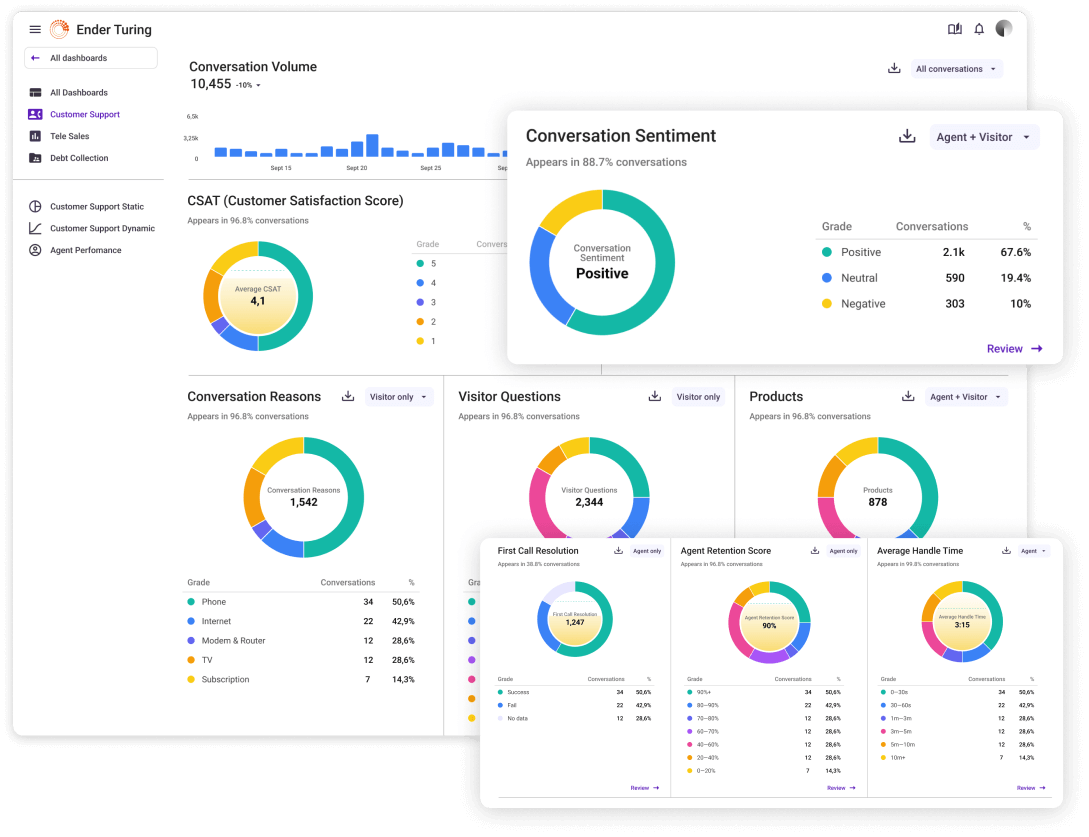
Ender Turing listens to every call, chat and meeting, in any language, analyzes each one in seconds and lets you ask it anything. For first call resolution it links each call to the same customer's previous call: the same caller for inbound calls, the same number for outbound calls. Your repeat-contact rules set what counts as a repeat: the previous call's minimum length, its direction, the same queue, how it ended and its CRM status (metrics and variables).
- Interval to prev call finds the calls that came back within a window you choose, such as 5 minutes to 48 hours, and Root call only (FCR failed) keeps the first call of each chain: the one that did not resolve the request (conversations).
- Topics name the reason for every conversation, so the repeat chains show which call reasons send customers back.
- Charts group the results by FCR, topic, agent and team. If your own data already marks calls as resolved or not, Ender Turing uses those values for FCR reporting too.
- Chat with EnderGPT: ask "Why do customers call back after filing a claim?" and get repeat calls by reason, a cited customer quote and recommendations.
- AI CSAT adds the customer's side: satisfaction at the start and the end of every conversation, without a survey.
In OTP Bank's retail contact center, first call resolution rose from 81% to 86% (case study). See contact center operations analytics.
Averages across 50+ contact-center deployments: 100% of calls automatically scored versus a 3–5% manual baseline, +19% customer satisfaction, −15% average handle time, and 68 QA hours saved per specialist per month (case studies). Ender Turing is rated 4.8/5 on G2 and has a free plan for up to 5 agents: 100 calls per agent a month, calls up to 10 minutes, no expiry. Start free.
First call resolution FAQ
What is first call resolution?
First call resolution (FCR) is the share of customer calls resolved on the first contact, with no need for the customer to call back about the same issue.
What does FCR mean in a call center?
FCR stands for first call resolution. A call center uses it to track how often agents answer the question or fix the problem during the first call.
How do you calculate first call resolution?
Divide the calls resolved on the first contact by the eligible calls and multiply by 100. 630 resolved calls out of 900 eligible calls is an FCR rate of 70%.
What is a good first call resolution rate?
SQM Group puts a good FCR rate at 70% to 79% and world-class at 80% or higher. Compare each queue with its own history, because complaints and technical support calls are resolved less often than general inquiries.
Is first contact resolution the same as first call resolution?
Yes, with one difference in scope: first contact resolution counts every channel, such as chat and email, while first call resolution counts phone calls.
What is the 80/20 rule in a call center?
It is a service level target: 80% of calls answered within 20 seconds. It measures how fast calls are answered, not whether they are resolved, so track it next to FCR, not instead of it.
How do you improve first call resolution?
Find the call reasons that bring customers back, fix the policies and processes behind them, give agents the access and knowledge to finish the call, and route calls to the right team the first time.