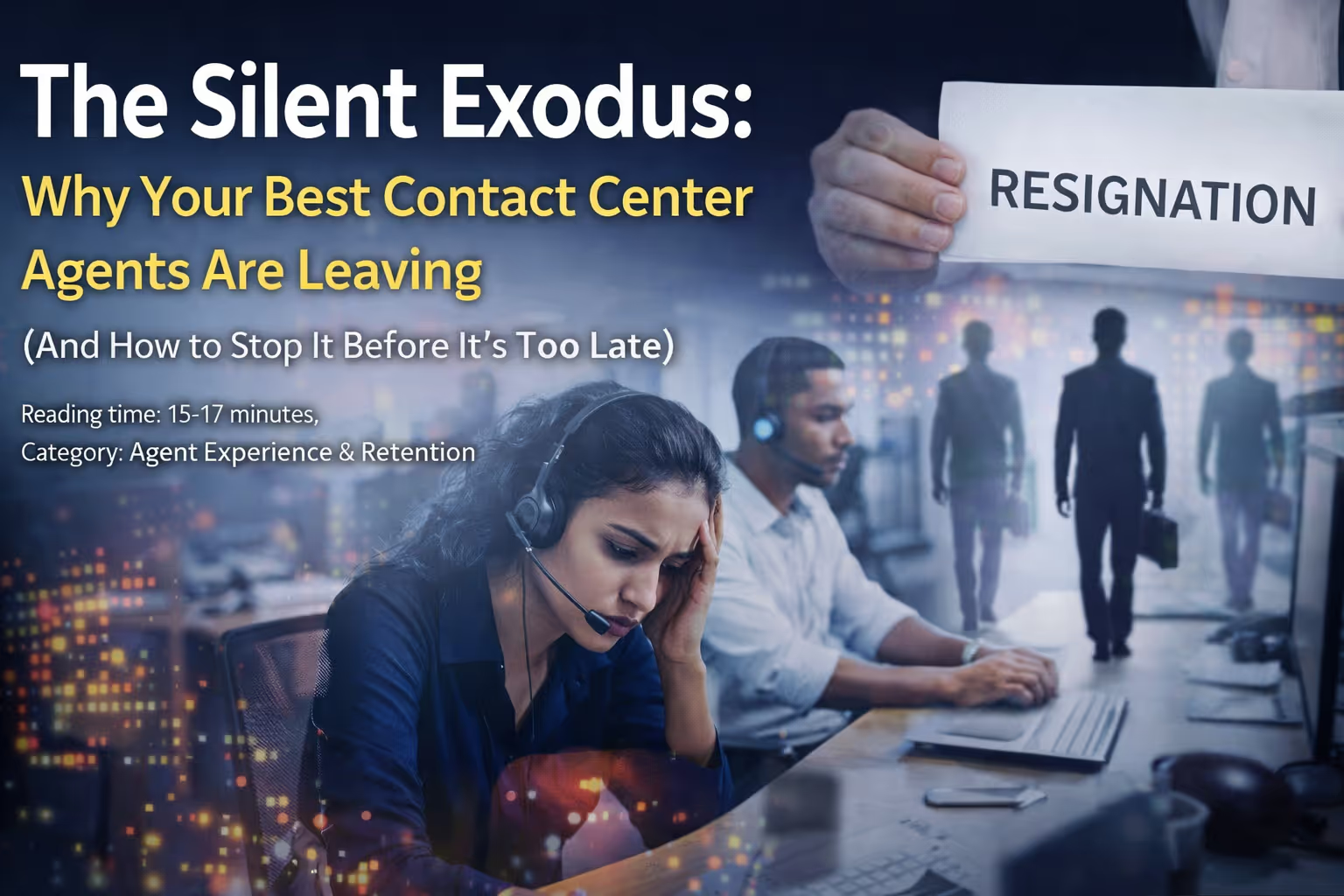
The Silent Exodus: Why Your Best Contact Center Agents Are Leaving (And How to Stop It Before It's Too Late)
Every Monday morning, your contact center looks the same. Same desks. Same headsets. Same login screens. But look closer—three faces missing from last month. Two more gave notice on Friday. Your best agent from the Q3 performance leaderboard? Just accepted an offer from your competitor.
This isn't about compensation. It's not even primarily about remote work policies or career advancement—though those matter. The real story lives in the 47 seconds of silence your departing agents spend searching for the right words during exit interviews. "Better opportunity elsewhere," they finally say. You write it down. They leave. The pattern continues.
But here's what nobody's measuring: those agents didn't decide to leave on their resignation day. They decided weeks earlier, during the calls nobody reviewed, the moments nobody noticed, the slow accumulation of signals that screamed "I'm burning out" while your systems stayed silent.
Let me show you what's really happening—and what you can do about it.
The Invisible Timeline of Agent Attrition
Sarah's been with your contact center for 18 months. Solid performer. Consistent quality scores around 87-89. Handles escalations well. Never complains. Perfect employee, right?
Here's what you didn't see:
Week-8 (Eight weeks before resignation): Sarah's average handle time increases from 6:12 to 7:43. Your system notes it. Flags it in a report. Nobody acts on it because it's still "within acceptable range."
Week-7: Call quality analysis shows her empathy markers declining. First three calls of her shift: warm tone, active listening, emotional validation present. Calls 15-20: flat affect, minimal engagement, robotic script adherence. The system captures this pattern in 100% of her calls. Nobody's looking at the pattern. Your QA team samples three random calls—all from her fresh morning hours. Score: 88. "She's fine."
Week-6: Sarah's sick days jump from her normal 0.5 per month to 2 days this week alone. HR notes it. Checks if FMLA applies. Doesn't. File closed. Nobody connects this to the performance pattern shift.
Week-5: Conversation intelligence detects resignation language in 40% of Sarah's customer interactions. Not toward customers—toward her own capabilities. "I'll try to figure that out." "I'm not sure I can help with that." "Let me see if someone else knows." Her confidence is eroding in real-time, captured in transcripts nobody reads comprehensively.
Week-4: Sarah stops asking questions in team meetings. Your supervisor notices she's "quieter lately" but attributes it to focus and maturity. She's not focused. She's disengaged. She's mentally rehearsing her resignation conversation.
Week-3: Sarah updates her LinkedIn profile. Marks herself "open to work." Responds to three recruiter messages. Your competitor's recruiter reaches out. She takes the call during her lunch break.
Week-2: Sarah's performance metrics show a strange inversion: her customer satisfaction scores actually improve (customers sense her detachment as "calm professionalism"), but her handle time increases further to 8:34. She's checked out but still professional. Muscle memory carrying her through while her mind's already left.
Week-1: Sarah schedules a meeting with her supervisor titled "Quick chat." Your supervisor assumes it's about a customer issue or schedule request. It's her resignation.
Week 0: Exit interview. "I got a better opportunity elsewhere." She's not lying—the competitor offered better work-life balance and $3,000 more annually. But that's not why she looked. She looked because she was already burned out, already disengaged, already gone.
Every one of those signals was measurable. Every pattern was detectable. Every intervention point was missed.
The Real Cost (That Your Budget Doesn't Capture)
Your finance team has a line item: "Recruitment & Training - $12,000 per agent replacement."
That's adorably incomplete.
Here's the actual math for replacing Sarah:
Direct Costs:
· Recruitment advertising: $1,200
· Recruiter time (15 hours at $85/hour): $1,275
· Interview panel time (8 people× 2 hours × $45/hour): $720
· Background checks and onboarding admin: $380
· Training program (3 weeks):$4,200
· Trainer time: $2,100
· New hire technology and workspace setup: $890
- Subtotal:$10,765 (close to your budget estimate)
Hidden Costs You're Not Tracking:
Productivity Loss During Transition:
· Sarah's last two weeks (checked out, minimal productivity): $2,240 in lost output
· Knowledge transfer time (if it even happens): $560
· New hire ramp-up to Sarah's productivity level (12 weeks at 50% → 75% → 90% efficiency): $8,960 in productivity gap
- Subtotal:$11,760
Team Impact:
· Remaining agents cover Sarah's shifts (overtime costs): $3,200
· Quality degradation during coverage period (errors, escalations, customer dissatisfaction): $4,100 estimated impact
· Team morale hit (seeing colleagues leave creates anxiety in others): Unquantified but real
- Subtotal:$7,300
Knowledge Loss:
· Sarah knew the workarounds for system bugs (18 months of institutional knowledge): Gone
· Sarah had relationships with difficult customers who trusted her: Transferred to new agents unfamiliar with history, creating friction
· Sarah understood product edge cases from experience: New agent will take 8-12 months to develop equivalent expertise
- Value: Impossible to fully quantify, conservatively $12,000
Compounding Risk:
· Sarah leaving prompts two other agents to update their resumes (turnover clusters): Potential $60,000 if both leave
· Customer churn from degraded service during transition: 3-7 customers typically affected, lifetime value $2,200 each = $6,600 - $15,400
- Subtotal:$6,600 minimum
Total Actual Cost of Sarah Leaving: $48,425
Your budget said $12,000. Reality says $48,425. And that's a conservative estimate for a mid-level agent. Lose a senior agent or team lead? Double it.
Now multiply by your annual turnover rate. If you're at 35% attrition with 100 agents, you're losing approximately $1.7 million annually in actual replacement costs. Not the budgeted $420,000. The real $1.7 million.
The Pattern Nobody's Connecting
Here's where this gets interesting—and infuriating.
Take a contact center with attrition above 35% a year. Analyze 100% of its conversations, follow the agents who resign over an 18-month period, and work backward through their performance data.
Voluntary departures often follow the same pattern:
1. Performance degradation starts weeks before resignation (handle time increases, quality markers shift, empathy depletes faster across shifts)
2. Resignation language appears in customer conversations ("I don't know if I can help with that," "Maybe someone else can assist you better," "I'll try my best but no promises")
3. Behavioral changes become visible (sick days increase, participation decreases, productivity becomes erratic)
4. Decision crystallizes (LinkedIn activity, external outreach, mental checkout while physically present)
5. Resignation conversation surprises leadership (because nobody connected the visible signals into a coherent "this person is leaving" pattern)
Read together, these signals can warn you long before the current system does. It only knows someone's leaving when they submit notice.
The tragedy? Every single signal in that pattern was captured by your existing systems. Call recordings. Quality scores. Attendance logs. Performance dashboards. The data existed. Nobody synthesized it. Nobody acted on it.
Why Traditional "Engagement" Efforts Fail
At this point, many contact center leaders think: "We already invest in engagement. Annual surveys. Recognition programs. Team building activities. Career development conversations."
All valuable. All insufficient.
Let me show you why.
Traditional Approach: Annual Engagement Survey
Question: "On a scale of 1-10, how satisfied are you with your work?"
Sarah's answer (Week -6): 7/10
Your interpretation: "Above midpoint. She's fine."
Sarah's reality: She's signaling moderate dissatisfaction but doesn't want to be labeled a complainer. She's already interviewing elsewhere.
The survey happened too late (annually vs. weekly needs), measured too broadly (overall satisfaction vs. specific burnout signals), and relied on self-reporting (agents moderate responses to avoid consequences).
Traditional Approach: Recognition Programs
"Employee of the Month" based on quality scores and handle time.
Sarah never wins (she's consistently good, not exceptionally scoring high in gameable metrics).
Top performers win repeatedly (they've learned to optimize for measured criteria, not actual customer impact).
Result: Sarah feels invisible. Recognition goes to the same people. She's reliable, not celebrated. Disengagement deepens.
Traditional Approach: Career Development Conversations
Annual review conversation: "Where do you see yourself in two years?"
Sarah: "I'd like to move into a team lead role eventually."
Supervisor: "Great! Keep up the good work and we'll see what opens up."
Translation: No concrete timeline. No development plan. No visibility into whether this is actually possible.
Sarah leaves because "better opportunity elsewhere" included an actual team lead position with a competitor who promised instead of hinted.
None of these approaches are wrong. They're just insufficient for preventing this specific attrition pattern.
What Actually Works: Early Intervention Through Conversation Intelligence
Here's the alternative path—what happens when you can see the signals and act on them.
Sarah's Alternative Timeline:
Week-8: Sarah's average handle time increases from 6:12 to 7:43.
Traditional response: Note it in a report. Hope it self-corrects.
Conversation intelligence response: System doesn't just flag the metric—it analyzes why. Natural language processing reveals Sarah is spending extra time searching knowledge base articles mid-call (knowledge gap developing) and repeating explanations to customers (communication breakdown). Root cause identified: Product complexity increased with recent update, Sarah wasn't adequately trained.
Immediate intervention: Supervisor receives alert: "Sarah showing knowledge gap signals related to Product Update 3.2." Proactive coaching session scheduled within 48 hours. Targeted training provided. Handle time returns to 6:20 within one week. Crisis averted.
Week-7: Call quality analysis shows empathy markers declining across her shift.
Traditional response: Random QA sampling misses the pattern entirely (samples her strong morning calls).
Conversation intelligence response: System detects pattern across 100% of calls. Flags it not as "performance issue" but as "potential burnout signal—empathy depletion." Alert goes to supervisor: "Sarah may be experiencing emotional exhaustion. Recommend conversation about workload."
Immediate intervention: Supervisor has non-evaluative conversation: "I noticed you're handling a lot of complex calls lately. How are you feeling about the work?" Sarah admits she's been getting primarily escalations and difficult customers. Supervisor investigates: routing algorithm had shifted her to "experienced agent" queue—all hard calls, no breaks. Routing adjusted to balance easy/hard interactions. Empathy markers recover within two weeks.
Week-6: Sarah's sick days jump from 0.5 to 2 per month.
Traditional response: HR notes it, checks FMLA, moves on.
Conversation intelligence response: System correlates sick day timing with conversation pattern data. Discovery: Sarah's sick days follow clusters of particularly difficult call days (5+ de-escalation situations in single shift). This isn't random illness. It's stress-response recovery.
Immediate intervention: Supervisor implements "recovery protocol"—after particularly intense shifts, next day includes rotation to lower-intensity task (training review, customer email responses, documentation updates). Provides cognitive breaks. Sick days return to baseline.
Week-5: Resignation language detected in 40% of customer interactions.
Traditional response: Not detected at all (nobody reviews enough calls to spot pattern).
Conversation intelligence response: System flags language indicating declining confidence: "I'll try," "I'm not sure I can," "Maybe someone else." This isn't agent incompetence—it's confidence erosion. Root cause analysis: Sarah's resolution rates have dropped from 89% to 76%. Why? Recent product issues have made some problems unsolvable at front-line level, but she's being measured as if she can still resolve them.
Immediate intervention: Leadership addresses systemic issue: either fix product problems or adjust resolution expectations for agents. Sarah's metrics adjusted to reflect reality. Her confidence stabilizes knowing she's not failing—the system has constraints.
Week-4, -3, -2: None of these weeks happen. Sarah isn't disengaging. She's not updating LinkedIn. She's not interviewing. She was intervened with at Week -8, -7, -6, -5. The problems that would have driven her away were solved before they compounded.
Week 0: Sarah hits her 2-year anniversary with the company. Receives recognition for consistency and growth. Expresses interest in team lead training. Supervisor enrolls her in leadership development program with clear 6-month timeline to promotion.
Sarah stays. Her $48,425 replacement cost? Never incurred. Her 18 months of institutional knowledge? Retained and growing. Her team stability contribution? Invaluable.
The Business Case Is Almost Boring (It's That Clear)
Let's make this extremely concrete for a 100-agent contact center with 35% annual attrition (industry average).
Current State:
· 35 agents leave annually
· Replacement cost per agent:$48,425 (assumed, fully loaded)
· Total annual attrition cost:$1,694,875
· Recruiters on permanent hiring cycle (never-ending backfill)
· Constant training of new hires (experienced agents scarce)
· Quality inconsistency from perpetual inexperience
Intervention Scenario (100% conversation analysis + early intervention):
· Platform cost, assumed for this example: $30,000–$60,000 annually
· Staff time for intervention (2 hours per week per supervisor for proactive coaching): $52,000 annually (10 supervisors × $50/hour × 2 hours × 52 weeks)
- Total investment: $82,000 - $112,000
Example Result:
· Attrition reduction from 35% to 23% (this example's assumption)
· Agents retained: 12
- Replacement costs avoided: 12 × $48,425 =$581,100
ROI:518% - 708%
Payback period: 8-11 weeks
And that's just calculating direct replacement costs. We haven't even factored in:
· Quality improvement from stable, experienced workforce
· Customer satisfaction gains from consistent service
· Supervisor time reclaimed from perpetual training
· Institutional knowledge retention
· Team morale improvement (stability begets stability)
This might be the clearest business case in contact center operations.
The Implementation Reality (It's Easier Than You Think)
At this point, I know what you're thinking: "This sounds great in theory. Implementation will be a nightmare. Change management disaster. Technical complexity. Organizational resistance."
Let me walk you through what a rollout can look like.
Month 1: Foundation
Week 1-2: Speech analytics platform integration
· Connects to existing call recording system (already in place)
· No agent workflow changes (they keep doing their jobs exactly as before)
· Begins processing 100% of conversations automatically
Week 3-4: Baseline establishment
· System analyzes historical data (past 3-6 months of calls)
· Identifies normal patterns vs. anomalies
· No action taken yet—just learning
Month 2: Insight Generation
Week 5-6: Pattern recognition
· System begins flagging early warning signals (handle time shifts, empathy depletion, resignation language, knowledge gaps)
· Supervisors receive weekly "agent wellness report" highlighting concerns
· No immediate interventions required—building comfort with data
Week 7-8: Supervisor training
· 4-hour workshop: "From data to conversation"
· How to interpret signals (not as punishment but as support opportunities)
· Coaching conversation frameworks (non-evaluative, supportive approach)
· Practice scenarios with actual flagged patterns
Month 3: Active Intervention
Week 9-12: Pilot program
· 2-3 supervisors begin proactive outreach based on flags
· Weekly check-ins with flagged agents ("How are you feeling about work lately?")
· Root cause investigation and resolution (route adjustment, training, workload balance)
· Document outcomes (what interventions worked, what didn't)
Month 4 and beyond: Full deployment
All supervisors using system for early intervention
Refinement of flag thresholds based on pilot learnings
Integration into regular coaching rhythms (not extra work, better work)
Measurement of impact (attrition rate tracking, agent satisfaction, quality trends)
You'd think constant analysis would feel invasive to agents. It doesn't have to. Here's why:
When analysis is used for support (not surveillance), agents recognize their employer is actually paying attention to their wellbeing. The first time a supervisor says, "I noticed you had a rough shift yesterday with several escalations—are you okay?" the agent realizes: someone sees the work I'm doing. Someone cares. That recognition—that visibility—creates loyalty.
Compare that to the current system where agents handle nightmare shifts and nobody notices unless they make a mistake. Then they only hear criticism. The asymmetry breeds resentment.
The Hard Truth About Organizational Readiness
Not every contact center is ready for this approach. Let me be direct about what needs to be true for this to work:
You need leadership that believes agents are humans, not resources.
If your executive team refers to agents as "FTEs" or "seats" or "headcount" rather than people, this approach will fail. Not because the technology doesn't work, but because the organizational culture will weaponize it.
The same data that enables supportive intervention can enable oppressive surveillance. The difference is leadership intent.
If your VP of Operations wants to use conversation data to "catch agents slacking" or "prove who should be fired," don't implement this system. You'll make the problem worse.
But if your leadership genuinely believes that agent wellbeing drives customer outcomes (and data proves it does), this system becomes a force multiplier for doing what they already want to do—just doing it earlier, smarter, and more effectively.
You need supervisors who can have human conversations.
This system doesn't replace supervision with algorithms. It equips supervisors with better information for better conversations.
But if your supervisors are metrics robots who only know how to deliver quality scores and compliance warnings, they'll take empathy depletion alerts and turn them into "you need to show more empathy" criticism. That makes things worse.
This approach requires supervisors who can say: "I see you're struggling. Let's figure out why and fix it together." Not everyone can. If your supervisors can't, train them or replace them. Otherwise, don't implement.
You need willingness to fix systemic problems.
Conversation intelligence will surface root causes: broken processes, inadequate training, unrealistic metrics, unfair routing, product defects, knowledge gaps.
If your organization's response to root cause identification is "thanks for the data, we can't change any of that," don't implement this system. You'll just document problems you won't solve, which demoralizes everyone.
But if you're genuinely willing to say, "If our routing algorithm is burning out experienced agents, let's fix routing," then this system becomes transformational.
What Happens Next
You have choices.
Option 1: Do nothing.
Continue with current approach. Annual engagement surveys. Exit interviews that reveal nothing useful. Attrition rates that feel inevitable. Endless recruitment and training cycles. The $1.7M annual cost that never gets better.
Sarah leaves. Then Marcus. Then Priya. Then whoever your next best agent is. The pattern continues. Your spreadsheet shows it's "within industry norms." You accept it.
Option 2: Implement early intervention through conversation intelligence.
Install systems that surface early warning signals. Train supervisors to interpret and act on them. Create a culture where data enables support, not surveillance. Intervene at Week -8 instead of discovering resignation at Week 0.
Sarah stays. Marcus stays. Priya stays. If your attrition rate drops from 35% to 23%, you save $581,100 a year. Your agents feel seen and supported. Your customers get consistent service from experienced professionals. Your competitive advantage compounds.
Option 3: Pilot before committing.
Not ready for full deployment? Run a controlled pilot.
Take 2 supervisors and their teams (30-40 agents). Implement conversation intelligence for them only. Measure results over 6 months: attrition rate in pilot group vs. control group, agent satisfaction scores, quality metrics, customer outcomes.
Let data prove or disprove the approach with limited risk and investment. Then decide.
Most organizations choose Option 1. They read articles like this, nod along, and change nothing. Human nature favors inertia.
Some organizations choose Option 3. They're cautious, data-driven, want proof before investment. Respectable approach.
A few organizations choose Option 2. They see the problem clearly, recognize the cost, and commit to solving it. They implement quickly, iterate based on learning, and achieve results that seem impossible to their competitors.
Which are you?
The Question That Matters
At the end of this article, there's only one question worth asking:
Can you afford to keep losing people you could have saved?
Not "can you afford the technology" (you can—the ROI is absurd).
Not "can you afford the time" (you're already spending it on recruitment and training, just inefficiently).
Not "can you afford the change" (you're already experiencing change—it's just all negative).
The question is: Can you afford to keep watching Sarah, Marcus, and Priya walk out the door when you could have seen them struggling at Week -8 and done something about it?
Your budget says agent turnover costs $420,000 annually. Reality says it costs $1.7 million. The gap between those numbers is the cost of ignorance—not knowing what's happening until it's too late to intervene.
You can close that gap. The technology exists.
What's missing is the decision.
Make it.
---
About Ender Turing
We provide conversation intelligence for contact centers across any language, helping organizations transform from reactive firefighting to proactive agent support.
Coverage: 100% of conversations analyzed
If you'd like to discuss how early intervention through conversation intelligence could work in your specific context, we're happy to have that conversation. No sales pressure—just honest exploration of whether this approach fits your organization.