Why Your Contact Center Supervisors Can Coach Only 2 Agents Per Week—And How AI Changes the Equation
Contact center supervisors are drowning. Not from lack of skill, motivation, or work ethic. They are drowning in mathematics that do not add up.
The Brutal Math of Supervisor Capacity
Let's break down a typical supervisor's week with unflinching honesty:
Total available hours: 40
- Meetings (team huddles, leadership check-ins, operations reviews): 8 hours
- Administrative work (scheduling, reporting, system updates): 6 hours
- Firefighting (escalations, urgent customer issues, crisis management): 10 hours
- Reporting and data compilation: 4 hours
Coaching time remaining: 12 hours
Now add the other side of the equation:
- Agents under supervision: 15 (industry standard span of control)
- Time required per meaningful coaching session: 1 hour (call review, feedback delivery, action planning)
- Agents that can receive coaching this week: 12
Result: 3 agents get no coaching this week.
The Never-Ending Coaching Rotation
Week 1: Coach agents 1-12. Agents 13-15 wait.
Week 2: Coach agents 13-15 and agents 1-9. Agents 10-12 wait.
Week 3: Coach agents 10-12 and agents 1-9. Agents 13-15 wait again.
The cycle continues perpetually. On average, each agent receives coaching every 5-6 weeks. That is a 40-day performance feedback cycle.
By the time Agent 7 gets coached on the mistake they made in Week 1, they have repeated that mistake 180 times across 6 weeks of calls. The bad habit is not just present—it is cemented.
This Is Not a Motivation Problem. It Is a Mathematics Problem.
Supervisors are not lazy. They are not avoiding coaching. They are trapped in an impossible equation:
- They cannot reduce meetings (leadership requires alignment)
- They cannot eliminate firefighting (urgent issues demand immediate response)
- They cannot skip reporting (operations needs data)
- They cannot reduce coaching session quality (surface-level feedback does not drive change)
The traditional solution—"hire more supervisors"—only shifts the problem. To coach 15 agents weekly, you need 15 hours of coaching capacity. Your supervisor has 12. That means you need 1.25 supervisors per 15 agents, or roughly 8 agents per supervisor.
At that ratio, a 100-agent contact center needs 12.5 supervisors instead of the typical 6-7. Your labor cost just increased 80%. Most contact centers cannot or will not absorb that expense.
The 45-Minute Prep Time Nobody Talks About
That "1 hour per coaching session" calculation is optimistic. It assumes the supervisor arrives at the session ready to coach. In reality, meaningful coaching requires preparation:
- Pull the agent's call recordings (5-10 minutes of system navigation)
- Listen to sample calls to identify coaching opportunities (20-30 minutes)
- Review performance metrics and quality scores (5-10 minutes)
- Prepare feedback and action plan (5-10 minutes)
Total prep time: 45 minutes per coaching session.
Actual time investment per agent: 1 hour coaching + 45 minutes prep = 1.75 hours.
Suddenly, that 12-hour weekly capacity can coach only 6.8 agents, not 12. Nearly half your team gets zero coaching this week.
What Happens When Agents Do Not Get Coached
Inadequate coaching frequency creates a predictable cascade of consequences:
Performance stagnation: Agents plateau early in their careers because they do not receive the consistent feedback needed to improve. Your average agent stays average. Your struggling agents stay struggling.
Quality inconsistency: Without regular coaching, agents develop their own interpretations of "good service." One agent thinks empathy means a 30-second apology. Another thinks it means active listening. Another skips it entirely when busy. Your quality scores scatter.
Supervisor frustration and burnout: Supervisors see the same mistakes repeated week after week, month after month. They know coaching would fix it. They do not have time. This creates a soul-crushing sense of ineffectiveness. You are not managing a team—you are managing failure in slow motion.
Agent disengagement: High-performing agents who desperately want feedback to accelerate their growth get nothing. They feel ignored. They leave for companies that invest in their development. Your best talent walks out the door.
How AI Speech Analytics Solves the Mathematics Problem
AI does not coach agents. It enables supervisors to coach effectively and frequently by eliminating the time-consuming preparation work.
Here is what changes:
From Hunting to Receiving Coaching Moments
Before AI: Supervisor spends 30 minutes listening to calls, hoping to find a coachable moment.
With AI: System automatically flags: "Agent 7, Call #142, 3:47 timestamp—customer expressed frustration, agent missed empathy opportunity." Supervisor goes directly to the moment that matters.
From 45-Minute Prep to 5-Minute Prep
Before AI: Manual call retrieval, listening, note-taking, pattern identification.
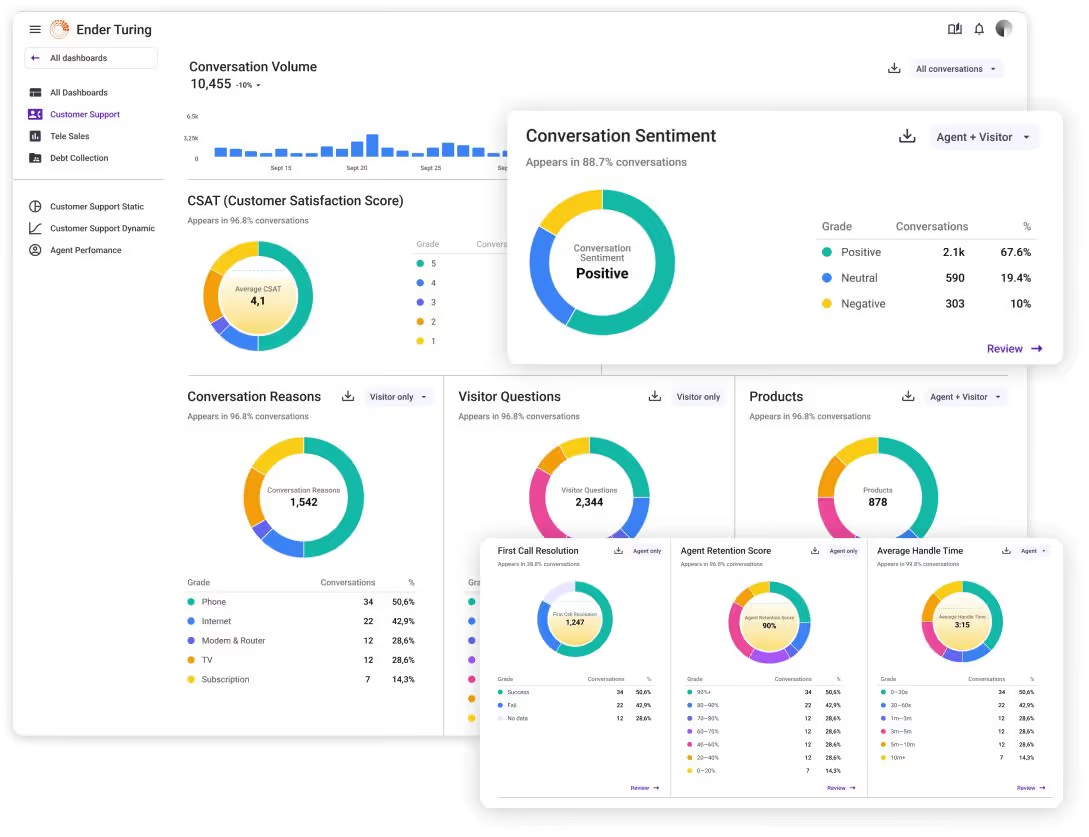
With AI: Pre-loaded coaching dashboard shows:
- Agent's quality trend (improving, declining, or stagnant)
- Specific calls flagged for coaching (with exact timestamps)
- Patterns identified across all agent calls (not just sampled ones)
- Comparison to team benchmarks and top performers
Prep time: 5 minutes to review AI-generated insights and select coaching focus.
From 12 Monthly Coaching Sessions to 15 Weekly Sessions
The mathematics shift dramatically:
- Coaching time available: 12 hours weekly (unchanged)
- Prep time per session: 5 minutes (down from 45 minutes)
- Coaching session: 1 hour (unchanged)
- Total time per agent: 1.08 hours (down from 1.75 hours)
Agents coached per week: 11.1 → realistically, all 15 if supervisor focuses coaching time strategically.Every agent gets weekly coaching. The 40-day feedback cycle becomes a 7-day feedback cycle. Mistakes corrected before they become habits.
Real-World Impact: Retail Contact Center Case Study
A national retail contact center with 14-agent supervisor teams tracked coaching frequency before and after implementing AI-assisted coaching:
Before AI implementation:
- Agents coached per week: 2.3 average
- Agents receiving no coaching in a given month: 4-6 per team
- Supervisor prep time: 40-50 minutes per session
- Agent performance improvement: Stagnant (quarterly performance reviews showed minimal change)
After AI implementation (6 months):
- Agents coached per week: 12.7 average
- Agents receiving no coaching in a given month: 0-1 per team
- Supervisor prep time: 5-8 minutes per session
- Agent performance improvement: +19% quarterly (quality scores, CSAT, handle time efficiency)
The difference was not supervisor effort. It was supervisor efficiency.
The Hidden ROI: Supervisor Retention and Satisfaction
Contact center supervisor turnover averages 42% annually across the industry. This creates constant disruption, knowledge loss, and team instability.
Why do supervisors leave? The exit interview data is consistent:
- "I felt like I was failing my team."
- "No matter how hard I worked, agents were not improving."
- "I spent all my time firefighting, never coaching."
- "I could not make a real impact."
This is not a compensation problem or a workload problem. It is an effectiveness problem. Supervisors do not leave because the job is hard. They leave because the job feels futile.
Organizations using AI-assisted coaching report supervisor turnover of 23%—nearly half the industry average.
Why the retention improvement? Supervisors see their teams improve. They coach all 15 agents weekly instead of 2-3. They watch quality scores rise. They receive feedback from agents: "This coaching is actually helping." The job becomes effective, not futile.
From Firefighters to Strategic Coaches
The most profound change is not the mathematics—it is the role transformation.
Before AI, supervisors function as:
- Firefighters (reacting to crises)
- Call hunters (searching for coaching opportunities in haystacks)
- Data compilers (manually aggregating performance information)
- Referees (resolving agent conflicts and customer escalations)
With AI, supervisors become:
- Strategic coaches (developing agent skills with precision)
- Performance analysts (interpreting AI-surfaced patterns)
- Talent developers (accelerating agent growth trajectories)
- Culture builders (investing time in team engagement and morale)
The shift is not from "working hard" to "working easy." It is from "working on the wrong things" to "working on what actually matters."
Making the Transition: Implementation Considerations
Implementing AI-assisted coaching requires more than technology deployment. Organizations that achieve the results described above follow these principles:
Train supervisors to use AI insights, not replace judgment
AI surfaces coaching opportunities. Supervisors decide which opportunities to prioritize based on individual agent needs, team dynamics, and strategic goals. Technology augments judgment; it does not replace it.
Redesign supervisor calendars to protect coaching time
If AI reduces prep time from 45 minutes to 5 minutes but supervisors immediately fill that recovered time with more meetings, nothing changes. Leadership must actively protect coaching time as a non-negotiable calendar block.
Measure coaching frequency and impact, not just quality scores
Track: How many agents received coaching this week? What was the average time between coaching sessions? Are agents who receive weekly coaching improving faster than those who do not? Data-driven coaching management ensures the mathematical advantage translates into performance gains.
Celebrate supervisor effectiveness, not just agent performance
When agent quality scores improve +19%, recognize the supervisors who coached them there. Supervisor retention improves when supervisors receive credit for the results their coaching produces.
The Choice: Accept the Mathematics or Change the Equation
Contact center leaders face a binary decision:
Option 1: Accept that supervisors can coach only 2-3 agents weekly. Accept that 80% of agents go weeks without feedback. Accept that performance improvement will be slow, inconsistent, and frustrating. Accept 42% supervisor turnover as inevitable.
Option 2: Change the mathematics. Eliminate the 45-minute prep burden through AI. Coach all 15 agents weekly. Create 7-day feedback cycles. Watch performance improve measurably. Retain supervisors who finally feel effective.
The difference is not philosophical. It is mathematical.Your supervisors are working as hard as they can. The current system makes it mathematically impossible for them to succeed. AI does not make their job easier—it makes it possible.
From Crisis to Capability
The supervisor coaching crisis is not about work ethic, motivation, or capability. It is about a system designed in an era when call recording was expensive, data was scarce, and manual analysis was the only option.
That era is over.
Today, 100% of conversations can be analyzed automatically. Coaching opportunities can be surfaced instantly. Patterns can be identified across thousands of interactions. Prep time can drop from 45 minutes to 5.
The mathematics that once made comprehensive coaching impossible now make it inevitable.
The question for contact center leaders: Are your supervisors firefighters hunting for random coaching moments in 2% of calls? Or are they strategic coaches armed with AI-surfaced insights from 100% of conversations?
The mathematics of your answer will determine the performance of your team.
Transform Your Supervisor Coaching Model
Ender Turing's conversation intelligence platform eliminates the 45-minute coaching prep burden, enabling supervisors to coach all agents weekly instead of a fraction monthly.
- Implementation: 2-4 weeks
- Coverage: 100% of customer conversations analyzed
- Supervisor prep time reduction: 45 minutes → 5 minutes per session
- Typical results: +19-31% agent performance improvement within 6 months
Schedule a 30-minute consultation to calculate your specific supervisor capacity gap and ROI from AI-assisted coaching.