Every vendor pitch deck in 2026 says the same thing. AI agents will handle 80% of contact center volume by 2028. Headcount will collapse. The contact center as we know it is over.
We disagree. AI in contact centers isn’t replacing humans. It’s splitting the work into two streams that look almost nothing alike. And the companies that miss this split are about to spend 18 months building the wrong thing.
This is the actual transition happening underneath the headlines. If you run a contact center, plan for it.
Why The Replacement Story For AI In Contact Centers Is Failing
Start with the data the vendors don’t put on slides.
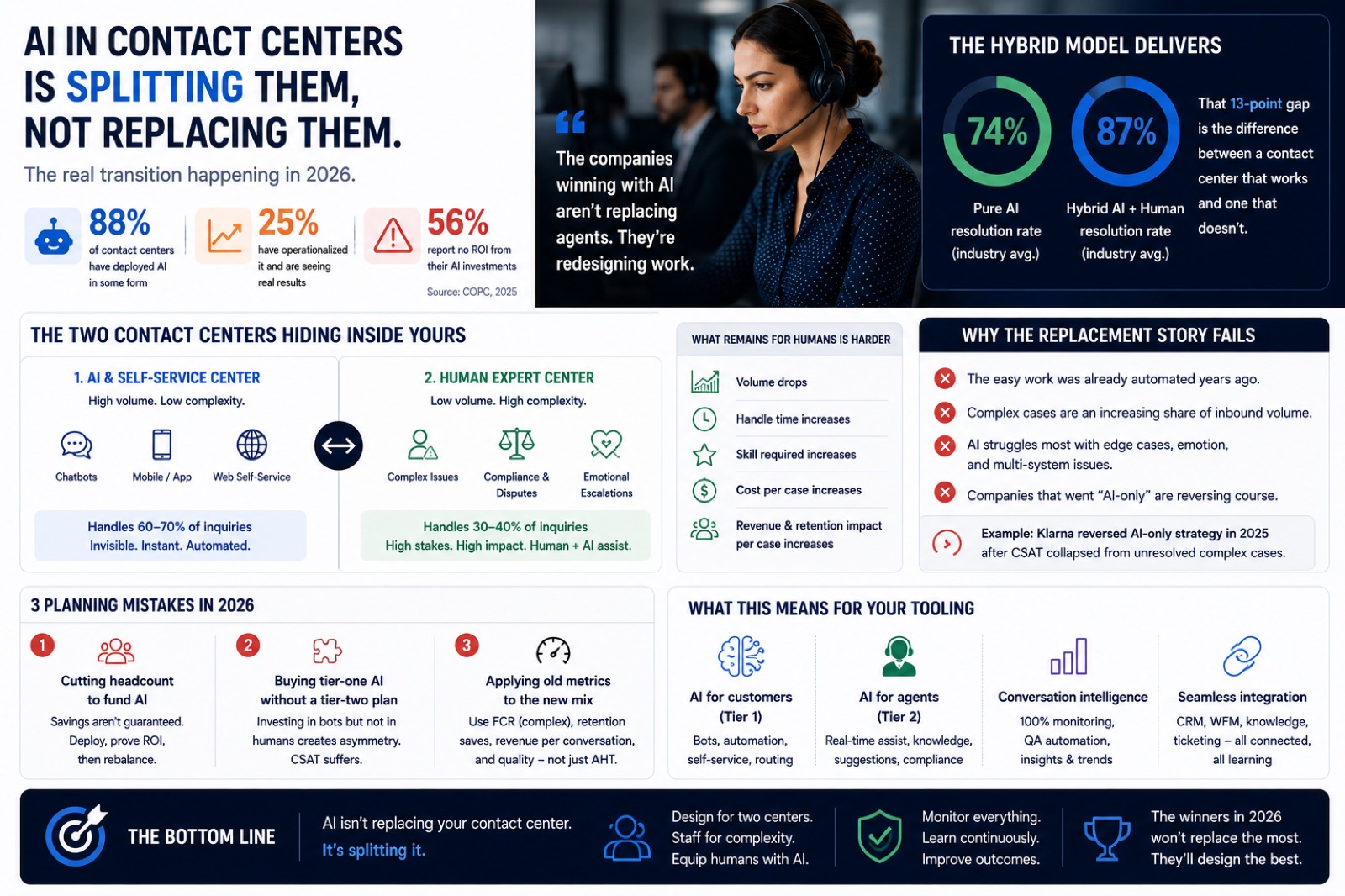
79% of organizations now use AI in customer care, yet 56% of contact centers are not realizing the return they expected from AI, according to COPC. That gap is not a “give it more time” problem. It’s the predictable result of buying a story instead of buying a workflow.
The replacement story assumes AI does what an agent does, only cheaper. That framing breaks the moment you look at what real agents handle. The easy work — password resets, balance checks, order status — was already automated by IVR and self-service portals years before generative AI existed. Customers who want those answers don’t call. They tap an app.
What reaches a human in 2026 is what couldn’t be automated by a decade of digital transformation. Compliance-sensitive disputes. Edge-case billing errors. Emotional escalations. Multi-system troubleshooting. Cases where the customer has already tried three channels and is now angry. These are the calls AI is worst at, and they are an increasing share of inbound volume.
Klarna learned this the hard way: in May 2025 its CEO told Bloomberg that putting cost first had left it with “lower quality,” and Klarna started hiring people for customer service again.
The Two Contact Centers Hiding Inside Yours
The split looks like this. Self-service and AI agents absorb the high-volume, low-complexity tier — what used to be 60-70% of contact volume. That tier becomes invisible. It happens in apps, on websites, in chat widgets. It rarely escalates to humans.
What remains is a smaller, harder, higher-stakes contact center. The volume drops. The average handle time goes up. The skill required per call goes up. The cost per resolved case goes up. The revenue and retention impact per call also goes up — because these are the customers most at risk of leaving.
When the simple inquiries move to self-service and AI, what’s left for humans is harder: complaints, retention saves, and complex cross-product issues, the calls where conversation intelligence earns its keep.
If you staff and tool the second contact center the way you staffed the first one, you will fail. Different skills. Different coaching. Different metrics. Different technology stack.
What The Data Says About Hybrid AI Customer Service
The hybrid model — AI handling tier-one volume, humans handling tier-two complexity, with AI tools supporting the humans — is the configuration that’s actually working.
But the hybrid model hides a second insight. It only works when the human side is also instrumented with AI — real-time coaching, conversation analysis, automated quality scoring, CRM auto-summarization. The “human” in hybrid is not the same human you had three years ago. They are working with a different cockpit.
Without that cockpit, the harder calls overwhelm the agents. AHT spikes. CSAT drops. Attrition climbs. The 1,000-seat contact center running 40% turnover is now spending $4 million to $8 million a year replacing the people it most needs to retain — the ones who can handle the calls AI can’t.
Why Most 2026 Plans For AI In Contact Centers Are Wrong
Three planning mistakes are everywhere right now. Each one comes from believing the replacement story.
Mistake one: cutting headcount to fund AI. This treats AI savings as guaranteed. They are not. If your AI deployment doesn’t operationalize you cut your way into a CSAT crisis with no way to recover. The right sequence is deploy, prove ROI on contained call segments, then rebalance staff. Not the other way around.
Mistake two: buying tier-one AI without a tier-two plan. Companies pour budget into voice bots and chat AI but spend nothing on the human side that has to handle what AI can’t. That asymmetry is why AI projects show ROI on paper while CSAT craters in practice. You’re shifting cost, not eliminating it.
Mistake three: applying old metrics to the new mix. AHT was a useful metric when calls were uniform. In a split contact center, AHT goes up because the easy calls left. Punishing agents for that is how you accelerate attrition. The new metric set looks like first-contact resolution on complex tier, retention saves, revenue captured per conversation, and quality consistency on calls AI couldn’t take. Old dashboards measure the wrong thing.
What This Means For Your Tooling
If the replacement story were true, you’d buy one big AI platform and shrink everything else. Because the split story is true, you need a different stack.
You need a tier-one AI layer — voice bots, chatbots, deflection — that’s good enough to take the simple cases without dropping CSAT. Quality matters here. A voice bot that handles 60% of calls badly is worse than no voice bot at all because the customers who reach a human after a bad bot interaction are pre-frustrated.
You need a tier-two agent layer with conversation intelligence on every call. 100% coverage, not 2% sampling. Real-time coaching when an agent is mishandling a complex case. Auto-generated CRM summaries so agents can focus on the customer, not the paperwork. Behavioral analytics that catch coaching needs before patterns become attrition.
You need a quality layer over the AI itself. The same way you QA human agents, you have to QA voice bots. Most companies don’t. They deploy AI and assume it’s working because complaints don’t surface. The complaints don’t surface because the customer just hung up and didn’t call back. Silent churn.
And you need vertical intelligence. A generic AI dashboard for “contact center” doesn’t know that in lending, a borrower mentioning hardship is a churn signal worth $40,000 in lifetime value. In medical labs, it’s a compliance event. In banking retention, it’s a save opportunity with a 72-hour window. The same conversation means three different things in three industries. Vertical-specific models catch these. Generic ones don’t.
The Bigger Trend Behind The Split
Step back. The split is the current expression of a longer trend.
For two decades, contact centers have been pulling work out — first to IVR, then to web self-service, then to chat, now to AI. Each wave removed the easiest tier and pushed the human side toward harder, more emotional, more consequential work. Each wave promised a smaller contact center. None of them produced one. The total volume kept climbing because customer expectations climbed faster.
The current wave is not different in kind. It’s faster, and the gap between tier-one AI and tier-two human work is wider than ever. But the underlying pattern is the same. Easy work leaves. Hard work intensifies. The contact center doesn’t disappear. It transforms.
Adrian Swinscoe wrote in his Punk CX work that the future of customer service is not “AI vs humans” but “AI plus better humans.” The companies winning are not the ones with the most AI. They are the ones with the best human + AI combination on the calls that count.
What To Do This Week
You don’t need a 2030 strategy to act. You need three things on Monday.
The contact center is splitting. The companies that build for the split — better AI on tier one, better humans on tier two, real intelligence across both — will spend the next two years pulling away from competitors who are still chasing the replacement story.
We’re betting on the split. The data is on that side.