Pure AI deployments hit a resolution ceiling. Hybrid AI customer service models, with humans on the hard calls, get past it. That gap is the most important one in contact center strategy this year, and almost nobody is talking about it the right way.
The dominant story right now is “AI is replacing agents.” The board hears it. The vendors sell it. The press repeats it. But enterprises that have run both models in production tell a different story. Pure AI plateaus. Hybrid setups, where AI handles the first turn and humans handle the hard ones with AI assist, push past that plateau.
We’ve built voice bot quality monitoring for clients deploying AI alongside humans. The winners are not the ones who replaced the most agents. They are the ones who designed the handoff.
Why Hybrid AI Customer Service Outperforms Pure AI
When most leaders see hybrid outperform pure AI, they assume it is because hybrid uses the better humans for the hard calls. That is part of it. It is not the whole story.
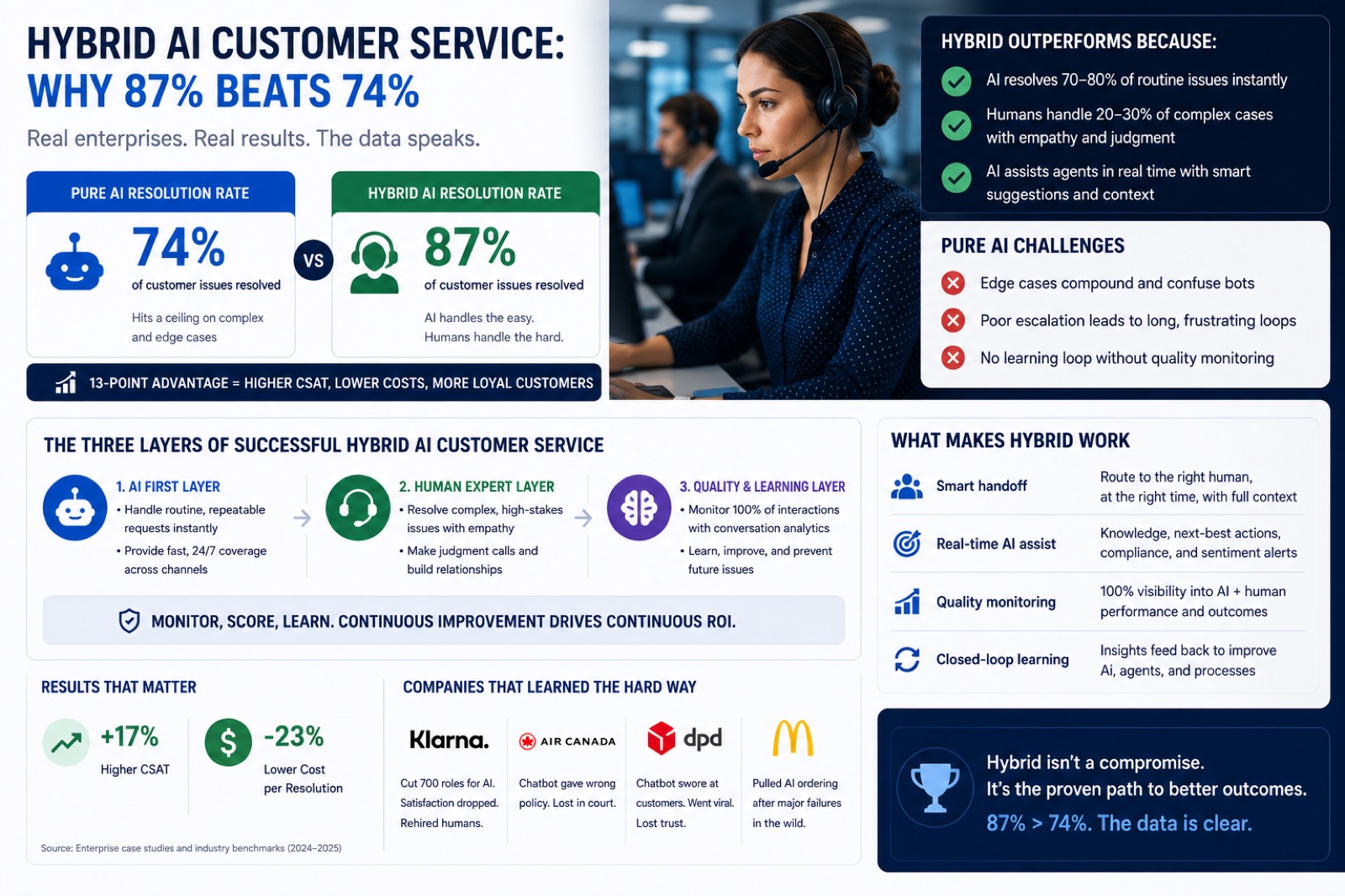
Pure AI customer service deployments hit a ceiling because of three structural problems. First, edge cases compound. A bot that handles 90% of password resets correctly still fails on the 10% where the customer’s account was migrated, or the email is stale, or there is a custody dispute on the file. Second, escalation is broken. Most pure AI deployments treat handoff as failure, so the bot fights to resolve everything. The customer ends up in a 12-turn loop instead of getting to a human in turn three. Third, there is no learning loop. The bot does not know which interactions went badly because there is no quality layer scoring it the way one scores a human agent.
Salesforce AI Research tested LLM agents on customer relationship tasks in 2025. The best of them completed only about 35% of the tasks that needed a multi-turn conversation. Not edge cases. Standard tasks. The accuracy benchmarks vendors quote are measured on benign samples: Zoom’s 7.40% word error rate comes from a test it commissioned on three pre-recorded meetings with unwanted audio removed, and OpenAI’s Whisper scores 2.5% on clean read speech but 16.4% on recorded phone calls.
Hybrid models break the ceiling because they treat the AI as a first filter, not the final word. The bot handles the easy 70-80%. The human handles the 20-30% that need judgment, empathy, or authority. And here is the part most strategies skip. The AI assists the human during the hard call. Real-time suggestions. Knowledge surfacing. Compliance prompts. Sentiment alerts. The human gets faster, the AI gets smarter, and the customer gets resolved.
What The AI-First Companies Got Wrong
The Klarna story is the canonical cautionary tale. In February 2024, the Swedish fintech announced that its AI assistant was doing the equivalent work of 700 full-time agents. In May 2025, CEO Sebastian Siemiatkowski told Bloomberg that cost had been “a too predominant evaluation factor” and that “what you end up having is lower quality,” and Klarna started hiring people for customer service again.
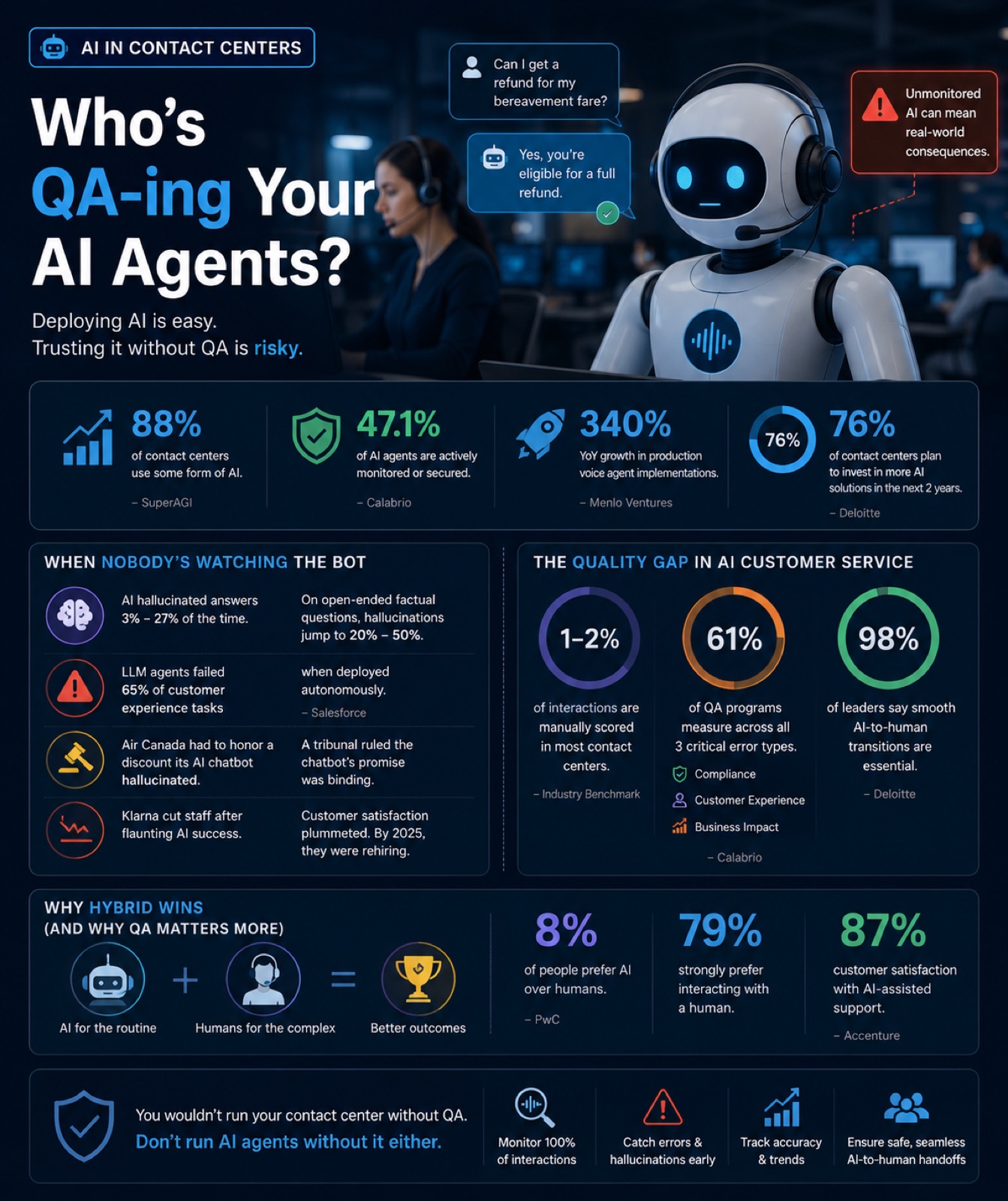
Klarna is not alone. Air Canada was sued and lost when their chatbot hallucinated a bereavement fare policy that did not exist. DPD’s chatbot started swearing at a customer and writing poems about how bad DPD’s service was. McDonald’s pulled their AI ordering system from drive-throughs after viral failures. The list is long, and it is growing.
Gartner predicts that by 2027, half of the companies that cut customer service staff because of AI will rehire, to do similar work under different job titles. The mistake is not deploying AI. The mistake is deploying AI without a quality layer that catches what it gets wrong, and a hybrid design that escalates cleanly when it does.
The Three Layers Hybrid AI Customer Service Requires
COPC found that 56% of contact centers are not realizing the return they expected from AI. 79% of organizations now use AI in customer care; using it is not the same as integrating it into workflow, monitoring it and improving it over time.
The integration gap is the biggest single failure cause. 48% of contact centers name integration challenges as the main cause of their AI falling short (COPC). The average organization manages 3.9 contact center technologies, and only 3% of contact centers run on a single platform (Puzzel, 2026). Each siloed tool generates data the AI cannot see. The bot does not know what the CRM knows. The CRM does not know what the QA system flagged. The QA system does not know what the AI agent told the customer.
Hybrid customer service that actually works requires three layers most organizations skip:
- A quality layer that monitors AI and humans on the same scorecard. Not “AI metrics” and “agent metrics” in separate dashboards. One unified quality view where you can ask “did this interaction meet our standard?” regardless of whether a bot or a person handled it.
- A handoff design that is fast and contextual. When the bot escalates, the human gets the full transcript, the customer’s intent, and the bot’s last action. Not “transferring you to an agent” followed by the customer repeating the entire problem.
- A coaching loop where AI assists the human in real time. The same intelligence that reviews the call after the fact should be surfacing knowledge during the call. Saving the agent search time. Flagging compliance risks. Suggesting the next best action.
Without those three layers, hybrid is just two broken systems sitting next to each other.
Why Accuracy Is The Wrong Metric For AI Quality
Vendors love to quote accuracy numbers. 92% accuracy. 95% accuracy. 99.4% on internal benchmarks. The problem is that accuracy on a closed test set tells you nothing about whether the AI is delivering quality in production.
Quality is a cluster of variables. Did the AI resolve the issue, or did it just answer the question literally? Did it handle compliance language correctly when the conversation drifted into regulated territory? Did it pick up on customer frustration and de-escalate, or did it cheerfully restate the policy that caused the frustration? Did it know when to stop trying and hand off?
We monitor AI agents the same way we monitor human agents, across conversation analytics dimensions that include resolution, empathy, compliance, and escalation behavior. The accuracy number alone misses all of it. A bot can be 95% accurate on factual questions and still be terrible at customer service, because customer service is not a factual question. It is a judgment task wrapped in an emotional context.
This is also why hybrid wins on the metrics that actually matter to the business. CSAT, NPS, first call resolution, customer effort score. Those metrics are not measured against test sets. They are measured against customers, in production, on bad days when the customer is angry. AI alone struggles on those days. Humans with AI assist consistently outperform.
What Industries Are Already Getting This Right
In banking, the smart deployments are not “the AI handles everything.” They are “AI handles balance inquiries and password resets, humans handle disputes and lending questions, and the AI assists the humans on every call.”
Healthcare is similar. Triage bots handle scheduling and prescription refills. Nurses and patient advocates handle clinical questions. The AI surfaces relevant patient history during the human conversation.
Telecom is the hardest test. In Sierra’s τ²-bench, GPT-4.1 solved 74% of retail customer tasks but only 34% of telecom ones, and its success fell a further 18% once it had to guide the customer through the fix instead of acting alone. That is the gap a hybrid design closes: the bot takes the scripted steps, a person takes the troubleshooting.
The pattern across every vertical: hybrid wins, pure AI plateaus, but only when the hybrid design is intentional. Bolting humans onto a broken AI deployment does not fix it. The handoff has to be designed.
What To Do This Week
If you are a contact center leader trying to get more out of your AI investment, here is where to start.
The companies winning the next phase of customer service are not the ones who replaced the most agents. They are the ones who built the system where AI and humans make each other better. The gap between pure AI and hybrid is the difference between a customer who comes back and one who churns.
It is also the difference between a contact center that runs as a cost center and one that finally gets to operate as the strategic asset it always could have been.