Picture a senior agent who quits and sums up her exit interview in one line: it wasn’t the customers, it was the notes.
Say she spends 4 minutes 20 seconds wrapping up each call, forty calls a day. That’s 2 hours and 53 minutes of typing summaries, tagging dispositions, and copy-pasting between four systems, against about four hours of actual conversations with customers. She talks to humans for half her shift. She talks to forms for the other half.
This is what agent performance management looks like in 2026. Most leaders measure handle time, schedule adherence, and QA scores. The metric that actually predicts whether an agent stays, after-call work, is invisible on most dashboards. And it’s killing the people doing the work.
The Invisible Half of Every Shift
After-call work, or ACW, is the time between hanging up and being ready for the next call. Notes, CRM updates, ticket creation, disposition codes, follow-up tasks. Industry benchmarks put ACW at 2 to 7 minutes per call depending on vertical. Banking and insurance land at the high end. Retail and utilities at the low end.
Now do the math on a 1,000-seat contact center. At 40 calls per agent per day and 4 minutes of ACW per call, you’re burning 2,667 agent-hours daily on paperwork. That’s the equivalent of 333 full-time agents who exist only to type things into systems. At an average loaded cost of $45,000 per agent, that’s $15M annually spent on data entry by people you hired to solve customer problems.
But the real cost isn’t the wages. It’s the agent attrition those hours create. Agents don’t burn out on hard calls. They burn out on the second job they have to do after every hard call.
What ACW Hides From Agent Performance Management Data
Here’s the part most QA programs miss. The notes agents leave aren’t accurate.
Post-call notes go wrong in predictable ways: wrong root cause, wrong product, wrong sentiment, wrong follow-up commitment. Agents under handle-time pressure write notes that pass disposition validation, not notes that capture what actually happened. Some skip fields entirely. Some copy yesterday’s notes. Some invent.
So when your VP of Operations pulls a report on “top reasons for repeat calls,” they’re reading fiction. When marketing pulls a list of churn-risk customers based on disposition tags, they’re targeting the wrong people. When the product team asks “what feature requests came in this month,” they get the codes agents picked from a dropdown, not the actual asks.
This is the second tax of ACW: you pay agents to generate bad data, then make decisions on it.
The Coaching Loop That Never Closes
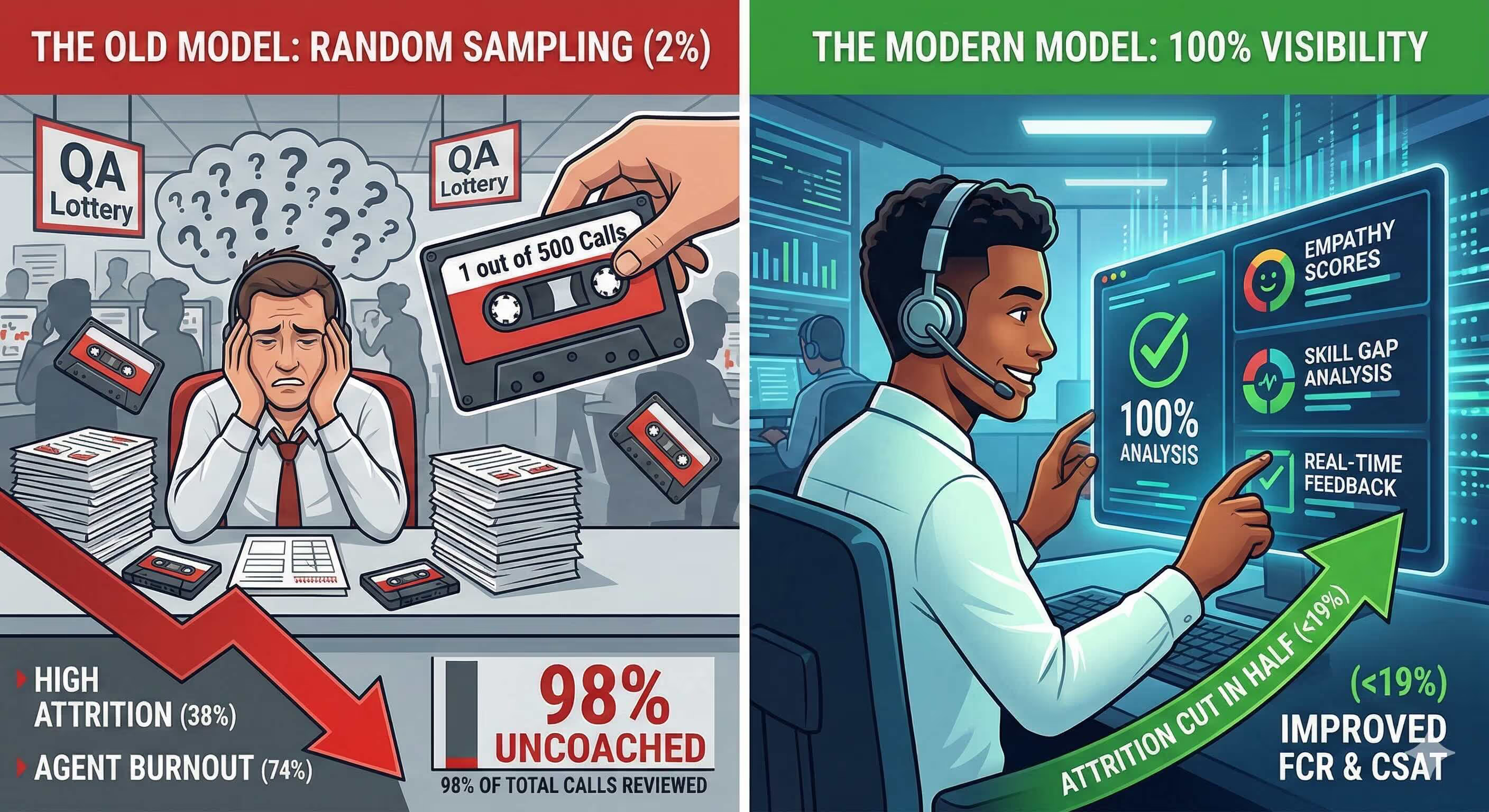
Now layer in QA. Most contact centers review 2-5 calls per agent per month, roughly 2% of total volume. Coaches listen back, score against a rubric, schedule a 30-minute coaching session 11-18 days after the call happened. By the time the agent hears feedback on a January call, it’s mid-February. The customer is gone, the context is gone, and the agent has handled 800 more calls.
This is what we call delayed-feedback agent performance management. It’s the default model in most contact centers. It produces the data backing the QA scorecard, but it does not improve agent behavior.
Combine the two failures, bad notes plus stale coaching, and you get a system that:
- Costs $15M+ annually per 1,000-seat center in agent paperwork time
- Produces inaccurate CRM data that downstream teams treat as truth
- Delivers coaching feedback so late it changes nothing
- Drives 30-45% annual turnover, at $10K–$20K replacement cost per agent
That’s not a performance problem. That’s an architectural problem. And it’s invisible on every dashboard your leadership team looks at.
How to Fix It
The fix has two parts: eliminate ACW where possible, compress coaching loops everywhere else.
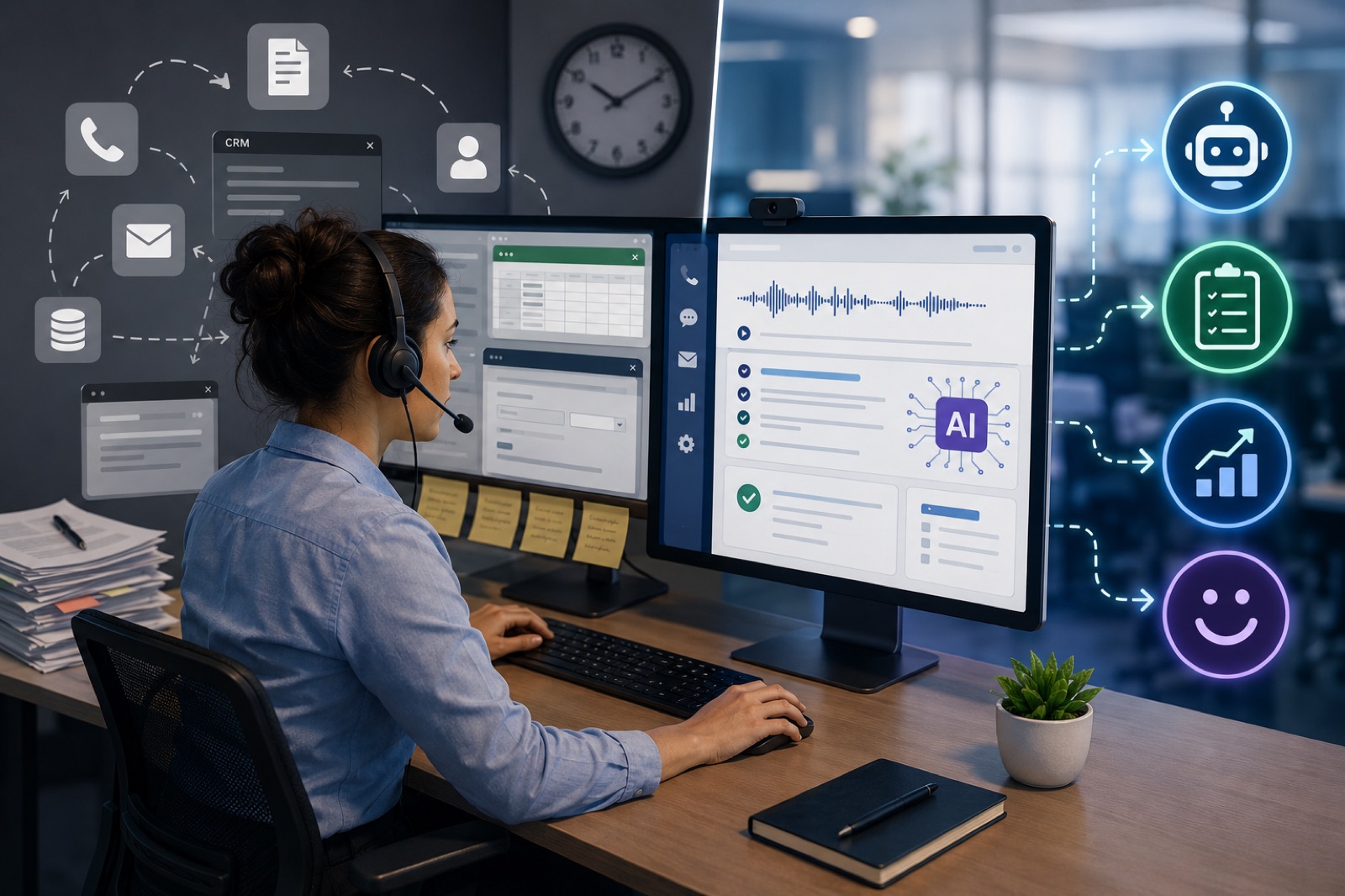
On ACW: auto-generated post-call summaries are now mature enough for production. Agents finish the call. AI generates a structured summary: root cause, sentiment, products mentioned, follow-up commitments, suggested disposition. Agent reviews and edits in 30-45 seconds. Done.
This is what conversation intelligence does that handle-time targets can’t. It removes the work, doesn’t just measure it.
On coaching: feedback within 24 hours isn’t aspirational anymore. It’s table stakes. Real-time and near-real-time agent coaching systems flag missed opportunities while the agent is still on the call, or queue micro-coaching nudges into the agent’s dashboard within hours. The behavior change is measurable.
The Behavior Layer Agent Performance Management Skips
There’s a third piece, less discussed. Behavior analytics.
If you’re only listening to a 2% sample, you can’t catch call avoidance. The agents who deliberately disconnect difficult calls. You can’t catch handle-time gaming. The agents who pad ACW to dodge the next contact. You can’t catch the silent strugglers, whose CSAT is fine but whose sentiment trajectory is sliding month over month, who will quit in Q3.
We monitor all of this in our conversation intelligence platform. A slide like that stays invisible when QA scores three calls a quarter and happens to pick the good ones.
This is why performance management should track agent-behavior signals independently of QA scoring. The two systems answer different questions. QA tells you whether the agent followed the playbook. Behavior analytics tells you whether the agent is still in the game.
What to Do This Week
If you’re running an agent performance management program and you suspect ACW is eating your team, start here:
- Measure ACW honestly. Pull the average wrap time across your top 20% performers vs your bottom 20%. If the gap is greater than 90 seconds, ACW is a hidden performance differentiator, not a flat overhead.
- Audit disposition accuracy. Pick 50 random closed tickets. Have a QA analyst listen to the calls and compare ground truth to what agents typed. If accuracy is below 70%, your downstream reporting is unreliable.
- Calculate the coaching gap. Pull the timestamp of the call vs the timestamp of the coaching session. If your median gap is more than 5 days, coaching cadence is too slow to drive behavior change. Lengthening the QA sample won’t help. Shortening the feedback loop will.
- Stop tracking only QA scores. Add three behavior signals to your weekly performance review: average ACW, disposition accuracy, and 90-day sentiment trajectory.
- Pilot auto-summarization on one team. Pick 10 agents on the same queue. Run them with AI-generated post-call summaries for 30 days. Measure ACW, CSAT, agent NPS, and disposition accuracy. The economics speak for themselves.
The contact centers that figure this out in 2026 won’t be the ones with the best AI. They’ll be the ones who realized that agent retention strategies and operational efficiency are the same problem viewed from two angles. You can’t fix call center turnover with a pizza party. You fix it by giving agents back the 3 hours a day you took from them.
And the senior agent from the start? Her replacement will be complaining about the notes by his second week.