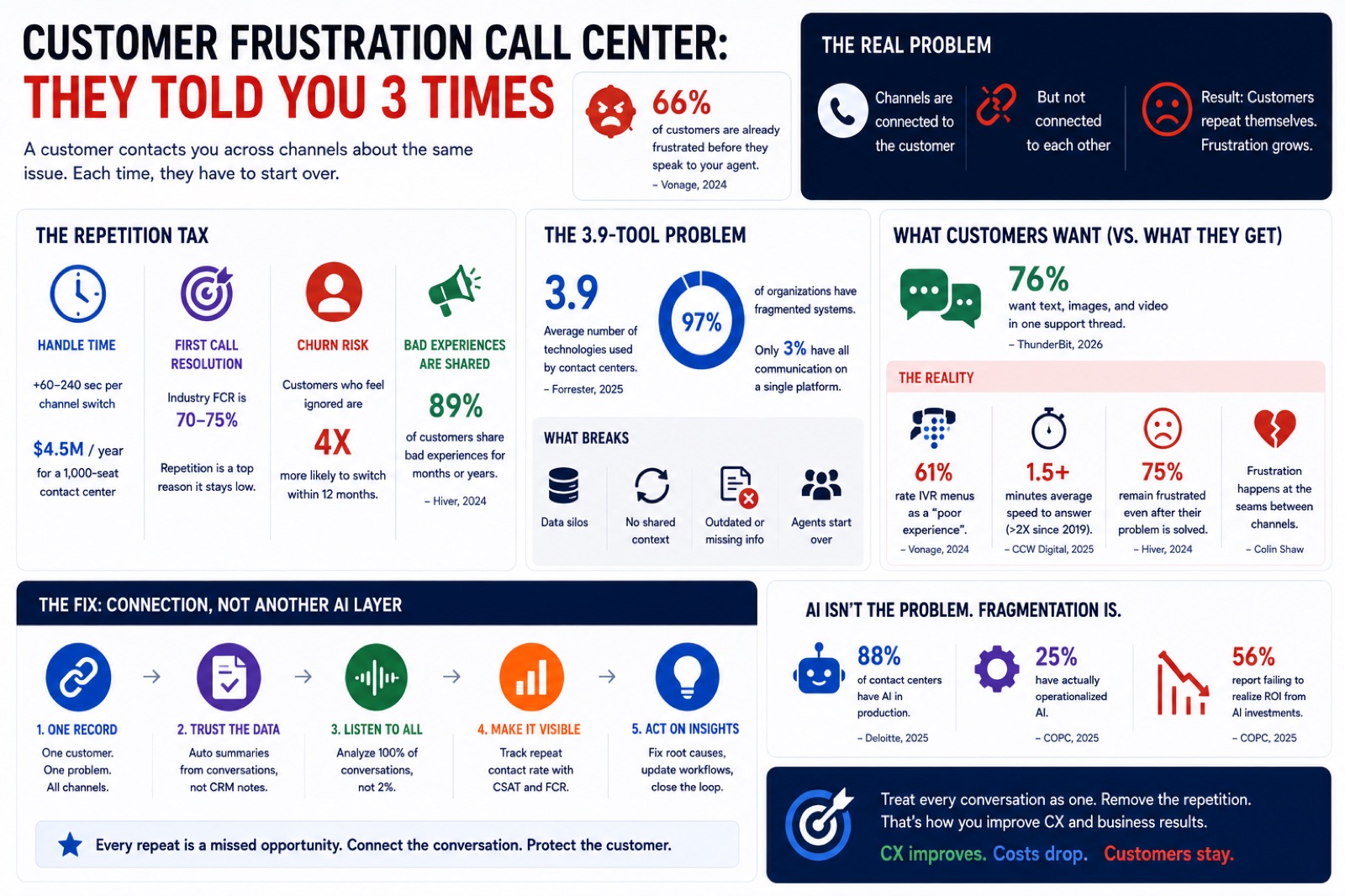
Look at a contact center’s call mix quarter by quarter, and the shape is changing. The volume of “easy” calls (balance checks, password resets, basic policy questions) is dropping. The calls that are high-complexity, high-emotion, or multi-system are growing. Average handle time creeps up. CSAT on the harder calls drops.
The future of contact centers is not a smaller version of today. It’s a different shape. And most playbooks still assume the old one.
The Easy Calls Are Already Gone
If you look at any contact center benchmarking report from 2019, the call mix looks roughly normal. A long left tail of complex cases. A fat middle of routine inquiries. A short right tail of edge cases. Average handle time made sense as a metric because most calls clustered near the average.
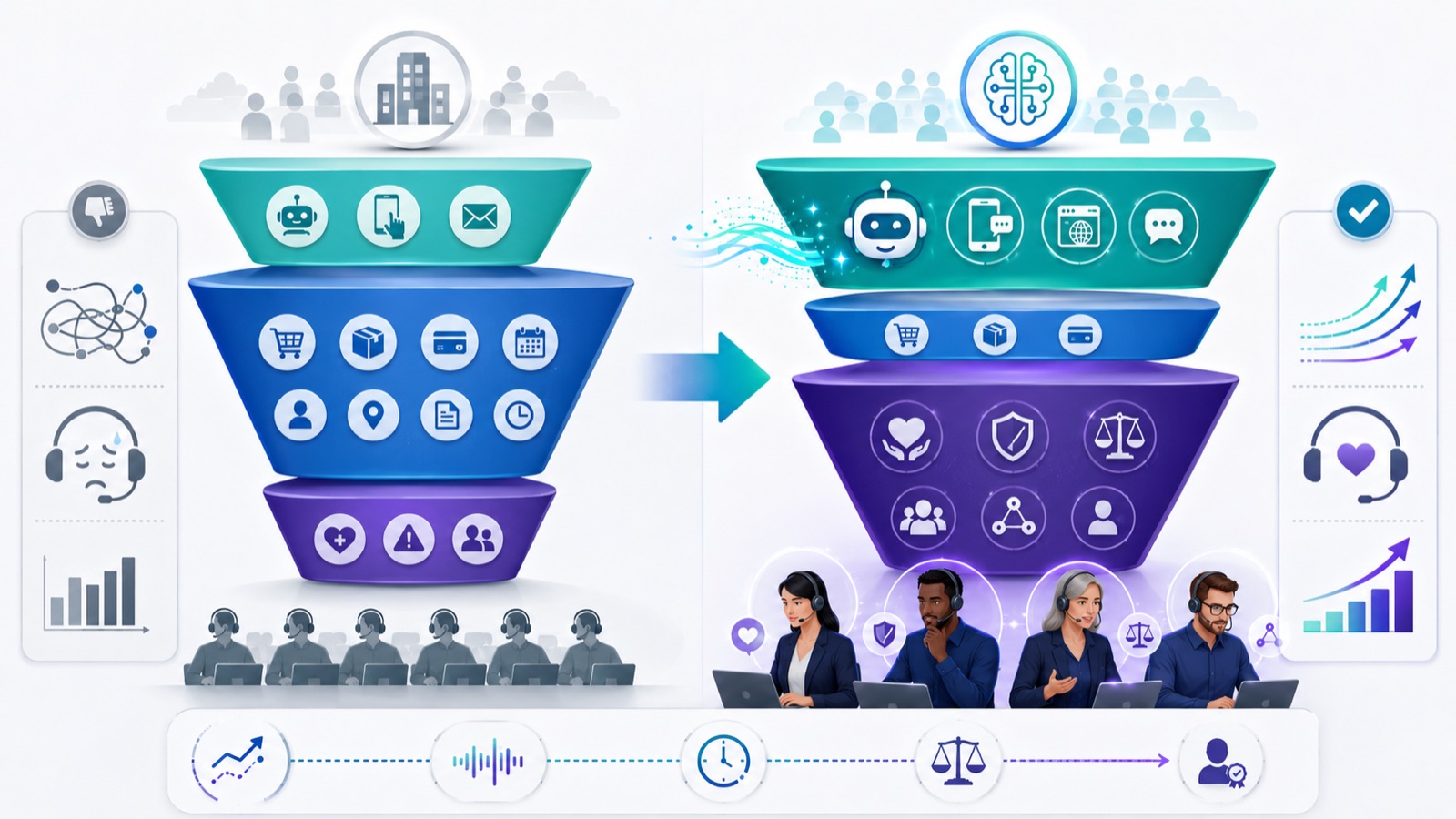
That distribution is collapsing. Self-service apps absorbed account lookups. Chatbots absorbed FAQ-style questions. Voice bots absorbed appointment confirmations and basic policy renewals. The middle, the part that used to make “average” a useful word, is being eaten from both sides.
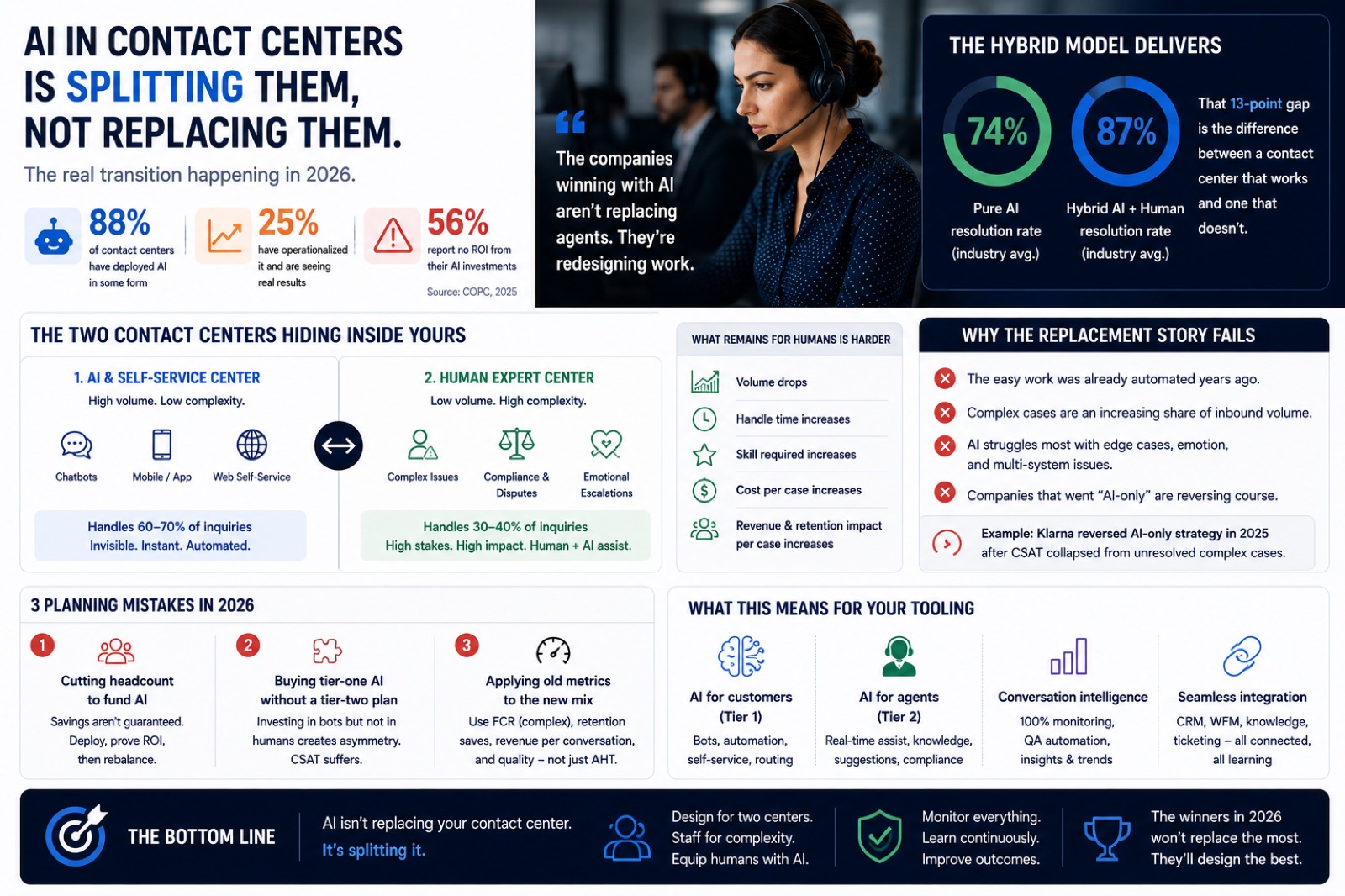
What stays in the human queue?
The conversations where the customer is angry, the issue spans three systems, the policy doesn’t quite fit, the regulator is watching, and the next move depends on judgment a script can’t capture. These calls used to be a small share of volume. They are becoming the main event.
This is the shrinking middle. It’s not a smaller contact center. It’s a harder one.
What “Average” Hides
Here’s the trap: as the middle shrinks, the average call gets harder, longer, and more expensive. But aggregate metrics keep reporting averages.
Picture a VP of contact center operations looking at her Q4 dashboard. AHT is up year over year. FCR is down. CSAT is flat. By every traditional metric, she has a performance problem.
She doesn’t. She has a composition problem. The simple calls left. The hard calls stayed. Her team may be performing better on the hard calls than a year ago, but the averages can’t see it. Segment the data by call complexity, and the picture can flip: handle time falling on both routine and complex calls while the blended average rises.
This is what happens when you measure 2030’s contact center with 2019’s metrics. Same call center. Different work. Invisible improvement. When the bonus structure is tied to AHT and CSAT, a team’s real improvement hides inside metric definitions written when the call mix was different.
Why Legacy Strategies Break the Future of Contact Centers
Three load-bearing assumptions of traditional contact center strategy are about to snap.
Assumption 1: Most calls are similar enough to standardize. This was the foundation of scripts, training matrices, and tiered support. It produced 30 years of process-improvement gains. When the middle disappears, every remaining call is closer to an edge case. Standardization stops compounding. Judgment becomes the bottleneck.
Assumption 2: Newer agents handle easy tickets, senior agents handle escalations. When the easy tickets are automated away, the entire training pipeline breaks. There’s no on-ramp anymore. The 30-day new-hire who used to learn by handling 40 routine calls a day now lands a customer threatening litigation on call #3. Industry agent attrition data already shows newer cohorts churning faster. This is one reason.
Assumption 3: Coaching scales by reviewing a sample. Random 2% sampling assumes the population is somewhat homogeneous. When every call is unique and high-stakes, sampling misses the calls that actually need coaching attention. Manual QA was designed for a world that no longer exists.
In McKinsey’s 2024 survey of customer care leaders, more than 80% were already investing in gen AI or expected to within months. Investing is not the same as redesigning. If the metrics, hiring profiles and coaching models built for the old call mix stay in place, the strategy lags the technology. That lag is the actual risk.
What The Winners Are Doing Differently
The contact centers handling the shrinking middle well share four patterns.
They segment calls by complexity instead of topic. Topic (“billing inquiry”) used to be a useful proxy for difficulty. It isn’t anymore. A billing call from a 30-year customer who’s threatening to switch banks is not the same call as a billing call from someone who just wants to know their next payment date. Modern conversation analytics tag calls by emotional intensity, system count, regulatory flag, and resolution path. The dashboards split on those axes, not on call codes.
They redesigned agent profiles. The skills that mattered in 2019 (speed, script adherence, average performance) matter less than judgment, emotional regulation, and cross-system fluency. Some centers now hire ex-paralegals and ex-social workers for complex queues: lower volume per agent, and calls worth more.
They moved coaching from monthly to weekly. When every call is high-stakes, a one-month feedback loop is too slow. Real-time AI quality assurance is what gets coaching latency from weeks to under 24 hours.
They stopped pretending AI is replacing humans. The most mature deployments treat AI as the layer that handles 70-80% of volume invisibly, while making the remaining 20-30% of human conversations more effective. The point of AI isn’t fewer humans. It’s better human moments.
The Metric Stack Has to Change
If the work is changing, the scorecard has to change with it.
The new metrics are not exotic. They just require data the old QA stack didn’t capture. 100% coverage, real-time analysis, and the ability to segment calls by signal rather than category.
The Future of Contact Centers in 2027
The contact center of 2027 won’t look smaller. It will look denser. Fewer total interactions, each one carrying more weight, more risk, and more upside. The companies that win the next phase of customer experience won’t be the ones with the most automation. They’ll be the ones whose human conversations are noticeably better than everyone else’s, and whose strategy stack actually measures that difference.
If your scorecard, your hiring profile, and your coaching loop were designed for the old call mix, they’re already obsolete. The middle is shrinking. The strategy gap is widening. The window to redesign is now.
What To Do This Week
The shrinking middle is not a threat. It’s the most interesting time to be running a contact center in 20 years. But it will reward the leaders who see the shift early and punish the ones who keep measuring the call center they used to run.