A 1,000-seat contact center running 40% annual attrition burns $4 million to $8 million a year replacing people. The number doesn’t shock the industry anymore. It should. Most of those agents didn’t quit because the calls were hard. They quit because the system designed to “develop” them was the most demoralizing part of their week.
Agent attrition in the contact center has a primary cause nobody on the exec floor wants to own: the QA program itself. Not the customers. Not the wages. Not the schedule. The scorecard, the calibration meeting, the 2% sample, the gotcha review.
The pattern is simple. When QA is designed to catch agents failing, agents leave. When QA is designed to help them get better, they stay longer.
This post is for VP Operations, QA Directors, and CC Managers who are tired of treating attrition as a recruiting problem when it’s actually a coaching design problem.
The Real Cost Of Agent Attrition In The Contact Center
McKinsey puts the cost of attrition at $10,000 to $20,000 per contact center agent, depending on geography, tenure and the training the role requires. A 1,000-seat center at industry-average 40% attrition loses $4 million to $8 million a year just on replacement. Most CFOs see this as the cost of doing business.
It isn’t. Metrigy’s research shows that when agent turnover stays below 15%, customer satisfaction increases by 26%. Lower attrition isn’t a cost win. It’s a customer experience win that compounds.
And here’s the budget asymmetry that makes the problem self-perpetuating: contact centers spend 43% of their budget on labor and 0.6% on technology designed to reduce turnover (DMG Consulting). The leaders complaining loudest about attrition are the ones underinvesting hardest in the systems that would fix it.
The math isn’t subtle. A 1-point reduction in attrition is worth $100K–$200K per year for that 1,000-seat center. A QA program redesign that drops attrition by 5 points is worth $500K–$1M annually, before counting the downstream CSAT and FCR gains.
So why doesn’t every center do this? Because they treat QA as compliance theater instead of a retention tool.
Why Your Current QA Program Drives Agents Out
Walk into any contact center QA huddle and you’ll see the same pattern. The QA analyst sampled 2-5 calls per agent that month. The agent first hears about those calls in a coaching session two weeks after they happened. The feedback is delivered as a score with three negative bullets and one boilerplate positive. The agent doesn’t remember the call. They can’t argue the context. They can’t fix what they did because they don’t remember what they did.
Then the score goes into their performance file.
That’s the program. And it produces three predictable agent behaviors:
1. Defensive call handling. Agents start optimizing for what gets scored, not what helps the customer. Scripts get followed more rigidly. Hold times get hidden inside transfer queues. Empathy disappears because it’s hard to score consistently.
2. Score gaming. Agents learn which calls get monitored (often the longest or the angriest ones) and route accordingly. They learn to say the closing phrase in the first 90 seconds in case the call gets cut short during sampling.
3. Quiet quitting, then loud quitting. Agents who consistently feel surveilled and surprised by feedback don’t argue. They wait for a job offer. The exit interview blames pay or “growth opportunities” because saying “your QA program made me feel watched and never helped me get better” doesn’t help them get a reference.
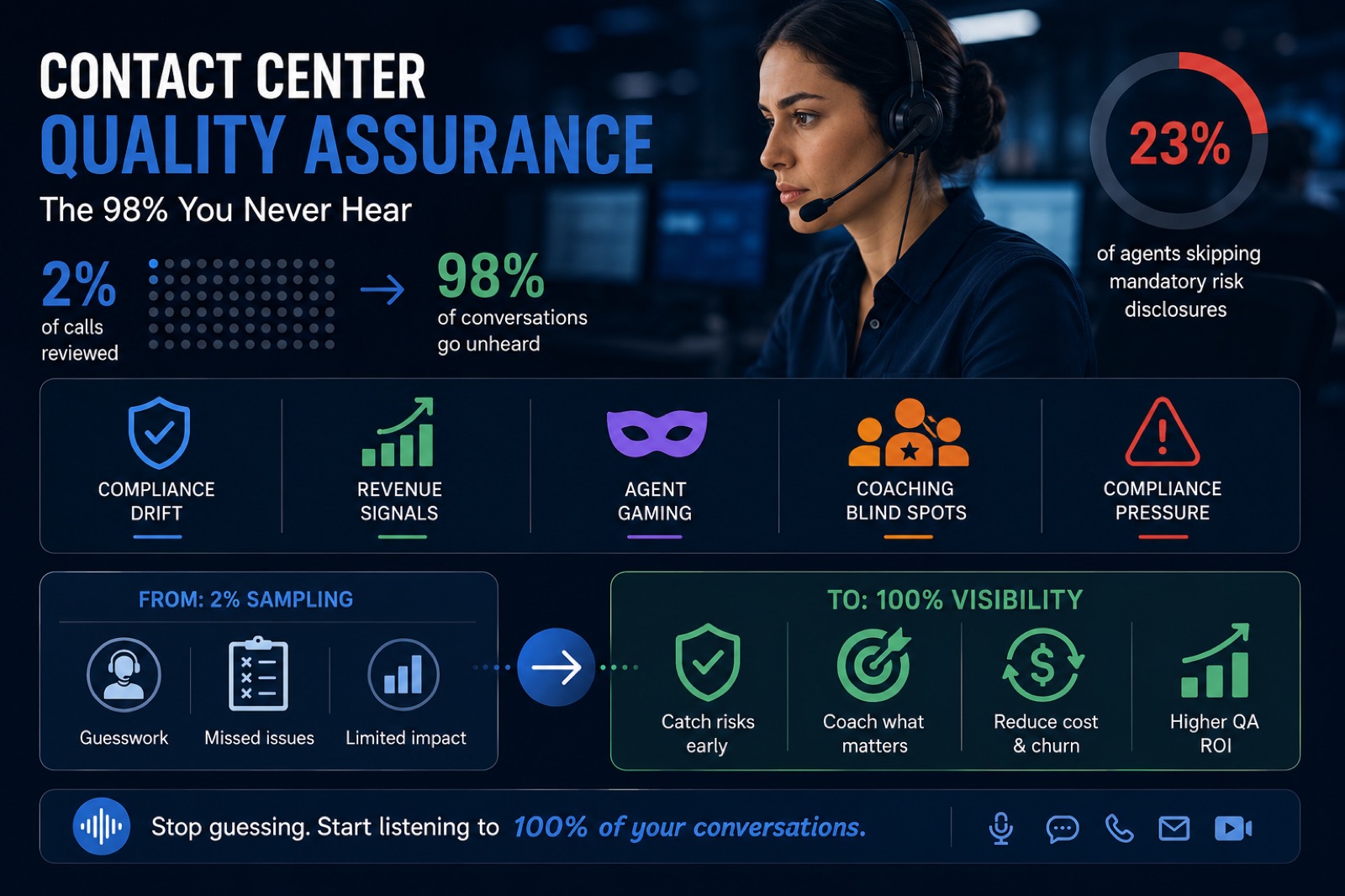
The root issue isn’t that QA exists. It’s that QA was designed around a sampling constraint (“we can only review 2% of calls”) and that constraint shaped every other decision. Delayed feedback. Generic coaching. Punitive tone. No agent visibility into their own performance. No self-correction loop.
When the sampling constraint goes away, the whole program can be redesigned. That’s what makes 2026 different from 2020.
The Data On QA Coverage And Retention
The 2% sampling number is industry-wide. SQM Group finds that quality checks cover 1–2% of calls, done by hand, with most agents evaluated on 4 to 10 calls a month.
The gap between manual and AI-powered QA isn’t subtle:
- Coverage: 2-5% manual vs 100% with automated quality assurance
- Scoring accuracy: McKinsey estimates manual QA scoring is 70–80% accurate, against more than 90% for a largely automated process
- Time to feedback: Real-time or next-day with AI; 7-14 days for manual programs
That last one matters most for retention. Coaching delivered within 24 hours of a call is acted on. Coaching delivered two weeks later is argued with, ignored, or experienced as punishment. Behavioral psychology has been clear on this for 60 years: feedback is only useful when the action it references is still in working memory.
People stay where they’re growing. They leave where they’re being judged.
There’s one more data point that should be required reading for every CC leader. Agents who can see their own performance dashboard in real time (their own scores, their own trends, their own coaching items) show measurably higher tenure than those who only see scores during reviews. Transparency reduces the surveillance feeling. Self-coaching loops let agents fix small things before they become coaching escalations.
What A QA-Driven Retention Program Looks Like
The redesign isn’t complicated. It’s three shifts.
Shift 1: From sampling to 100% coverage. Every call gets scored automatically. Not because every call needs a coaching conversation, but because the agent and the supervisor get a complete picture instead of an inferred one. Patterns become visible. Outliers become obvious. The 1% of calls that actually need intervention surface immediately instead of being missed in the 98% that weren’t sampled.
100% coverage also kills the “you got unlucky in sampling” complaint, which is the most corrosive thing an agent can believe about their QA program.
Shift 2: From delayed feedback to instant coaching loops. When a call ends, the agent should see how it scored before they take the next one. They should see what went well and what one thing to improve. They should have the option to listen back and reflect. Tools that pair AI scoring with agent self-coaching, best-practice playlists, skill gap detection, and micro-coaching nudges convert QA from punishment into development.
Shift 3: From scorecard reviews to skill-building conversations. Supervisor 1:1s stop being score recitations. They become “here’s a behavior pattern I noticed across 40 of your calls this month — let’s work on it.” The conversation moves from defending a sample to building a skill. Agents leave those conversations with one specific thing to practice, not three things to feel bad about.
This is the architecture behind centers that beat industry attrition. It’s not magic. It’s a program designed around how humans actually learn and stay engaged at work.
One operational note: this redesign also exposes which supervisors are good coaches and which aren’t. That’s uncomfortable, but it’s diagnostic information you’d rather have than not have. The best AI QA programs make the coaching layer transparent. The centers that act on that transparency see the biggest retention gains.
For a deeper look at how 100% coverage changes the visibility problem, our earlier piece on conversation analytics and the cross-channel blind spot covers the technical side of moving off sampling.
What To Do This Week
Five concrete actions, all doable in a week, that move agent attrition in the contact center in the right direction:
1. Audit your time-to-feedback. Pick 10 random coaching sessions from the last 30 days. How many days passed between the call being made and the feedback being delivered? If the median is over 7 days, your program is built on a foundation that retention research has called out for two decades.
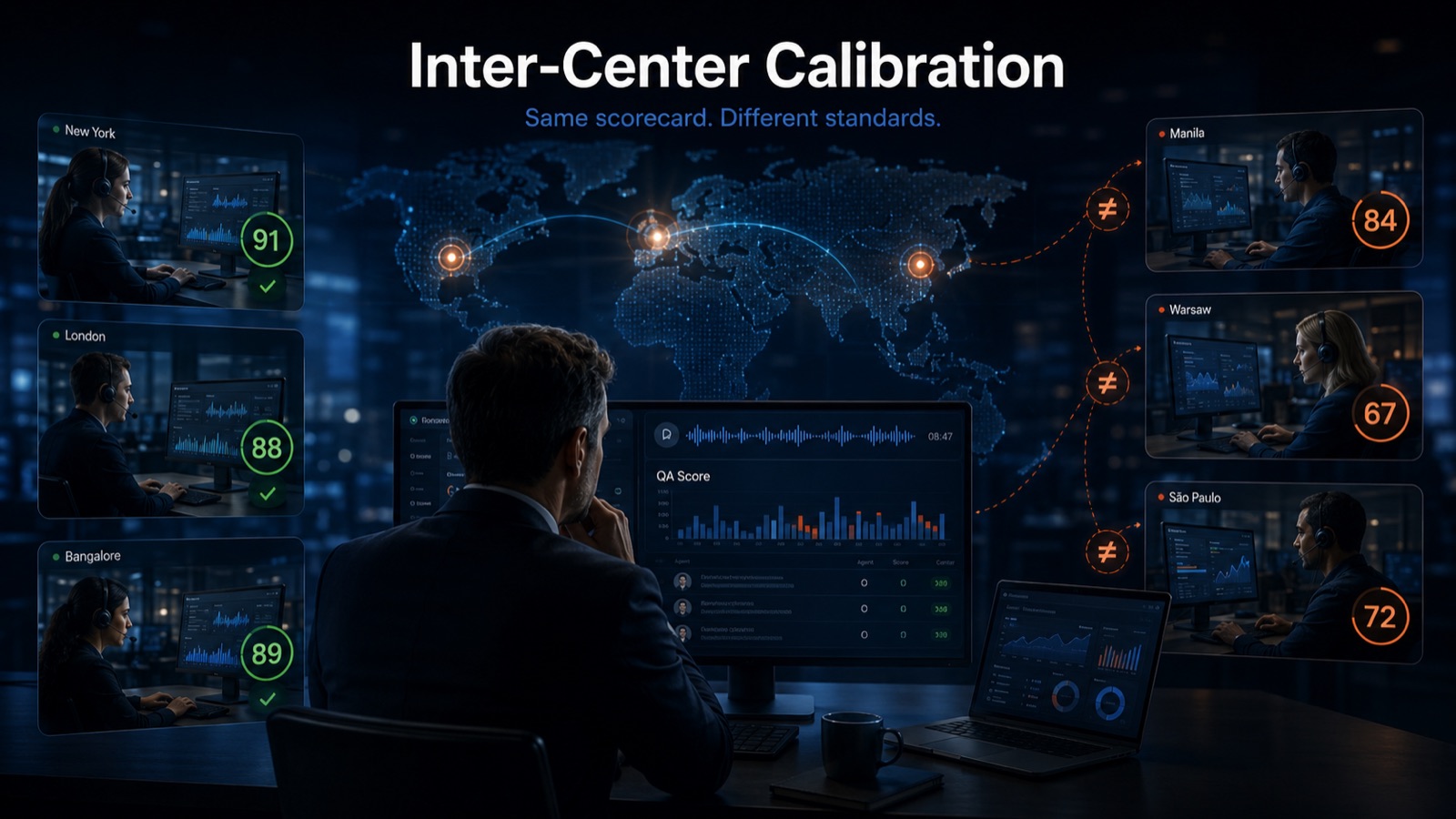
2. Run a calibration audit on your human QA team. Have three QA analysts score the same 10 calls independently. Compare. If inter-rater agreement is under 75%, your scores aren’t measuring what you think they’re measuring. And your agents know it. That alone is a retention killer.
3. Survey your agents on QA experience, not just job satisfaction. Two questions: “How fair is your QA program?” and “How much does QA help you improve?” Score below 7/10 on either, and you’ve found the leak in your retention bucket.
4. Pilot 100% coverage on one team. Pick a 20-30 agent unit. Run automated quality assurance alongside your manual program for 60 days. Compare: issues caught, coaching items generated, agent NPS, voluntary attrition. The data will make the business case for you.
5. Stop publishing QA scores as the primary agent metric. Replace them with “coaching items completed” and “skill progression.” Agents stay where they see themselves growing. They leave where they see themselves being measured.
Agent attrition in the contact center is not a recruiting problem. It’s a coaching design problem dressed up as a budget line. The centers that figure this out in 2026 will be the ones whose competitors are still hiring against them every nine months.
If you’re inside a QA program that feels stuck in 2015, the fix isn’t more training for analysts. It’s redesigning the loop so feedback is immediate, coverage is complete, and the conversation between agent and supervisor stops being adversarial.
That’s the program that keeps agents in their seats.