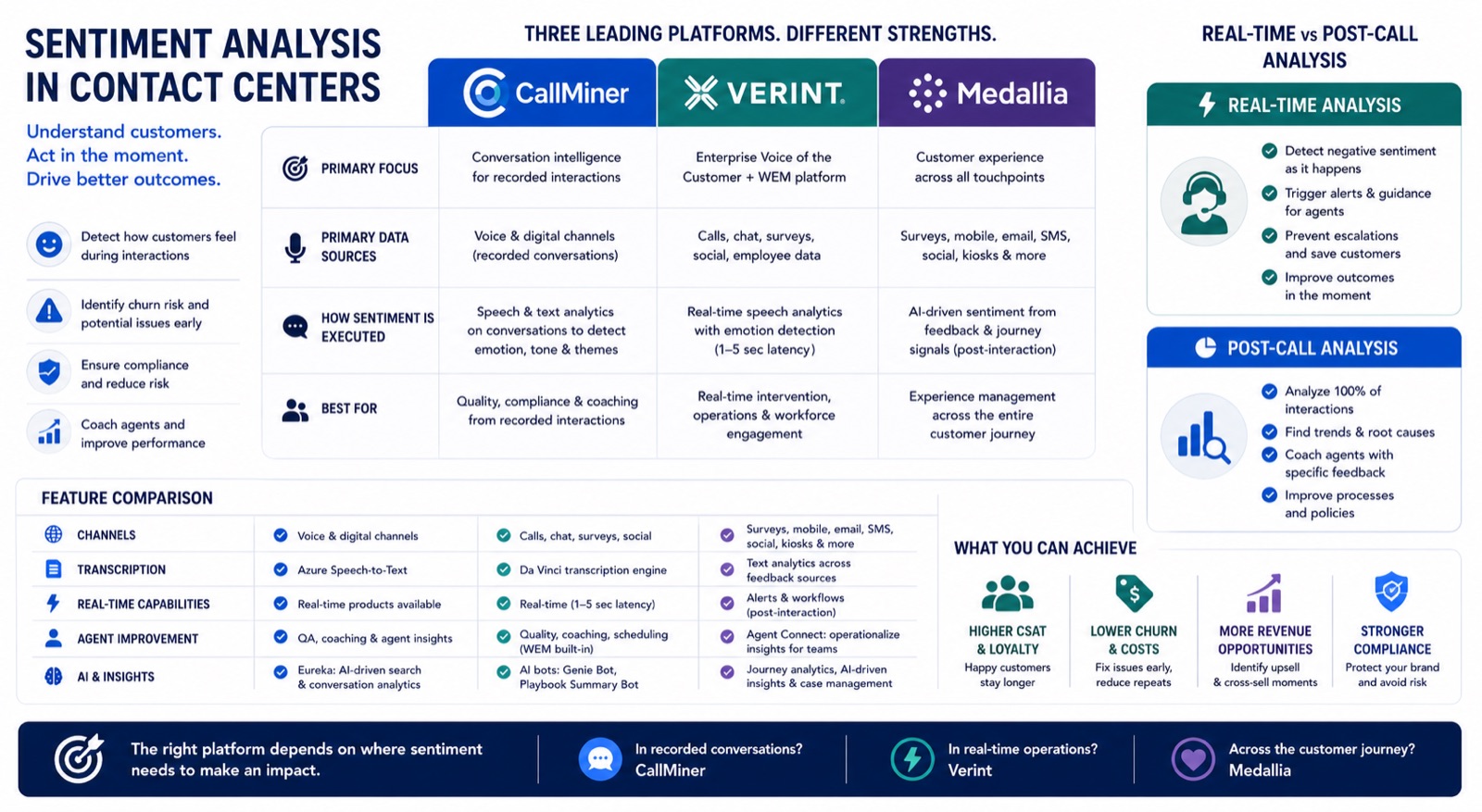
Look, sentiment analysis in contact centers isn't rocket science, but it's not exactly straightforward either. You're basically trying to figure out how customers feel during interactions - whether they're calling in frustrated, chatting with hope, or sending emails that could go either way. The payoff? Teams that nail this can spot customers about to jump ship, fix problems before they explode, keep compliance folks happy, and actually coach agents in ways that matter.
If you're hunting for CallMiner alternatives, here's what you need to get straight: every platform has its own idea of what "sentiment" means and where it fits into your daily operations. That matters more than you might think.
Choose Ender Turing when you want speech analytics and QA on every call, in any language, at a published price: free for up to 5 agents, then $39 per agent a month. Stay with CallMiner when you run a large analytics program with your own analysts: its FAQ describes subscriptions that scale from midsize teams of more than 60 agents, priced by users or interaction volume (CallMiner, checked October 13, 2026).
What each platform is designed to do
| Platform | Primary function | Primary data sources | Target market focus | How sentiment analysis is typically executed |
|---|---|---|---|---|
| CallMiner | Conversation intelligence platform for conversation analytics | Recorded conversations from voice and digital channels | Contact centers needing real-time and post-call insight | Speech and text analytics applied to conversations to detect emotional tone and themes |
| Verint | CX automation platform with AI-powered bots across analytics, voice of the customer and workforce engagement | Customer interaction data plus employee performance context | Organizations needing deeper interaction insights and employee experience management | Sentiment inferred from speech analytics in the contact center, often tied to workforce workflows |
| Medallia | Experience management platform: feedback, conversation, behavioral and operational data across the customer journey | Feedback and journey touchpoints across channels | CX programs focused on cross-touchpoint experience | Emotion, sentiment and intent detected in voice, chat and messaging interactions, as well as in feedback |
Sources, checked September 25, 2026: CallMiner, Verint, Medallia platform, Medallia contact center.
Real-time analysis versus post-call analysis in day-to-day operations
Post-call analytics? That's your Monday morning quarterback move. You're digging through completed interactions, hunting for patterns in customer behavior and coaching goldmines. Real-time analytics? Now we're talking intervention mode - helping agents while they're still on the call.

Picture this: compliance alerts pop up mid-conversation, sales suggestions appear right when the customer's wavering, supervisors get pinged the second sentiment tanks.
Which platform fits your contact center
Got the sentiment analysis basics down? Good. Now let's dig into the platforms that actually deliver these capabilities for contact centers.
Choosing between these three usually boils down to where you need sentiment to actually do something: inside recorded conversations, during live calls for real-time interventions, or across your entire customer experience program. Skip the buzzword bingo - this comparison focuses on outcomes.
Feature by feature comparison table for contact centers
| Capability that drives outcomes | CallMiner | Verint | Medallia |
|---|---|---|---|
| Primary focus | Conversation intelligence platform for analyzing recorded conversations and trends | Open platform with AI-powered bots for CX automation | Customer experience management across touchpoints |
| Channels | Voice and digital channels (conversation-centric) | Surveys, calls, chat, social media | Surveys, voice, chat, web behavior, social media and employee feedback |
| Transcription and analytics | CallMiner’s own recognizer, or a transcription engine the customer brings, in hundreds of languages | Exact Transcription Bot; a Da Vinci AI transcription engine was announced in 2021 | Speech and text analytics with AI-driven sentiment across conversations and feedback |
| Real-time behavior | Real-time products with immediate attention capabilities | Coaching Bot: in-the-moment guidance for agents during live calls | Insights and alerts moments after each interaction |
| Agent improvement | CallMiner agent coaching via quality assurance and insight workflows | Coaching, scheduling and performance management; quality monitoring now sits in Quality Automation | Medallia Agent Connect supports contact center use cases by operationalizing insights for teams |
| AI packaging | Generative and agentic AI across its core products | Da Vinci AI and bots such as Genie Bot and Playback Summary Bot | Actionable insights with alerting and case management |
Sources, checked September 25, 2026: CallMiner Analyze, RealTime, advanced AI; Verint speech analytics, Coaching Bot, workforce engagement; Medallia platform, speech analytics, conversational intelligence.

CallMiner Eureka strengths and trade offs for sentiment analysis
Teams pick CallMiner Eureka when they need serious post-call analytics on recorded conversations and clear customer behavior patterns for quality assurance, compliance, and targeted coaching. Its OmniAgent is a different kind of product: voice-optimized virtual agents informed by conversation intelligence, which automate customer conversations rather than coach agents. Agent performance sits in CallMiner Coach, and live guidance in RealTime.
Verint strengths for enterprise real time operations and engagement
Verint calls itself a leader in CX automation, with an open platform and a team of AI-powered bots. You get Voice of the Customer collection through surveys, calls, chat, and social media, plus speech and text analytics with real-time call transcription, emotion detection, and trend analysis.
Medallia strengths for customer experience programs and multi touchpoint Voice of the Customer
Medallia's core strength? Pulling together direct and indirect feedback into one view of experience. They collect signals across surveys, voice, chat, web behavior, social media and employee feedback, then apply journey analytics to track experience across multiple touchpoints. You also get text analytics and AI-driven sentiment analysis, plus actionable insights with alerting and case management.
Beyond core features, you need to understand the specific strengths of each platform in areas like speech analytics and Voice of the Customer integration for informed decision-making.
Contact center sentiment analysis only drives measurable outcomes when speech analytics turns recorded conversations into reliable transcripts, then connects those insights to your broader Voice of the Customer program. CallMiner, Verint, and Medallia all support this goal, but they differ in transcription workflow, category design, and how easily conversation intelligence becomes action inside CRM and customer experience systems.
How speech analytics turns calls into usable sentiment signals
Here's the workflow: audio gets captured from telephony systems, transcribed, then analyzed using natural language processing and machine learning to detect topics, intent, and sentiment. Transcription accuracy matters because small errors (product names, negations like "not happy") can flip sentiment and mess up AI-driven root cause analysis.
Beyond words, mature programs also measure paralinguistic signals from customer interactions and voice analysis - emotional tone, silence, talk speed, overtalk. These signals often correlate with escalation risk and coaching opportunities, even when customers use neutral language.
Generative AI summaries and agent assistance in practice
Generative AI commonly produces call summaries, drafts disposition notes, and recommends next-best actions for agent coaching. Some teams also deploy agent-assist chatbots (Verint, for one, sells a Genie Bot) to surface policy snippets during live calls, but capabilities vary by packaging and deployment choices.
Practical constraint: summaries inherit transcript errors, so quality assurance leaders should spot-check summaries against audio before using them for compliance.
Voice of the Customer integration and categories that drive root-cause visibility
Conversation analytics delivers the most value when voice and text analytics (calls plus chats) combine with structured data like surveys, Net Promoter Score, and Customer Satisfaction to expose emerging trends and unstructured data root cause analysis.
| Capability | CallMiner | Verint | Medallia |
|---|---|---|---|
| Category design | CallMiner offers an unlimited number of categories or out-of-the-box categories | Categories and unlimited terms for trend discovery | Hundreds of prebuilt topic models, plus custom low- to no-code models |
| Integrations focus | CallMiner provides a truly open API to sync conversation intelligence with CRM or customer experience tools | Verint supports Salesforce, Microsoft Dynamics, Genesys, NICE and other contact center systems; its Integration Studio lists more than 500 application connectors across 300 vendors | Hundreds of out-of-the-box integrations, including Salesforce and Microsoft Dynamics 365, plus APIs |
Sources, checked September 25, 2026: CallMiner vs Verint, integrations; Verint speech analytics, Integration Studio; Medallia text analytics, integrations.
While features matter, the financial investment and overall cost of ownership are critical factors in selecting the right sentiment analysis platform.
If you're evaluating the best sentiment analysis software for a contact center, pricing rarely comes down to a simple per-seat fee. CallMiner, Verint, and Medallia are commonly sold via quote-based, enterprise contracts, so total cost of ownership depends as much on enablement and operations as licensing. Your goal? Align spend to measurable outcomes like improved customer experience, faster agent coaching cycles, and better compliance across customer interactions.
Direct answers on costs and how pricing is structured
How much does Verint cost? Verint quotes each deal, but its own public listings give real numbers: Verint Speech Analytics is £385.25 per named user a year and Verint Quality Management £125.21 on the UK government’s G-Cloud framework, and Verint Workforce Engagement is listed at $200,000 a year on Microsoft’s marketplace (sources under the pricing table).
How much does CallMiner cost? CallMiner pricing is typically quote-based and varies by deployment scope, data volumes (recorded conversations), and the speech and text analytics capabilities selected. CallMiner publishes no prices; it sells bundled packages priced by user count or interaction volume, for midsize teams of more than 60 agents up to global enterprises, with its advanced AI included. Its last public list price, an Amazon Connect starter edition on AWS Marketplace, was $1,275 a month for 1,500 hours of call audio.
Comparison table for budgeting and procurement
| Platform | Published prices | Main pricing drivers to validate | Typical total cost of ownership risk areas to plan for |
|---|---|---|---|
| CallMiner | No published prices: bundled packages by user count or interaction volume, for teams of more than 60 agents. Its last public list price, an Amazon Connect starter edition on AWS Marketplace, was $1,275 a month for 1,500 hours of call audio | Users, interaction volume, analytics modules, integrations, deployment model | Training time for analysts and quality assurance, ongoing tuning of categories and models, internal administration ownership |
| Verint | Speech Analytics £385.25, Quality Management £125.21 and Workforce Management £317.83 per named user a year on the UK government’s G-Cloud framework; Workforce Engagement $200,000 a year on Microsoft’s marketplace | Modules, named users, transcription minutes (£76.25 per 1,000), deployment type | Professional services, upgrades, support tiers, rollout across voice and digital channels |
| Medallia | Priced per Experience Data Record in annual tiers: £43,870 a year for 20,000 records in its UK public-sector contact center suite; its QA and coaching app for Salesforce starts at $5,000 a year | Experience Data Records per year (analytics, workflows and unlimited users included) | Implementation planning, cross-team governance, integration work for Voice of the Customer workflows |
Sources, checked September 25, 2026: CallMiner pricing FAQ, AWS Marketplace listing (archived October 2024); Verint on G-Cloud: speech analytics, quality management, workforce management; Verint on Microsoft Marketplace; Medallia pricing, G-Cloud contact center suite, Salesforce AppExchange.
Total cost of ownership checklist for contact center sentiment analysis
For a fair benchmark against CallMiner alternatives for contact centers such as Calabrio Analytics and NICE Interaction Analytics, apply the same total cost of ownership worksheet and insist on an itemized quote that separates platform fees from services and support. This is where total cost of ownership and flexible pricing either supports scale, or silently penalizes growth.
Even with powerful tools, organizations often encounter common challenges and limitations when implementing sentiment analysis, which are important to anticipate and address.
Sentiment analysis fails most often for practical reasons, not model quality: noisy data, hard integrations, and unclear ownership of actions. A useful speech analytics platform comparison should therefore measure operational friction as much as sentiment accuracy, especially when the goal is real-time analytics that improves customer experience.
Data quality and emotional detection limits
Sentiment models depend on consistent transcripts and clean metadata from voice and digital channels. Accents, crosstalk, sarcasm, and incomplete tagging can distort customer behavior patterns, which then misguides agent coaching and contact center performance decisions.
Setup complexity and learning curve risks
Enterprise dashboards take time to make operational. Even Verint’s own target is 30 days for most of its bots. Plan for an enablement owner (often quality assurance or workforce management) who maintains category definitions, calibration, and score interpretation.
Capability gaps and packaging constraints
Some limitations are product-level, not process-level.
The problem decision makers keep running into
Most buyer guides stop at "alternatives to X" or a single one-versus-one matchup, which leaves you without a true contact center Voice of the Customer software comparison across all three platforms. The result is slow decisions, because teams debate feature lists instead of aligning tools to the operating model that drives measurable outcomes.
A structured way to compare the three platforms
Use a three-way frame based on where sentiment needs to take action across customer interactions, not on vendor categories.
Practical constraints and a workflow hint
Trade-off to test early: real-time analytics versus post-interaction depth. Assign ownership up front (Operations for compliance and agent coaching, Customer Experience for journey insights) to avoid stalled adoption.
Next, we'll look more closely at Medallia's contact center capabilities and where it fits best.
Where Medallia fits in contact center sentiment analysis
Medallia makes sense when sentiment analysis needs to reflect the end-to-end customer journey, not only what happened inside recorded conversations. Medallia captures experience signals as they happen across every channel, from surveys to contact center conversations, which helps teams connect customer interactions to business outcomes like churn risk and improved customer experience. This positioning matters when evaluating CallMiner competitors 2026, because CallMiner and Verint are often more speech-analytics-native, while Medallia is frequently the hub for broader voice and digital channels feedback.
What you can make happen with Medallia
Medallia provides journey analytics to track experience across multiple touchpoints, which can surface customer behavior patterns that single-channel tools miss. In practice, customer experience leaders often assign journey owners to turn insights into closed-loop actions, while contact center leaders use agent coaching workflows (sometimes alongside programs such as Agent Connect) to reinforce what high-performing conversations look like.
Trade-offs versus speech-first platforms
Medallia can be a better conversation intelligence platform for cross-channel Voice of the Customer, but teams should verify real-time analytics needs, integration depth, and compliance workflows during evaluation.
You're usually choosing between three operating models: deep analysis of recorded conversations, tighter day-to-day control of contact center execution, or broader journey analytics across voice and digital channels. Use these FAQs to pressure-test fit before you commit time to demos or procurement.
Which platform should you choose for sentiment analysis outcomes
Q: When does Medallia make the most sense for sentiment analysis? A: Choose Medallia if the primary goal is to enhance customer journeys through sophisticated feedback analytics across multiple channels, suited for retail chains, business-to-business firms, and service industries looking for insights and sentiment analysis across the customer journey. A Medallia Net Promoter Score analytics review is most useful when you need to connect customer behavior patterns to journey steps, not only agent talk time.
Q: When does Verint make the most sense for contact centers? A: Choose Verint if focus includes voice interaction insights, call center analytics, and closely managing workforce performance alongside Voice of the Customer, suited for large contact centers, financial services, telecommunications, and regulated sectors needing compliance tools. Verint is best suited for large enterprises seeking broad coverage from a single vendor with deep workforce engagement integration, particularly those already invested in the Verint ecosystem.
Q: How should you frame Medallia versus CallMiner Customer Satisfaction tracking? A: Treat this as journey feedback versus conversation-derived sentiment. If Customer Satisfaction actions live in customer experience operations, Medallia often fits; if actions live in quality assurance and agent coaching from speech and text analytics, CallMiner often fits.
What buyers ask about pricing and total cost
Q: How much does Verint cost and what is Verint sentiment analysis pricing? A: Sentiment comes with Verint Speech Analytics, which Verint lists at £385.25 per named user a year, plus £76.25 per 1,000 minutes of transcription, on the UK government framework. Costs then vary with modules, volume, and contract structure. Ask for a written scope that spells out licenses, analytics, real-time analytics needs, and implementation effort so the total cost of ownership discussion is concrete.
Q: What should you compare across CallMiner alternatives for contact centers? A: In a speech analytics platform comparison and contact center Voice of the Customer software comparison, confirm integration ownership, category tuning workload, and how quickly supervisors can act on customer interactions.
Reputation and market positioning questions
Q: How much does a Verint subscription cost per user? A: On Verint’s own UK public-sector price list, £32.10 a user a month for speech analytics, £26.49 for workforce management and £10.43 for quality management. Platform bundles on Microsoft’s marketplace are listed at $200,000 a year.
Q: Who are Medallia's competitors and where do these three sit in CallMiner competitors 2026? A: For most teams, the practical competitor set is any conversation intelligence platform that covers recorded conversations and connects insights to improved customer experience and compliance. Your shortlist should reflect your operating model, not brand familiarity.
To summarize, choosing the right sentiment analysis platform requires careful consideration of features, costs, and specific contact center needs.
Choosing between CallMiner, Verint, and Medallia isn't about "who wins" - it's about which operating model matches your goals for improved customer experience across customer interactions. The right choice depends on whether you need real-time analytics for in-the-moment intervention, deeper analysis of recorded conversations, or broader journey insights across voice and digital channels. Use this section as a final speech analytics platform comparison and contact center Voice of the Customer software comparison to decide with fewer demos and faster internal alignment.
A fourth option worth shortlisting: Ender Turing
Ender Turing listens to every conversation and scores it on your own scorecard, so reviewers spend their time on the calls that need a person: critical calls, disputes, calibration and coaching. AutoQA scores 100% of conversations, typically in 95%+ agreement with your own reviewers; the accuracy is shown for every scorecard point, and the accuracy-improvement workflow rewrites point definitions from their reviews.
Across 50+ contact-center deployments, the averages are 100% of calls automatically scored versus a 3–5% manual baseline, +19% customer satisfaction, −15% average handle time, and 68 QA hours saved per specialist per month (case studies). Ender Turing is rated 4.8 out of 5 on G2.
It works on the platform you already run: an app for Genesys Cloud, a connector for Five9, and a browser extension for NICE CXone, Talkdesk, Amazon Connect and more, plus the API, SFTP or upload. It analyzes calls in any language, on speech analytics built on its own speech recognition, and auto-scoring starts from the first calls. On Enterprise it runs in your private cloud or fully on-premise.
The free plan covers up to 5 agents with no expiry; Team is $39 per agent a month.
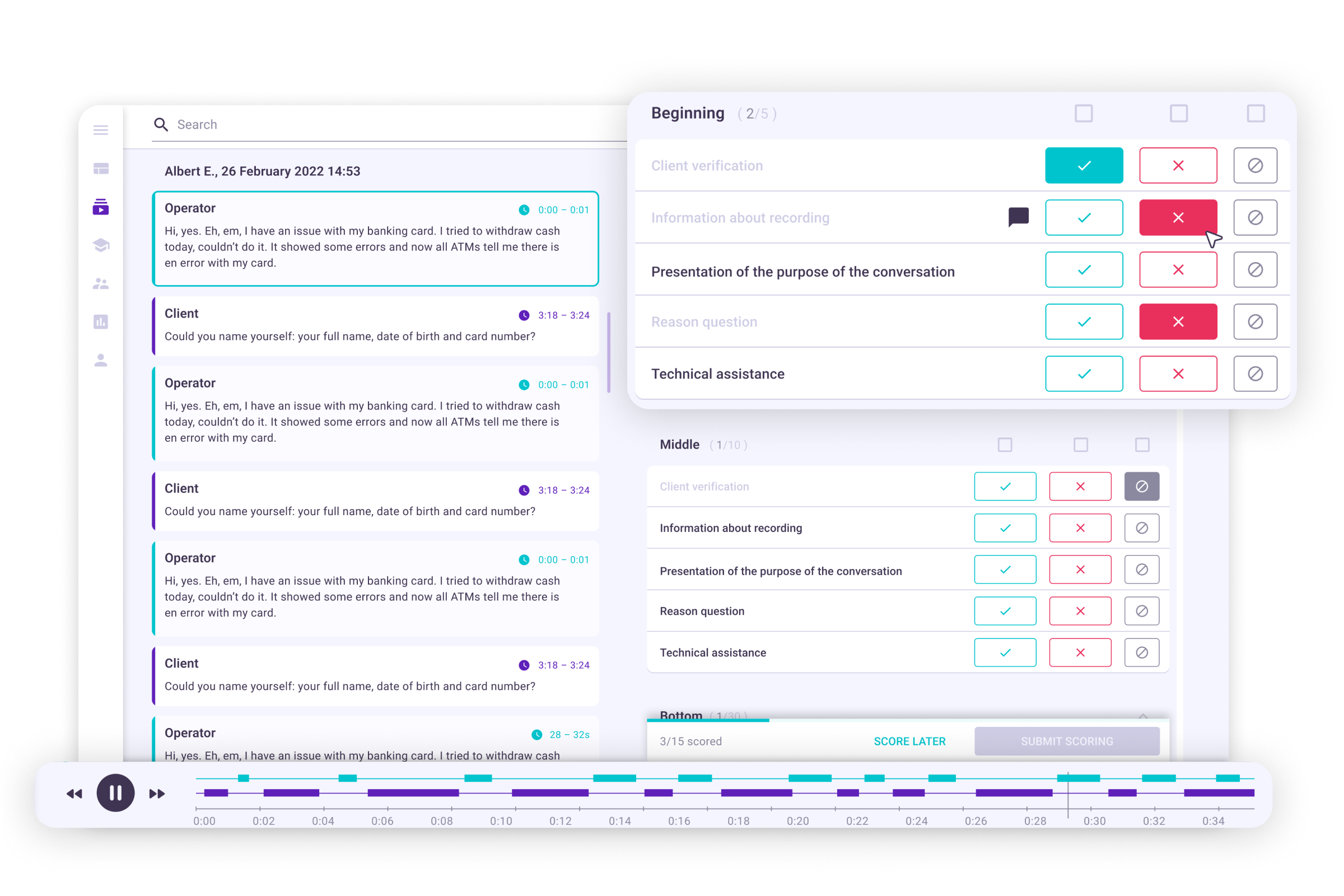
The review screen: transcript on the left, the scorecard on the right, one click per point. Quality management →
Switching from CallMiner to Ender Turing
- What stays: your phone system and your recordings. Ender Turing receives them through an app or connector where one exists, the browser extension, the API, SFTP or upload.
- What changes: every call is scored on your own scorecard, with the accuracy against your reviewers shown for every point, and EnderGPT answers questions across all your conversations, in any language.
- What it costs: CallMiner prices bundled packages by users or interaction volume, from midsize teams of more than 60 agents, and offers pilots in certain cases (CallMiner FAQ, checked October 13, 2026). Ender Turing is free for up to 5 agents, and Team is $39 per agent a month.
- How to switch without risk: score the same calls in both, compare with your reviewers point by point, and move when the numbers agree.
Cost and rollout cautions to avoid surprises
For Verint sentiment analysis pricing and any enterprise quote, costs vary based on scope, integrations, and enablement. If you're buying the best sentiment analysis software for a contact center, validate time-to-value, integration limits, and who will maintain categories and coaching playbooks.
Armed with this comparative analysis, contact center leaders can make an informed decision to elevate their customer experience strategies.