How Contact Centers Actually Measure Customer Sentiment and Satisfaction to Prove ROI
Here's something most executives don't realize: your contact center is sitting on a goldmine of customer intelligence, but you're probably treating it like a cost center instead of the strategic asset it could be. A Voice of the Customer program changes that equation completely.
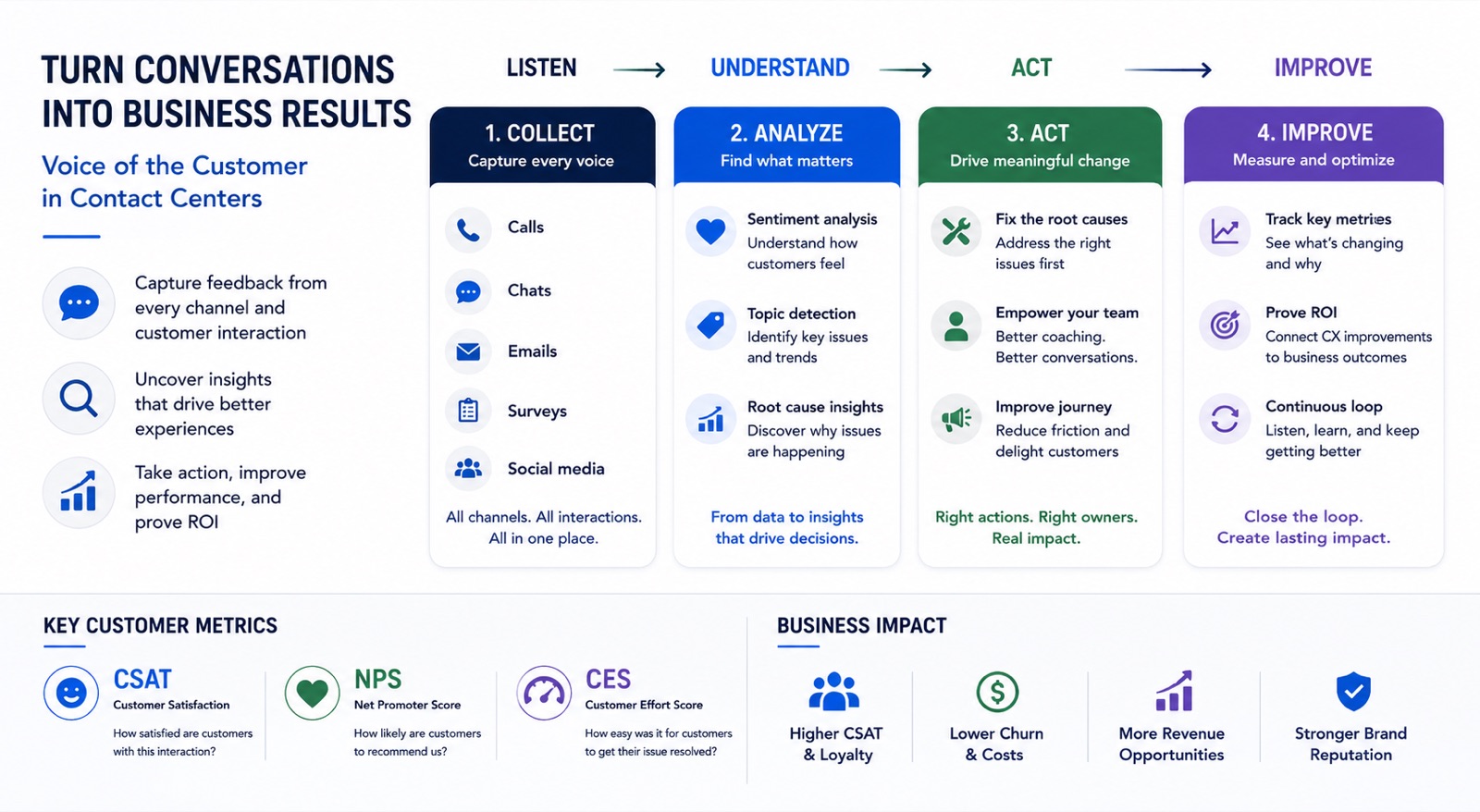
Think of VoC as your systematic approach to capturing, analyzing, and actually acting on customer feedback from real interactions—calls, chats, emails, surveys, the whole nine yards. The endgame? Converting those messy, unstructured conversations into concrete decisions that slash CX problems, boost performance, and deliver measurable business results. When you nail this, your contact center stops being a necessary evil and becomes the nerve center that drives product decisions, policy changes, and revenue priorities.
Understanding Voice of the Customer Programs in Contact Centers
Voice of the Customer isn't just another corporate buzzword—it's your operating system for listening at scale. In contact centers, VoC captures both the obvious stuff (what customers actually say) and the subtle signals hiding in their behavior (repeat calls, escalations, those telling moments when sentiment shifts mid-conversation).

And no, VoC isn't some one-and-done survey. It's a continuous feedback loop that connects multiple data streams.
Why VoC becomes critical for modern contact centers
Your contact center agents hear the same customer complaints over and over again across every channel. Without VoC, you're flying blind—relying on outdated metrics, random escalations that bubble up, and manual processes that take forever to produce actionable insights.
With VoC? You shift from "handling tickets" to creating genuine customer wins. You'll spot systemic problems before they explode, eliminate digital friction that's driving customers crazy, and prioritize fixes that customers will actually notice. The catch? You need solid governance. Without clear ownership, all those insights just become background noise.
How VoC improves agent performance and drives ROI
VoC transforms coaching by grounding quality monitoring in actual patterns instead of isolated QA scores. Your teams can focus coaching efforts on the specific moments that move customer satisfaction—things like clarity, empathy, and resolution momentum.
When you connect sentiment tracking to real outcomes, your contact center becomes a revenue driver. Better retention cuts churn, fewer repeat contacts reduce operational costs, and timely insights reveal upsell opportunities right when customers are most receptive.
Building an Effective VoC Framework for Your Contact Center
A VoC framework is basically your operating system for converting customer conversations into decisions. It spells out what you collect, how you analyze it, who takes action, and how you prove continuous improvement over time. Skip the framework, and you'll end up accumulating tons of feedback while missing the root causes of CX problems and the business wins tied to fixing them.
Define the VoC framework and the outcomes you need
Deploy a VoC framework when leadership needs confidence that customer problems won't just get heard—they'll get resolved and prevented. Your framework should explicitly connect customer journey friction to measurable outcomes like fewer repeat contacts, higher retention, and clearer coaching opportunities.
Here's a trade-off to plan for: higher coverage (analyzing more interactions) often reduces manual QA depth unless you've got automation or a solid sampling strategy defined.
Implement the four phases with a repeatable, numbered process
A practical VoC framework in contact centers typically runs through four phases: Collect, Analyze, Act, Monitor.
Capture voice and digital conversations (calls, chats, emails) plus survey responses. Tag interactions by customer journey stage to prevent "data without context" syndrome.
Use conversation intelligence to classify themes, sentiment signals, and escalation drivers. When possible, apply predictive modeling to prioritize which patterns correlate with churn risk, repeat contacts, or failed digital journeys (interpretation, not a crystal ball).
Convert themes into two action queues: quick fixes (policy clarification, agent guidance) and backlog items for cross-functional teams (product bugs, billing workflows). This surfaces systemic improvement opportunities, not just individual agent mistakes.
Track whether your fix actually changes outcomes in subsequent contacts—not just whether someone closed a ticket.
Practical constraint: taxonomy drift happens fast. Assign one owner to maintain issue categories so "login issue" and "access problem" don't split your reporting.
Operationalize closed-loop feedback with contact center software
Closed-loop feedback means every high-value signal gets routed to an owner, resolved, and verified with evidence from later customer interactions.
Workflow hint: QA often owns analysis quality, while Operations owns action completion. Product and Digital teams should own fixes tied to digital friction and inconsistency.
Comparing CSAT NPS and Other Customer Satisfaction Metrics
Customer feedback can look "good" while churn risk quietly climbs, because each metric answers a different question. In contact centers, CSAT, NPS, and CES work best as a portfolio: one for immediate interaction quality, one for relationship strength, and one for effort and friction across the customer journey. Used together, these metrics connect day-to-day customer issues to retention and lifetime value.
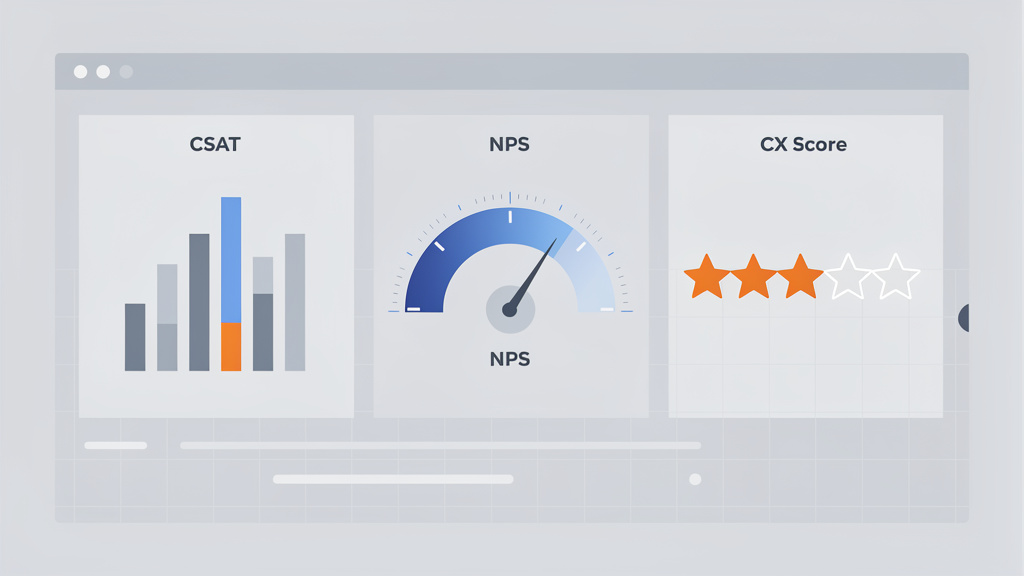
CSAT vs NPS vs CES definitions calculations and best use cases
CSAT measures transactional satisfaction. It captures how satisfied a customer feels about a specific interaction (like "How satisfied were you with this support experience?"). Calculate CSAT as the percentage of positive responses (your chosen "satisfied" and "very satisfied" options) out of total responses. Use CSAT when you need fast quality monitoring, coaching opportunities, and proof that process changes improved front-line customer wins.
NPS measures relational loyalty. It gauges a customer's likelihood to recommend your company, making it a practical proxy for the relationship behind customer satisfaction and loyalty. Use NPS when leadership needs a stable trendline connecting support performance to business gains, renewal health, and overall brand confidence. Avoid using NPS as your only contact center KPI—it's less sensitive to single interaction changes.
CES measures effort and friction. Customer Effort Score captures how easy it was for a customer to get an issue resolved (often framed as ease or effort). CES fits best for diagnosing digital friction, handoffs, and repeat contact drivers. Use CES when you're prioritizing systemic improvement opportunities across channels, not just agent behavior.
Featured snippet calculation for NPS in a contact center
How do you calculate NPS? NPS equals the percentage of Promoters minus the percentage of Detractors.
- Promoters: 9 to 10
- Passives: 7 to 8
- Detractors: 0 to 6
Workflow hint: CX leaders typically own NPS measurement strategy, while contact center operations teams own CSAT and CES instrumentation and closed-loop follow-up.
Comparison table for choosing the right metric
| Metric | Measures | Best for contact center scenarios | Primary limitation |
|---|---|---|---|
| CSAT | Satisfaction with a specific interaction | Post-call or post-chat QA, agent coaching, validating policy changes | Can miss broader relationship risk |
| NPS | Relationship strength and recommendation intent | Executive reporting, renewal risk trending, linking support to customer retention | Less actionable at individual interaction level |
| CES | Effort to resolve an issue | Root cause analysis, reducing repeat contacts, improving self-service and handoffs | Requires consistent question wording to compare over time |
Practical constraint: keep survey questions stable for at least a full reporting cycle, or trends become impossible to trust.
Customer satisfaction benchmarking for contact centers
Benchmarks matter because "good" scores mean nothing without context. Use two benchmark types: internal and competitive.
Where to find benchmarking data: many SaaS organizations use a mix of industry surveys, analyst reports, and peer benchmarks from customer communities. When no credible competitive benchmark exists, treat internal benchmarks as your decision anchor and focus on movement tied to specific CX issues.
Avoiding Common Pitfalls in Customer Sentiment Tracking
Customer sentiment tracking fails when teams treat sentiment as a single score instead of a decision system tied to outcomes. Accurate tracking requires consistent definitions, unbiased coverage across the customer journey, and a clear path from insight to action that improves customer satisfaction metrics—not just dashboards. The practical goal? Surface root-cause CX issues early, then prove business gains through continuous improvement.
Pitfall One is measuring feelings without a clear business question
Sentiment can reflect tone, frustration, or urgency, but those signals only matter when mapped to a specific decision. A common failure mode? Launching an NPS measurement strategy that isn't aligned to what the contact center can actually change—things like response time, transfer rates, or policy friction.
Use this constraint: if a sentiment insight doesn't change a workflow, it won't create customer wins. Treat your contact center as an impact center, not a reporting function.
Pitfall Two is channel bias and missed digital friction
Many programs over-weight calls and under-sample chat, email, and in-product messages, where digital friction often shows up first. Teams pursuing digital-first strategies should validate that sentiment coverage reflects the real channel mix, not the legacy organization chart.
Trade-off to manage: broad coverage improves detection of customer issues, but increases taxonomy and QA workload. Assign clear ownership—QA for labeling rules, Operations for action routing, and CX for benchmarking.
Pitfall Three is insight without action and no accountability loop
Sentiment tracking stalls when findings get shared as summaries instead of operational tasks. Build a closed-loop feedback process that connects insights to fixes, and fixes back to measured outcomes.
Using AI and Automation for Deeper VoC Insights
AI and automation help your team convert high-volume, unstructured customer feedback into decisions you can execute during the workweek—not after the quarter ends. The practical outcome? Faster root-cause detection for CX issues, tighter coaching loops for frontline teams, and clearer links between customer satisfaction metrics and business gains. In many SaaS contact centers, this makes the difference between a reporting function and an impact center.
Use AI to analyze unstructured feedback at contact center scale
Unstructured data is customer feedback that doesn't arrive as a neat score—call recordings, chat transcripts, email threads, and open-text survey comments. AI processes this volume consistently, so you're not forced into manual sampling that creates blind spots.
Trade-off to plan for: automation increases coverage, but quality depends on clean categories, consistent definitions, and regular reviews by CX and QA owners.
Apply NLP and sentiment analysis to convert language into measurable signals
Natural Language Processing (NLP) is how AI interprets text and speech as structured information. Sentiment analysis estimates emotional tone in customer language, then connects that tone to intents, topics, and outcomes like escalations or repeat contacts.
Practical constraint: sentiment models can misread sarcasm, industry jargon, and multilingual conversations. Treat sentiment as a directional signal, then confirm priorities with examples and agent feedback before changing policy.
Implement real-time insights and coaching with a clear workflow
Quick example: when real-time signals flag repeated confusion about billing steps, supervisors can coach the explanation immediately while operations updates the self-serve flow for continuous improvement.
Frequently Asked Questions About Customer Sentiment and Satisfaction
Decision-makers usually ask the same core questions: what to measure, how to interpret it, and how to tie insights to business outcomes. The goal isn't more dashboards—it's clearer decisions that reduce CX issues, resolve customer issues faster, and show sentiment tracking contact center ROI through measurable business gains and customer wins.
Voice of the Customer programs and contact center sentiment basics
Q: What is a Voice of the Customer program in a contact center? A: A Voice of the Customer program is the operating practice for capturing feedback from voice and digital conversations and turning that feedback into actions. In a contact center, VoC scope typically spans the full customer journey, from first contact to escalation, renewal, or churn risk signals. The practical outcome? Continuous improvement you can assign, track, and validate.
Q: What counts as customer sentiment analysis? A: Customer sentiment analysis classifies emotional tone and intent in customer interactions so teams can identify friction, satisfaction, and emerging risks. In practice, many teams use AI to summarize themes, detect repeat complaints, and flag moments that predict dissatisfaction. Trade-off: faster detection usually requires tighter governance on definitions, labeling, and QA checks to avoid inconsistent scoring.
CSAT, NPS, and satisfaction metrics decision guidance
Q: What's the difference between CSAT and NPS for a contact center? A: CSAT measures satisfaction with a specific interaction, while NPS reflects relationship loyalty at a broader level. Use CSAT to manage frontline performance and queue-level quality monitoring. Use NPS to test whether the experience customers remember matches your strategic objectives.
Q: Which customer satisfaction metrics should a SaaS contact center prioritize? A: Prioritize a small portfolio of customer satisfaction metrics that map to decisions. For example, one metric for interaction quality, one for effort and friction, and one for longer-term retention risk. Workflow hint: assign ownership—operations owns instrumentation and QA, while CX leadership owns actions and follow-through.
Customer satisfaction benchmarking for contact center decision makers
Q: Why benchmark satisfaction metrics at all? A: Benchmarking prevents false confidence. Internal benchmarks show whether changes improve performance over time. Competitive benchmarks indicate whether customer expectations rise faster than your operation. Where to find benchmarking data: your historical baselines, peer comparisons from customer advisory groups, aggregated ranges from customer satisfaction benchmarking contact center surveys, and benchmarks shared inside contact center software and VoC framework contact center software reporting. Treat benchmarks as directional, because collection methods often differ.
Key Takeaways for Driving Contact Center ROI with VoC
A strategic Voice of the Customer program turns day-to-day feedback into measurable outcomes. When VoC operates as a decision system, your contact center becomes an impact center that prevents repeat contacts, reduces CX issues across the customer journey, and documents business gains in language finance teams accept.
Where AI actually helps
AI matters when volume and speed exceed human review. AI helps teams move from delayed sampling to near real-time insight, so managers can spot systemic improvement opportunities early and prioritize fixes that change outcomes, not just dashboards.
Practical constraints and trade-offs to plan for
Expect a trade-off between speed and precision in early rollouts: faster insights can be noisier until taxonomies and workflows stabilize. Also, avoid treating sentiment as a final verdict. Use sentiment signals to trigger investigation, then confirm root cause with context from conversations and frontline feedback.
If you want a step-by-step implementation aid, use an internal VoC playbook or a resource guide that documents owners, thresholds, and decision timelines.