Picture a contact center running a rigorous quarterly performance review process. Each agent gets a formal evaluation built on QA scores, attendance, adherence, and a manager narrative. The process is documented, fair on paper, and universally disliked. Ask the agents what they think of it, and you may hear, in one form or another, that it doesn’t describe them.
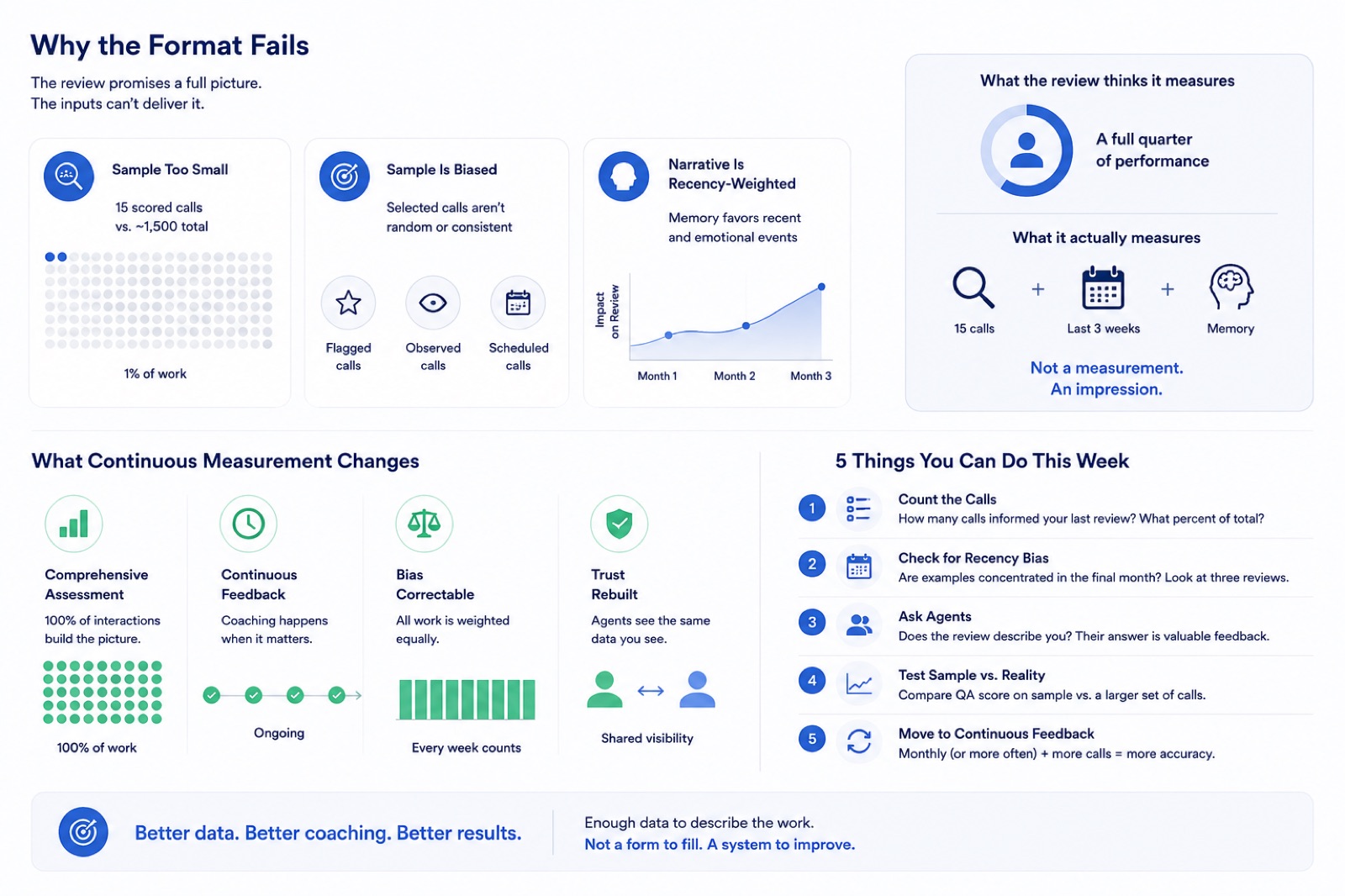
Look at what the reviews are actually built on. The QA component draws on five scored calls per month — fifteen calls per quarter, out of roughly 1,500 the agent handles. The manager narrative draws heavily on recent events, because that’s what managers remember. The review that is supposed to assess a quarter of work is actually assessing fifteen calls and the last three weeks. The agents are right. It doesn’t describe them, because it was never built from enough data to describe anyone.
This is the structural flaw in nearly every contact center performance review. The format implies comprehensive assessment. The inputs are a tiny, non-random sample plus recency bias. The gap between what the review claims to measure and what it actually measures is enormous, and everyone involved can feel it even when they can’t articulate it.
Why the Format Fails
The quarterly review has three input problems that no amount of process rigor can fix.
The sample is too small. Fifteen scored calls cannot represent fifteen hundred. Whatever pattern the review identifies might be real or might be sampling noise, and there’s no way to tell which. An agent who had two bad calls among their fifteen reviewed looks worse than an agent whose two bad calls happened to fall outside the sample, even if their true performance is identical.
The sample is biased. Calls selected for QA aren’t random — they’re often the ones agents knew were being monitored, or the ones a manager flagged, or the ones that fit the QA schedule. Each selection method introduces bias that the review then treats as representative.
The narrative is recency-weighted. Human memory privileges recent and emotional events. A manager writing a quarterly narrative remembers last week’s escalation and last month’s win far more vividly than the steady competent work of weeks five through eight. The narrative describes the memorable quarter, not the actual one.
What Continuous Measurement Changes
When agent management runs on 100% of interactions instead of a quarterly sample, the review changes from an event to a reflection of an ongoing record.
The assessment becomes comprehensive. Every call contributes to the picture. The agent’s actual patterns — across all their work, not fifteen calls — are what the review reflects. Sampling noise disappears because there’s no sample.
The feedback becomes continuous. Instead of accumulating observations for a quarterly download, coaching happens in near-real-time as patterns emerge. The quarterly review stops being the moment the agent learns how they’re doing and becomes a summary of conversations that have been happening all along.
The bias becomes correctable. Recency bias is a human cognitive limitation. A system that weighs all of an agent’s work equally doesn’t have it. Managers can still add human judgment and context, but the foundation is comprehensive rather than memory-dependent.
The Trust Dimension
The most underrated cost of bad performance reviews is what they do to the relationship between agents and the measurement system.
When agents experience reviews as inaccurate — built on too few calls, distorted by recency, disconnected from their actual work — they stop trusting the entire performance apparatus. The QA scores lose credibility. The coaching loses authority. The whole system gets treated as a bureaucratic ritual to be survived rather than a genuine signal to act on.
Comprehensive measurement rebuilds this trust, but only if it’s transparent. Agents who can see their own performance data continuously, understand how it’s calculated, and verify it against their own experience of their work, engage with it very differently than agents who receive a quarterly verdict from a black box. The shift from sampling to full coverage matters most when the agent can see the same data the manager sees.
Five Things You Can Do This Week
1. Count the calls behind your last review cycle. How many calls per agent actually informed the QA component? Divide by total calls handled. The coverage will be lower than the review’s authority implies.
2. Test for recency bias in manager narratives. Read three recent reviews. Note how many specific examples come from the final month versus the first two. The skew will be visible.
3. Ask agents whether their review describes them. The answer tells you whether your process has credibility. Disagreement is a signal the inputs are inadequate.
4. Separate signal from sampling noise. For one agent, compare their QA score on the reviewed sample against their score across a much larger set of calls. If the numbers differ materially, your sample isn’t representative.
5. Move toward continuous feedback. Even a monthly version of the review, built on more calls, beats a quarterly verdict built on fifteen. Frequency and coverage both improve accuracy.
A performance review built on fifteen calls and three weeks of memory isn’t a measurement. It’s an impression with a form attached. The agents who say it doesn’t describe them are giving you accurate feedback about your process, and the fix isn’t a better form — it’s enough data to actually describe the work.