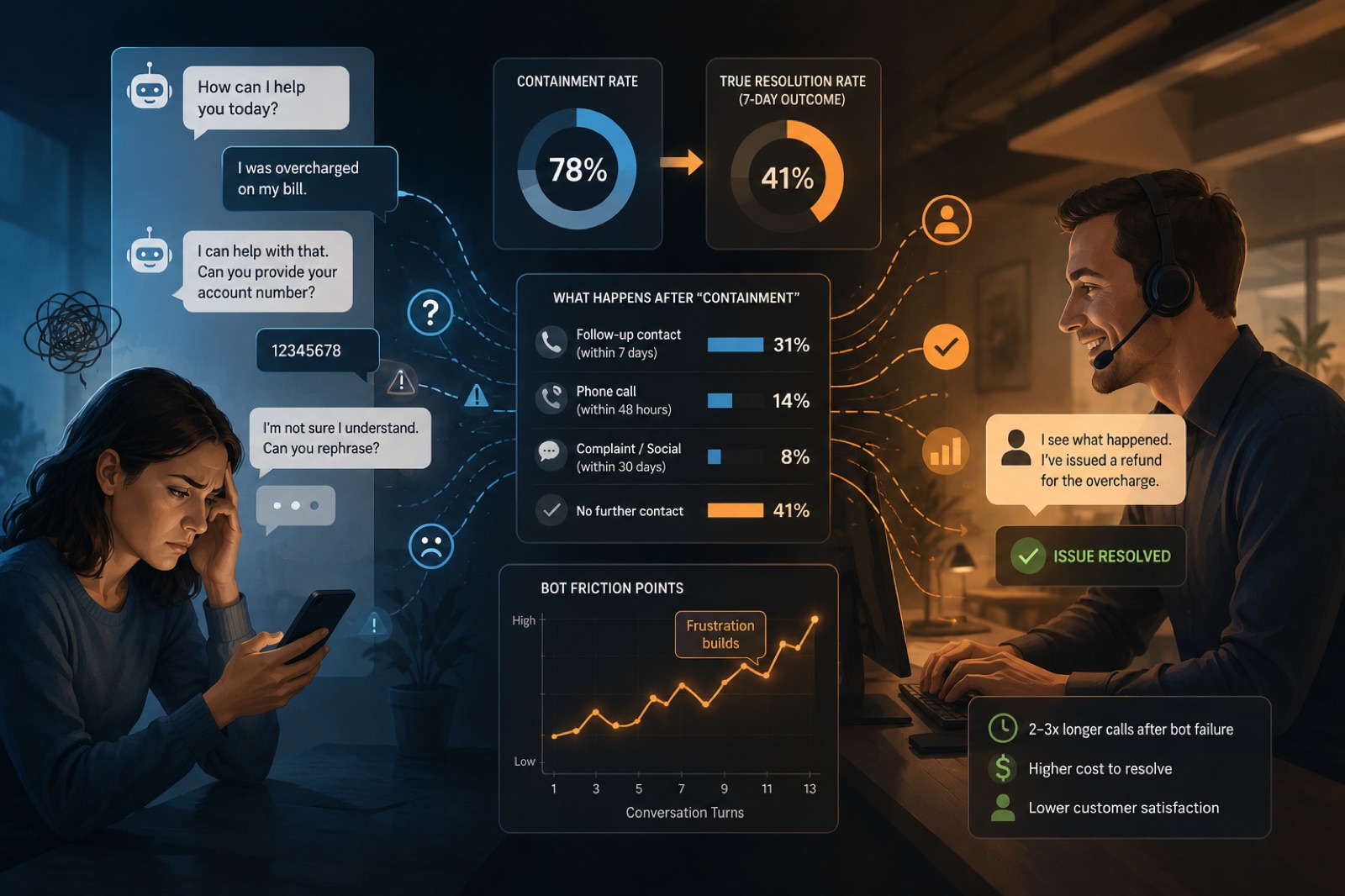
Picture a consumer brand that launches what its vendor describes as an “AI customer service agent.” The marketing positions it as autonomous problem-solving. The demo shows it handling returns end-to-end. The pricing reflects an enterprise commitment. Six months later, the implementation team is frustrated. The “agent” is effectively an elaborate decision tree wrapped in conversational language. It handles simple cases well, escalates nearly everything complex, and the resolution work the marketing promised is still being done by humans.
The category “AI agent” has become marketing shorthand applied to dramatically different capabilities — from sophisticated rules engines with chat interfaces all the way to genuinely autonomous systems with tool-use and reasoning. The customer-facing labels are nearly identical. The underlying capabilities are not.
This matters because the operational implications of deploying a real agentic system are completely different from deploying a sophisticated chatbot. Conflating the two — which most vendor pitches do — leads to procurement decisions, implementation plans, and governance frameworks that don’t match what’s actually being deployed.
What Distinguishes a Real Agent
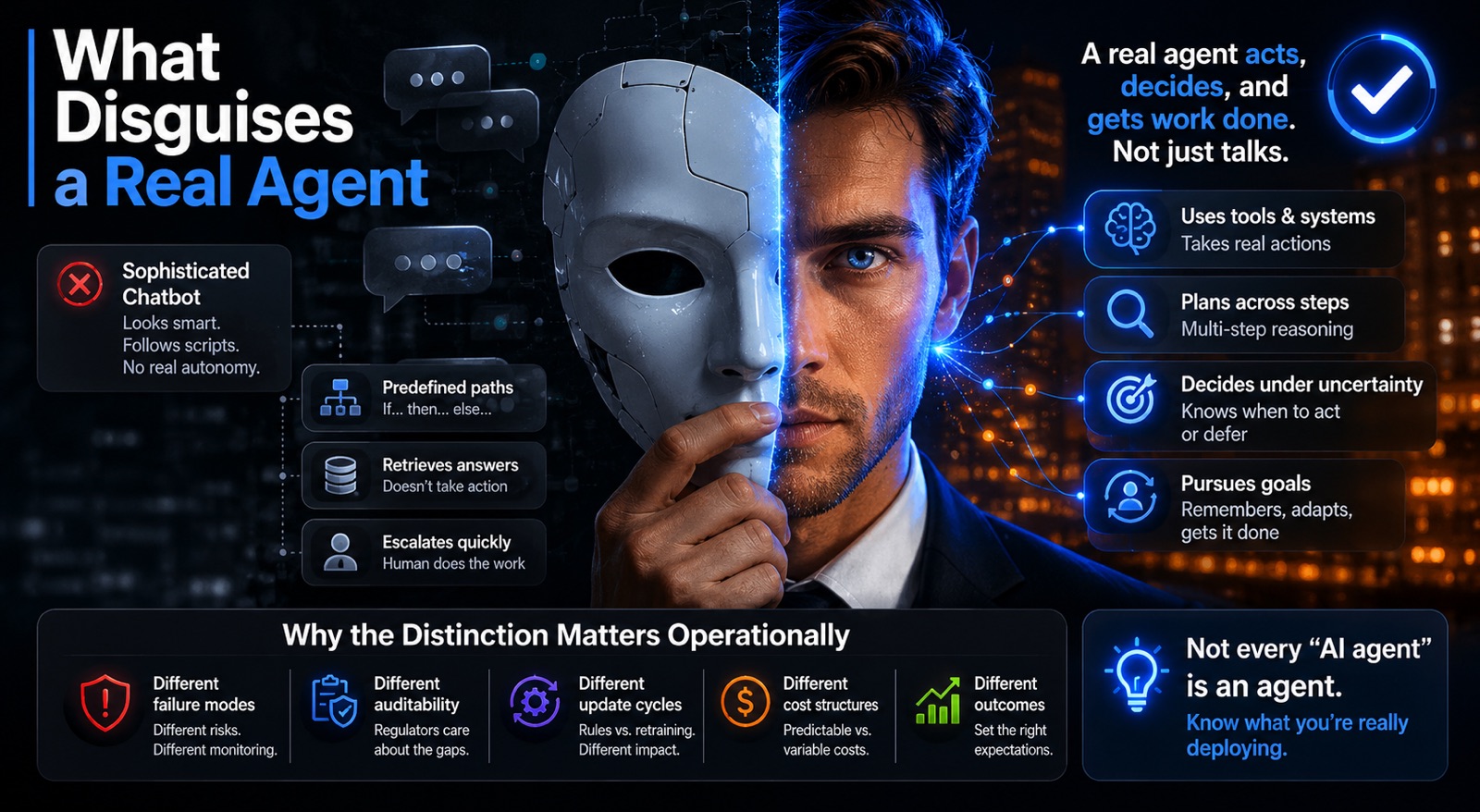
The technical literature on agentic AI converges on a few characteristics that separate genuine agents from advanced rule-based systems.
Tool use. Real agents can take actions in external systems — query databases, update records, trigger workflows — not just generate text responses. A system that can only talk isn’t an agent in the meaningful sense.
Planning across multiple steps. An agent can decompose a complex task into a sequence of sub-tasks, execute them, and adapt the plan based on intermediate results. A system that handles one turn at a time, without state across turns, isn’t agentic.
Decision-making under uncertainty. Agents can reason about confidence in their own actions, decide when to act and when to defer, and choose between multiple possible approaches. A system that always takes the highest-confidence next action isn’t reasoning, it’s executing.
Goal persistence. Agents pursue an objective across multiple interactions, maintaining state and adapting strategy. A system that resets after each turn isn’t pursuing anything.
By these criteria, most “AI agents” being marketed to contact centers are not, in fact, agents. They’re sophisticated conversational interfaces over rules engines or retrieval systems. This isn’t a criticism — sophisticated chatbots have real value. It’s a clarification that affects how they should be procured, deployed, and governed.
Why the Distinction Matters Operationally
Genuine agentic systems and sophisticated chatbots behave differently in production, and the operational handling needs to match.
Failure modes differ. A rules-based system fails when it encounters a case it wasn’t designed for — usually predictably, often gracefully. An agentic system can fail in less predictable ways because it’s making decisions across longer chains. The QA and monitoring requirements are different.
Auditability differs. A rules-based system has traceable decision paths. An agentic system’s behavior depends on model state, tool-call sequences, and context that may not be fully logged by default. Regulatory environments care about this distinction.
Update cycles differ. A rules-based system gets updated by changing rules. An agentic system gets updated by retraining or by prompt engineering, with corresponding effects on behavior that can be subtle and hard to test comprehensively.
Cost structures differ. Rules-based systems have predictable per-interaction cost. Agentic systems have variable cost depending on reasoning depth and tool calls, which complicates capacity planning.
Procurement decisions made without these distinctions clear in mind frequently produce mismatched governance — agentic systems treated like rules engines (insufficient oversight) or rules engines treated like agents (over-engineered governance).
What “Real” Agentic AI Currently Does Well in Contact Centers
Where genuine agentic systems are starting to deliver value, the use cases tend to share characteristics.
Multi-step transactional work. Account changes, returns processing, scheduling — tasks that require multiple system interactions and some judgment about which path to take. Agentic systems can compress these into single customer interactions where rules-based systems would require multiple escalations.
Investigation and resolution. Looking up information across multiple systems to diagnose an issue, then taking the resolution action. Rules-based systems can do simple versions of this; agentic systems handle the variations that rules engines need an explicit path for.
Personalized engagement. Tailoring approach to the customer’s history, current state, and apparent preference. Agentic systems can make this judgment in real time; rules engines need pre-built rules for each variation.
Handoff with full context. When the agent can’t or shouldn’t complete a task, transferring to a human with substantive context preserved. This is one of the highest-value applications and one of the worst-implemented across current deployments.
What Most Current Deployments Are Actually Getting
The marketing of “AI agents” has outrun the deployments significantly. Most contact center “AI agent” deployments in production today are doing one of these things well, not the full agentic capability.
Many are sophisticated chatbots with conversational polish — useful, but conceptually closer to evolved IVR than to autonomous agents.
Some are retrieval-augmented systems that surface relevant information and let humans act on it — valuable, but not autonomous problem-solving.
A smaller number are doing genuine multi-step transactional work in narrow domains — the actual frontier of useful agentic deployment.
Knowing which one you have determines what you can realistically expect, what governance you need, and what claims you can defensibly make about the deployment.
Five Things You Can Do This Week
1. Test your current “AI agent” against the four criteria. Tool use, multi-step planning, uncertainty reasoning, goal persistence. The result will clarify what you actually have.
2. Audit what your deployment actually resolves vs. escalates. True resolution rate, not chatbot containment. The number will inform what you should expect operationally.
3. Map your governance to what you actually have. If your “agent” is a sophisticated rules engine, your governance can be lighter. If it’s genuinely agentic, your governance needs to be heavier.
4. Listen to 20 customer-facing interactions. Are they conversations or are they decision-tree navigation in friendly language? The customer can usually tell.
5. Define what “real success” looks like for your deployment. Not vendor metrics — operational outcomes. The clearer this is, the easier the next 12 months become.
The “AI agent” category currently spans capabilities that differ by orders of magnitude. The marketing flattens this. Procurement decisions made on flattened marketing produce deployments that don’t match what was promised, governance that doesn’t match what was deployed, and customer experiences that don’t match what was sold. The first step in getting value from agentic AI is being precise about what you actually have — which is harder than it sounds when the vendor pitches don’t differentiate.