Picture a regional bank that launches an AI voice agent to handle routine balance inquiries, payment confirmations, and basic account questions. The deployment is treated as a phone-channel extension of its existing IVR — same regulatory framework, same QA approach (essentially none), same launch criteria (the bot answered correctly in user acceptance testing). Six months later, the bot is handling about 14% of inbound calls.
Then a customer receives what they describe as confusing and contradictory information from the AI agent about their loan. The customer ends the call frustrated, escalates to a human agent the following day, and lodges a formal complaint. The bank’s compliance team wants to understand what happened.
The transcript shows three things the AI agent said that, taken together, were misleading about the customer’s payment options — not lies, exactly, but a combination of partial information and confident phrasing that would cause a reasonable customer to misunderstand their position. Any of the bank’s human agents would be QA-flagged for any one of those statements. The AI agent said all three to this customer, and no one reviewed the conversation until the customer complained.
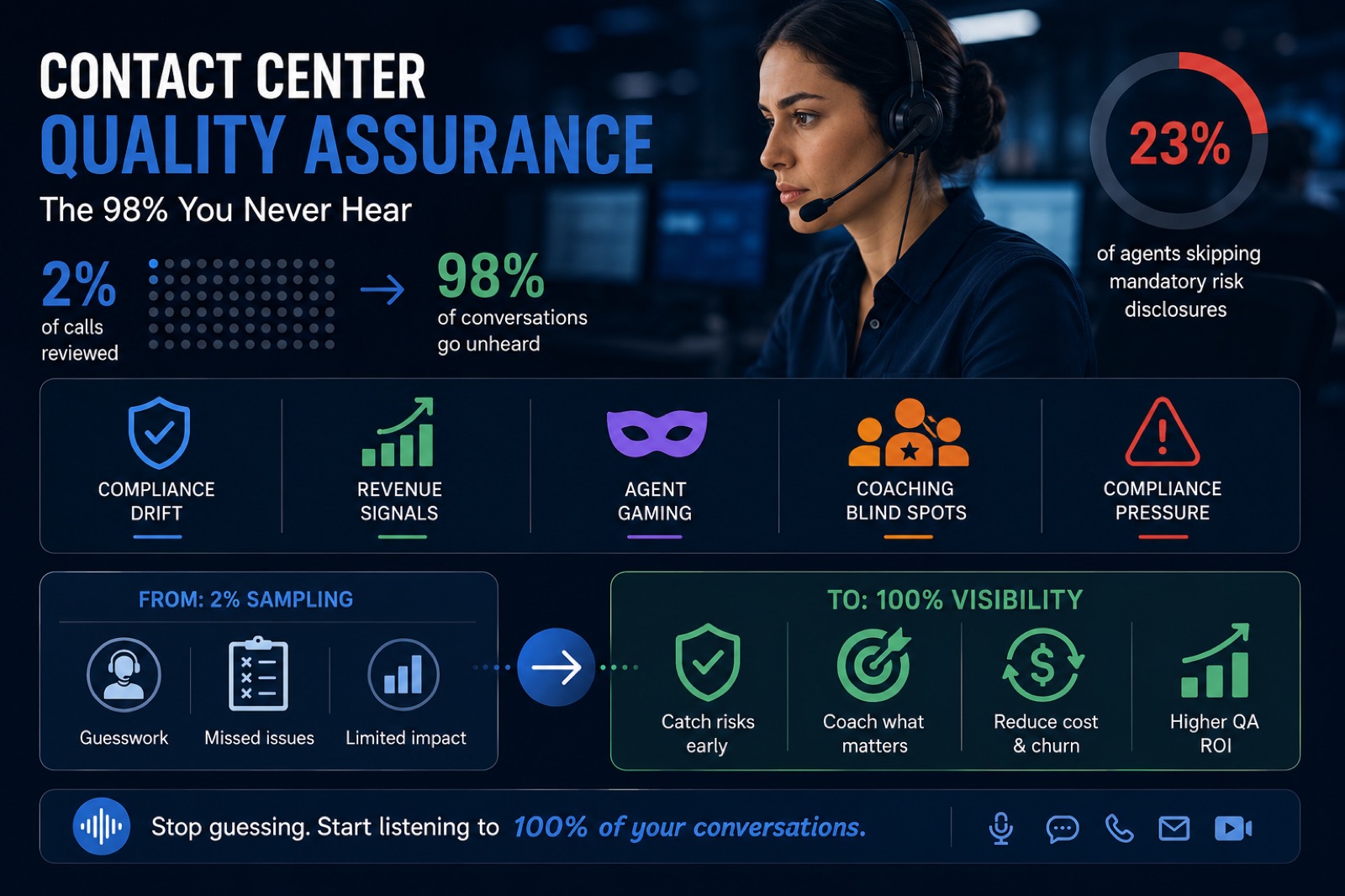
This is the situation modern contact centers are walking into with AI voice agents, and almost no one has built the supervision infrastructure that the situation requires. The technology has outpaced the governance, and the governance gap is widening as deployment accelerates.
What Makes AI Voice Agents Different From IVR
The temptation is to treat AI voice agents as smarter IVR. They’re not. The differences matter substantively.
IVR is deterministic. It plays pre-recorded prompts in a tree structure. Every utterance has been reviewed and approved. The customer hears exactly what the company intended them to hear, in the order intended. Compliance review can be done once, at design time, and trusted to apply at runtime.
AI voice agents generate responses dynamically. The exact words spoken to a given customer have not been pre-approved. They’re produced by a model interpreting the conversation in real time and generating language that fits the context. This generation is influenced by training data, system prompts, conversation history, and the specific phrasing the customer used. The compliance posture that worked for IVR doesn’t extend to AI voice agents, because the assumption it depended on — pre-approved language — no longer holds.
This shift is structural and most deployments haven’t recognized it yet. The result is AI voice agents operating in regulated industries with effectively no per-conversation oversight, on the assumption that they’re an evolution of IVR. They’re not. They need different governance.
The Five Questions That Should Govern Voice AI Deployment
We covered the broader version of this in AI agent testing: who QAs your contact center bots. The specific voice-agent application sharpens the questions.
1. How do you know what the agent actually said? Logging the conversation isn’t enough. Someone or something has to be reviewing what was said against what should have been said. Without that review loop, your only signal that something went wrong is a customer complaint, which is too late and too narrow.
2. How do you detect compliance failures? A misstatement about fees, a misleading description of a product, a missed required disclosure — these need to be caught by systematic review, not by customer complaints. This requires running compliance criteria against the actual conversation content, not against the training documentation.
3. How do you handle conversations that go wrong mid-call? When the AI agent encounters a situation it isn’t equipped for, the failure mode matters. Does it gracefully transfer to a human with full context? Does it confidently invent an answer? Does it loop the customer through circular responses? Each failure mode has different downstream costs.
4. How do you measure customer outcome, not bot containment? The bot containment metric — the percentage of conversations completed without human transfer — measures the wrong thing. The right question is whether the customer’s issue was actually resolved, whether they had to follow up, and whether their experience would predict retention.
5. What’s your kill switch? When the AI agent is producing systematically poor outcomes — wrong information, regulatory violations, customer dissatisfaction — how quickly can you take it offline? In legacy IVR, this is straightforward. In AI voice deployments, the answer is often “we’d have to figure it out,” which means there’s no real kill switch.
The Regulatory Acceleration
The regulatory environment is moving faster on AI voice agents than most contact center operators have noticed.
The EU AI Act requires that people are told when they are talking to an AI system, a rule in effect since August 2026. AI systems it classes as high-risk, such as those that assess creditworthiness or price life and health insurance, carry further oversight and monitoring duties from 2 December 2027. Breaking either rule can cost up to €15 million or 3% of worldwide turnover.
The CFPB has signaled increasing scrutiny of automated customer interaction in consumer finance, with explicit reference to the limitations of bot-based responses and the obligation to ensure substantive equivalence between human and automated channels.
AI voice agents are losing the regulatory grace period in which they were treated as enhanced IVR.
What Realistic Voice AI Governance Looks Like
Contact centers serious about voice AI deployment are converging on a four-part governance approach.
Sampling-plus-comprehensive review. A subset of conversations gets deep human review. A larger subset — ideally all — gets automated review against compliance and quality criteria. The combination catches what either alone would miss.
Continuous evaluation against ground truth. Periodic blind tests, where the AI agent’s responses are evaluated against expert-defined correct answers. This catches drift between the model’s behavior and the policies it’s supposed to reflect.
Human-in-the-loop for high-stakes interactions. Conversations involving certain topics (account closure, financial advice, vulnerable-customer situations) get routed to humans or get human review of the AI’s response before it goes to the customer. This is operationally heavier but it’s what regulatory expectations are moving toward.
Outcome measurement. The bot’s actual effect on customer experience and outcomes is measured continuously, not assumed from its design specifications. This data is what proves the deployment is working — or reveals that it isn’t.
Five Things You Can Do This Week
1. Pull 20 random conversations from your AI voice agent. Review them for accuracy, compliance, and customer outcome. The distribution of issues will be more informative than any vendor benchmark.
2. Identify your three highest-stakes conversation topics. What does the AI agent currently handle that, if it went wrong, would create real damage? Those are your priority for additional governance.
3. Audit your detection capability. When the AI agent makes a mistake, how do you find out? If the answer depends on customer complaints, your governance has a gap.
4. Map your AI deployment against current regulatory frameworks. The EU AI Act and the rules of your sector. The gap between where you are and where compliance is heading is the work ahead.
5. Build an explicit kill switch. Documented process, tested at least once, with criteria for when it gets used. The absence of this is one of the most common gaps in current voice AI deployments.
The AI voice agent that’s been deployed into your customer-facing operation isn’t enhanced IVR. It’s a dynamic generation system making consequential statements to customers in regulated contexts, with governance built for static IVR systems. The gap is widening as deployment accelerates and oversight doesn’t. A bank that learns about a loan misstatement only when the customer complains isn’t an aberration. It’s the predictable result of the current state of voice AI governance, and most operators are about to learn the same lesson the same way.