Picture a SaaS company that has built sophisticated deal forecasting. Pipeline weighting by stage, multi-threading scores, engagement signals from email and meetings — all flowing into a forecast the leadership team reviews weekly. The forecast accuracy is middling. Deals that look like sure things slip or die with no warning. Deals that look weak occasionally come in. Sales leadership has grown skeptical of its own forecast.
Analyze twelve months of closed deals — won and lost — against the conversation history of each, and a pattern tends to emerge that the pipeline data doesn’t show. Six-figure deals are often decided in a specific set of conversations. Some are obvious — the demo, the proposal review. Most aren’t — early-discovery conversations with secondary contacts, an objection-handling call that turns a doubting stakeholder, a champion-development conversation that never gets logged. A deal that dies has often skipped several of these decisive conversations entirely. The pipeline stage says it is active. The conversations say it is already over.
The lesson isn’t that a company like that needs more conversations. It’s that the conversations that decide deals aren’t the same as the activities the pipeline tracks. A measurement system built on stage progression and engagement signals systematically misses the moments where deals are actually won or lost.
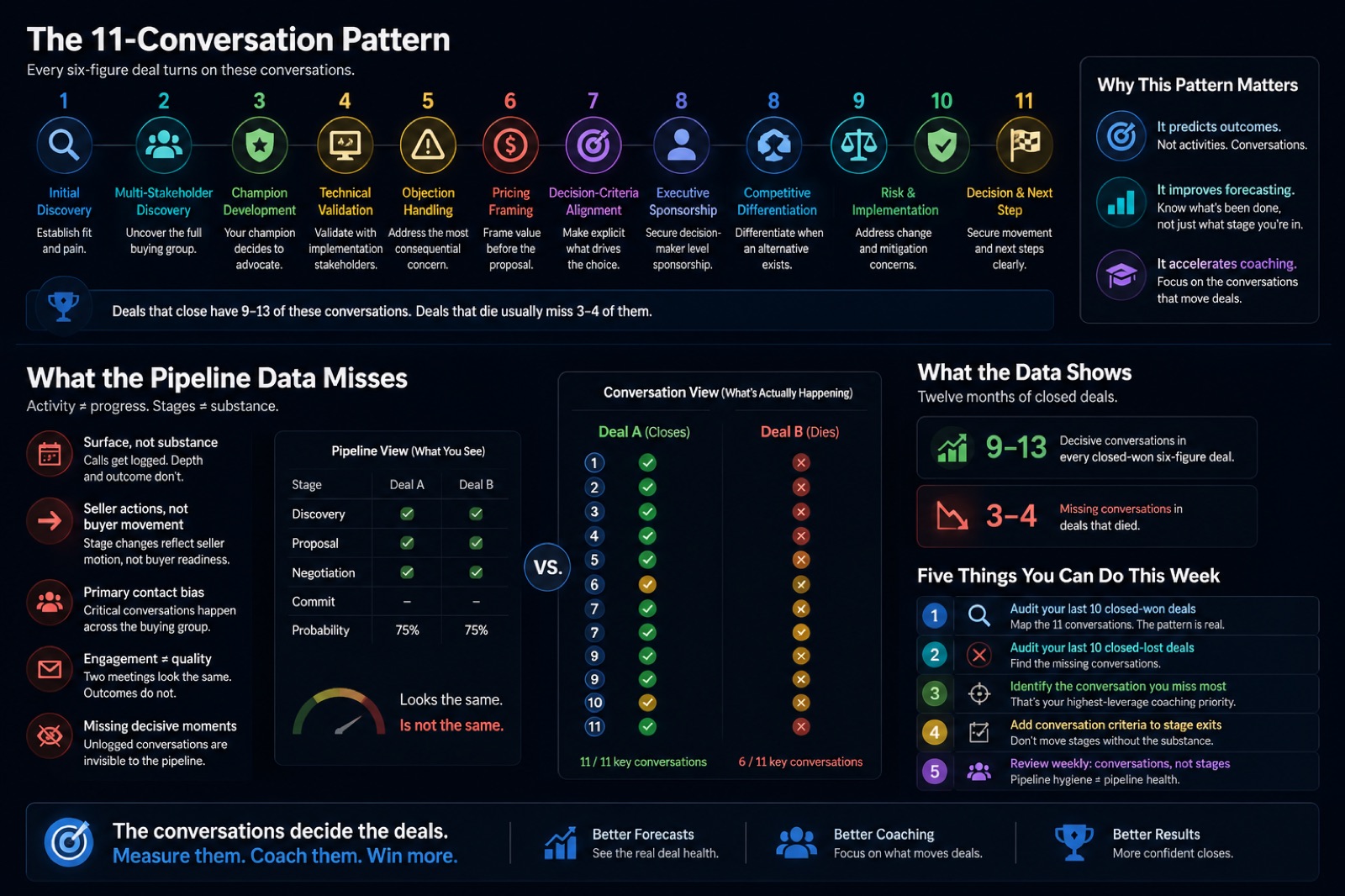
The 11-Conversation Pattern
Enterprise B2B deals tend to turn on a similar small set of conversations, though the timing and order vary.
The set typically includes:
- Initial discovery with the primary contact, establishing fit and pain
- Multi-stakeholder discovery uncovering the full buying group
- Champion development — a conversation where the primary contact decides whether to advocate
- Technical validation with implementation stakeholders
- Objection-handling for the most consequential concern
- Pricing framing before formal proposal
- Decision-criteria alignment — making explicit what will drive the choice
- Executive sponsorship at decision-maker level
- Competitive differentiation when an alternative is in play
- Risk-and-implementation conversation addressing change concerns
- Decision and next-step framing that secures movement
Each of these is decisive in its own right. Missing one is usually recoverable. Missing several can be fatal. Together they work as a checklist for deal health that most pipelines don’t capture.
What the Pipeline Data Misses
Standard pipeline tracking misses these moments for predictable reasons.
Activity logging captures surface, not substance. A call gets logged with duration and contact name. Whether the call was substantive champion development or a polite check-in is invisible to the log. Two deals with identical activity logs can be in completely different states.
Stage progression tracks seller actions, not buyer movements. When a deal moves from “discovery” to “proposal,” it reflects the seller having sent a proposal — not the buyer having reached a decision-readiness state. The two often diverge substantially.
The conversations that matter most aren’t always with the primary contact. Champion development happens with the primary contact. Decision-criteria alignment often happens with a procurement contact. Executive sponsorship requires a different conversation entirely. Pipeline systems often track the primary contact and miss the others.
Engagement signals from email and meetings don’t predict conversation quality. Two meetings get scheduled. One produces substantive movement; the other doesn’t. The engagement signal looks identical. The deal trajectory diverges.
What Conversation Analysis Adds
Conversation analytics applied to deal cycles can identify which of the 11 conversation types have actually occurred, with whom, and to what depth.
This shifts deal review from “what stage is this deal in” to “which decisive conversations have happened and which haven’t.” A deal in proposal stage that’s missed champion development and decision-criteria alignment isn’t a healthy deal. A deal in discovery stage that’s already had executive sponsorship and clear champion commitment is further along than its stage suggests.
The forecast accuracy improvement that comes from this reframe is substantial. Deals that look healthy on activity but missed key conversations get flagged as at-risk. Deals that look weak on activity but had decisive conversations get marked as more likely to close. The forecast starts reflecting deal substance rather than deal motion.
The Coaching Implication
The same data that improves forecasting improves rep development. When you can see that a rep consistently misses the decision-criteria alignment conversation, the coaching is specific. When you can see that another rep does discovery brilliantly but loses deals at executive sponsorship, the development path is clear.
This is different from generic methodology training. It’s targeting the specific conversation type each rep struggles with, with real examples from their own pipeline, against a known pattern of what decides deals.
Five Things You Can Do This Week
1. Audit your last 10 closed-won deals for the 11-conversation pattern. How many of the decisive conversations actually happened? The pattern will be more consistent than expected.
2. Audit your last 10 closed-lost deals for the same pattern. The missing conversations will be specific and informative.
3. Identify the conversation type your team most often misses. It’s usually one specific type. That’s your highest-leverage coaching priority.
4. Add conversation-completion criteria to your stage exit definitions. A deal doesn’t exit discovery without discovery, multi-stakeholder discovery, and champion development. Make the gates real.
5. Stop forecasting on stage alone. Augment the stage signal with which decisive conversations have actually occurred. The forecast accuracy will improve materially within a quarter.
The six-figure deal isn’t decided in the demo or the proposal. It’s decided across a small number of specific conversations, and most pipeline systems track the wrong things to know whether those conversations have happened. The deals that slip without warning aren’t slipping without warning — the warning was in the conversations that didn’t happen. You just weren’t measuring for them.