Suppose you run an informal audit of contact center technology stacks across a sample of mid-market organizations. The question is simple: how much of what’s now technically available are these centers actually running?
The answer can be uncomfortable. A center can have modernized its platform — cloud telephony, unified agent desktops, CRM data integrated into the contact flow — and still leave the capability layer that platform enables unused: full-coverage conversation analytics, real-time agent assist, AI quality scoring, predictive routing. Many centers pay for the platform that could support these capabilities and then stop at the basic features. The gap between technically available and operationally deployed tends to widen faster than operations teams realize.
This is the structural state of contact center technology in 2026. The leading edge has moved sharply. Operational reality often hasn’t followed. The cost of that lag is measurable, and it’s becoming the dominant competitive variable in the segment.
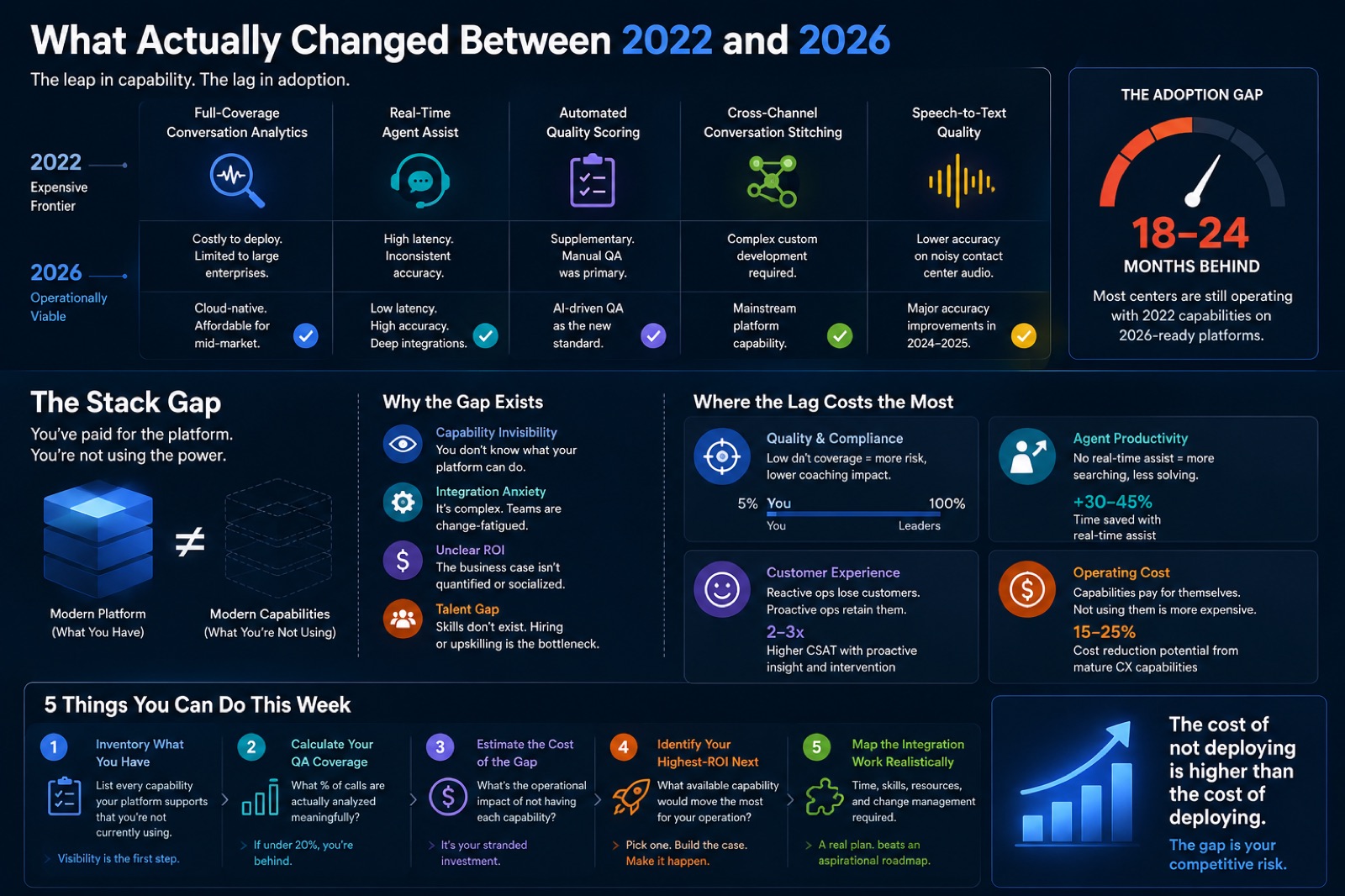
What Actually Changed Between 2022 and 2026
Several capabilities moved from “expensive frontier technology” to “table-stakes for serious operations” in the past 24 months.
Full-coverage conversation analytics. What used to require enterprise-scale infrastructure now runs on cloud platforms at price points mid-market centers can absorb. The technical barrier has fallen substantially. The operational adoption hasn’t kept pace.
Real-time agent assist. Real-time agent assist platforms have improved markedly in latency, accuracy, and integration depth. The category went from “promising but flawed” to “operationally viable in well-designed deployments” in a remarkably short window.
Automated quality scoring. AI-driven QA has moved from supplementary to primary in leading operations. Manual QA hasn’t disappeared, but its role has shifted from comprehensive scoring to exception review and human judgment on complex cases.
Cross-channel conversation stitching. The technical capability to connect voice, chat, email, and messaging into a unified customer journey now exists in mainstream platforms. The integration work is real but the underlying infrastructure no longer requires custom development.
Speech-to-text quality. Recognition accuracy on contact center audio improved more in 2024-2025 than in the preceding five years combined, driven by better acoustic models and better domain adaptation.
The Stack Gap
Ask operations leaders why their center hasn’t deployed these capabilities, and the answers tend to cluster.
Capability invisibility. Many operations leaders don’t fully know what their existing platform can support. Vendors sold the platform without consistently up-selling the capabilities, and operations teams haven’t been resourced to inventory what’s available.
Integration anxiety. Each new capability requires integration work, configuration, and change management. Operations teams that survived the platform migration often have no appetite for the next wave of complexity.
Unclear ROI presentation. The benefit case for each individual capability is real but isn’t always quantified in terms operations leaders can take to budget conversations.
Talent gap. Some capabilities require skills that didn’t previously exist in the contact center organization. Hiring or upskilling for them is the actual bottleneck.
The result is centers that have invested heavily in modern platforms and are operationally still running on 2022 capabilities. They’re paying for the modernization without capturing most of its return.
Where the Lag Costs the Most
The gap costs differently in different areas, but a few stand out.
Quality coverage. Centers still sampling 2-5% of calls for QA are competing against centers analyzing 100%. The latter has better coaching, faster compliance detection, and more accurate operational visibility. The competitive gap shows up in agent retention, customer satisfaction, and regulatory exposure.
Agent productivity. Without real-time assist running well, agents spend significant time searching for information. The productivity gap compounds across hundreds of thousands of calls.
Customer experience. Centers without sentiment analytics, dissatisfaction detection, and conversation-derived insights respond to customer experience reactively. Centers running these capabilities respond proactively. The customer feels the difference.
Operating cost. The capabilities that look expensive in isolation generally pay for themselves through productivity, retention, and prevented churn. The actual cost of not deploying them is usually larger than the cost of deploying them, but it appears as missed opportunity rather than line-item spend, which makes it easier to ignore.
Five Things You Can Do This Week
1. Inventory what your platform supports. Make a list of every capability your CCaaS/platform vendor advertises that you’re not currently using. The list will be longer than expected.
2. Calculate your QA coverage rate. What percentage of calls are actually analyzed in any meaningful way? If the answer is under 20%, you’re operating at 2022 capability with 2026 stakes.
3. Estimate the cost of your capability gap. For each unused capability, what’s the operational impact of not having it? The total is your stranded modernization investment.
4. Identify your highest-ROI next capability. Of what’s available, what would move the most for your specific operation? Usually it’s full-coverage analytics or real-time assist. Pick one and build the case.
5. Map the integration work realistically. What would it take to actually deploy the next capability? Time, skills, change management. The realistic plan beats the aspirational roadmap every time.
The contact center technology stack of 2026 is a substantial leap from 2022. Many centers have bought the foundation and stopped. The competitive cost of that gap is showing up in retention, satisfaction, and unit economics, and it’s compounding quarterly. The platforms aren’t the bottleneck anymore. The willingness to operationalize them is.