Picture a B2B software company that has quietly concluded that cold calling is dead. Its SDR team’s connect-to-meeting conversion has dropped below 2%, leadership has reallocated budget toward inbound and paid channels, and the outbound motion is being wound down. The data, on its face, supports the decision.
Now analyze three months of its actual cold call recordings before the wind-down completes. The recordings can tell a different story than the conversion rate does.
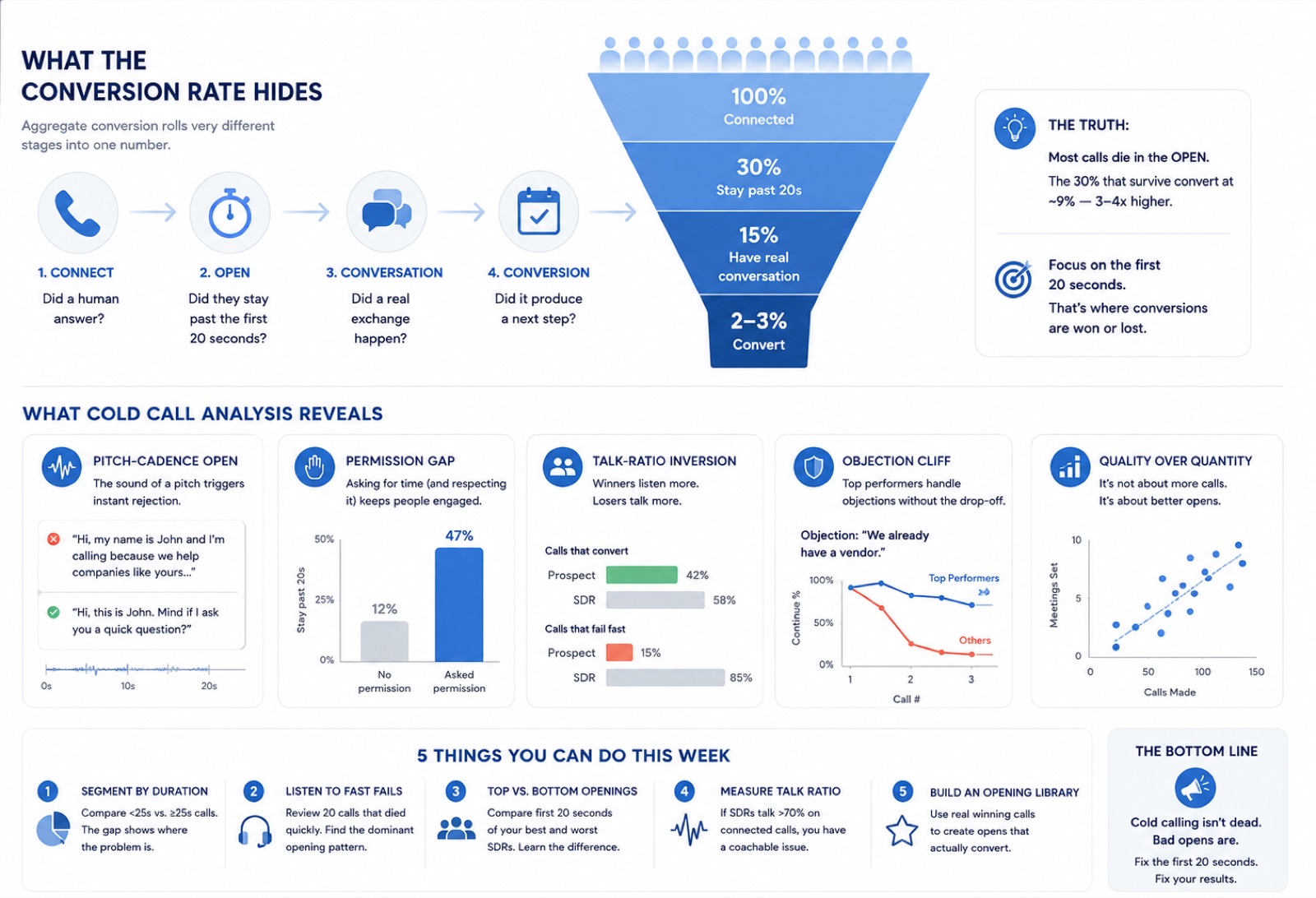
The connect rate may be fine. People are answering. The problem can be concentrated in the first 20 seconds of the calls that connect. Many connected calls end within seconds, and the recordings show why: the SDRs are opening with a script that triggers immediate rejection — the unmistakable cadence of a sales pitch that gives the prospect every reason to hang up. The calls that survive the opening can convert to meetings at a far higher rate than the average suggests. Cold calling isn’t dead. Their opening is.
This is the pattern in most “cold calling doesn’t work anymore” conclusions. The channel gets blamed for an execution problem that lives in a span of seconds, is completely coachable, and is invisible to the conversion metrics leadership uses to make the kill decision.
What the Conversion Rate Hides
Aggregate cold calling conversion is a deeply misleading number because it averages across stages that have completely different dynamics.
A cold call has at least four distinct phases: the connect (did a human answer), the open (did they stay past the first 20 seconds), the conversation (did a real exchange happen), and the conversion (did it produce a next step). Each phase has its own failure rate and its own fix. Rolling them into one conversion number tells you the motion isn’t working without telling you where or why.
Most cold calling failures concentrate in the open. The prospect makes a stay-or-go decision in the first 15-20 seconds based almost entirely on whether the opening sounds like a pitch or a conversation. SDRs who survive this phase have dramatically higher downstream conversion because the prospects who stay are pre-qualified by their willingness to keep talking.
The aggregate conversion rate can’t see this. It treats a call that died at second 18 the same as a call that had a real conversation and didn’t convert. They’re completely different events with completely different lessons.
What Cold Call Analysis Reveals
When conversation analytics runs across outbound call recordings, the coachable patterns surface fast.
The pitch-cadence open. SDRs who open with the rhythm and vocabulary of a sales script trigger rejection reflexes. The specific words matter less than the cadence — prospects recognize a pitch by its sound before they process its content.
The permission gap. Top performers ask for a small amount of time explicitly (“do you have 27 seconds?”) and respect it. Weaker performers launch straight into value props, which reads as not respecting the prospect’s time.
The talk-ratio inversion. In cold calls that convert, the prospect talks more than expected — often 40%+ of the conversation. In calls that fail, the SDR talks 80-90% of the time. The pattern is detectable across hundreds of calls and it’s one of the cleanest predictors of conversion.
The objection-handling cliff. Specific objections (“we already have a vendor,” “send me an email”) produce a sharp drop-off for most SDRs and a much smaller one for top performers. The difference is entirely in the response, which is fully coachable from real examples.
Why This Matters Beyond Sales
The cold calling lesson generalizes to every outbound motion a contact center runs — collections, retention, win-back, renewals. The first 20 seconds of an outbound call to someone who didn’t ask to be called is the highest-leverage span in the entire interaction, and it’s the span almost nobody measures or coaches with real data.
Sales coaching has historically relied on ride-alongs, manager intuition, and self-reported call notes. None of these scale and none of them produce the systematic view of what actually happens in the opening seconds across the whole team. The recordings have always been there. The analysis usually hasn’t.
Five Things You Can Do This Week
1. Segment your cold call data by call duration. Separate calls that died under 25 seconds from calls that survived. Calculate conversion for each. The gap will reveal whether your problem is the open or the conversation.
2. Listen to 20 calls that died in the first 20 seconds. Identify the opening pattern. There’s almost always a dominant cadence or phrase doing the damage.
3. Compare openings between top and bottom SDRs. Pull five calls each from your best and worst performers. The difference in the first 20 seconds will be audible and specific.
4. Measure talk ratio on connected calls. If your SDRs are talking more than 70% of the time on calls that connect, you’ve found a coachable pattern that correlates directly with conversion.
5. Build an opening library from real winning calls. Replace your script’s opening with patterns extracted from your own calls that actually converted. Real examples beat written scripts every time.
Cold calling didn’t stop working. The way most teams open cold calls stopped working, and because nobody was measuring the open separately from the conversion, the channel took the blame for an execution problem that lives in 20 seconds and is entirely fixable.