Picture a payments company that is confident in its compliance posture. It records 100% of calls, it has pause-and-resume for card capture, it runs quarterly PCI assessments, and it has never had a finding. By every checklist, the program is buttoned up.
Now run a single test against six months of its recordings: search for spoken card numbers in segments where pause-and-resume should have suppressed them. Card data can still turn up — agents who forgot to trigger the pause, customers who read their number before the agent was ready, system failures where the pause didn’t engage. In a center handling 200,000 card-present calls a quarter, even a small fraction of a percent can mean hundreds of calls with exposed PAN data sitting in the recording archive.
If it does, the compliance program isn’t buttoned up. It’s buttoned up everywhere a human has thought to put a button. The exposure lives in the gap between the policy and the execution, which is exactly where compliance findings come from.
What “Compliant” Stopped Meaning
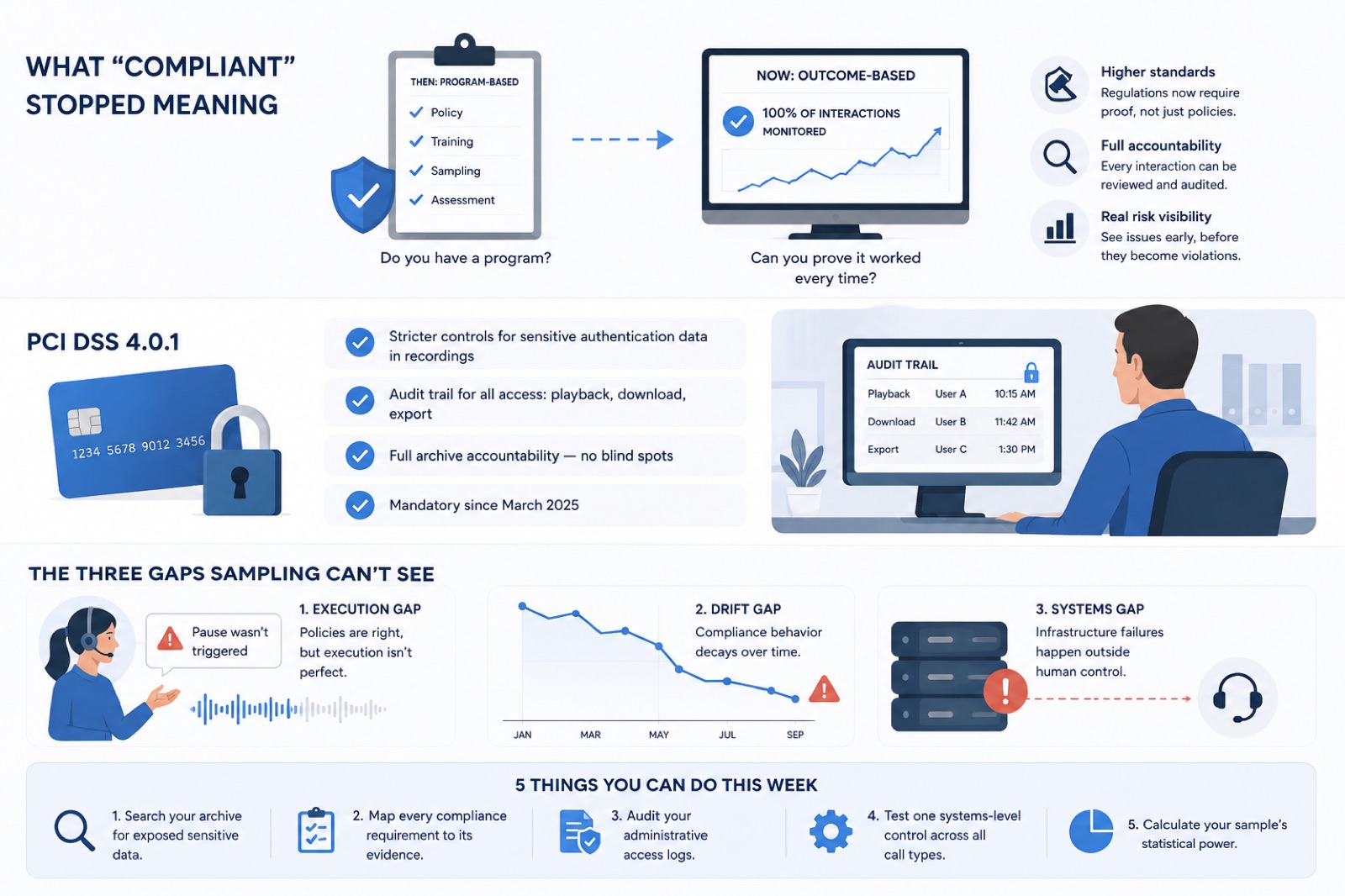
For most of the last decade, contact center compliance was a documentation exercise. You had a policy. You trained agents on it. You sampled some calls. You filed the assessment. The regulator generally accepted that a reasonable program, reasonably executed, was sufficient.
That standard has shifted across several frameworks in the past 24-36 months, and the common direction is the same: from “do you have a program” to “can you prove it worked on every interaction.”
Under PCI DSS 4.0.1, mandatory since March 2025, a contact center may not keep the card security code in any call recording after the payment is authorized. Pause-and-resume leaves that to an agent remembering on every call. Every administrative action on recordings — playback, download, export — needs an audit trail. The standard assumes you can demonstrate control across the full archive, not across a sample.
The EU AI Act’s high-risk provisions, which apply from 2 December 2027, classify AI systems used for contact center performance monitoring and employment decisions as high-risk, with logging, oversight, and transparency obligations that apply to any organization whose AI touches EU residents.
In financial services, off-channel communications enforcement in the US has produced more than $3.2 billion in penalties since 2021 (SEC, CFTC), with regulators making clear that inability to demonstrate monitoring equals liability.
The pattern is consistent. The regulator no longer accepts the program as evidence. They want the outcome, across every interaction.
The Three Gaps Sampling Can’t See
When compliance runs on a 2-5% sample, three categories of exposure are structurally invisible.
The execution gap. Policies are correct; execution is imperfect. The pause-and-resume that didn’t engage. The disclosure the agent skipped. The consent that wasn’t captured. These happen at low rates per call but high absolute volumes, and a sample large enough to reliably catch a failure rate that low would have to be far larger than any manual QA team can review.
The drift gap. Compliance behavior decays over time as agents get comfortable, as edge cases accumulate, as new products launch without updated scripts. Sampling catches drift only after it’s become common enough to show up in a small sample — by which point it’s been happening for months.
The systems gap. Some compliance failures aren’t about agents at all. A recording system that fails to engage on certain call types. A redaction process that misses certain number formats. These are invisible to call-level QA because they’re infrastructure failures, and they’re often the most serious because they’re systematic rather than occasional.
What Full-Coverage Compliance Monitoring Changes
When speech analytics runs compliance checks against 100% of interactions instead of a sample, the compliance function changes character.
Detection moves from retrospective to near-real-time. A disclosure failure is flagged within hours of the call, not weeks later in a QA cycle. The remediation window shrinks from “next coaching session” to “same day.”
Evidence becomes comprehensive. When a regulator asks how you monitor a given requirement, the answer shifts from “we sample 200 calls a quarter” to “we screen every interaction against this criterion and here’s the exception report.” The second answer is defensible in a way the first one increasingly isn’t.
Exposure becomes quantified. Instead of assuming the sample represents the whole, you know the actual failure rate across the full volume. That rate becomes a number you can manage rather than a risk you can’t see.
Five Things You Can Do This Week
1. Search your recording archive for exposed sensitive data. Pick one regulated data type — card numbers, in your environment. Search recent recordings for instances that should have been suppressed. The hit rate will tell you your real execution gap.
2. Map every compliance requirement to its evidence. For each obligation that touches conversations, answer: “If a regulator asked for proof of monitoring, what would we produce?” Any requirement where the answer is “a sample” is an exposure.
3. Audit your administrative access logs. PCI DSS 4.0.1 requires audit trails on recording access. Check whether yours capture playback, download, and export with user IDs and timestamps. Most legacy systems don’t.
4. Test one systems-level control. Pick your pause-and-resume or redaction process. Verify it engages correctly across every call type, not just the common ones. Systems gaps hide in the uncommon paths.
5. Calculate your sample’s statistical power. For your most important compliance requirement, work out the failure rate your current sample size could reliably detect. If it’s higher than your acceptable risk threshold, your monitoring is structurally inadequate regardless of how well it’s executed.
Compliance findings don’t come from the calls you reviewed. They come from the calls you didn’t, in the gap between the policy you wrote and the execution you assumed. That gap is always there. The only question is whether you find it before the regulator does.