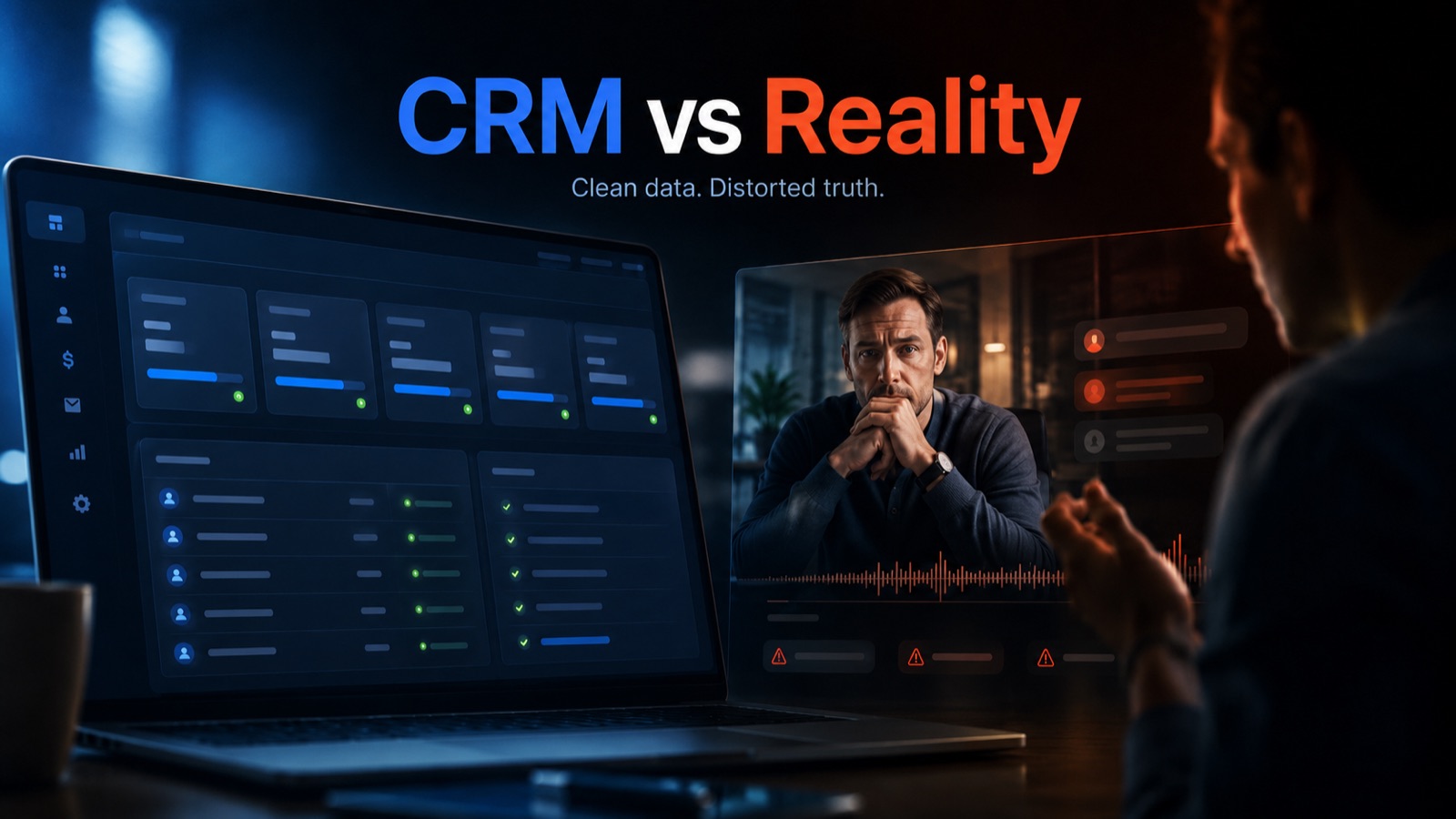
Picture a B2B sales organization that has just completed a CRM consolidation. New platform, cleaner data model, integrated activity capture, mandatory call logging. Six months in, leadership is frustrated that pipeline forecasts haven’t improved. The data is cleaner; the predictions aren’t.
Compare CRM call notes against the actual call recordings for a sample of in-flight deals, and the gap is often uncomfortable. Notes can materially mischaracterize what happened on the call. Sometimes the misalignment is minor — the rep marks a deal as “strong interest” when the prospect’s actual language was polite but tepid. Sometimes it is substantial — a deal logged as “decision in 30 days” has a recording where the prospect explicitly says they are “looking at this for next year.” The CRM is clean, well-structured, and populated with information that doesn’t reflect what actually happened.
This is the structural limitation of any CRM that depends on rep self-report. The cleanliness of the database is a function of process discipline; the accuracy of the database is a function of human reporting, which is systematically biased in predictable ways. The pipeline forecast built on this data is only as good as the reporting that feeds it, and the reporting is often quite poor.
How CRM Data Diverges from Reality
The misalignment between CRM notes and conversation reality isn’t random. It has predictable patterns rooted in normal human behavior under measurement pressure.
Optimism bias. Reps who are being measured on pipeline health tend to characterize prospect interest more positively than the prospect’s actual language warrants. This isn’t dishonesty; it’s interpretation drifting toward the answer that makes the rep look better.
Recency over precision. A long conversation gets compressed into a short note. The note tends to capture the most recent or most emotionally salient moments, not the most operationally significant ones. The objection that was raised early but addressed late may not appear in the note.
Process compliance over insight. Reps who are graded on CRM hygiene fill in the required fields. They don’t necessarily fill them in with depth. The note exists; the substance often doesn’t.
Manager-shaped reporting. Reps learn what their manager wants to see and shape notes to match. If the manager focuses on next steps, notes emphasize next steps. If the manager focuses on objections, notes emphasize objections. The note describes the rep’s understanding of the manager’s preferences as much as it describes the conversation.
Time pressure. A 45-minute call followed by a five-minute note can’t capture the substance. The note becomes a summary plus the rep’s intuition rather than a record of what happened.
What This Costs
The cost of bad CRM data shows up in places that aren’t usually attributed to it.
Pipeline forecasts are inaccurate. Deals weighted as 70% likely close at 40%. Deals weighted as 30% close at 5%. The calibration is off because the underlying data is off.
Coaching is misdirected. Managers coach reps based on the deals visible in CRM. If the CRM shows a healthy pipeline for a rep whose actual conversations are weak, the coaching priority gets misallocated.
Marketing attribution is wrong. When CRM data drives attribution analysis, decisions about lead sources and channels get made on data that doesn’t reflect what actually moved the deal.
Customer success starts blind. When CS teams pick up an account at handoff, the CRM is their main source of context. If that context is half right, the early CS engagement reflects it.
What Conversation-Derived Data Adds
Conversation analytics running on actual call recordings produces a different kind of data than rep-entered notes.
It’s neutral. The analytics doesn’t have a quota to hit. It captures what was said, not what the rep wishes had been said.
It’s comprehensive. Every call contributes data. The selective memory and selective documentation problems disappear.
It’s specific. Rather than “strong interest,” the data captures the prospect’s actual language, their specific objections, the stakeholders mentioned, and the buying signals or their absence.
It’s verifiable. The note can be checked against the source. Disputes about deal state can be resolved against the recording.
This doesn’t replace rep judgment — judgment about strategy and next steps still matters. It supplements rep-entered data with a parallel stream of conversation-derived information, and the combination produces materially better pipeline visibility than either source alone.
The Cultural Shift Required
The technical capability to derive structured data from conversations is real and improving. The harder shift is cultural.
Sales reps who are accustomed to controlling the CRM narrative about their deals can experience conversation-derived data as a loss of autonomy. Sales leaders accustomed to managing through rep-entered data can experience it as a different decision-making rhythm. Both can adapt, but the adaptation takes deliberate change management.
The reframe that works is treating conversation-derived data as objective ground truth that protects everyone. Reps benefit because their actual work — including the parts that don’t show up in CRM-friendly summaries — becomes visible. Managers benefit because they can coach on substance. Leadership benefits because the forecast finally reflects deal reality.
Five Things You Can Do This Week
1. Spot-check 10 CRM notes against the actual recordings. The variance will be visible immediately. The pattern is what’s instructive.
2. Calculate your forecast calibration. For deals weighted at various confidence levels, what’s the actual close rate? The miscalibration tells you how much your CRM data is misleading you.
3. Identify the field with the worst quality. Usually it’s “next steps” or “deal stage” or “objections raised.” That’s your priority for conversation-derived augmentation.
4. Pilot conversation-derived data on one team. Don’t replace CRM entry. Add a parallel data stream from analytics. Compare. The contrast will make the case for broader deployment.
5. Reframe the metric. Stop measuring rep performance on CRM hygiene. Start measuring on deal conversation quality. The cultural shift follows the metric shift.
The CRM is as clean as your process can make it. The data inside it is as accurate as your reps can self-report. These two truths are in tension, and the tension is where the pipeline forecast loses calibration. The misalignment isn’t a hygiene problem. It’s a structural limit of self-reported data, and the only fix is augmenting it with a source that doesn’t depend on what reps choose to write down.