Picture a retail bank whose complaints team handles roughly 4,200 escalated calls per month. Its operations director is convinced the team needs broader resolution authority — bigger refund ceilings, faster credit decisions, more discretion on fee waivers. The hypothesis is that escalations grow because frontline agents can’t say yes fast enough.
Analyze the escalation patterns before signing off on that conclusion, and the data may say something different. Many escalated calls don’t actually need extra authority to resolve. By the time the customer reaches the senior team, the resolution itself is often technically simple — a fee reversal, a date change, a balance correction. The customer is just no longer willing to accept it from a regular agent.
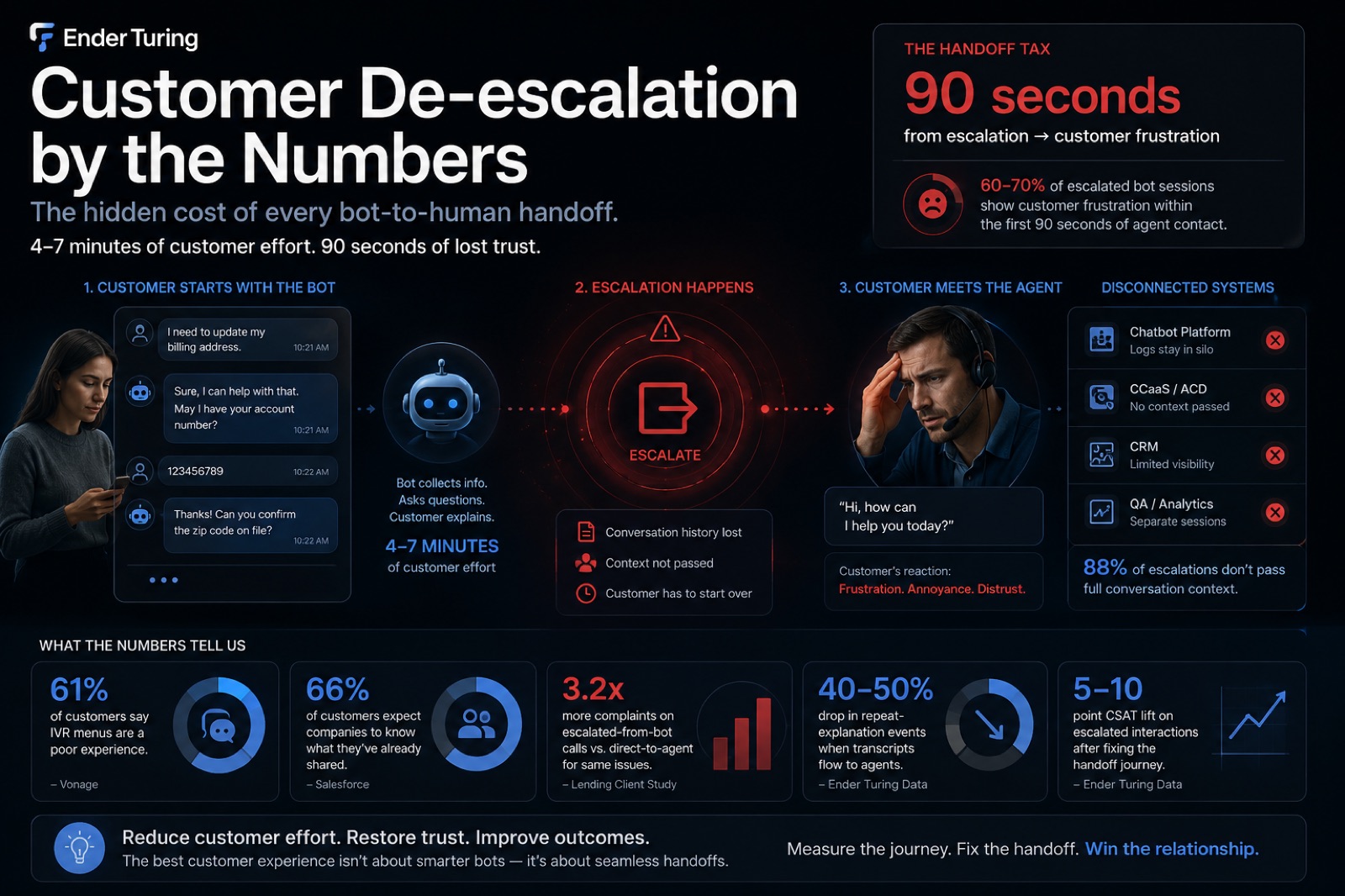
In a case like that, the escalation isn’t an authority problem. It’s a conversation problem that starts in the first 90 seconds of the original call and compounds from there.
This is the gap most contact centers miss when they think about customer de-escalation. The training budget goes to senior agents who handle escalated cases. The conversation analytics budget goes to QA scoring. Almost nothing goes to the window where escalations actually originate — the opening 90 seconds, with a customer who hasn’t escalated yet and isn’t angry yet, but is one wrong sentence away from both.
Customer De-escalation by the Numbers
The economics of failed de-escalation are uglier than most contact center leaders realize.
A single escalated call costs roughly 3-5x more than a baseline call to resolve. Senior agent time is more expensive. Handle time stretches because the customer now has to re-explain the situation from the beginning. After-call work expands because escalations require documentation, supervisor notes, and often a callback. Industry benchmarks from contact-center research firms put the all-in cost of a typical escalation between $35 and $90 in mid-market financial services, depending on complexity.
That cost compounds into churn. Customers who escalate a complaint and feel mishandled have every reason to reduce their relationship. In banking and telecom, where the customer relationship is the entire product, that’s the most expensive line item in the contact center P&L.
And the failure rate is structural. When QA teams score escalated calls in retrospect, they typically find that 60-80% of escalations had clear warning signs in the original call. The customer used escalation language (“this is ridiculous”, “I want to speak to a manager”, “I’ve been a customer for 12 years and this is how you treat me?”). The agent missed it, deflected it, or — worst — argued back. The escalation became inevitable somewhere between the 30-second mark and the 90-second mark of the first call.
What Actually Happens in the First 90 Seconds
There’s a predictable structure to calls that escalate.
The signal phase (0-30 seconds). The customer states the problem. Tone is usually neutral or mildly frustrated. The agent has the cleanest possible read on the emotional state of the call. This is where the de-escalation either starts or doesn’t.
The framing phase (30-60 seconds). The agent either acknowledges the impact or moves straight to process. “I can see this has been frustrating, let me look into it for you” lands differently than “Can I have your account number please?” Both are necessary at some point in the call. The order matters enormously. Customers who get the process question first interpret it as the agent not caring. Customers who get the acknowledgment first interpret it as the agent being on their side.
The commitment phase (60-90 seconds). The agent either tells the customer what they’re going to do or tells the customer what they can’t do. This is where most escalations seal themselves. Phrases like “Unfortunately our policy doesn’t allow…” or “I’m not authorized to…” often trigger an escalation response, even when the underlying issue would have been resolvable. The customer hears: “this person can’t help me, I need someone who can.”
By the 90-second mark, the trajectory of the call is set. Recovery is possible after that, but it’s expensive in handle time and emotional labor.
The Words That Make It Worse
Behavior analytics at scale lets you see exactly which phrases predict escalation. The list is shorter than most agents think and the pattern is consistent across industries.
Hedging language. “I’ll try to help” instead of “I’ll help you.” The customer hears uncertainty in the first instance and reads it as the agent doubting whether their problem can be solved.
Policy language. “Our policy is…” and “Per our guidelines…” are among the most common escalation triggers. The customer interprets these as the agent siding with the company against them.
Time language. “It’ll take some time” with no specific timeframe. Customers will accept long waits if they know the duration. They escalate when they don’t.
Disclaiming language. “I didn’t make this rule but…” This phrase, intended as empathy, almost always backfires. The customer concludes the agent doesn’t believe in the resolution either, which means it’s not a real resolution.
Repeat-the-script language. “As I mentioned earlier…” Customers experience this as condescending even when the agent is being purely informational.
These aren’t subjective patterns. With 100% speech analytics coverage, you can correlate specific phrases against escalation outcomes across thousands of calls and identify the trigger language for your specific customer base.
The Regulatory Layer Nobody Discusses
Consumer Duty in the UK is making de-escalation a compliance issue, not just a CX issue. Under the FCA framework, firms are now required to demonstrate that their conversations with customers — particularly customers in vulnerable circumstances — meet specific standards for clarity, fair treatment, and avoidance of foreseeable harm. A poorly handled complaint that escalates because of mishandled language is no longer just a CSAT problem. It’s a documentation problem when the regulator asks for evidence.
In the US, CFPB enforcement against banks for “deceptive or unfair” complaint handling has produced multi-million dollar consent orders in the past 24 months. The exact language agents use in difficult conversations is now in scope for regulator review. In Australia, the FAR regime extended individual accountability for senior managers when conversation-handling failures contribute to consumer harm.
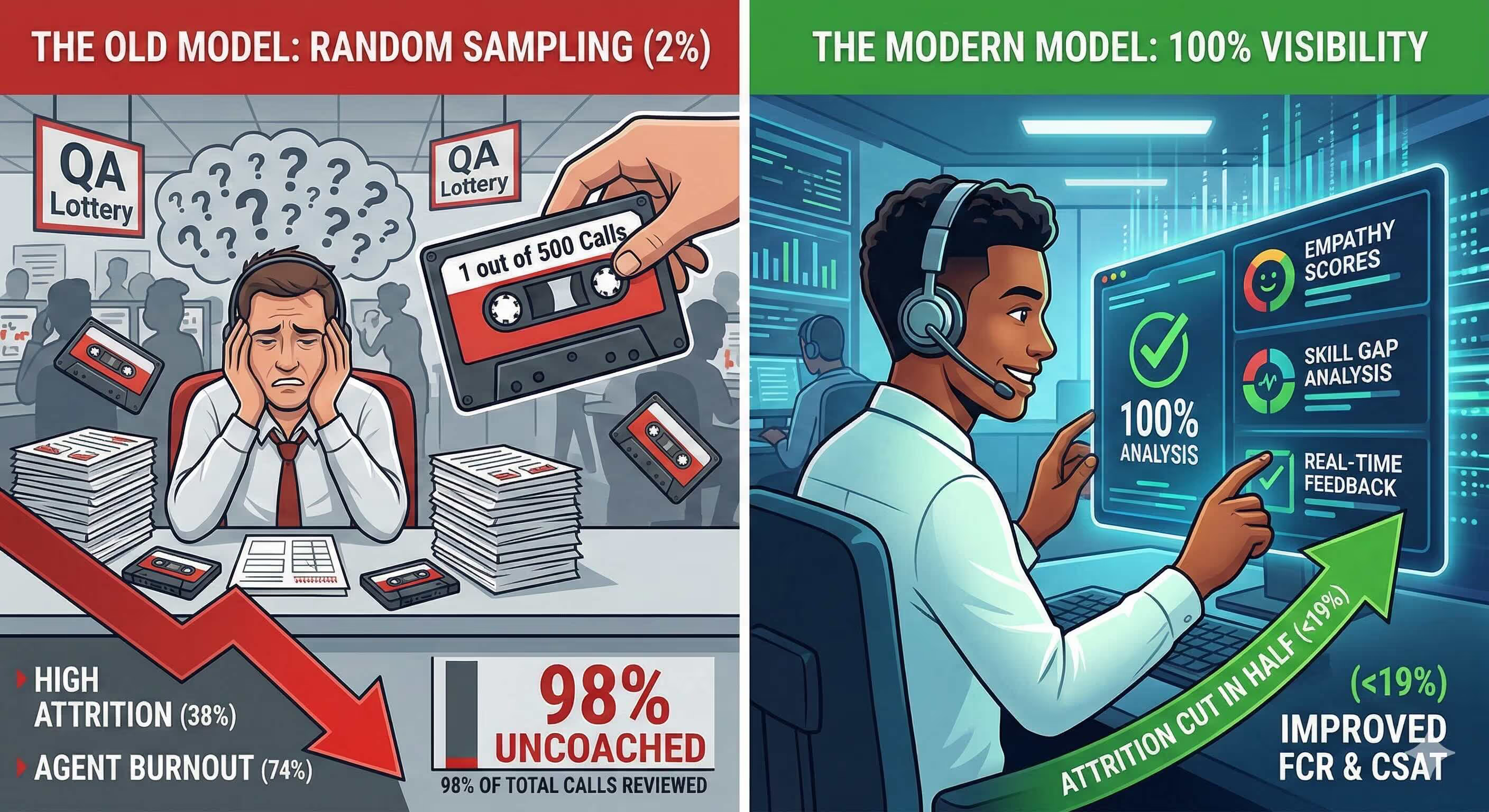
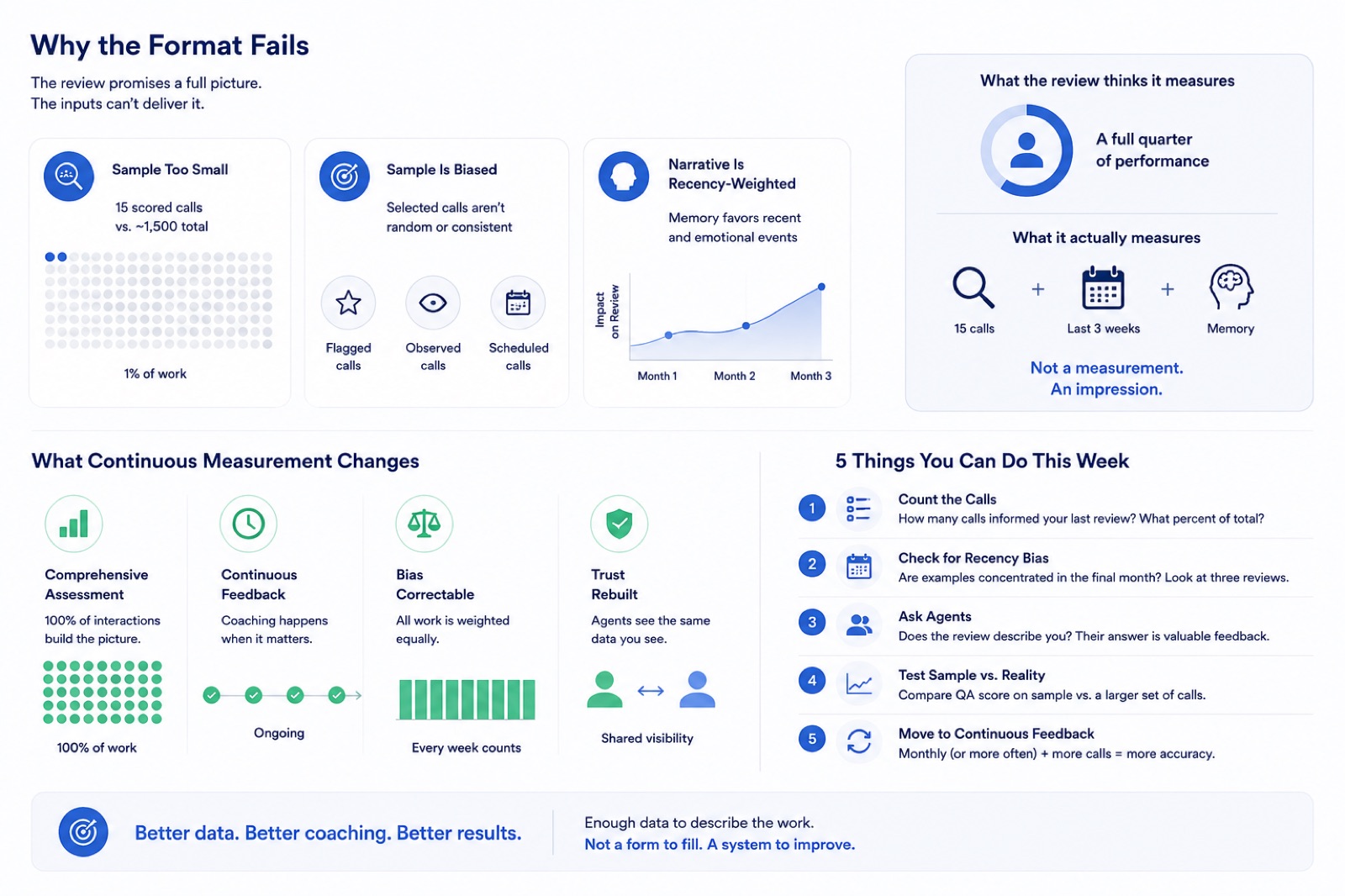
This shifts de-escalation from a soft skill to a documented capability. Contact centers need to demonstrate not just that they trained agents on de-escalation, but that the training is producing measurable behavior change at the call level. Sampling 5 calls per agent per month doesn’t get you there.
From Reactive to Predictive: What Actually Changes
When contact centers move from coaching de-escalation in QA sessions to coaching it from real conversation data, the timeline tends to run like this.
Week 1. Leaders see for the first time which specific agents are triggering escalations through language patterns, not through resolution failures. The list is usually different from the agents flagged by traditional QA. Some agents who score well on scorecards are the worst on early-call language patterns because they’re hitting compliance script requirements at the expense of customer connection.
Month 1. Coaching shifts from “what should you have said” retrospectives on a handful of cherry-picked calls to “here’s the specific phrase you used in 47 calls last month that correlated with escalation in 31 of them.” Agents respond differently to data than to opinion. They argue with the analyst less.
Month 3. Escalation volume can start to drop in the cohort getting targeted coaching. Not because the underlying issues changed, but because the first 90 seconds of those calls now sound different. AHT on those same calls often drops as a side effect — calls that don’t go sideways are faster to resolve.
Month 6. The pattern compounds into hiring. Recruiters start screening for first-90-second language patterns in role-plays. New agent ramp time shortens because trainees are working from real conversation examples rather than generic role-play scenarios.
The Mid-Market Gap
Enterprise contact centers have been investing in conversation-pattern analysis for years. Mid-market centers (200-1,000 seats) typically haven’t, because first-generation conversation intelligence platforms were priced and deployed for 5,000+ seat environments. The result is a measurable performance gap. Mid-market escalation rates run roughly 2-3 percentage points higher than enterprise rates in comparable industries, and we attribute most of that gap to the absence of conversation-level coaching infrastructure.
That gap is closing fast as cloud-native agent management platforms drop implementation timelines from quarters to weeks. But the window where mid-market centers can leapfrog enterprise capabilities is open right now and won’t stay open long.
Five Things You Can Do This Week
You don’t need a six-month transformation to start improving de-escalation outcomes.
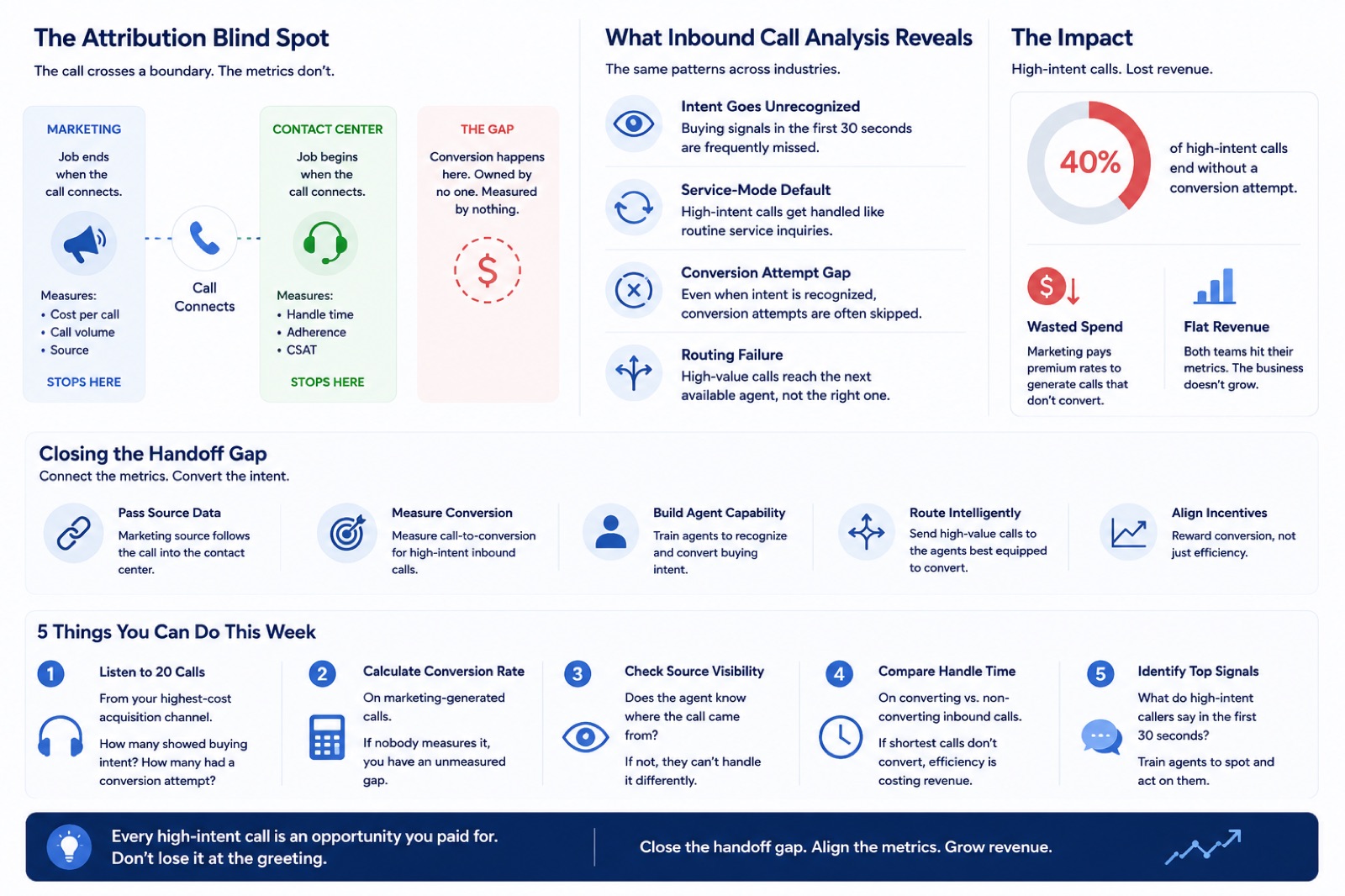
1. Pull your top 10 escalated calls from last week. Listen to the first 90 seconds of each one, before the escalation actually happened. Identify the specific moment the call’s trajectory changed. The patterns will jump out quickly.
2. Audit your opening script. Map every required compliance line against the emotional flow of a difficult conversation. If your first 30 seconds force agents through three pieces of process before they can acknowledge the customer’s problem, you’ve designed escalations into your script.
3. Identify your top three escalation phrases. Pick agents from a cross-section of tenure and review what they tend to say in the 30-90 second window of difficult calls. If you can identify three phrases that consistently appear in calls that escalate, you have your coaching priority for the month.
4. Separate skills coaching from compliance coaching. Most QA programs blend these together, which means agents leave coaching sessions confused about what to fix first. Compliance failures need different intervention than skill failures.
5. Connect de-escalation outcomes to retention data. Take your escalated customer list from last quarter. Cross-reference against churn in the following 90 days. The correlation will give you a dollar figure for the business case to invest in early-call coaching infrastructure.
The first 90 seconds of every difficult call are happening right now in your contact center. You’re either monitoring them or you’re paying for the consequences three weeks later in escalation costs, six months later in churn, and twelve months later in CFPB filings. The window is narrower than most leaders think and more decisive than most realize.