Customer Experience Contact Center: Fix What Breaks Before Hello
Pull sentiment data from a telecom contact center, and you expect to find frustration with billing errors, annoyance about service outages, complaints about contract terms.
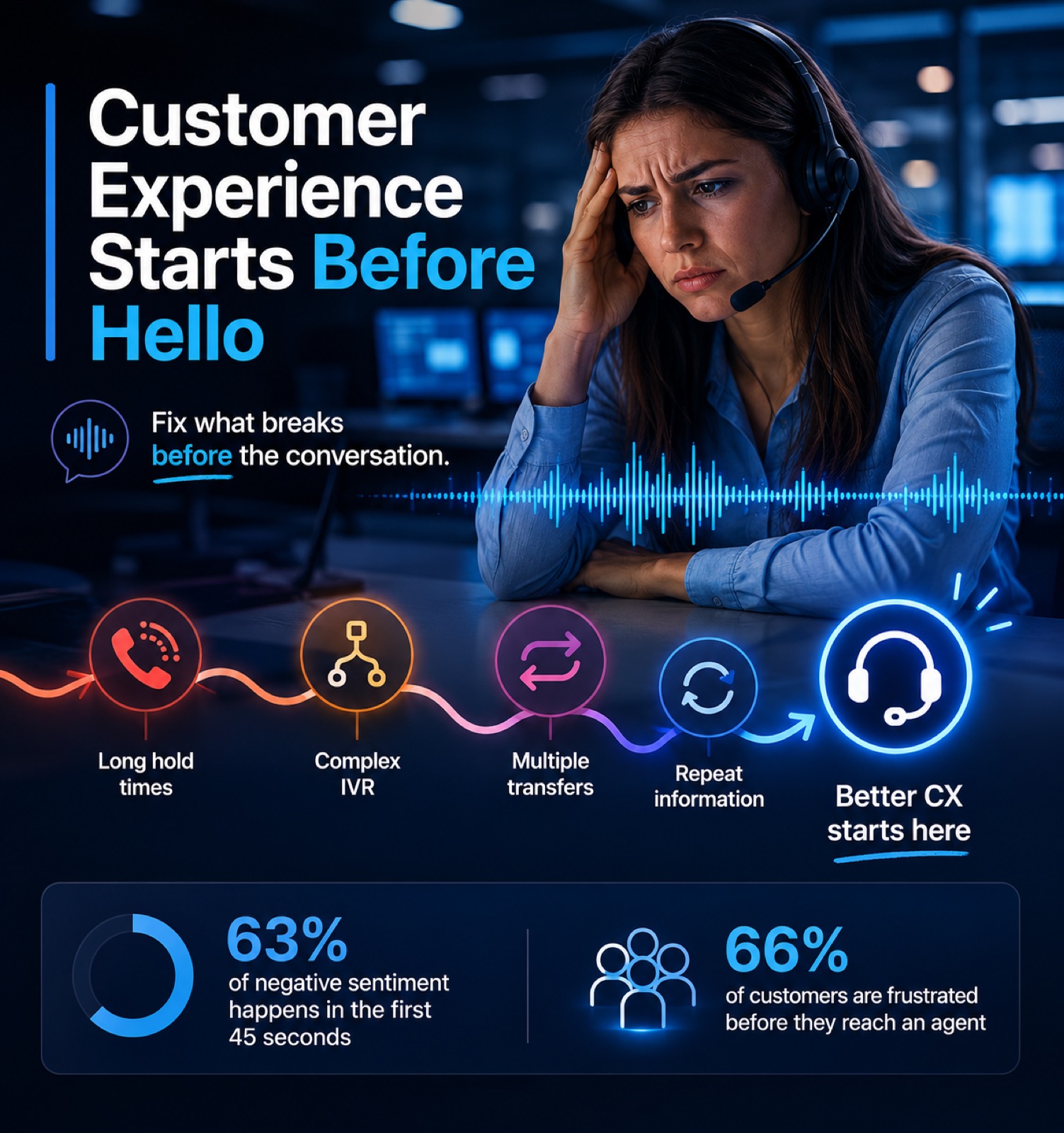
Look at when negative sentiment spikes instead, and many spikes land in the first seconds of the agent conversation. Before the agent says anything substantive. Before any troubleshooting. Before any resolution attempt. The customer is already angry when the call connects.
The agents weren’t the problem. The journey to the agent was.
Two-Thirds of Your Customers Are Frustrated Before Anyone Picks Up
This isn’t an anomaly. Qualtrics XM Institute research puts $3.7 trillion in global revenue at risk annually due to poor customer experience. And the frustration doesn’t start with bad agents or wrong answers. It starts with what happens before the conversation.
Industry data paints the picture clearly. Nearly two-thirds of customers are frustrated before they speak to an agent (Mattersight, 2015). 61% of US consumers say IVR menus make for a poor experience (Vonage, 2019). And here’s the stat that should worry every CC leader: 60% of callers hang up after just two minutes on hold.
That means your most impatient customers, the ones most likely to churn, never even make it to an agent. They disappear. Silently. And 56% of unhappy customers never complain. They just stop buying.
Most contact centers measure none of this. They track handle time, first call resolution, agent utilization. All post-connection metrics. But the customer experience contact center leaders need to care about starts the moment someone decides to pick up the phone or open a chat. Everything before “Hello, how can I help you?” is a black hole.
The Repeat-Yourself Tax
If the pre-connection frustration doesn’t get you, the repetition will.
Zendesk’s 2026 CX Trends report found that 87% of customers become frustrated when they have to repeat themselves across channels. 73% of those customers question why they spend money with that brand at all.
Think about that ratio. Nearly three out of four customers who repeat themselves start reconsidering the entire relationship. Not the product. Not the price. The relationship.
And the repetition is everywhere. Customer calls about a billing issue. Gets transferred. Explains the problem again. Calls back the next day. Explains it a third time. Opens a chat because the phone line is busy. Starts from scratch.
Nearly three-quarters of service interactions now span multiple channels. But 84% of business leaders admit they struggle to fully integrate those channels. The result: 71% of consumers expect consistency across channels, yet only 29% say they receive it.
That 42-point gap between expectation and reality? That’s the customer experience problem most contact centers are actually facing. Not bad agents. Not slow resolution. Broken context.
Why Your CES Score Is Lying to You
Customer Effort Score has become the metric everyone tracks and few actually act on. The theory is straightforward: make things easier, customers stay. And the data supports it. Gartner’s research through CEB found that 96% of customers with high-effort interactions become more disloyal, compared to just 9% who had a low-effort experience.
But most CES implementations survey customers after the interaction. Post-resolution. When the relief of getting their problem fixed temporarily masks the frustration of the journey.
Here’s what CES surveys miss:
The abandoned customers. 60% who hung up after two minutes never took a survey. Their effort score was infinite. It doesn’t appear in your data.
The silent defectors. 56% who churned without complaining. They didn’t fill out the survey because they’d already decided to leave.
The cross-channel journey. CES measures one touchpoint. The customer who called, chatted, emailed, and called again experienced four friction points. Your CES captured one.
The pattern is common. The CES score looks fine. CSAT is stable. But when you analyze 100% of conversations using speech analytics, you find frustration signals scattered across interactions that never made it into a survey response.
A credit union can post a healthy effort score while its “satisfied” customers mention competitors on their calls and churn climbs. The survey says everything is fine. The conversations say otherwise.
The $3.7 Trillion Customer Experience Contact Center Blind Spot
Contact centers process millions of conversations. Every single one contains signals about customer effort, frustration, intent, and loyalty risk. But most organizations are making decisions based on a tiny sample.
Consider the math. An average contact center handles 50,000 calls per month. Traditional QA reviews 2-5 calls per agent per month. That’s roughly 2% coverage. The other 98% of conversations, where customers are expressing frustration, mentioning competitors, signaling churn risk, or asking for help in ways that suggest they’re close to leaving, go unheard.
That’s not a QA gap. That’s a customer experience gap.
72% of customers switch brands after just one negative experience. 52% stop buying entirely. And those negative experiences are hiding in the 98% of conversations nobody is listening to.
When you use automated quality management to analyze every interaction, the patterns become visible. You can see which IVR paths correlate with highest frustration. Which transfer patterns cause the most repetition. Which agents consistently de-escalate angry customers, and which ones make it worse. Which times of day produce the worst customer effort scores, not from surveys, but from actual conversation sentiment.
How to Improve Customer Experience Contact Center Performance
The organizations that actually improve these metrics, not just measure them, share three characteristics.
They measure before “Hello.” Queue times, IVR abandonment paths, callback request patterns, channel-switching behavior. If you only measure what happens after the agent picks up, you’re ignoring the phase where most frustration originates.
Routing intelligently can cut IVR navigation time when it is based on conversation history and caller intent signals. Instead of “Press 1 for billing, press 2 for technical support,” the system already knows why the customer called, because they called about the same issue three days ago and the ticket is still open.
They connect the journey across channels. The customer who chatted yesterday and is calling today about the same issue shouldn’t have to start over. When the agent sees the full history, including prior sentiment, unresolved issues, and previous interaction summaries, the customer doesn’t have to repeat themselves.
Track how often customers have to repeat themselves, and connected channel data is what moves that number. Not because agents get better. Because the system stops forcing customers through the same conversation three times.
They catch frustration in real time, not in surveys. Traditional feedback loops run on a delay. Customer gets frustrated. Maybe fills out a survey. Survey data aggregated weekly. Reviewed in a monthly meeting. Action taken next quarter. By then, the customer is long gone.
Behavior analytics and real-time sentiment analysis change the timeline. When the system detects rising frustration mid-call, it can flag the interaction for immediate supervisor attention. When it detects the same complaint pattern across 50 calls in a single day, it surfaces the operational issue before it becomes a churn wave.
96% of high-effort interactions drive disloyalty. But effort is measurable in real time, from the conversation itself, if you’re listening to all of them.
The Effort Equation Your Board Needs to See
CFOs think about customer experience in terms of CSAT scores and NPS benchmarks. Here’s a more useful calculation.
A mid-size contact center with 200 agents handles approximately 400,000 interactions per year. If nearly two-thirds of inbound customers are already frustrated before reaching an agent, as Mattersight found, that’s roughly 260,000 interactions starting at a deficit. If 72% of customers switch after one bad experience and your center has a 25% negative experience rate, the math says 19,000 customers are actively deciding to leave.
Multiply by your average customer lifetime value. For a bank, that’s often $3,000-8,000. For a telecom provider, $1,200-3,000. Even at the low end, $1,200 per lost customer times 19,000 defections equals $22.8 million in annual revenue at risk. From one mid-size center.
Companies leading in customer experience grow revenue 80% faster than competitors. The gap between CX leaders and laggards isn’t shrinking. It’s accelerating. Because the leaders are connecting conversation data to business outcomes, and the laggards are still surveying 3% of customers and hoping for the best.
Five Things to Do This Week
Forget “digital transformation roadmaps.” These are concrete changes a CC leader can start implementing immediately.
1. Audit your pre-connection experience. Call your own contact center. Navigate the IVR. Wait on hold. Track exactly how many seconds and how many menu levels it takes to reach a human. If it takes longer than 90 seconds, you have a problem.
2. Measure abandonment by IVR path. Most platforms can tell you how many calls were abandoned. Few tell you WHERE in the IVR journey they dropped. That’s the data that reveals which friction points are actively driving customers away.
3. Pull a sample of calls where customers mention repeating themselves. Search your call transcripts, or run a quick speech analytics scan, for phrases like “I already explained this,” “I called yesterday about this,” “Why do I have to say this again?” Count them. The number will be higher than you expect.
4. Connect your channel data. If your chat, email, and voice systems can’t share customer context, prioritize that integration above everything else. The single highest-effort interaction for customers is repeating their problem across channels. Fix the pipe, fix the experience.
5. Stop relying on post-interaction surveys for effort measurement. Your most frustrated customers aren’t filling out surveys. They’re hanging up, switching to a competitor, and telling friends. Use actual conversation data, sentiment analysis, keyword patterns, and quality management across 100% of interactions, to understand effort where it actually happens: in the conversation itself.
The customer doesn’t owe you a survey. They already told you what’s wrong. On the call. In the chat. In the email they sent twice. The question is whether anyone is listening.