Picture a B2B sales organization that has concluded its SDR team needs restructuring. Connect-to-meeting conversion is sitting at 1.6%, below the 2.5% target leadership has set. Two performers are hitting target. The rest are below. The plan is to manage out the bottom half and rebuild.
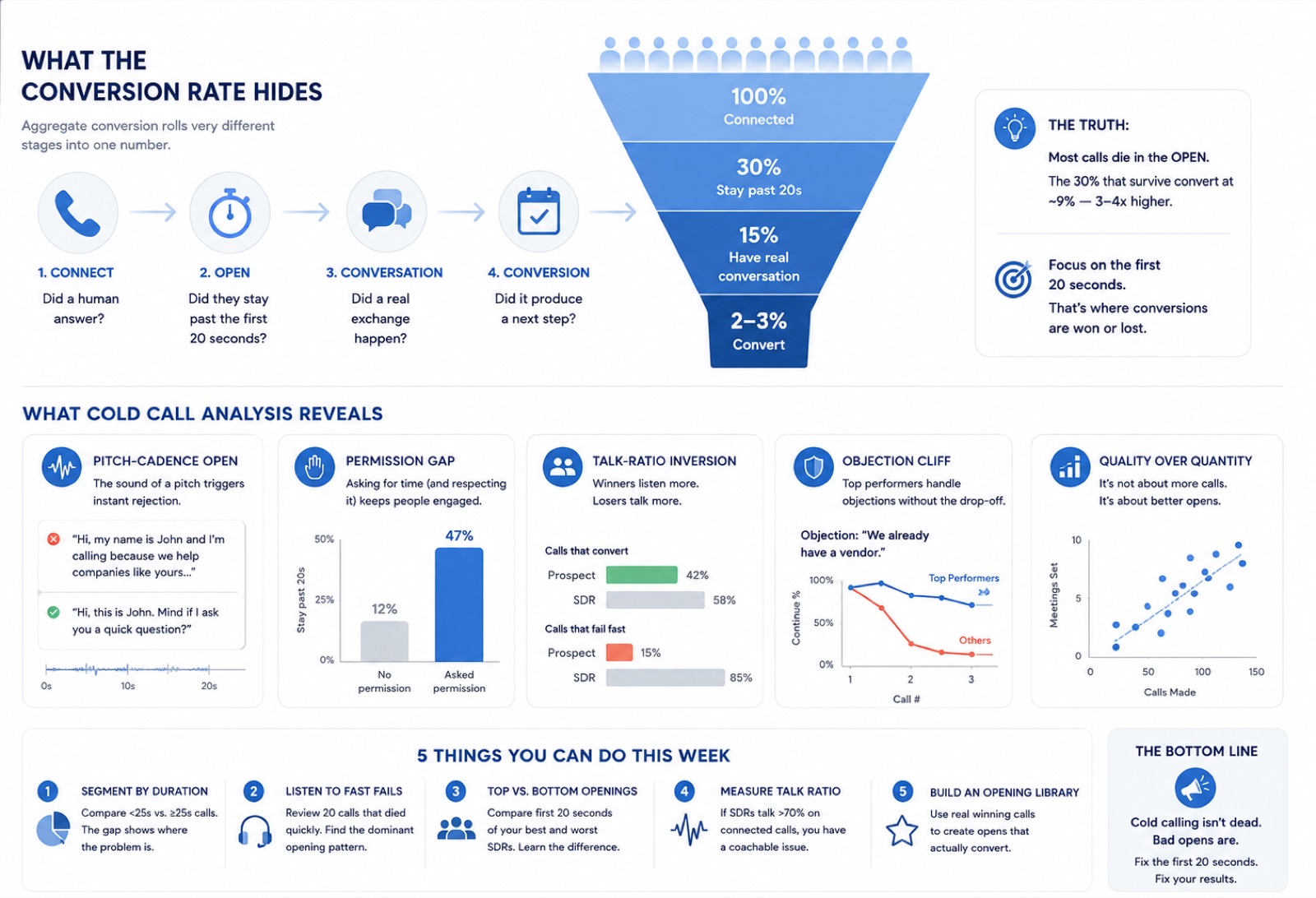
Stratify three months of the team’s connected calls — the conversations where an SDR actually got a human on the line — and the picture can look completely different from the aggregate. Connect rate may be healthy across the team, with the performance variance sitting in what happens after connect. Top performers keep the prospect on the line for a real conversation; bottom performers lose the call in its opening seconds. The 1.6% aggregate conversion hides the fact that some SDRs are having real conversations and converting, while others are getting hung up on early and converting near zero. The “underperformer” problem is often an “opening conversation” problem, concentrated in a fixable span of seconds.
This is the dominant pattern in SDR performance analysis and it’s the one most sales leaders miss. The aggregate conversion rate combines call outcomes that have completely different dynamics. The fix isn’t headcount changes. It’s the coaching that the aggregate metric can’t see.
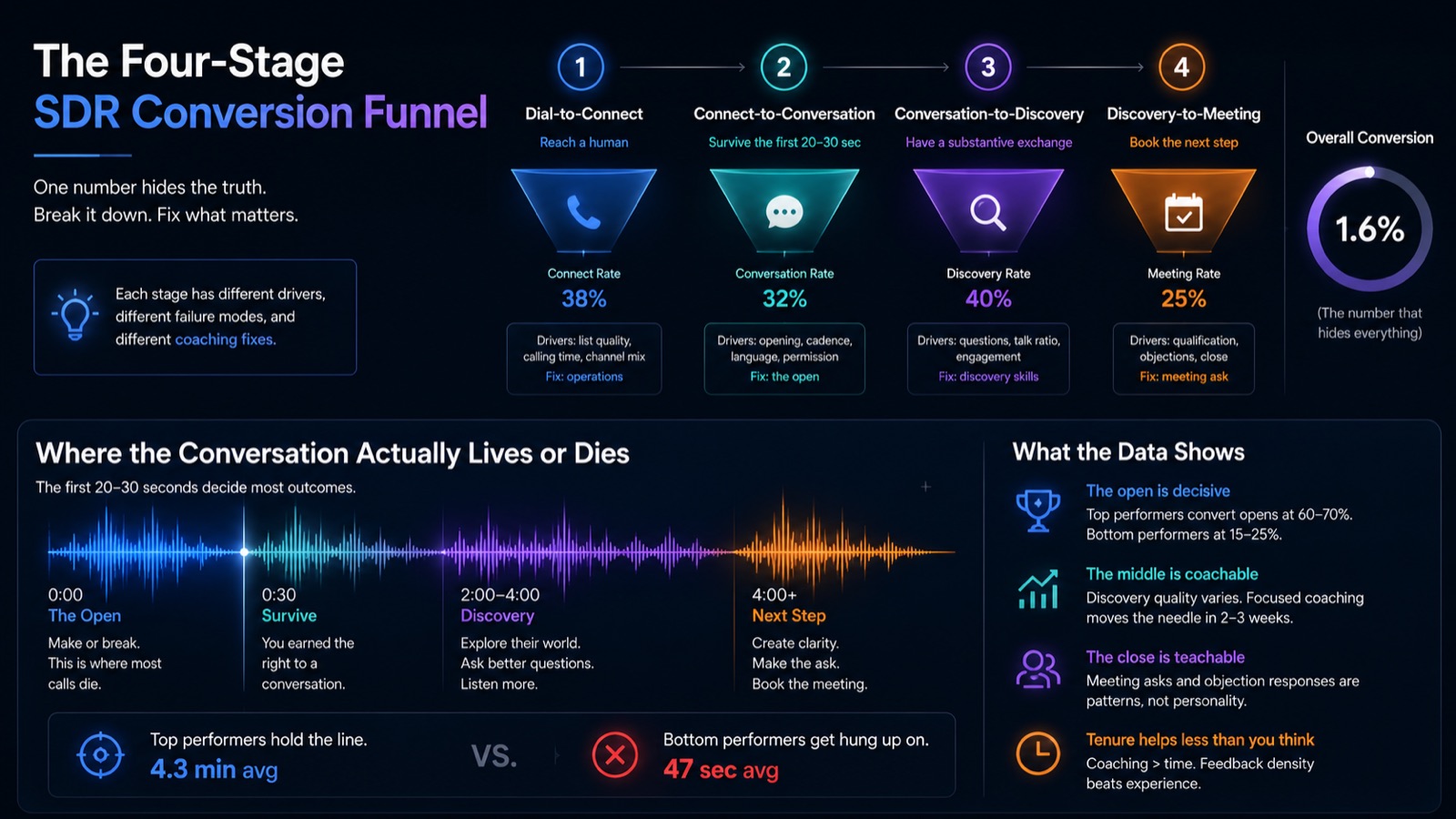
The Four-Stage SDR Conversion Funnel
SDR outcomes flow through stages that need to be measured separately to be managed well.
Dial-to-connect. The percentage of dials that reach a human. Driven by list quality, calling time, and channel mix. Mostly an operations problem.
Connect-to-conversation. The percentage of connected calls that survive the first 20-30 seconds without immediate hang-up. Driven almost entirely by the opening — the cadence, the language, the permission-asking. Highly coachable.
Conversation-to-discovery. The percentage of surviving calls that produce a substantive exchange. Driven by question quality, talk ratio, and ability to engage the prospect’s actual situation. Coachable.
Discovery-to-meeting. The percentage of substantive conversations that produce a booked meeting. Driven by qualification skills, objection handling, and clear next-step framing. Coachable.
Each stage has different drivers, different failure modes, and different coaching interventions. Treating the funnel as a single conversion number flattens this complexity into a metric that diagnoses nothing.
Where the Conversation Actually Lives or Dies
When conversation analytics stratifies SDR performance by stage, predictable patterns emerge.
The open is decisive. Most SDR variance lives in the connect-to-conversation stage. Top performers convert far more of their opens than bottom performers do. This single stage often accounts for the majority of total performance variance.
The middle is coachable. SDRs who survive the open differ on discovery quality. The variance is real but narrower than the open. Coaching here produces measurable returns within 2-3 weeks of focused intervention.
The close is teachable. The transition from substantive conversation to booked meeting has its own dynamics. SDRs who lose deals in this final stage usually have specific patterns in how they handle the meeting ask — vague framing, defensive responses to “send me an email” — that respond well to targeted coaching.
Tenure helps less than people expect. The performance gap between 6-month and 18-month SDRs is smaller than the gap between coached and uncoached SDRs at any tenure. The lesson is that performance is built by feedback density, not by time alone.
Why the Aggregate Hides All of This
Aggregate conversion is operationally seductive — one number, easy to track, easy to compare. It’s also analytically misleading because it averages across stages with different dynamics and different fix paths.
An SDR with a 1.2% aggregate conversion might have a 12% open rate and a strong downstream funnel — fix the open and they’re at 8% aggregate. Another SDR with the same 1.2% might have a great open and a weak discovery — completely different fix. The aggregate treats them identically and points at neither solution.
Sales leaders managing on aggregate conversion are making coaching decisions and headcount decisions based on a metric that can’t tell these cases apart. The result is the wrong SDRs getting coached, the wrong ones getting managed out, and a lot of preventable turnover in roles that could have been fixed with stage-specific intervention.
Five Things You Can Do This Week
1. Stratify your team’s conversion by stage. Connect rate, conversation rate, discovery rate, meeting rate. Each SDR has a profile, and the profile tells you exactly where they need help.
2. Listen to 5 sub-25-second hang-ups from a struggling SDR. The pattern in their open will be audible. Compare to 5 same-length non-hang-ups from a top performer.
3. Calculate talk ratio on connected calls. SDRs who talk more than 70% in the first three minutes convert at materially lower rates than SDRs who get the prospect talking earlier.
4. Identify your top three “killer phrases.” Specific openings that correlate with immediate hang-up. They exist on your team and they’re more concentrated than most leaders expect.
5. Coach the open separately from the rest. A weekly 30-minute session focused only on the first 30 seconds of calls, using real recordings, will move the connect-to-conversation rate within 2-3 weeks for most teams.
The SDR team that looks like a headcount problem is usually a coaching problem hiding inside an aggregate metric. The performance variance lives in specific, fixable stages of the call. The conversion rate that says you need to restructure is almost always telling you something different than what you’re hearing. The fix is upstream of the personnel decision, in the conversation data the aggregate metric can’t see.