The moment a customer hears “let me transfer you to the right team,” something breaks. Not the connection. The trust.
Every transfer makes the customer re-explain the problem before the next agent can begin working it. Customer experience contact center metrics rarely surface this cost because it hides inside average handle time and gets rewarded as “escalation efficiency.” It isn’t efficient. It is the tax customers pay for organizational design decisions they had no part in making.
Why the Transfer Breaks Customer Experience Contact Center Trust
Most contact center leaders think the moment of failure is the escalation itself. It isn’t. The failure happens 90 seconds later, when the new agent picks up the call and asks, “Can you tell me what’s going on?”
The customer has now told three people the same story. Once to the IVR (they typed the account number, said “billing,” and picked option 3). Once to the first agent (who gathered symptoms, verified identity, and then decided this was a “Tier 2 issue”). Now to the second agent, who has none of that context and has to start over. The customer isn’t angry about the transfer. They are angry that the transfer proved nobody was actually listening.
A 2019 Vonage study found that 61% of US consumers feel IVR menus make for a poor customer experience, but the deeper problem is what happens after IVR, when a transferred call arrives without the context the customer already gave. In banking and telecom, this restart tax compounds.
The Data Everyone Ignores About Transfers
Industry benchmarks treat transfers as neutral events. They shouldn’t.
- First Call Resolution average: 70-75%. Meaning 25-30% of calls require a transfer, callback, or repeat contact. That is the industry standard we all quietly accept.
- $3.8 trillion lost globally to customer dissatisfaction in 2025 (Qualtrics). Not all of this is transfers. Transfer-driven repetition is one of the top three named frustrations.
Notice what these numbers have in common. None of them show up on a standard contact center dashboard. FCR is tracked. AHT is tracked. Transfer rate is sometimes tracked. But nobody measures the customer effort embedded inside a single interaction. That effort is where satisfaction lives or dies.
Why the Transfer Tax Exists, and Why It Persists
Transfers exist because contact centers are organized around internal expertise, not customer intent. Billing here, technical there, retention over there, cancellations somewhere else entirely. The customer, who has one problem, gets routed through this org chart like a package that keeps getting the wrong shipping label.
Three structural reasons the tax persists:
1. Fragmented tooling. The average organization manages 3.9 different contact center technologies, and only 3% of contact centers run on a single platform (Puzzel’s State of Contact Centres 2026, via CX Today). Agent A uses one CRM. Agent B uses a different case management tool. There is no shared context layer, so context has to travel with the customer’s voice, which means the customer becomes the context transport mechanism. Every transfer is a manual data pipeline where the customer is the API.
2. Skill-based routing rewarded over intent-based routing. Most WFM systems route by agent skill match. That is efficient for the workforce. It is inefficient for the customer, because the routing decision is being optimized for handle time and agent utilization, not for how many touchpoints the customer will endure. A customer with a billing dispute that stems from a technical error will get bounced between billing and tech at least twice before someone owns it.
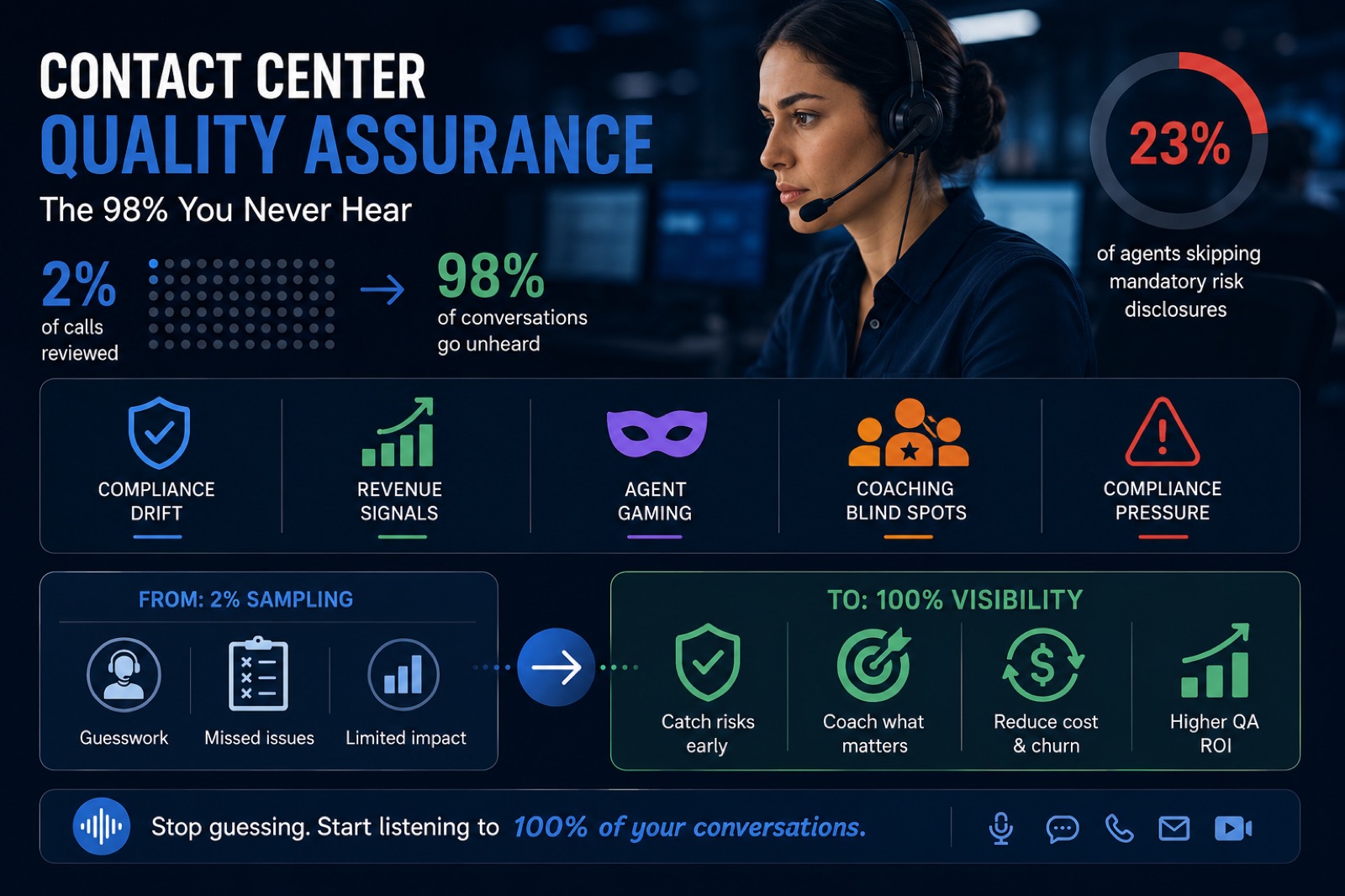
3. Zero visibility into transfer-driven friction. Nobody watches 100% of calls. The 2-5% of interactions that QA teams manually review rarely include the calls with heavy transfer patterns because those calls are longer and less “efficient” to review. So the pattern hides. Leaders don’t see it. Coaching doesn’t address it. Agents get promoted for closing tickets fast, not for being the one who takes ownership and doesn’t hand the customer off.
We disagree with the conventional wisdom that transfer rate is a KPI you can chase. Chasing it produces the wrong behavior. Agents hold calls longer to avoid the escalation, wrong-team resolutions that create callbacks, and forced first-touch closures that leave the underlying issue unresolved. The real metric is transfer effort per resolved case: how much did the customer have to re-explain to get their problem solved?
How the Best Contact Centers Reduce Customer Effort
Contact centers that measurably reduce customer effort share three habits. None of them are about firing more agents at the problem.
They see every conversation, not 2%. 100% call monitoring is table stakes now. When speech analytics processes every interaction, transfer patterns become visible: which intents chronically get misrouted, which agent transitions bleed the most context, which recurring issues create multi-transfer loops.
They measure context handoff quality, not just transfer rate. A transfer is not inherently bad. A transfer without context is. The best contact centers measure how much time the receiving agent spends on re-verification and re-explanation before working the case. Speech analytics can flag when the second agent asks a question the first agent already answered. That signal, aggregated, tells you exactly which team-to-team handoffs need process fixes.
They coach for ownership, not for closure speed. AI-driven coaching surfaces the agents who take a call and don’t transfer. Not because they’re avoiding escalation. Because they’re taking accountability for the customer’s problem. Those agents get replicated. Their behaviors, phrasing, and problem-solving patterns become the training material for everyone else. When ownership is the celebrated behavior, transfer rates drop naturally. Not because they were targeted. Because the underlying motivation shifted.
We built Ender Turing around a simple idea: the person on the other end of the phone deserves a company that heard the last call, coached the agent who answers this one, and knows when something is going wrong before the customer has to say it twice. Transfers, done right, honor that. Done at scale, they violate it.
The Cost of Not Fixing Call Center Customer Satisfaction Leakage
The math is unforgiving. A 1,000-seat contact center handling 100,000 calls per week at industry-average transfer rates burns roughly 1,500 hours per week on re-explanation alone. At a fully loaded agent cost of $28/hour, that’s $42,000 per week. $2.2M annually. Spent on customers repeating themselves. And that ignores the CSAT damage, the churn signal, the reduced customer effort opportunities lost, and the agent burnout that comes from constantly being the third person in a conversation the customer no longer wants to have.
The compounding cost is worse. McKinsey found that inbound service call centers generated up to 25% of new revenue at some credit card companies and up to 60% at some telecom companies. Every transfer-driven CSAT drop is a signal that revenue conversation could have happened. A card upgrade offer. A service upsell. A churn save. The agent never got there because the customer was still explaining the problem when the interaction window closed.
The industry has a name for this: revenue leakage. But it’s not really leakage. It’s a design choice being made every day by contact centers that optimize for the wrong number.
What To Do This Week
Not next quarter. This week. Three specific actions that any VP of Contact Center Operations can start on Monday:
- Pull last 90 days of transferred calls. Sort by number of transfers per case. Take the top 20% by transfer count and read (or better, run speech analytics on) the first 60 seconds of each transferred segment. How much of that time is re-verification and re-explanation? That number is your transfer tax baseline.
- Map your top 10 transfer paths. Which team-to-team transitions happen most? For each, ask: is this a routing failure (should have gone to the second team first) or a scope failure (the first team could have owned it with better tools)? Routing failures are IVR/CRM fixes. Scope failures are training and empowerment fixes. Different problems, different owners.
- Change one KPI. Stop rewarding low transfer rate. Start rewarding low customer effort per resolved case. Measure it via post-call sentiment analysis, agent handoff quality, and total customer speaking time relative to resolution complexity. The KPI you measure is the behavior you get. If you measure transfer rate, agents hoard calls. If you measure customer effort, agents take ownership.
The transfer isn’t the problem. The transfer is the symptom. The problem is that most contact centers are still organized around what makes internal operations efficient, not around what makes the customer’s day easier. Fixing that isn’t a technology purchase. It’s a decision about whose experience matters more.
We know which one we’d pick.