A customer called your bank on Tuesday about a failed transfer. They chatted with support on Wednesday about the same transfer. They emailed on Thursday with a screenshot. By Friday, when they finally got an agent on the phone, they spent four minutes explaining the problem from scratch — for the fourth time.
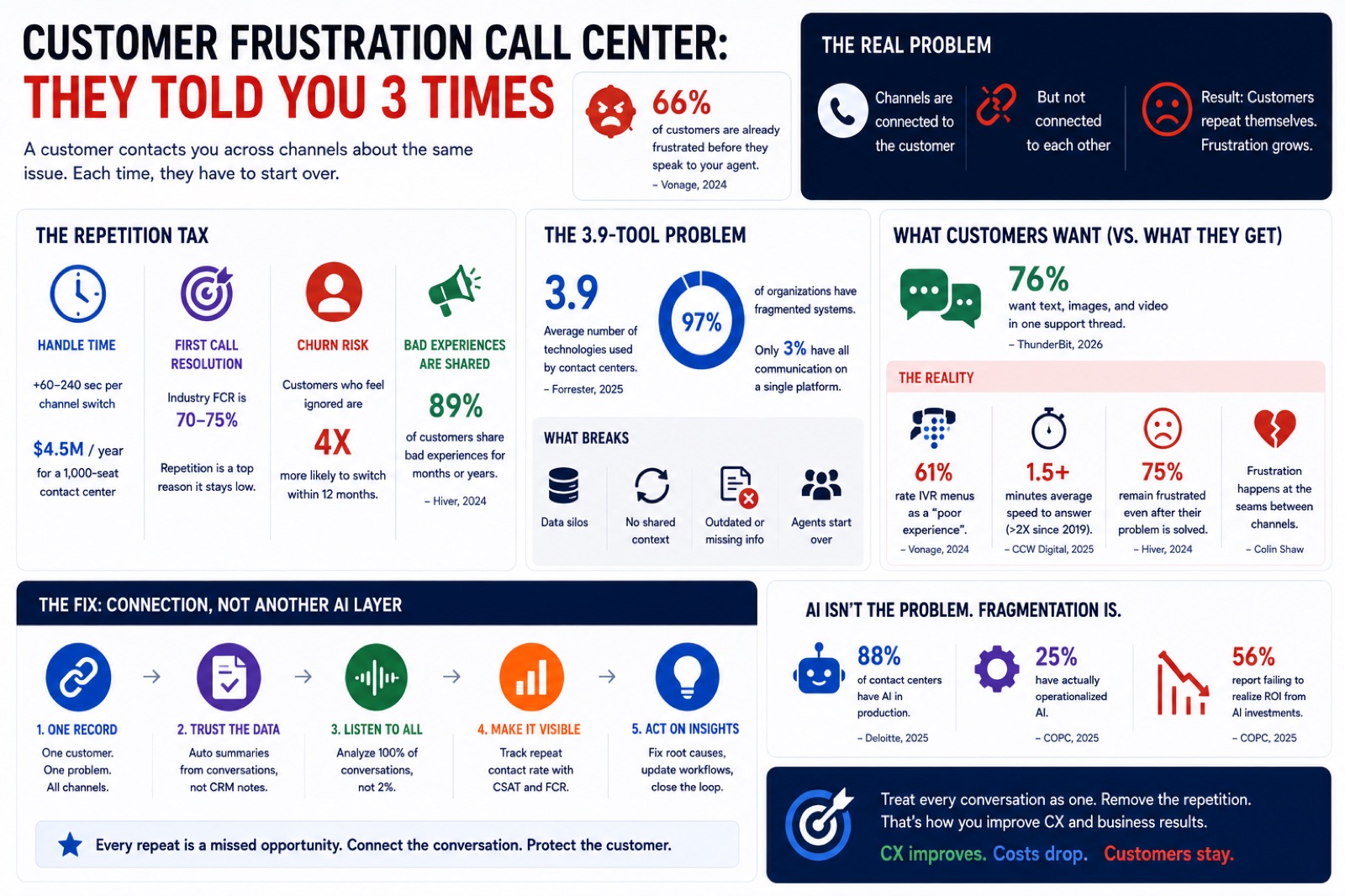
That customer is not angry about the failed transfer anymore. They are angry that nobody on your side seems to remember they exist. And here is the part that should keep contact center leaders awake: nearly two-thirds of customers are already frustrated before they speak to your agent (Mattersight, 2015). The IVR did not cause that. The repetition did.
This is the customer frustration call center problem nobody wants to admit. Channels are connected to the customer. They are not connected to each other.
The Repetition Tax Customers Pay Every Day
Accenture put the number at 89% — that is how many US consumers said having to repeat their issue to multiple representatives frustrates them (Global Consumer Pulse, 2013).
The cost of forcing repetition is not a soft metric. It shows up in three measurable ways.
Handle time. Every channel switch adds 60 to 240 seconds of context-rebuilding at the start of the next interaction. For a 1,000-seat center handling 30,000 calls per day, even one minute of avoidable repetition costs roughly 500 agent-hours per day. At a fully-loaded cost of $35 per agent-hour, that is $17,500 per day. About $4.5M per year, just to make customers tell you the same thing twice.
First call resolution. Industry FCR sits at about 71%, according to SQM Group. The single biggest reason FCR stalls is that the agent answering call number two cannot see what was promised on call number one. The customer ends up bouncing between channels not because the issue is hard, but because each touchpoint starts with a blank slate.
Churn. After a bad experience, 34% of consumers spend less with that company and 13% stop spending with it entirely. And in the customer experience contact center economy, switching is one click away.
The 3.9-Tool Problem
The reason customers repeat themselves is structural. The average organization manages 3.9 different contact center technologies (Puzzel’s State of Contact Centres 2026, via CX Today). Voice platform, chat platform, email/ticketing, CRM, and usually a separate WFM and QA stack. Only 3% of contact centers run on a single platform.
The other 97% have built their customer view by hand. Maybe a Salesforce widget that pulls in chat history. Maybe a custom report that lands in someone’s inbox at 7am. Maybe nothing at all.
A few things break in that environment:
- The voice channel records the call. The chat channel logs the transcript. The email channel keeps the thread. None of them talk to each other.
- The agent on the phone sees a CRM note. The note was typed by an agent who was tired and rushing through after-call work, and 76% of CRM users say less than half of their company’s CRM data is accurate and complete.
- Sentiment data lives in your CSAT survey, which most customers never answer: the median survey response rate is 9.98%. So when the customer calling today is the same person who emailed angry yesterday, your agent has no idea.
- The AI tools you bought to “fix” this — chatbots, voice bots, copilots — sit on top of the same fragmented data. They make the problem faster, not better.
This is the gap our conversation analytics and quality management work was built to close. Not by replacing your existing stack. By analyzing every conversation across every channel and giving the agent (and the AI agent) the context the customer already shared.
What Customers Actually Want
What customers want is not a separate ticket per channel: 76% of consumers say they would choose a company that allows text, images, and video in the same thread without restarting. One thread. One context. One conversation that travels with them.
What they get instead:
- 61% of US consumers say IVR menus make for a poor experience (Vonage, 2019)
- 3 in 4 are frustrated by long waits on calls and by having to repeat their queries (Hiver)
That last stat is the one to sit with. Three out of four customers are frustrated by the waiting and the repeating, not only by the problem itself. The question is not whether you resolve. It is how much effort you forced them to spend to get there.
Companies do not set out to frustrate. They optimize each channel in isolation. The frustration is what happens at the seams between channels — and customers feel every seam.
The Fix Is Not Another AI Layer
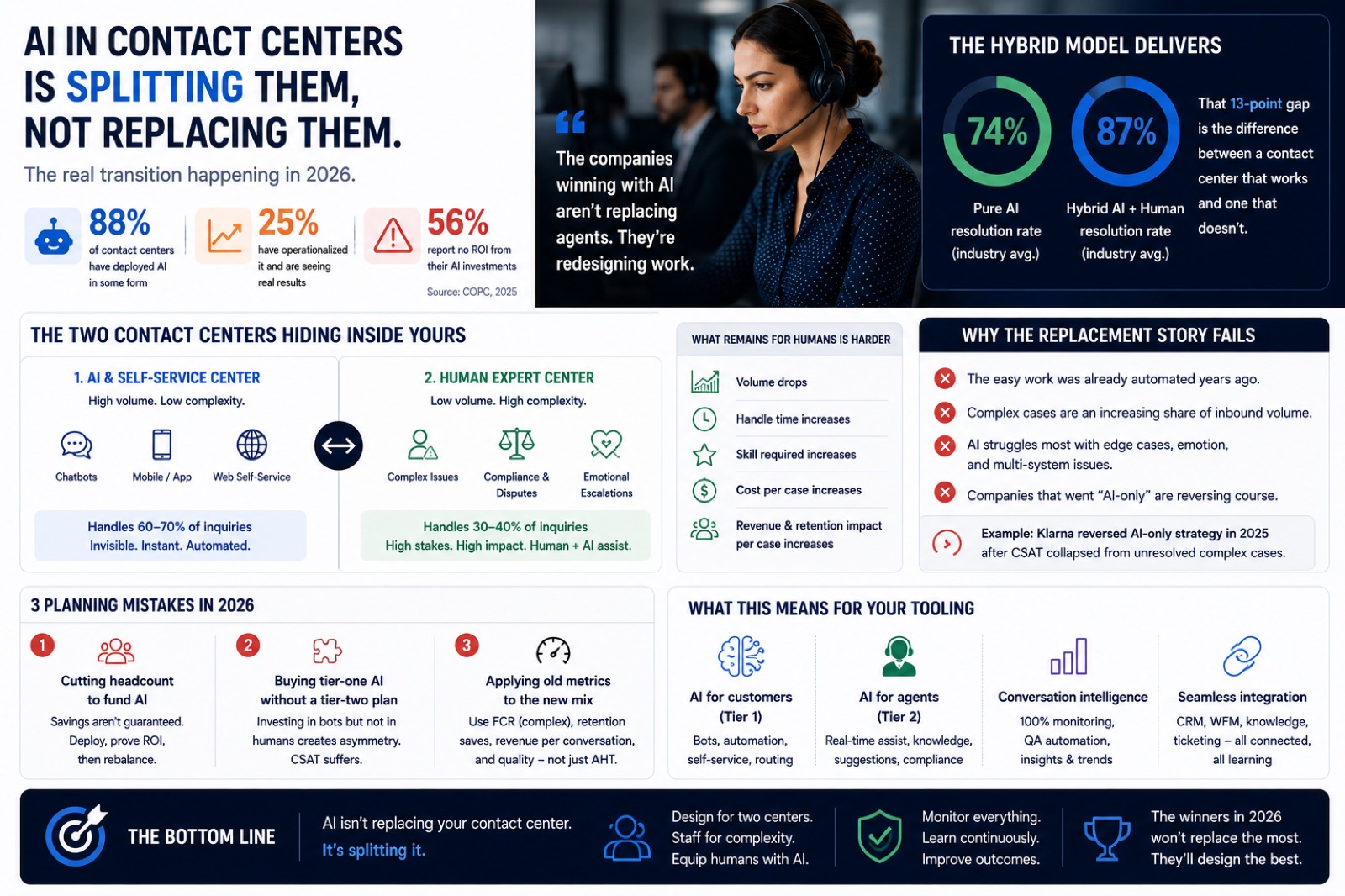
The instinct in 2026 is to throw more AI at this. AI chatbot to deflect. AI agent assist to summarize. AI voice bot to handle simple calls. Add up the deployments and 61% of customer service organizations now use AI (Deloitte, 2025). Yet 56% of contact centers are not realizing the return they expected from it (COPC).
The reason is that AI on top of fragmented data is just faster fragmentation. The chatbot does not know about the email thread. The voice bot does not know about the chat. The agent copilot summarizes the current call but cannot reach the previous one.
The fix is connection, not addition. Concretely:
Treat every conversation as one record. Voice, chat, email, social. Same customer, same problem — same record. This is what 100% conversation analytics actually buys you. Not just transcription. Not just sentiment. The ability to ask “what did this customer say last time?” before the agent picks up.
Stop trusting CRM notes. Replace them with auto-generated summaries from the actual conversation, validated against the transcript. We covered this in detail in our contact center cost reduction analysis — bad CRM data is the most expensive cost center most companies do not measure.
Listen to all of it, not 2% of it. The traditional QA model — review 2-5 calls per agent per month — was built for a world where everything had to be done by a human. It cannot catch repetition patterns at scale. Automated QA reviewing 100% of conversations catches what a sample misses, and crucially, it catches the customer telling you the same thing across three different agents.
Make repetition visible to the leadership team. Track “repeat contact rate” alongside CSAT and FCR. If a customer touches your brand more than twice for the same issue, something is broken. Most contact centers do not measure this. The ones that do see it correlate almost perfectly with churn.
What This Looks Like When It Works
Here is what connection looks like at OTP Bank. Its retail contact center went from scoring about 5% of calls by hand to running every call and chat through Ender Turing: first call resolution rose from 81% to 86%, and average handling time fell by 25% (OTP Bank case study).
None of that came from buying a new chatbot. It came from making the conversations the bank already had visible to the agents and the systems that needed them.
The financial case in our contact center ROI analysis holds: when customers stop having to repeat themselves, revenue goes up because retention goes up. Bain’s classic finding — that a 5% retention increase produces a 25% to 95% profit increase — does not work on its own. It requires the operational fix underneath: connecting what the customer said to what the agent hears.
What To Do This Week
Five concrete actions for VP and Director-level customer experience contact center leaders to take Monday morning:
- Pull a “repeat contact” sample. Pick 50 customers who contacted you 3+ times in the last 90 days. Listen to or read all of their interactions. Count how many times each customer had to re-explain the problem. Across industries, 56% of customers say they often have to repeat or re-explain information to different representatives.
- Audit your CRM data quality. Pick 100 random calls. Compare what the agent typed in the CRM to what was actually said.
- Map your channel handoffs. When a customer moves from chat to voice, what context travels? Usually nothing. Document this on a single page and circulate it to leadership.
- Define a “first contact” SLA, not a first call SLA. First call resolution measures the wrong thing in a multi-channel world. Track whether the issue is resolved in the first contact, regardless of channel.
- Stop scoring agents on the call you sampled. Score them on the journey. Until your QA covers 100% of conversations across channels, you are coaching agents on partial information — and they know it.
The customer who called your bank on Tuesday and the one who emailed on Thursday is the same person. Treating them like one person is not an AI feature. It is the basic promise of customer service. Most contact centers have stopped delivering it. The ones that fix it first will own the next decade of customer experience.
Want to see what 100% conversation coverage looks like in your environment? Request a demo.