Picture a SaaS company that has built what its CRO would call a modern customer success function. Defined CSM ownership of accounts, regular business reviews, health scores driven by usage data, renewal motions starting 90 days before contract end, and a clean handoff from sales at deal close. The function has grown headcount substantially over three years. Net revenue retention has moved modestly. Gross retention has been flat.
Ask why the CS effort isn’t translating into retention outcomes at the expected rate, and the answer is often in a place the CS team isn’t looking. Customers who eventually churn can be making contact center support requests at rising rates for months before the CSM notices any health-score change. The product usage data shows engagement holding up — these customers are still logging in, still using features. The support data shows something different — increasing frequency of friction, repetition of unresolved issues, signs that the relationship is deteriorating in ways the usage signals can’t detect.
The CS function is operating on the data CRMs and product analytics produce easily, and ignoring the churn signals sitting in the support function. The customers are telling the company they have problems through every available channel. The channel CS is watching isn’t the one customers are using.
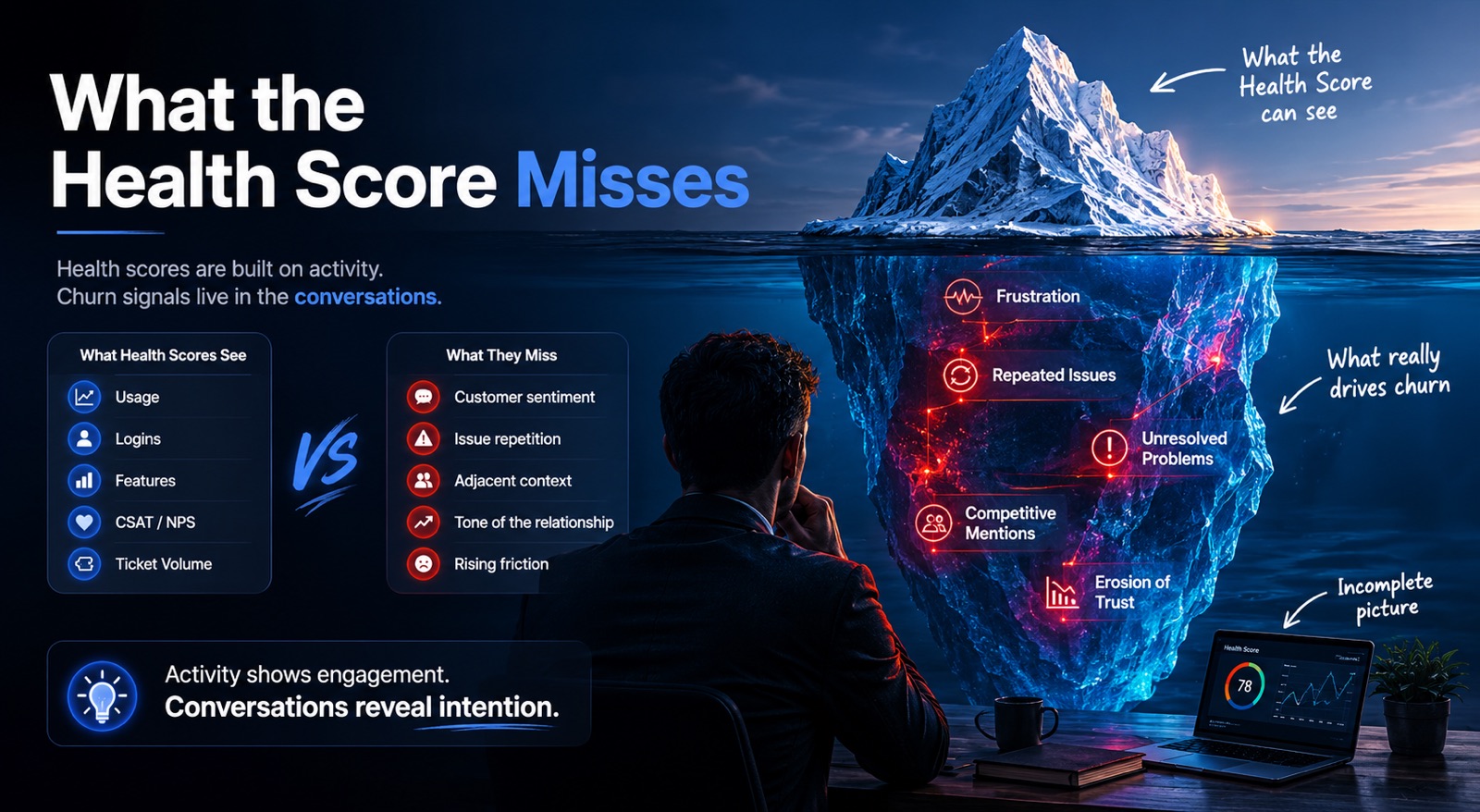
What the Health Score Misses
Most modern customer success health scores combine some mix of these inputs: product usage frequency, feature breadth, login activity, NPS or CSAT scores, support ticket volume, billing status, executive engagement. These are useful, but they share a common limitation — they capture activity, not experience. A customer can be active and unhappy. A customer can be using the product and quietly preparing to leave.
Several categories of signal that strongly predict churn are systematically absent or under-weighted in typical health scores.
Conversational sentiment. What customers actually say when they contact support reveals their current relationship with the product more directly than usage data does. A customer who logs in daily and tells your support team “I’m getting tired of fighting with this product” is in a different state than the usage data alone would suggest.
Issue repetition. A customer who contacts support multiple times about related issues — even if each ticket is technically resolved — is showing accumulated friction that pure ticket-volume metrics miss. The same number of tickets resolved differently in their conversational pattern produces wildly different churn outcomes.
Adjacent context. Mentions of internal pressure, organizational change, vendor evaluations, or competitor consideration in routine support conversations are extremely high-value signals. They almost never appear in CRM, but they show up regularly in support call recordings and chat transcripts.
Tone of the relationship. The shift from collaborative (“can you help us figure out how to…”) to transactional (“I just need you to fix…”) to adversarial (“we’ve been having this problem for months”) is one of the cleanest signals of relationship trajectory. It’s invisible to any data source other than the conversation itself.
Why CS Teams Don’t See This Data
The structural reason CS doesn’t act on conversation data is that it lives in a different operational system, owned by a different team, with different metrics and different access patterns.
Support tickets are owned by the support function, measured on resolution metrics, and analyzed by support managers. CSMs see ticket counts in their account dashboards but rarely review the underlying conversations. Going deeper would mean listening to calls, reading chats, and translating that into account-level insight — which is operationally expensive without conversation analytics infrastructure.
The result is that the support function has rich customer experience data flowing through it daily, none of which is being structured for retention use. The CS function has retention responsibility, none of the rich data, and a thin substitute in usage analytics.
The fix isn’t reorganization. It’s data integration. The conversation data needs to flow into the CS function in a structured form — sentiment trajectory, issue repetition, conversational warning signals, adjacent context — so the CS team can act on it without having to listen to every call.
What Conversation-Informed Customer Success Looks Like
Organizations that connect these signals tend to make four operational changes.
Health scores incorporate conversation signals. Sentiment trajectory across recent support contacts, issue repetition patterns, language signals of disengagement — all flow into the composite health metric alongside usage data. The score becomes more predictive because it incorporates the dimension previously invisible to it.
CS gets alerts on conversation triggers. Specific phrases or patterns in support calls — competitive mentions, frustration markers, escalation signals — produce CSM alerts in real time. This shortens the window between a warning signal appearing in support and CS being able to act on it.
Joint customer reviews include conversation context. Periodic account reviews look at recent support conversations, not just ticket counts. The picture of the customer’s actual experience becomes available to the CSM as they plan engagement.
Closed-loop measurement. Customers where CS intervened based on conversation signals are tracked against outcomes. The data refines the trigger criteria and validates which signals are worth acting on.
The Cultural Shift That Has to Happen
The harder part of this transition usually isn’t the technology — it’s the cultural one. Customer success teams have historically considered support a separate function with separate concerns. Listening to support calls felt like operational overhead, not strategic intelligence.
The reframe that works is treating support conversations as the most honest form of voice-of-customer data the company will ever capture. Customers in support are not on their best behavior. They’re not curated by the CSM’s account plan. They’re not phrasing things diplomatically for a quarterly business review. They’re telling the truth about their experience because they have an immediate problem they need solved.
That data is too valuable to leave unused. The CS function that takes it seriously can catch churn signals months earlier than the CS function that doesn’t, and the retention difference compounds quarterly until the gap becomes structural.
Five Things You Can Do This Week
1. Pull last quarter’s churned customer list. Check their support history. How many contacts in the 180 days before cancellation? What was the trajectory of issues? Compare against retained customers in similar segments.
2. Calculate the integration gap. When a customer mentions a competitor in a support call, how long before CS knows? If the answer is “we don’t have a process for that,” you have an information delay that’s costing renewals.
3. Listen to 10 support calls from your top accounts. Even without analytics infrastructure, manual review of conversations from high-stakes accounts will surface signals your health score is missing.
4. Add one conversation-derived signal to your health score. Even a basic one — recent sentiment direction, repeat contact rate — improves the score’s predictive value materially.
5. Build the CSM-to-support data flow. Doesn’t have to be sophisticated. A weekly summary of high-risk conversation signals delivered to each CSM is a starting point. The friction-removal often produces immediate retention improvement.
The customer success function is asking the right question — which of our customers is in trouble — using the wrong data. The usage metrics tell you what customers are doing. The support conversations tell you what customers are feeling. Both matter, but only one of them changes weeks before retention is decided, and most CS teams aren’t reading it. The churn signals are there. The CSMs just don’t have a window into the room where customers are producing them.