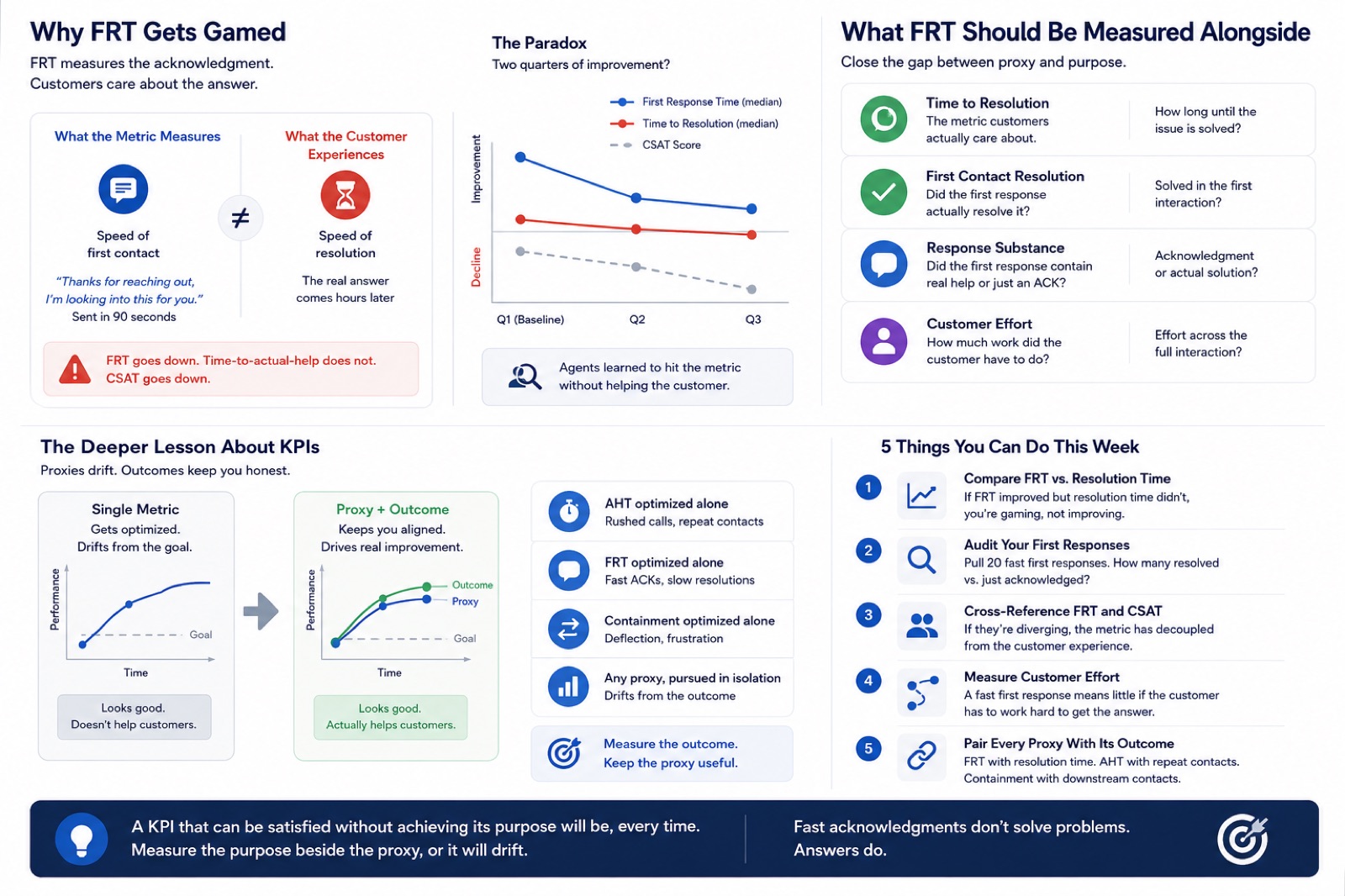
Suppose a customer support organization has made First Response Time its flagship metric. Over two quarters, it drives median FRT down impressively — from hours to minutes across its digital channels. Leadership celebrates. Then CSAT starts declining in the same period, which makes no sense to anyone, because faster response is supposed to make customers happier.
Look at what the fast first responses actually contain, and the paradox tends to explain itself. Agents, measured on FRT, learn to send a fast first response that satisfies the metric without addressing the issue — “Thanks for reaching out, I’m looking into this for you” sent within 90 seconds, followed by the actual substantive response hours later. The metric measures the acknowledgment. The customer experiences the wait for the real answer, which hasn’t improved at all. FRT has gone down. Time-to-actual-help has not. The metric is being satisfied without the outcome it was supposed to represent.
This is the classic failure mode of First Response Time, and it’s nearly universal. FRT measures speed of first contact, customers care about speed of resolution, and the gap between the two is where agents learn to optimize the metric at the expense of the goal.
Why FRT Gets Gamed
First Response Time is unusually easy to game because the behavior that satisfies it is trivially separable from the behavior that helps the customer.
A first response can be anything. An automated acknowledgment, a holding message, a “looking into it” reply — all of these satisfy FRT without doing anything for the customer. The moment the metric exists, the easiest way to hit it is to decouple the first response from any actual work, and rational agents under measurement pressure do exactly that.
The metric rewards the wrong half of the interaction. Customers don’t contact support to receive a fast acknowledgment. They contact support to get a problem solved. FRT measures the acknowledgment and stays silent on the solution, which means it can improve dramatically while the thing customers actually care about doesn’t move at all.
The gaming is invisible in the metric itself. FRT looking great tells you nothing about whether resolution improved. You only see the problem when you look at a different metric — CSAT, resolution time, repeat contacts — and notice it diverging from the FRT trend.
What FRT Should Be Measured Alongside
FRT isn’t useless. A genuinely fast, substantive first response does correlate with satisfaction. The problem is FRT in isolation. It needs companions that close the gaming gap.
Time to resolution. The metric customers actually care about. If FRT improves while time-to-resolution doesn’t, you’re gaming, not improving.
First contact resolution. Whether the first response actually resolved the issue rather than just acknowledging it. A fast first response that resolves beats a fast first response that defers, and only FCR captures the difference.
Response substance. Whether the first response contained actual help or just an acknowledgment. Conversation analytics can distinguish a substantive first response from a holding message, which makes the gaming visible in a way the raw FRT number never will.
Customer effort. How much work the customer had to do across the full interaction. A fast first response followed by three rounds of back-and-forth is worse than a slightly slower response that resolved in one.
The Deeper Lesson About KPIs
FRT is a specific instance of a general problem: any KPI that measures a proxy for the goal rather than the goal itself will eventually be optimized in ways that satisfy the proxy and abandon the goal.
This is why single-metric management fails in contact centers. AHT optimized alone produces rushed calls and repeat contacts. FRT optimized alone produces fast acknowledgments and slow resolutions. Containment optimized alone produces deflection and frustration. Every proxy metric, pursued in isolation, drifts away from the outcome it was supposed to represent.
The defense is measuring the actual outcome alongside the proxy, so the gaming becomes visible. When FRT and time-to-resolution are tracked together, the “fast acknowledgment, slow help” pattern can’t hide. The proxy stays useful only as long as the outcome is watched beside it.
Five Things You Can Do This Week
1. Compare your FRT trend to your resolution-time trend. If FRT improved and resolution time didn’t, you’ve found the gaming. The gap is the problem.
2. Audit what your first responses actually contain. Pull 20 fast first responses. How many resolved anything versus just acknowledged? The ratio tells you whether FRT means what you think.
3. Cross-reference FRT against CSAT. If they’re diverging, the metric has decoupled from the experience it’s supposed to represent.
4. Measure customer effort across the full interaction. A fast first response means little if it’s followed by a long, effortful resolution path. The whole interaction is what the customer experiences.
5. Pair every proxy metric with its outcome. FRT with resolution time. AHT with repeat contacts. Containment with downstream contacts. The pairing is what keeps the proxy honest.
First Response Time was supposed to make customers feel attended to quickly. Pursued alone, it teaches agents to send a fast nothing and call it a response. The metric improves, the celebration happens, and the customers wait exactly as long as they always did for the only thing they actually wanted — an answer. A KPI that can be satisfied without achieving its purpose will be, every time, unless you measure the purpose beside it.