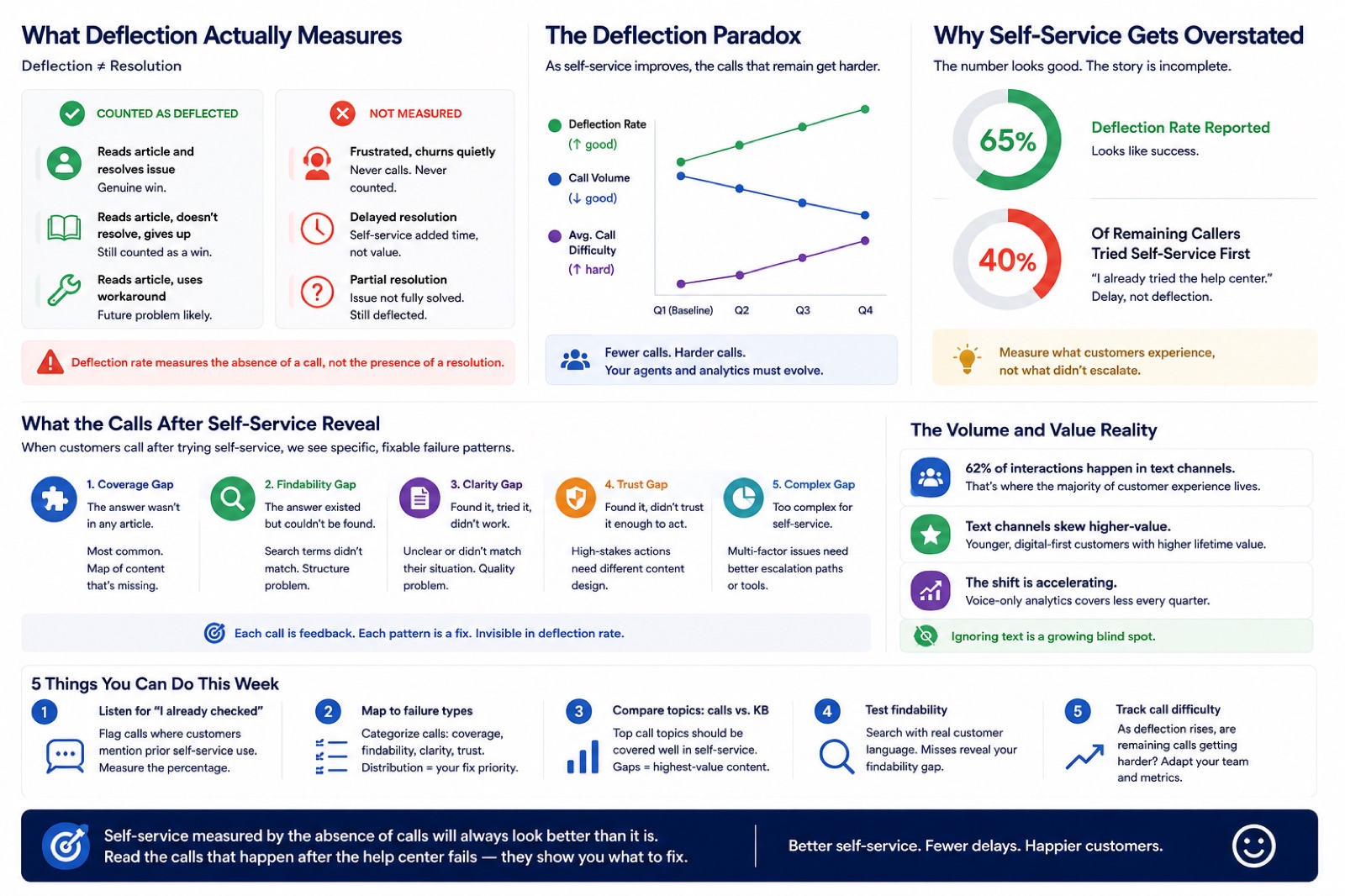
Suppose a software company has invested heavily in self-service. Comprehensive knowledge base, AI-powered search, community forums, in-product help. Its deflection metric — the rate at which self-service resolves issues without a support contact — is reported at 65%, and leadership treats it as evidence the investment is working.
Look at the calls that do reach support, and a pattern can emerge that undercuts the deflection number. A large share of callers may mention having already used self-service before calling: the article didn’t cover their situation, they searched and couldn’t find the answer, or the help center said to do X and X didn’t work. These customers haven’t been deflected. They’ve been delayed. Self-service has added a frustrating step to their journey before they end up exactly where they were headed anyway.
The deflection metric counts everyone who doesn’t call as a success, including the customers who read an article, give up, and resolve their issue some other way — or don’t resolve it and churn quietly. Self-service is being measured on the absence of calls, which is not the same as the presence of resolution.
What Deflection Actually Measures
The dominant self-service metric — deflection rate — has the same structural flaw as chatbot containment. It measures the absence of an escalation, not the presence of a resolution.
A customer who reads a help article and resolves their issue is deflected, correctly. A customer who reads a help article, doesn’t resolve their issue, and gives up is also counted as deflected. A customer who reads a help article, doesn’t find their answer, and resolves through a workaround that creates a future problem is deflected too. The metric can’t tell these apart, and they have completely different values.
This means deflection rate systematically overstates self-service success. The number includes genuine resolutions, abandoned attempts, and partial resolutions that store up future contacts, all counted identically as wins.
What the Calls After Self-Service Reveal
When conversation analytics flags calls where the customer mentions prior self-service use, the failure patterns become specific and fixable.
The coverage gap. The customer’s situation wasn’t covered by any article. This is the most common pattern and it’s a direct map of what’s missing from the knowledge base — the questions customers have that the content doesn’t answer.
The findability gap. The answer existed but the customer couldn’t find it. Their search terms didn’t match the article’s language. This is a search and content-structure problem, not a content gap, and it requires a different fix.
The clarity gap. The customer found the article, tried to follow it, and it didn’t work — either because the instructions were unclear or because they didn’t match the customer’s actual situation. This is a content quality problem.
The trust gap. The customer found the article but didn’t trust it enough to act on it without human confirmation. This is common for high-stakes actions and points to a need for different content design, not more content.
Each of these is a distinct failure with a distinct fix, and each is invisible in a deflection rate. The calls that follow self-service are the single richest source of knowledge base improvement priorities, and most organizations never analyze them as a category.
The Self-Service Paradox
There’s a counterintuitive dynamic in self-service investment. The better your self-service gets, the harder your remaining calls become.
As self-service successfully resolves the simple issues, the calls that still reach support are disproportionately the complex ones — the situations no article covers, the edge cases, the multi-factor problems. Your call volume drops, which looks like success, but your average call difficulty rises, which strains agents trained on a simpler call mix.
This means self-service investment changes the contact center, not just shrinks it. The agents need to be better, because the easy calls are gone. The analytics need to surface what self-service is failing at, because that’s what’s reaching the humans. Organizations that treat self-service purely as a volume-reduction play miss this and end up with a smaller contact center that’s worse at its harder job.
Five Things You Can Do This Week
1. Listen for “I already checked” in your calls. Flag calls where the customer mentions prior self-service use. The percentage tells you how much of your deflection is actually delay.
2. Map the calls after self-service to failure types. Coverage, findability, clarity, trust. Each call that follows self-service tells you which one failed, and the distribution is your fix priority.
3. Cross-reference your top call topics against your knowledge base. The topics customers call about most should be your best self-service content. Gaps between the two are your highest-value content priorities.
4. Test your findability with real customer language. Search your knowledge base using the words customers actually use, not the words your content team used. The misses reveal your findability gap.
5. Track call difficulty over time as self-service improves. As deflection rises, are your remaining calls getting harder? If so, your agent capability needs to rise with it, and your metrics need to account for the changing mix.
A 65% deflection rate sounds like a self-service program that’s working. The remaining callers who say they already tried the help center are telling you it’s working less well than the number suggests. Self-service measured on the absence of calls will always flatter itself. Measured on whether customers actually got what they came for, it tells you exactly what to fix — but only if you read the calls that happen after the help center fails.