Picture a B2B technology company that has grown its marketing-generated lead volume substantially over two years. Its cost-per-lead is healthy, the lead scoring model is sophisticated, and the SDR team has been scaled to handle the volume. Its conversion of MQL to opportunity, however, has drifted downward over the same period. Marketing blames sales. Sales blames lead quality. Both are partly right and entirely missing the actual problem.
Instrument the time stamps on its lead flow, and the drift often explains itself. As lead volume grows, the time from form submission to first SDR contact tends to stretch from minutes to hours. By the time the SDR reaches out, the prospect’s intent window has closed — they’ve moved on, contacted competitors, or simply forgotten the context that prompted the original form fill. The leads aren’t worse. The response timing is.
This is a common cause of lead conversion erosion in growing companies, and one that’s almost always invisible until someone instruments the time stamps. Speed-to-lead research has been published widely for a decade. Most organizations still don’t operationalize it.
What the Research Has Established
Research on lead response timing, including a study published in Harvard Business Review by James Oldroyd and colleagues, has converged on consistent findings.
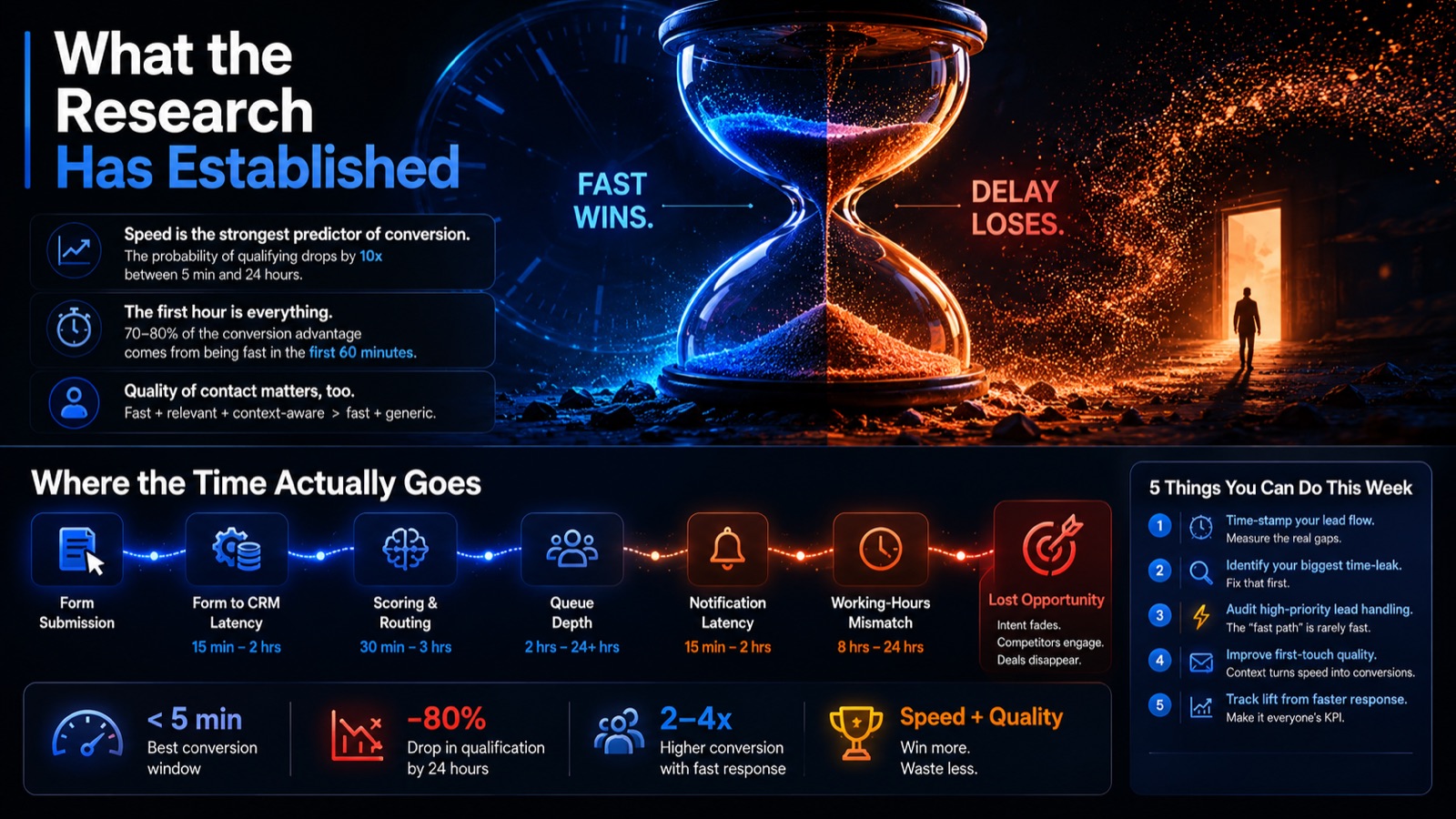
The probability of qualifying a lead drops sharply with response time. Leads contacted within 5 minutes are qualified at materially higher rates than leads contacted within an hour. By 24 hours, the qualification probability has dropped substantially. The exact numbers vary by study and industry, but the pattern is consistent.
The decay curve is steepest in the first hour. Most of the conversion advantage of fast response comes from being fast in the first 60 minutes, not from being modestly fast over 24 hours. The operational implication is that a system that responds within 4 hours instead of 24 hours captures far less of the available conversion benefit than a system that responds within 15 minutes.
Quality of contact matters as much as speed. A fast call that’s poorly handled captures less benefit than a slightly slower call that’s well-prepared. Speed without preparation produces low-quality conversations that don’t convert.
Where the Time Actually Goes
When organizations measure their actual lead-response pipeline, the time leaks happen in predictable places.
Form-to-CRM latency. Forms submitted on websites take longer to reach the CRM than most operations leaders assume. Integrations break, data quality rules block records, deduplication holds new leads pending merge decisions. Hours can elapse between submission and the lead being actionable in the SDR queue.
Scoring and routing latency. Lead scoring models that run nightly batches add hours to response time. Routing rules that require sales operations review before assignment add more.
Queue depth. When SDR teams handle leads in priority order, lower-priority leads can wait days. The “speed to lead” metric usually measures high-priority leads and ignores the long tail.
Notification latency. SDRs don’t always know a lead has arrived in real time. Email notifications, batched dashboard updates, and manual queue checks introduce additional delay.
Working-hours mismatch. Leads arriving outside business hours wait for the next business day. Organizations selling to global markets often have substantial portions of leads sitting overnight.
The cumulative effect is that even organizations with strong intent to respond quickly end up with median response times far longer than they realize.
What Conversation Data Adds
Once a lead does get contacted, the conversation analytics layer reveals patterns that determine whether the speed advantage gets capitalized.
The opening matters disproportionately. Fast contact with a generic opening still leaves much of the conversion benefit on the table. Fast contact with an opening that references the specific form the prospect submitted captures more.
Context preservation matters. The prospect who filled the form has context the SDR usually doesn’t. SDRs who can quickly orient to that context (what form, what page, what offer) convert better than SDRs who treat every lead as a cold opening.
Multi-touch sequencing matters. The first call is rarely the conversion call. The sequence of touches following the first call — voicemail, email, second call, LinkedIn — determines whether the initial speed advantage compounds or evaporates.
The Marketing-Sales Handoff Failure
The structural cause of slow lead response is usually the organizational boundary between marketing and sales rather than any individual team’s failure.
Marketing owns the lead until the SDR picks it up. Sales owns the SDR. The handoff itself is owned by no one. Process improvements proposed by either side typically run into “that’s not our team” responses from the other.
The fix requires explicit cross-functional ownership of the lead lifecycle from form fill through SDR contact. Without that, each team optimizes their own segment of the timeline and the gap in the middle stretches indefinitely.
Five Things You Can Do This Week
1. Time-stamp your actual response pipeline. From form submission to first SDR contact, what’s the median? The 75th percentile? The 95th? The distribution will probably surprise you.
2. Identify your biggest time-leak. Is it form-to-CRM, scoring, routing, queue depth, or working-hours? The biggest leak is your highest-leverage fix.
3. Audit your high-priority lead handling. When a lead enters the system flagged as high priority, what actually happens? The expected fast path often isn’t actually fast.
4. Calculate conversion by response-time bucket. Compare conversion rates for leads contacted within 1 hour, 4 hours, 24 hours, and longer. The pattern will tell you what response improvement is worth in revenue terms.
5. Make the handoff explicit and owned. One person, or one team, is accountable for the lead lifecycle from form submission to first contact. Without explicit ownership, the gap will keep widening.
The leads aren’t getting worse. The response timing usually is, and the lead-quality argument is what masks the timing problem from people who could actually fix it. The hours your leads are waiting aren’t neutral — they’re where the conversion you paid for is being lost. The fix isn’t a better lead source. It’s instrumenting the time stamps and treating the handoff like the revenue-critical operation it actually is.