The main Observe.AI alternatives are Ender Turing, Level AI, Cresta, CallMiner, Balto and MaestroQA, which add AI on top of the contact center platform you already run, and NICE CXone and Genesys Cloud CX, contact center suites with the AI built in. Observe.AI does not publish prices on its website: it says pricing is custom and based on deployment scope. Its own AWS Marketplace listings sell Real-Time AI and Post-Interaction AI at $828 per agent a year each, on a 12-month contract.
The short answer
- Published prices, a free start and every call scored: Ender Turing. Free for up to 5 agents; Team is $39 per agent a month, and you can cancel monthly.
- The same mix of AI agents, live assist and auto QA from another enterprise vendor: Level AI or Cresta.
- Root-cause analytics for a large program: CallMiner.
- Replacing your phone system too: NICE CXone or Genesys Cloud CX.
- Live guidance on sales and service calls: Balto.
- A support QA program on Zendesk or Salesforce: MaestroQA.
Observe.AI and eight alternatives at a glance
| Tool | Kind | Starting price | Try it | Live help during calls | Auto QA on every conversation |
|---|---|---|---|---|---|
| Observe.AI | AI platform on your phone system | Quote; $828 per agent a year per module on AWS Marketplace | Demo | Yes | Yes |
| Ender Turing | AI layer on your phone system | Free plan; $39 per agent a month | Free plan, no expiry | Early access | Yes |
| Level AI | AI platform on your phone system | Quote | Demo | Yes | Yes |
| Cresta | AI platform on your phone system | Quote; Agent Assist from $150,000 a year on AWS Marketplace | Demo | Yes | Yes |
| CallMiner | AI layer on your phone system | Quote | Demo | Yes | Yes |
| NICE CXone | Contact center suite | $110 per agent a month | Quote | Not on the pricing page | Quality Management from $135 a month |
| Genesys Cloud CX | Contact center suite | $75 per user a month, billed annually | Quote | Not on the pricing page | Quality management from $115 a month |
| Balto | AI layer on your phone system | Quote | Demo | Yes, on phone calls | Yes |
| MaestroQA | QA platform | Quote | Demo | No | Yes |
Sources, checked September 26, 2026: each vendor's own site (Observe.AI, its AWS Marketplace listing, Ender Turing, Level AI, Cresta, its AWS Marketplace listing, CallMiner, NICE, Genesys, Balto, MaestroQA). Prices change; check the vendor's page before you buy.
When Observe.AI is the right choice
Observe.AI builds AI agents that resolve customer inquiries end to end across voice and chat, a Frontline Companion Agent that assists live agents in real time, and operations agents that evaluate interactions, generate coaching and surface insights. Its Auto QA assesses 100% of customer interactions. It names more than 250 integrations, including Five9, Genesys, NICE, Amazon Connect, Talkdesk, Salesforce and Zendesk, and sells to enterprise customer-experience teams in banking, healthcare, insurance, transportation, travel and utilities.
If you want AI agents that answer your customers and AI for your human agents from one enterprise vendor, Observe.AI is built for that. Teams look at alternatives when they want prices before a sales call, a free start, a monthly commitment instead of a 12-month contract, or a tool focused on scoring and analyzing every conversation.
How we compared them
We read each vendor's own product, pricing and marketplace pages on September 26, 2026, and compared five things: whether it is a suite or a layer on your existing phone system, what it costs and how it is charged, how you can try it, whether it helps agents during the call, and whether it scores every conversation automatically. For the suite-or-layer choice in more depth, see our AI call center software comparison.
The 8 best Observe.AI alternatives
1. Ender Turing
Best for: contact centers that want every conversation analyzed and scored on their own scorecard, with prices they can see before a sales call.
Pricing: free plan for up to 5 agents (100 calls per agent a month, calls up to 10 minutes, no expiry); Team $39 and Business $79 per agent per month; Enterprise is custom and adds on-premise or private-cloud deployment. Sales and customer-success teams: $59 and $89 per user per month. See pricing.
G2 rating: 4.8/5.
What the AI does on your calls:
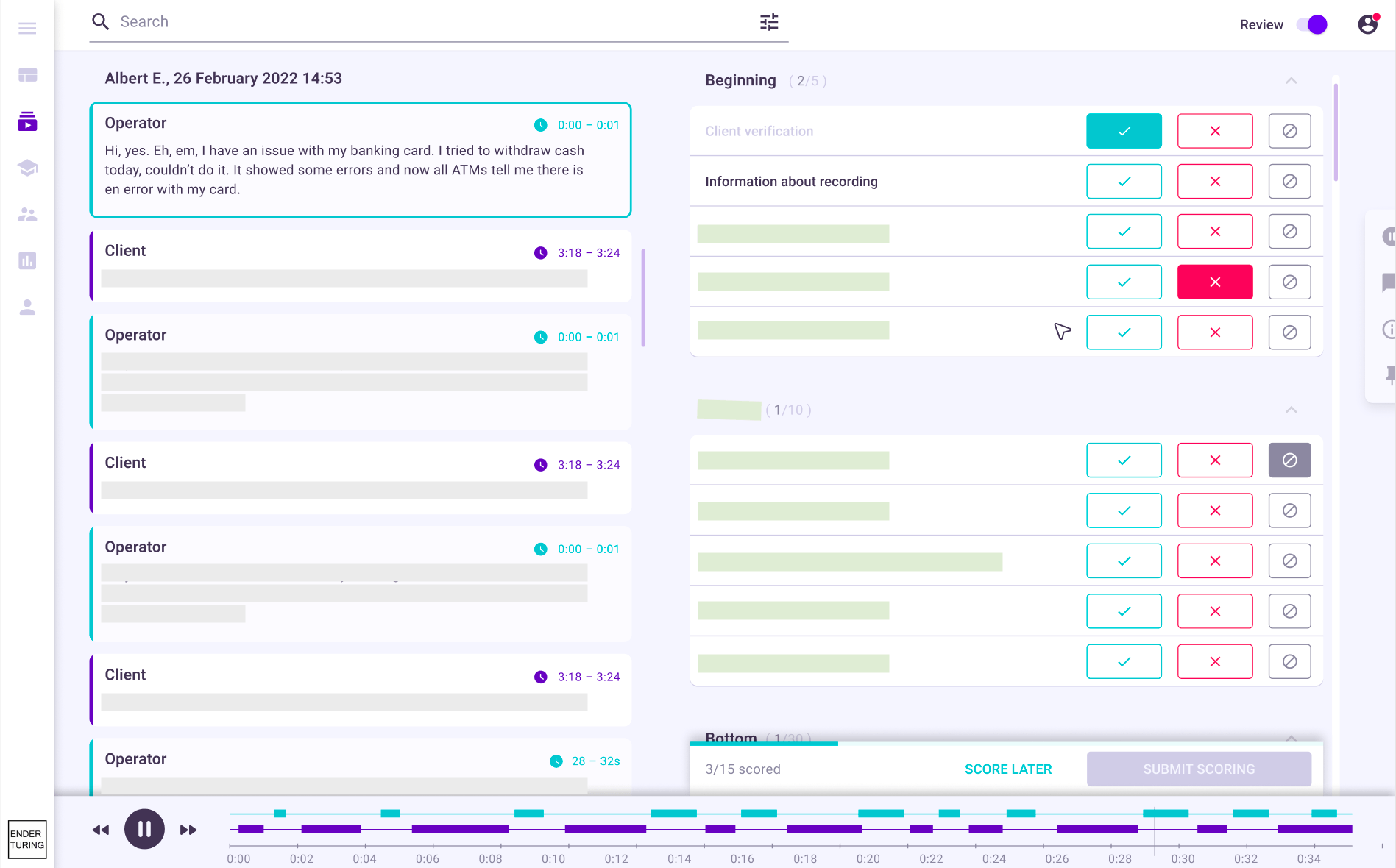
- Scores 100% of conversations on your own scorecard with AutoQA. Automated scorecards typically reach 95%+ agreement with your own reviewers, and the accuracy is shown for every point (quality management; how accuracy is measured).
- Analyzes every call, chat and meeting in seconds, in any language: transcript, topics, CSAT, silence and script adherence (speech analytics).
- Answers questions about your conversations in plain language: "Why did calls about blocked cards rise last week?" (Chat with EnderGPT).
- Automates the work around the calls with Enders: escalations, summaries and coaching material (Enders).
- Coaches each agent with their own dashboard, playlists of calls to learn from, training plans and quizzes (agent management).
What changes for customers: averages across our contact-center deployments are 100% of calls automatically scored (against a 3–5% manual baseline), +19% customer satisfaction, −15% average handle time and 68 QA hours saved per specialist per month (case studies). At OTP Bank, first call resolution rose from 81% to 86% once every call and chat was analyzed (OTP Bank case).
Works with your stack: it connects read-only to NICE CXone, Genesys Cloud, Five9 and Talkdesk, and to Amazon Connect, Zendesk, GoHighLevel and others, or records browser calls with its extension (integrations).
Languages: any language. Production speech recognition today covers English, Spanish, Portuguese, French, German, Polish, Ukrainian, Arabic, Chinese, Japanese and more; a language we do not run yet is added on request or connected through your own speech-recognition engine.
Choose it over Observe.AI when: you want to see prices before a sales call, start free, and cancel monthly instead of signing a 12-month contract; or you need on-premise or private-cloud deployment (Enterprise).
Limits to know: Ender Turing has no AI agents that talk to your customers, and it is not a dialer or a contact center suite; live suggestions during the call (agent assist) are still in early access.
We make Ender Turing. Every fact in this entry comes from our pricing page, our case studies, our Help Center or G2. See how quality management works or start free.
2. Level AI
Best for: enterprise contact centers in financial services, healthcare, retail, insurance, BPO and collections that want AI agents, live assist and QA from one vendor.
Pricing: not published. Level AI says its deployments combine per-agent pricing, platform licensing and usage components. Evaluation starts with a demo.
What the AI does:
- Quality Management scores 100% of conversations across calls, chats, emails and bot conversations.
- AI Virtual Agents handle voice and chat in 50+ languages; AI Workers run multi-step workflows.
- Assist gives agents real-time AI or manager help during the conversation, alongside voice-of-the-customer analytics, screen recording and coaching.
Choose it over Observe.AI when: you want a second enterprise quote for the same mix of AI agents, live assist and QA. It connects to Five9, Genesys, NICE, Amazon Connect, Talkdesk, Twilio, UJET, LivePerson, Salesforce and Zendesk.
3. Cresta
Best for: large enterprises. Cresta names companies with 250+ employees, often Fortune 1000, and teams of 100+ care agents or 50+ sales agents, in telecom, financial services, insurance, healthcare, travel, retail, home services and automotive.
Pricing: custom and sold direct to enterprise, with no public self-serve tier. On its AWS Marketplace listing, Agent Assist for Voice costs $150,000 a year for up to 100,000 calls ($1.50 per extra call), and Agent Assist for Chat $150,000 a year for up to 125,000 chats ($1.20 per extra chat), on non-cancellable 12-month contracts.
What the AI does:
- AI Agent works across voice and digital channels in 30+ languages.
- Agent Assist gives human agents real-time guidance; Conversation Intelligence analyzes 100% of conversations.
- Quality Management, Coach, Insights, AI Analyst, Knowledge Agent and Opera, a no-code builder for your own AI rules.
Choose it over Observe.AI when: real-time guidance for large care and sales teams is the priority and you want to write your own AI rules without code.
4. CallMiner
Best for: large enterprise contact centers and outsourcers with a team to run a broad analytics platform.
Pricing: not published; its pricing link leads to the CallMiner Eureka product page, which offers a demo.
What the AI does:
- Analyzes 100% of omnichannel interactions for root causes, performance, sentiment and emotion (CallMiner Analyze).
- Automated scoring, feedback and progress monitoring for QA and coaching (CallMiner Coach).
- Real-time guidance for agents during the call (CallMiner RealTime), plus generative categories and summaries (Advanced AI) and redaction (Redact).
Choose it over Observe.AI when: root-cause analytics across every omnichannel interaction is the main job and you have a team to run a broad platform. Compare it with Verint and Medallia in our CallMiner, Verint and Medallia comparison.
5. NICE CXone
Best for: contact centers replacing their phone system and buying routing, workforce management and analytics as one platform.
Pricing: published per agent per month: Omnichannel Suite $110, Essential Suite $135 (Quality Management included), Core Suite $169, Complete Suite $209 (Interaction Analytics included), Ultimate Suite $249 plus $0.25 per session.
What the AI does: quality management from the Essential Suite and interaction analytics from the Complete Suite; below those tiers they are add-ons.
Choose it over Observe.AI when: you are replacing your phone system too, and want routing, workforce management and analytics from one vendor. The trade-off: the analytics come with the suite.
6. Genesys Cloud CX
Best for: contact centers running Genesys Cloud as their platform that want analytics and QA priced per seat.
Pricing: published per user per month, billed annually: CX 1 $75, CX 2 $115, CX 3 $155, CX 4 $240.
What the AI does: quality management and evaluations are included from CX 2 ($115) and an add-on on CX 1; speech and text analytics are included from CX 3 ($155) and an add-on below it. Every plan includes a monthly pool of AI tokens per organization, and CX 4 adds 30 AI Experience tokens per named agent.
Choose it over Observe.AI when: you already run Genesys Cloud and want QA and analytics without a second vendor.
7. Balto
Best for: B2C contact centers where conversations drive revenue, such as insurance, banking, collections and healthcare. Balto's own FAQ says teams under 10 agents may not be a fit.
Pricing: not published. Balto says pricing depends on the number of seats and the contract length; there is no free trial, and evaluation starts with a demo.
What the AI does:
- Agent Assist: real-time answers and guidance during calls. It works on phone calls through a softphone.
- Quality: AI scores every interaction across voice, chat and email.
- Coaching, Insights, real-time Compliance monitoring, Notes (summaries) and Togo voice AI agents, all under one license.
Choose it over Observe.AI when: live guidance on sales and service calls is the main job. It connects to more than 50 contact center platforms, including Five9, NICE CXone, Genesys Cloud, RingCentral, Talkdesk and Amazon Connect.
8. MaestroQA
Best for: support and QA teams that want to run a quality program across calls, chats, emails, bots and surveys.
Pricing: not published; pricing is tailored to use case and team size after a form, and a demo is free.
What the AI does:
- AutoQA scores 100% of tickets on your own criteria.
- AskAI answers ad-hoc questions about conversation data; custom AI metrics run on every conversation.
- AI-assisted coaching, reporting and a data-warehouse export; it also monitors AI chatbots.
Choose it over Observe.AI when: you run a support QA program on Zendesk, Salesforce, Intercom, Five9, NICE or Talkdesk and do not need live agent assist, which MaestroQA does not offer.
Frequently asked questions
Who are Observe.AI's main competitors?
Level AI, Cresta, CallMiner, Balto and MaestroQA among AI platforms that work on top of your contact center, and NICE CXone and Genesys Cloud CX among contact center suites. Ender Turing is the alternative with published prices and a free plan.
How much does Observe.AI cost?
Observe.AI does not publish prices on its website; it says pricing is custom and based on deployment scope, with no public self-serve tier. Its own AWS Marketplace listings sell Real-Time AI (agent assist, knowledge, supervisor assist and summaries) and Post-Interaction AI (Auto QA, manual QA and coaching) at $828 per agent a year each, about $69 per agent a month, and screen recording at $144 per agent a year, on 12-month contracts.
Is there a free alternative to Observe.AI?
Yes. Ender Turing has a free plan for up to 5 agents: 100 calls per agent a month, calls up to 10 minutes, and no expiry. None of the other alternatives here lists a free plan on its own site; they start with a demo or a quote.
Which Observe.AI alternative suits a small contact center?
Balto says teams under 10 agents may not be a fit, Cresta names teams of 100+ care agents or 50+ sales agents, and Observe.AI, Level AI and Cresta sell custom enterprise deployments. Ender Turing starts free for up to 5 agents, and its Team plan is $39 per agent a month with no limits on conversations. Compare the plans.