For 40 years, the contact center ran on a simple pyramid. Tier 1 handled password resets and balance checks. Tier 2 took the escalations. Tier 3 owned the ugly, unusual, expensive ones. The math worked because 70% of calls were simple, and simple calls were cheap.
That pyramid is collapsing. AI in contact centers is eating the base. What remains is a shape nobody staffed for, budgeted for, or trained for. Most operations leaders still haven’t noticed.
AI in Contact Centers Ate the Base of the Pyramid
Look at the volume shift. Customers with simple problems no longer call. They tap the app. They text the bot. They ask Google. They ask ChatGPT. When they do reach a live channel, the AI voice agent or chatbot handles it before a human ever sees the ticket.
Klarna reported that its AI assistant handled two-thirds of its customer service chats in its first month, doing the equivalent work of 700 full-time agents. Bank of America’s virtual assistant Erica now handles over 2 billion interactions cumulatively. Bank of America publishes these numbers because they’re bragging, but the operational consequence is buried in the press release: those interactions used to be Tier 1 calls.
The live queue is shrinking at the bottom. Not because customers went away. Because the easy half of the queue did.
Here’s the part nobody’s saying out loud: the calls that remain are the ones nobody ever wanted. Emotional escalations. Compliance-sensitive conversations. Multi-system problems that require three departments. Fraud disputes. Complaints with legal exposure. Angry customers who already tried the bot and are twice as furious for having wasted their time.
Tier 1 is dying. Tier 3 is what’s left. And Tier 3 was never designed to be your average call.
The Data Behind the Restructure
The numbers reveal the shape of the new contact center, and they’re jarring.
Handle times keep rising, and vendors love to blame agent tenure. The real driver: the mix of remaining calls got harder.
Metrigy describes contact center interactions as increasingly complex. And 56% of contact centers are not realizing the return they expected from AI, according to COPC.
First call resolution numbers tell the same story from a different angle. SQM Group’s benchmark put industry-average FCR at 72% in 2020; its 2024 result was 69%. Not because agents got worse. Because the calls got harder to resolve on first contact.
The people problems are worse. Turnover on complex-only queues runs 45-55% annually versus 25-35% on mixed queues. Companies that automated their Tier 1 without restructuring created the industry’s most brutal jobs by accident.
The economics are ugly too. A conversation that used to cost $4.20 to serve (mostly Tier 1) now costs $14.80 (mostly Tier 2/3). Automated deflection saved the CFO money on volume but transferred every remaining minute into a more expensive category. Most finance teams don’t see the mix shift. They see AHT and cost per contact rising and blame operations.
Why the Traditional Tier Model Breaks
The 1/2/3 pyramid worked because it matched a cost-optimized routing problem. Cheap Tier 1 agents caught volume. Skilled Tier 2 agents caught escalations. Specialist Tier 3 handled edge cases. Training investment concentrated at the top of the pyramid because that’s where scarcity mattered.
When the base disappears, the whole structure inverts. You now need every agent to have the skills of what used to be Tier 2, because Tier 1 doesn’t exist as a warmup lane anymore. New hires don’t get a runway of easy calls to build confidence. Their first live interaction is often a customer who already failed with the bot, is on their second contact attempt, and is escalated by default.
Traditional hiring profiles break too. The old model recruited high-volume, cost-efficient agents for Tier 1 and let them earn promotions to Tier 2. That career ladder assumed a wide base to promote from. When the base is 30% of what it was, you can’t build a talent pipeline through it. Every hire has to start closer to what used to be a mid-tier role.
Training scales don’t match either. Onboarding used to be two weeks of scripts and system navigation, with real skill built through months of Tier 1 volume. Now you’re asking new agents to handle emotional, multi-system, high-stakes calls from week one. Companies still running two-week onboarding are producing agents who fail in month one and quit in month three.
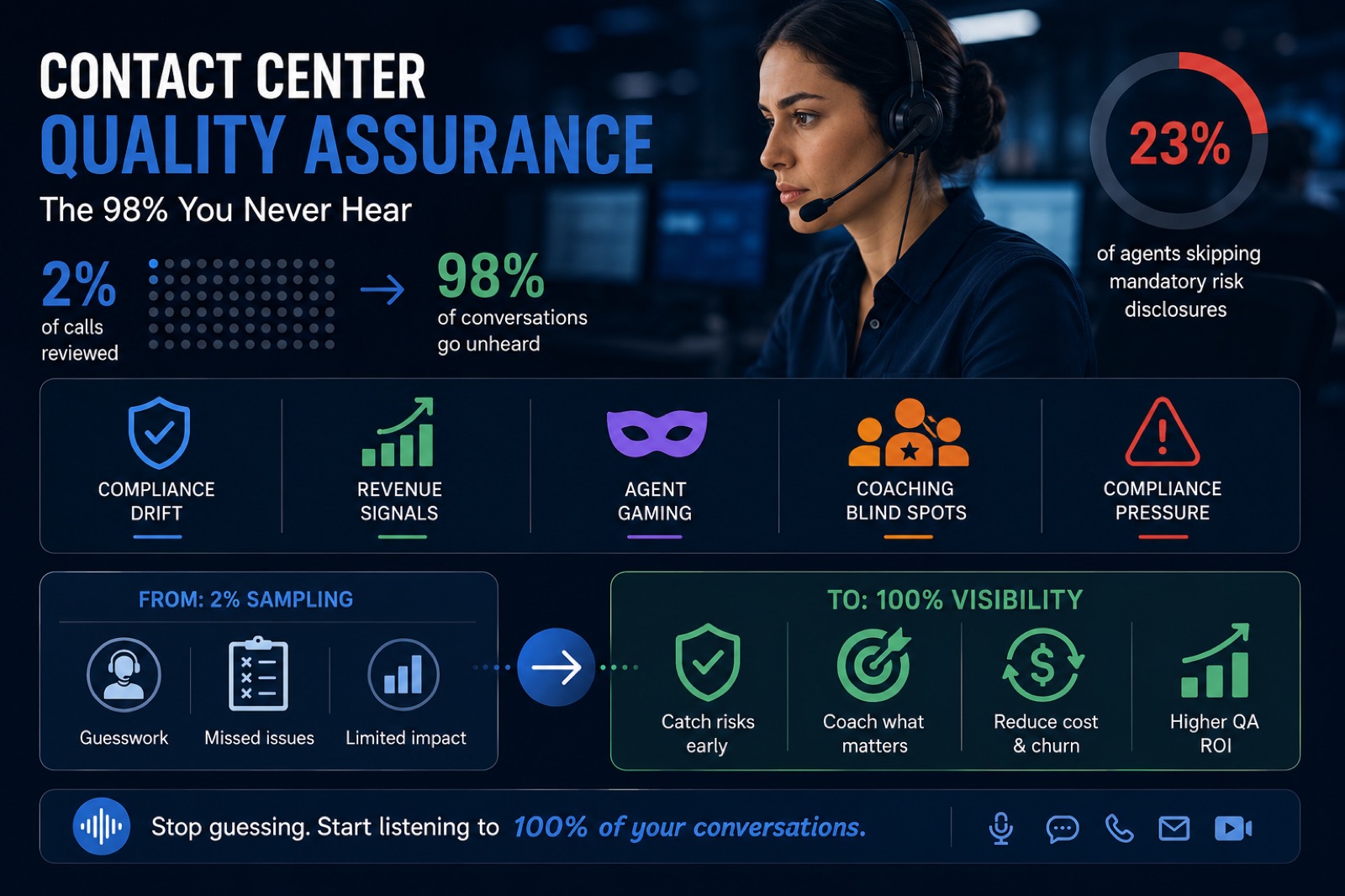
QA breaks too. Traditional QA sampling worked by pulling 2-5 calls per agent per month, mostly from a large pool of straightforward interactions where “did they follow the script” was a valid question. When most of the queue is complex, script adherence becomes the wrong metric. Sampling 2% of complex calls means you see almost nothing. This is why companies serious about the new mix are shifting to 100% AI-powered quality assurance. You cannot manage this shape of workload with the old sampling math.
Coaching cadence breaks. Weekly one-on-ones designed around script feedback don’t help an agent who just handled a two-hour compliance conversation. What they need is same-day debrief with someone who understands the specific case type. That requires either senior coach density that doesn’t exist, or AI-powered coaching that surfaces the coachable moment in real time.
What AI in Contact Centers Actually Restructures
The contact centers restructuring successfully, the ones actually capturing the promised ROI of AI in contact centers, share four patterns.
First, they redefine the role. The remaining human agent is not a “Tier 1 CSR” or even a “Senior CSR.” They are a customer resolution specialist. Their job is complex problem solving, emotional de-escalation, multi-system coordination, and judgment calls the AI cannot make. Compensation matches. Training matches. Career ladder matches. Companies still using titles from 2018 are attracting candidates who will not survive the new job.
Second, they invest in intelligence, not just automation. Deflecting simple calls to a bot is table stakes. What differentiates the survivors is the intelligence layer that spans the whole system: knowing which self-service failures led to which agent escalations, tracking sentiment across bot-then-human journeys, flagging compliance risks in real time. This is where conversation intelligence platforms earn their keep in the hybrid AI customer service model. You can’t run this shape of contact center on dashboards.
Third, they resize by capability, not headcount. The old plan was “we need N agents for X call volume.” The new plan is “we need agents with these five capabilities in this ratio for this mix of complex cases.” Volume forecasting still matters. Complexity forecasting matters more. Some teams now forecast by case type (fraud dispute, complaint with regulatory exposure, multi-account problem) and staff to peak-complexity, not peak-volume.
Fourth, they measure what actually matters. AHT and cost per contact still get reported to finance, but internal decision-making runs on different metrics. Resolution quality (did the customer’s problem actually get solved and stay solved?). Emotional trajectory (did the customer end the call in a better state than they started?). Cross-channel coherence (did the human agent see what the bot already tried?). Regret rate (did the customer feel heard, or did they hang up thinking “why did I bother?”). These are all AI-scoreable at 100% coverage. None of them are visible on a traditional wallboard.
The result is a smaller contact center where every conversation matters 10x more. The old KPI targets were built for volume. The new ones need to be built for stakes. Companies that make this transition intentionally end up with lower headcount, higher agent tenure, higher CSAT, and higher revenue per interaction. Companies that just automate Tier 1 without restructuring end up with the same headcount ratio, unhappier agents, worse CSAT, and a CFO who wonders why the AI investment didn’t pay off.
What To Do About It This Week
If you run a contact center, five actions this week matter more than any strategy deck about AI in contact centers you’ll read this quarter.
- Pull your handle-time trend for the last 24 months and segment by case type. If AHT is up but you don’t have the case-type breakdown, you’re flying blind. The mix shift is the story finance needs to hear before the next AI ROI conversation.
- Audit your onboarding curriculum against your current call mix. If new agents still spend week one learning password reset flows that the bot now handles, you’re preparing them for a job that no longer exists. Rebuild around the calls they will actually take.
- Sample 20 escalated calls from the last week and count how many started with a failed bot interaction. Then check whether the agent had visibility into what the bot tried. If they didn’t, the customer just explained their problem twice.
- Kill the 2-5 calls per agent per month QA sampling program. With most of your queue now complex, sampling is statistically meaningless. Move to 100% AI-scored quality on a small number of high-stakes dimensions (resolution quality, emotional trajectory, compliance risk). Better one metric measured on every call than eight measured on nothing.
- Reprice your agent role. Look at the top three complexity drivers in your current call mix and ask whether your current compensation attracts people who can handle them. If not, either resize the role or resize the pay. Trying to run the new contact center on old economics is why 45-55% of complex-queue agents are quitting.
The base of the pyramid is gone. Pretending the pyramid still exists just makes the collapse messier. The contact center of 2028 will be smaller, sharper, and, if you build it deliberately, a better job than the one it replaced. The window to restructure before your best agents quit is right now.