You learn about the bad call next week.
The survey goes out after the contact, the answer comes back later or never — and the customer who left angry has already told three people.
A survey tells you how the customers who answered it felt, days later. Ender Turing analyzes every call, chat and email as it comes in and gives each one an entry CSAT and an exit CSAT — how the customer arrived and how they left — by agent and by topic, on 100% of conversations. No survey to send, nothing for the customer to do. Free for up to 5 agents.
Example week — illustrative numbers, not customer data. Real boards below.
The customers who answer are mostly the delighted and the furious. The ones who went quiet, hesitated, got what they asked for but not what they needed — the majority — never rate anything. You manage satisfaction from a sample that was never meant to represent the whole.
The survey goes out after the contact, the answer comes back later or never — and the customer who left angry has already told three people.
A single 1-star from an unlucky queue day defines an agent's month, while forty calm, resolved conversations go unrecorded.
A CSAT of 3.6 says nothing about whether it was the refund policy, the hold time or one script line. The reason is in the conversations, and the conversations are unread.
Every survey is a message the customer did not ask for, a tool to run, and analysis work to turn answers into anything. Marketing and NPS studies take weeks and budget.
You cannot coach, escalate or fix what you only hear about from the few who filled in the form.
Ender Turing's AI customer-satisfaction analysis runs on the conversations your contact center already has. Here is what replaces what.
One survey per contact, answered by a few, days later.
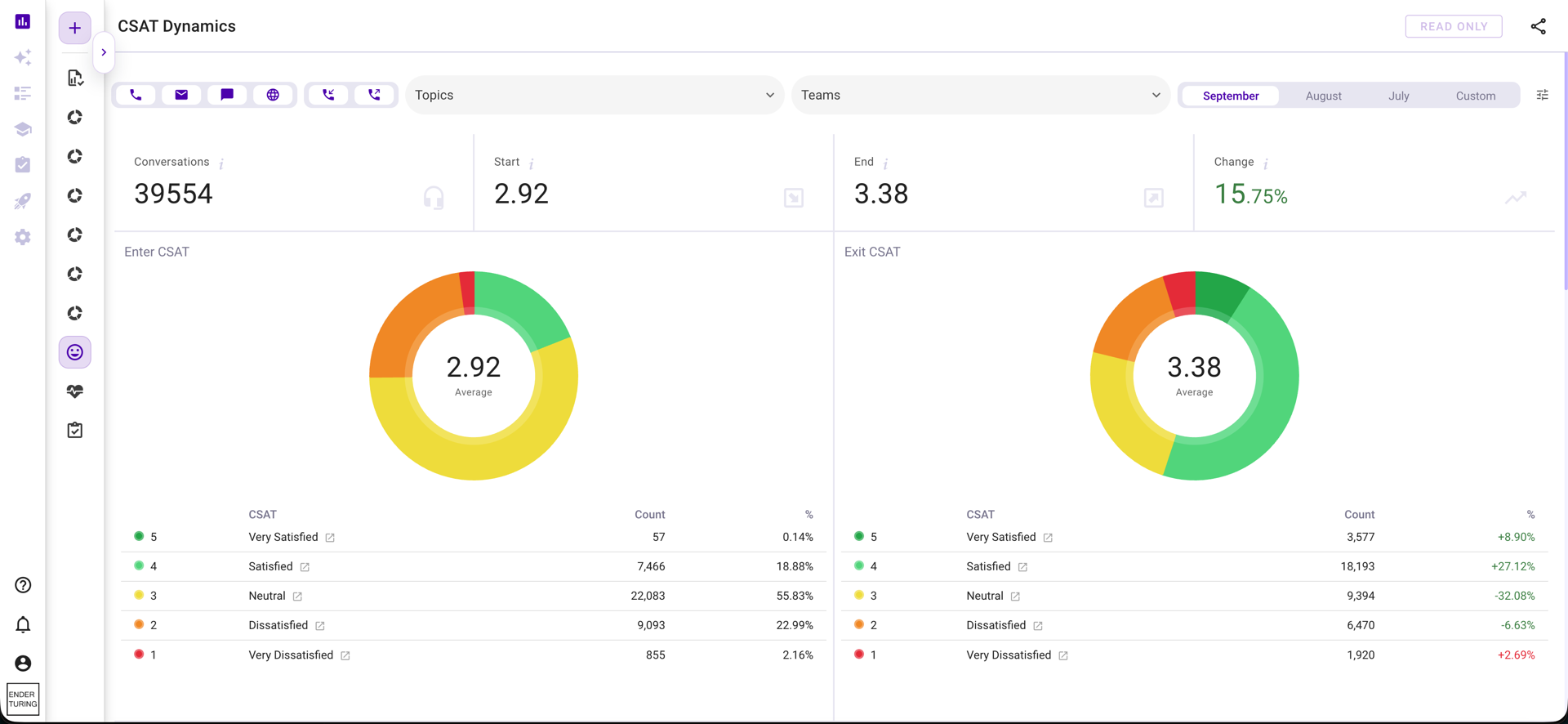
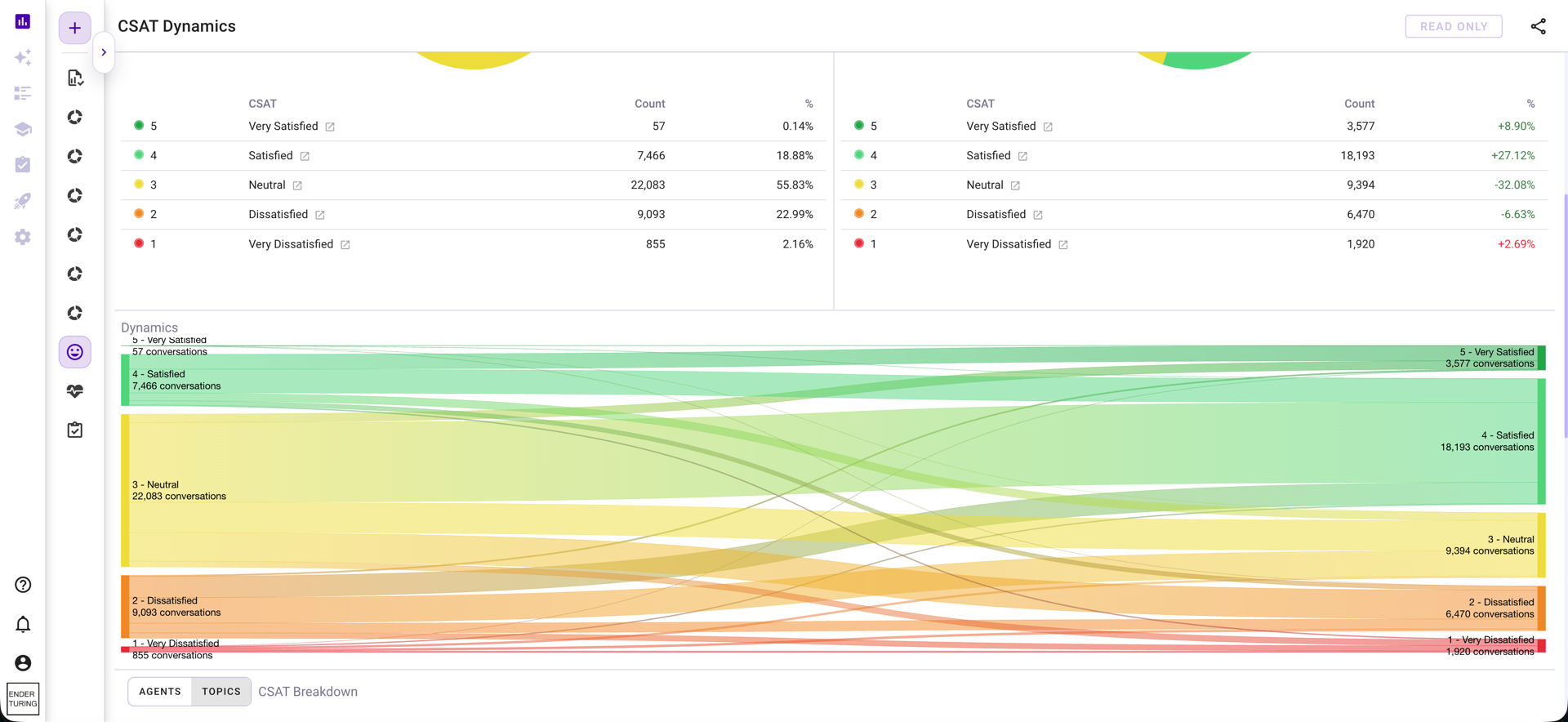
Each call, chat and email is scored 1–5 at the start and at the end by the built-in analysis; the change between the two is what your agents did. Per agent in the Dashboard's Common metrics, per conversation in the export. See Enter and Exit CSAT ↗
A score with no reason attached.
Charts cut satisfaction by topic, team and period; the pre-built CSAT Dynamics board puts the whole picture in front of the executive who asks. Open any number and the conversations are one click away. See C-Level Boards ↗ · Charts ↗
The unhappy customer is found when the survey comes back — if it does.
Enders — Ender Turing's automations — trigger on a conversation's CSAT summary and notify a team lead, create a task or send a message, filtered by the values you set. See Enders ↗ · Notifications ↗
Survey results in one tool, conversations in another.
Where your telephony or CRM supplies them, CSAT and NPS are filters on the same conversations — so you can compare the sample with the whole, and keep the surveys you want to keep. See conversation filters ↗
A quarterly deck to explain the CSAT trend.
Chat with EnderGPT answers from the conversations themselves; Scheduled chats send the same answer to your inbox every Monday. See Chat with EnderGPT ↗ · Scheduled chats ↗
Contact-center platforms and CRM dialers connect through the documented apps and connectors; recordings can also be uploaded in bulk. Calls are analyzed as they arrive.
Chat and email conversations come in through the documented apps and upload paths and are scored the same way as calls — one entry and one exit CSAT per conversation, in any language.
CSAT Dynamics is a managed generative-AI analysis in GenAI Studio: you can see what it does, and build your own prompts next to it — a satisfaction reason, a churn signal, a compliment to route to the agent.
Product screenshots — one contact center's CSAT Dynamics board in September: 39,554 conversations scored at entry and exit, and the flow between the levels.
Contact centers that run Ender Turing measure every conversation and manage the reasons, not the survey.
The published OTP Bank case — every call analyzed, coaching from the conversations. Read the case study.
With 100% of calls automatically scored versus a 3–5% manual baseline, −15% average handle time and 68 QA hours saved per specialist per month. See the case studies.
The questions a study used to answer in weeks — why customers call, what they praise, what makes them leave — answered from the conversations they already had.
Not as a survey answer next week: as a notification with the conversation attached, the moment the exit CSAT says so.
Customer results are reported by the customers named; product functions link to their Help Center articles.
100 calls per agent a month, calls up to 10 minutes, standard templates, self-connect and upload. When the floor or the volume grows, Team is $39 per agent with no limits on conversations.
Not the fit if you need survey software: this does not send surveys, it measures the conversations surveys never reach. Sales and customer-success teams have their own pages.
A customer-satisfaction score produced by analyzing the conversation itself instead of asking the customer to rate it afterwards. Ender Turing's AI customer-satisfaction analysis reads every call, chat and email and gives each conversation an entry CSAT and an exit CSAT on a 1–5 scale — how the customer felt at the start and at the end — so satisfaction is measured on 100% of conversations, not on the fraction who answer a survey.
CSAT — customer satisfaction score — is the classic post-contact metric: the customer is asked to rate the interaction, usually 1–5, and the score is the share of positive ratings or the average. It is accurate for the people who answer and silent about everyone else. AI CSAT keeps the same idea, a 1–5 satisfaction score per conversation, but produces it for every conversation from what was said.
A survey CSAT is arithmetic on the answers you received — for example the share of 4s and 5s among respondents. Ender Turing's AI CSAT is an analysis of the conversation: the customer's language, tone and how the interaction developed, scored at the start (entry CSAT) and at the end (exit CSAT) on a 1–5 scale, rounded to two decimals in the Dashboard. The difference between the two is the part your agents control.
Benchmarks vary by industry, channel and scale, and a survey benchmark only describes the customers who answered. The number that changes behavior is the movement inside the conversation: an entry CSAT of 2 that leaves at 4 is a great call; a 4 that leaves at 2 is the one to open. Ender Turing shows both per agent and per topic, so 'good' becomes a trend you can see week over week instead of a target you argue about.
No. Keep the surveys you send; Ender Turing measures the conversations they never reach. Where your telephony or CRM supplies survey results, CSAT and NPS are available as filters next to the AI scores, so you can compare the two on the same conversations and see how far the survey sample is from the whole.
Every conversation Ender Turing analyzes: phone calls from your telephony or CRM dialer, chats and emails imported through the documented apps and upload paths, and recorded meetings. The score appears for each conversation once the analysis has run.
Because you see where it drops. The Dashboard shows entry and exit CSAT per agent; charts cut it by topic, so the reasons that end conversations unhappy — a billing rule, a queue, a script line — are visible with the conversations behind them. Playlists turn the calls that lifted satisfaction into examples for the team, and Enders can notify a team lead the moment a conversation ends with a low exit CSAT.
Yes. Enders are Ender Turing's automations: they can trigger on the CSAT summary of a conversation and act — a notification, a task, a message to a team lead — filtered by the CSAT values you set. A conversation that ends unhappy becomes a follow-up the same day, not a survey answer next week.
CSAT rates one interaction; NPS asks how likely the customer is to recommend you and is a relationship metric. Ender Turing scores every interaction with AI CSAT and keeps survey-based NPS and CSAT beside it as filters where your platform supplies them — the interaction view on every conversation, the relationship view where you already measure it.
Yes, and it does not expire: up to 5 agents and 100 calls per agent a month, calls up to 10 minutes, with standard templates, self-connect to your telephony or CRM, upload, 30-day retention and email support. Team is $39 per agent per month with no limits on conversations, data export and the REST API; Business is $79 per agent with executive boards, scheduled reports, the CRM connector, priority support and a guided onboarding session.
Any language. Production speech recognition today covers English, Spanish, Portuguese, French, German, Polish, Ukrainian, Arabic, Chinese, Japanese and more; a language we do not run yet is added on request or connected through your own speech-recognition engine. SOC 2 Type II and GDPR-compliant data handling on every plan; Enterprise adds private cloud and on-premise deployment.
Security, hosting regions, sub-processors and response times are documented on the Data Security page; SOC 2 Type II examination completed.
Occasional analysis on conversation intelligence for contact centers and sales and customer-success teams — what moves pipeline, coaching, and time to value. No generic news.
Connect what you already run, or upload a week of recordings, and see satisfaction by agent and topic tomorrow. Free for up to 5 agents; upgrade when the floor grows.