The claim call decides the renewal
First notice of loss, the documents, the payout date: what the agent promised and what was missed decides whether the customer renews — and the quality team reviews a sample of those calls weeks later.
Labs, clinic networks and insurers run their patient lines on Ender Turing because a scheduling call is where demand, satisfaction and revenue meet — and only a sample of them was ever heard. Every call, chat and email is transcribed, categorized and scored the moment it ends; personal data is masked; the summary lands in your CRM or appointment system. In any language.
First notice of loss, the documents, the payout date: what the agent promised and what was missed decides whether the customer renews — and the quality team reviews a sample of those calls weeks later.
A customer calling three times about one claim — documents, status, payout — counts as three handled calls. Nobody sees that the second and third call were caused by the first.
The mandatory lines of a policy sale — what is covered, what is excluded, the cooling-off right, consent — are verified on a sample after the fact, when the misselling risk is already on the books.
Contact-center templates are installed on sign-up; personal-data masking, executive boards and engineer-set connectors come with the Business plan; private cloud or on-premise with Enterprise.
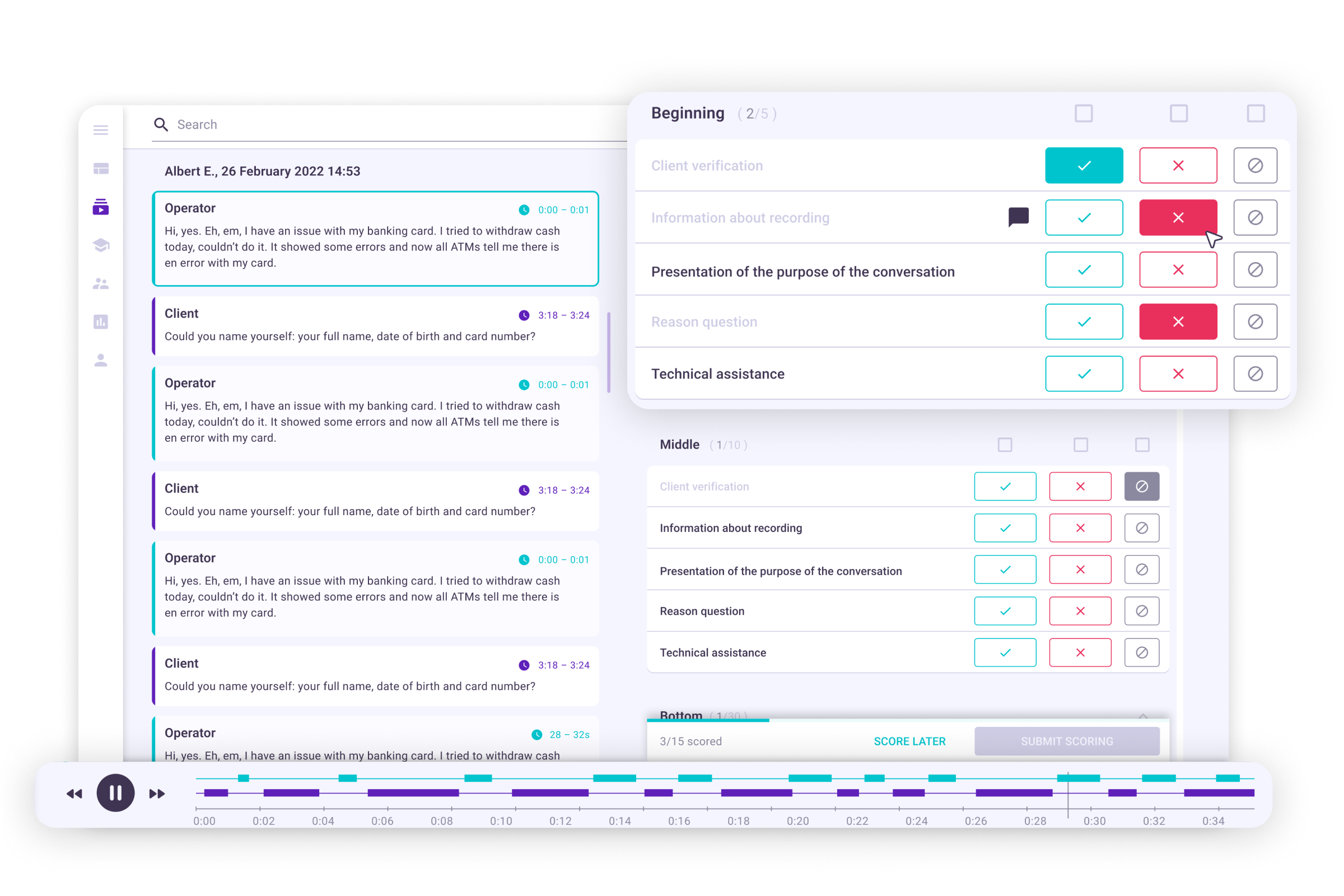
First notice of loss: identification, the incident captured, the document checklist given, the payout timing stated, empathy — AutoQA scores every call, chat and email, shows its accuracy against your reviewers per point, and the human queue gets only the calls that need one.
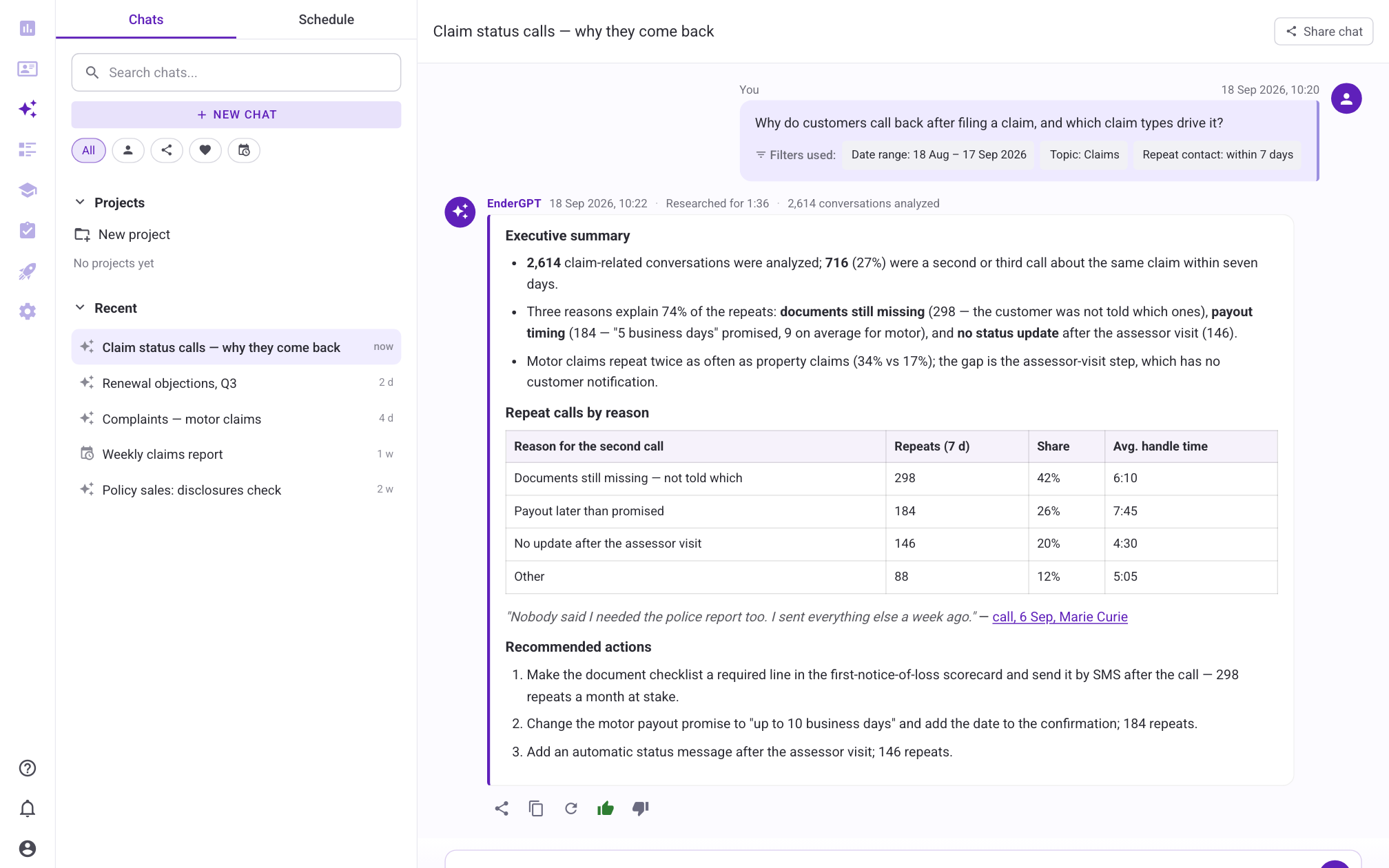
Topics categorize each conversation — documents missing, payout timing, status after the assessor, complaint — and your repeat-contact rules link a call to the customer's previous one; the claim types and steps that cause the second call are a chart, not an assumption.
Compliance rules score whether the coverage, the exclusions, the cooling-off right and the consent question were said on every sales and renewal call, with the exact moment linked; funnels follow quotes to policies per agent and campaign.
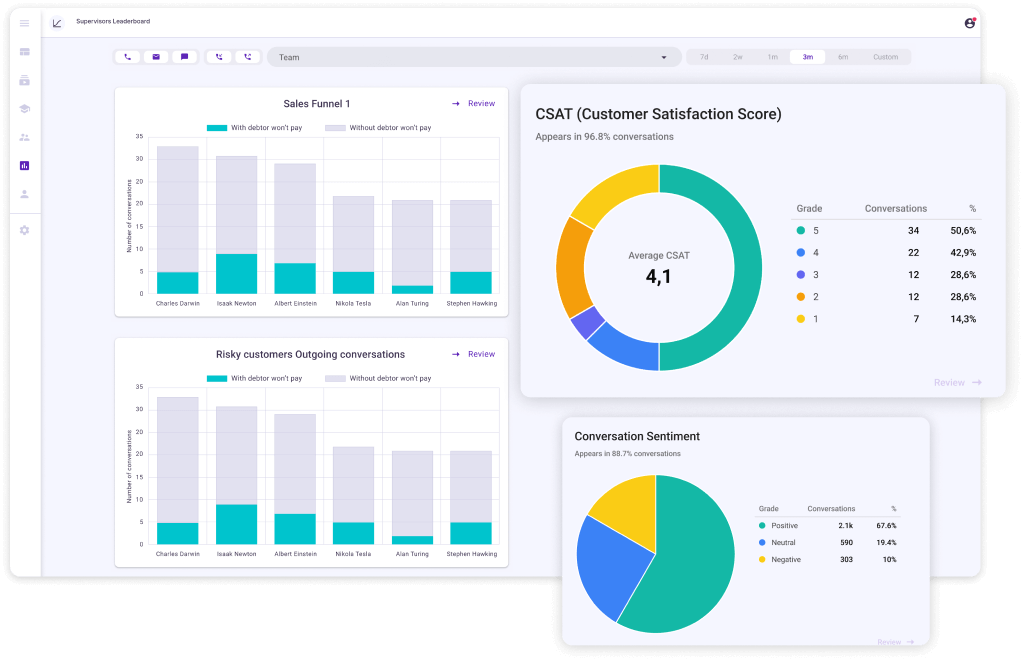
Satisfaction estimated from the dialogue at the start and the end of each call, interaction intensity where conversations get tense, sentiment per claim type and agent — on the built-in CSAT Dynamics board next to your own charts.
Names, policy numbers, addresses and health details masked in transcripts per language; roles decide who opens which conversations; SOC 2 Type II and GDPR-compliant handling on every plan; private cloud (AWS, GCP, Azure) or on-premise deployment on Enterprise.
If this, then that: when a conversation matches — a complaint topic, a satisfaction drop, a low score on a claims call — notify the right manager immediately or in a daily digest, add it to a review list, or send a webhook to your claims system. EnderGPT answers "why do customers call back after filing a claim" with the calls cited.
Averages across our contact-center deployments — each customer's own numbers are in the case studies. Case studies →
Product screenshots — dashboards and analyses from the platform, not illustrations.
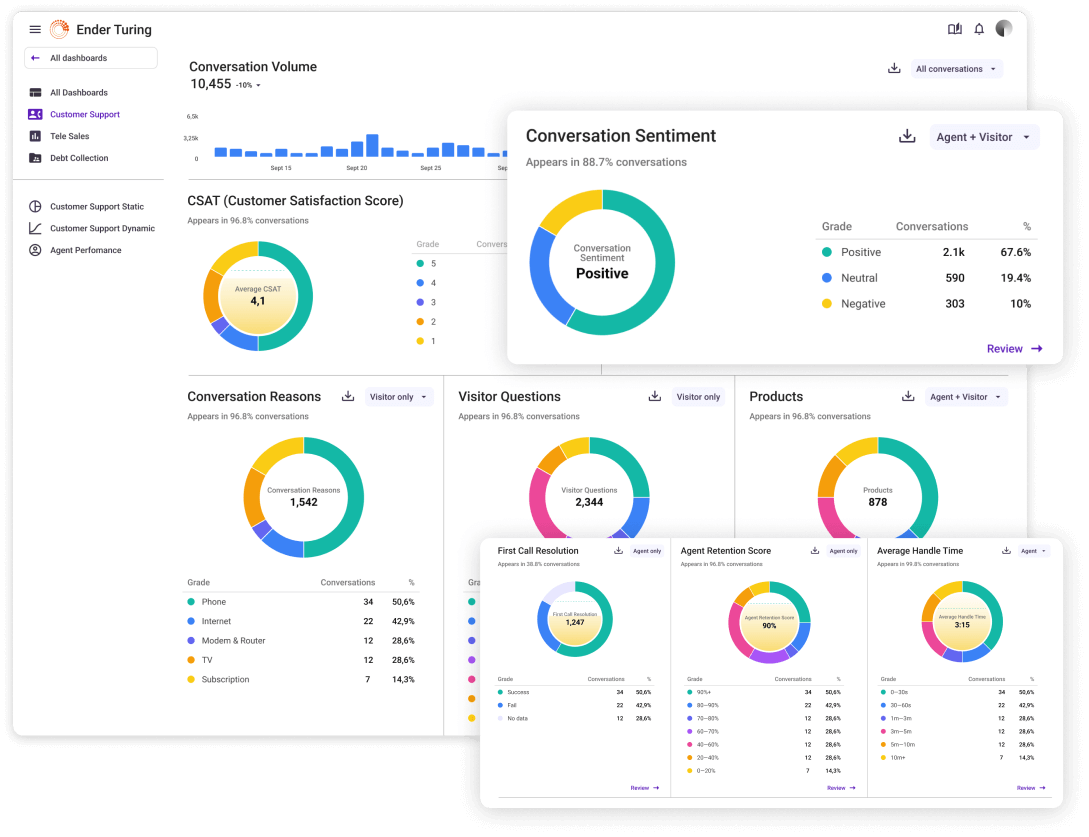
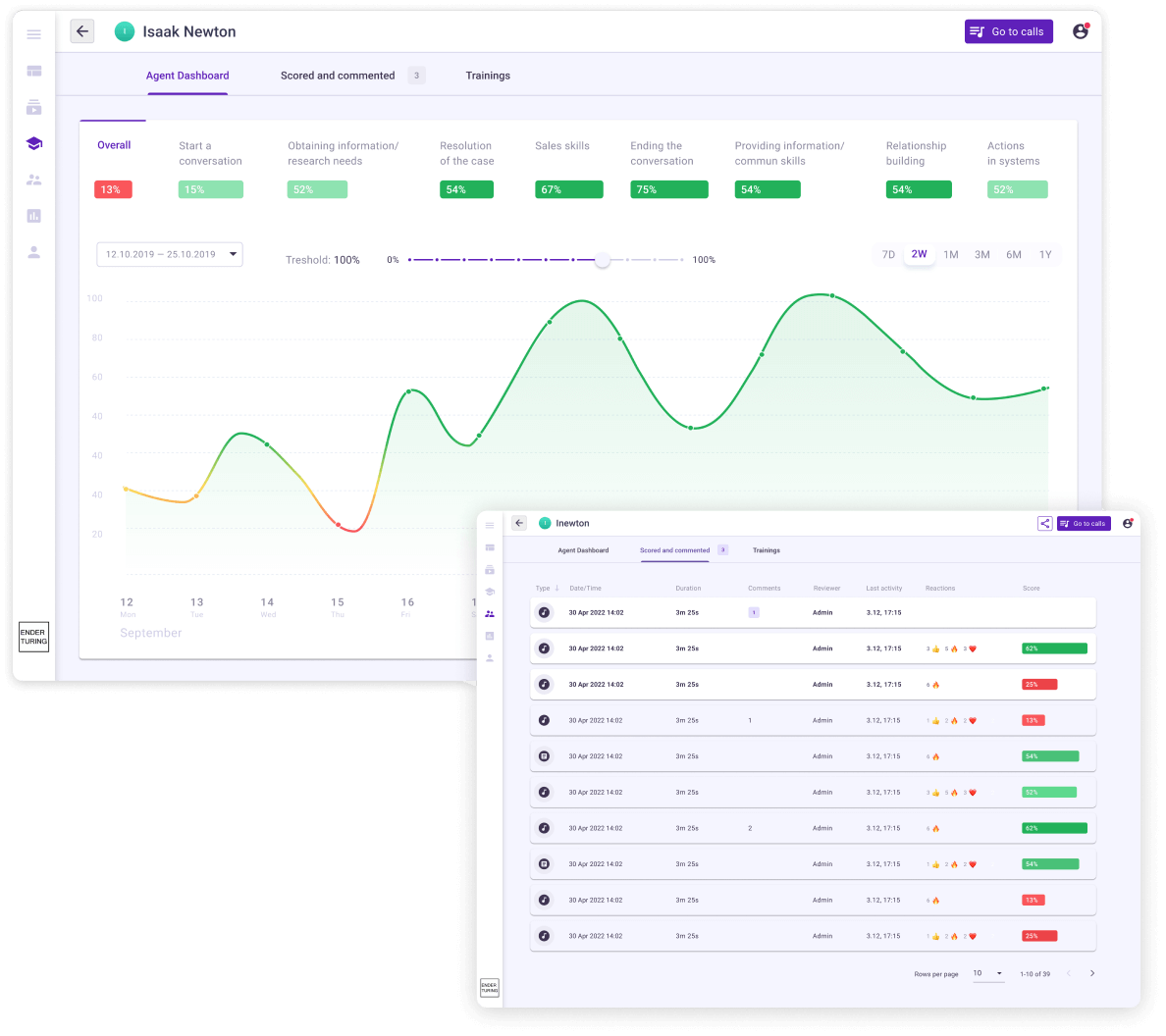
Satisfaction at the start and the end of every conversation, interaction intensity per claim type and agent — the customer's side of the operation.
AutoQA on every conversation with the accuracy measured against your reviewers; disputes, review queues, coaching from the scores.
Why customers call, which calls come back, where the time goes — the operations view of the same conversations.
Ender Turing is also built for healthcare call centers and bank contact centers.
It reads every claims, policy and renewal conversation the moment it ends: scores it against your scorecard (identification, the incident captured, the document checklist, the payout timing, empathy; on sales calls the coverage, exclusions, cooling-off right and consent), categorizes the reason, links repeat calls about the same claim, estimates satisfaction from the dialogue, masks personal data in the transcript and escalates complaints the same day — on 100% of conversations instead of a sample, in any language.
Yes. Your repeat-contact rules link a call to the customer's previous one and store the interval; Topics categorize the reason for the second call — documents still missing, payout later than promised, no status update after the assessor. A chart by claim type and reason shows which step of the claims process causes the second call; EnderGPT answers the question in plain language with the calls cited.
Compliance rules define the lines a sales or renewal conversation must contain — coverage, exclusions, the cooling-off right, the consent question — with the wording tolerance you set; every conversation gets a script-adherence score, the missed lines are linked to the exact moment, and an automation sends the misses to a review list or to compliance by email.
Yes — from the dialogue itself, at the start and the end of every conversation (Enter and Exit CSAT), so you see which claim types, steps and agents move it; interaction intensity shows where conversations get tense. A survey a few customers answer becomes a check on numbers you already have for all of them.
Personal data — names, policy numbers, addresses, health details — is masked in transcripts, configured per language, on the Business plan; roles and permissions decide who can open which conversations; data handling is SOC 2 Type II and GDPR-compliant on every plan; Enterprise runs in your private cloud (AWS, GCP, Azure) or on-premise. The current controls, regions, retention periods and sub-processors are on the data security page.
Documented apps for Genesys Cloud, Five9, Zendesk and other platforms; connectors to recording systems and a CRM connector set up by our engineers on the Business plan; the REST API, SFTP and upload for everything else. Results — the score, the topics, the summary — flow to your claims system or CRM by webhook and API. Nothing is written into your telephony platform.
UNIQA runs its customer contact center on it, alongside banks, lenders, medical laboratory networks and clinic networks. Names appear on the customer strip; case studies with their numbers are published as each customer approves them.
Compare on the same things: coverage (100% of conversations, with the accuracy of the scorecards measured against your own reviewers), time to numbers (a workspace in minutes with contact-center templates and auto-scoring from the first calls; implementation engineers on the Business plan), who runs it (a claims or service manager with EnderGPT and scheduled reports, not a program team), languages (any language), and price (published per agent, with a free plan that does not expire).
Any language.
Free for up to 5 agents, 100 calls per agent a month, with no expiry. Team is $39 per agent per month with no limits, your own scorecards and compliance rules, the accuracy loop and the REST API. Business is $79 per agent with personal-data masking, executive boards, scheduled reports, connectors set up by our engineers, the CRM connector; auto-scoring starts from the first calls. Enterprise adds private cloud or on-premise deployment and custom integrations. Book a demo with your own recordings, or start free and connect the claims line yourself.
Security, hosting regions, sub-processors and response times are documented on the Data Security page; SOC 2 Type II examination completed.
Book a demo with your own recordings, or start free and connect the claims line yourself: the first scored calls come back the same day.