1 Each required line, scored on each call
Write each line a call must contain — the recording notice, a product disclosure, the consent question, the mandatory opening — as a compliance rule. Each call gets a script-adherence score from 0% to 100% per rule (very short calls are skipped): the rule's text is aligned with the transcript, so missing or reworded words lower the score, while filler words spoken around the line do not. The matched words are highlighted in the transcript, and the Script adherence filter finds the calls where one rule, or all of them, scored below the percentage you choose.
2 Requirements met in the agent's own words, on calls, chats and emails
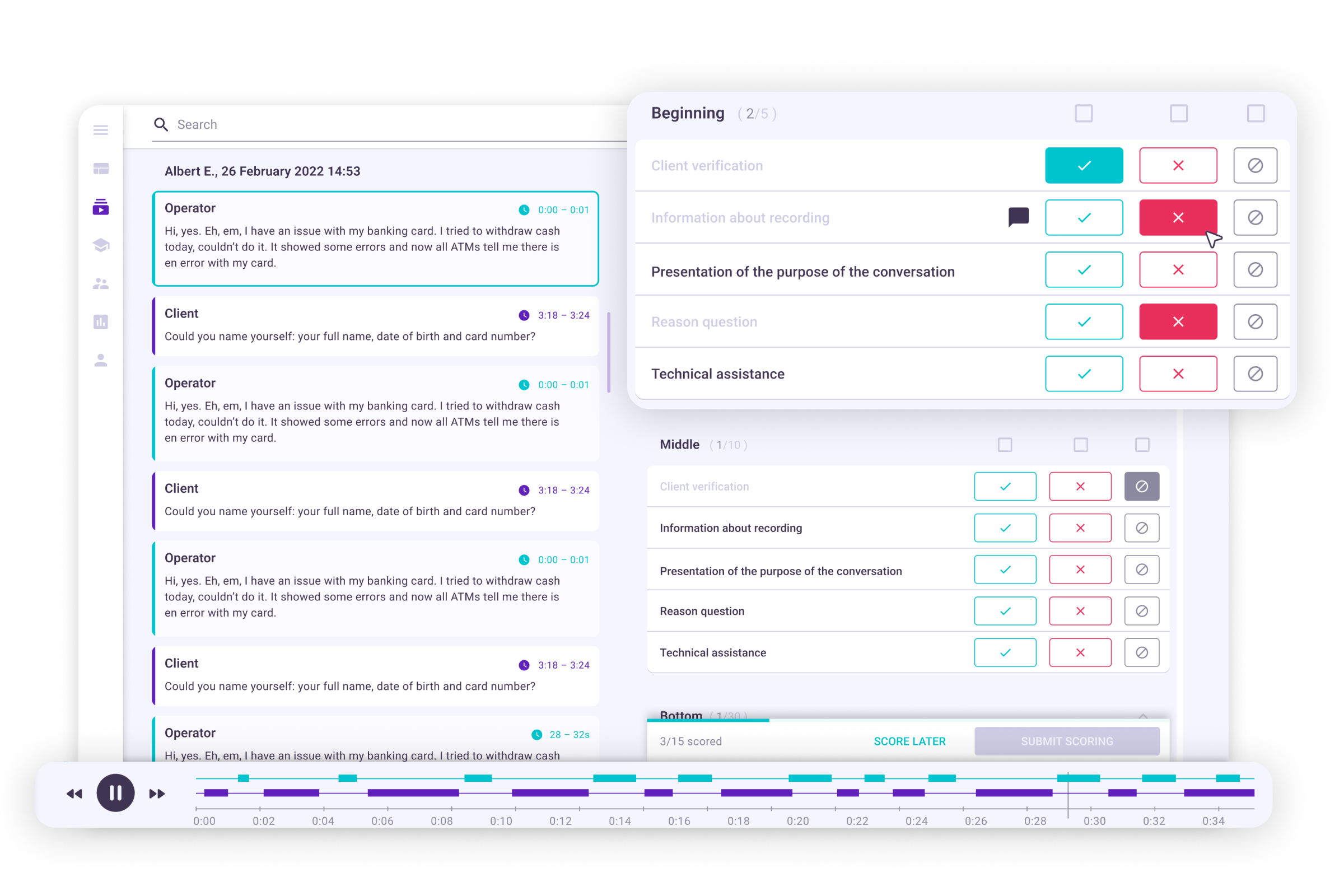
Write each requirement as a Yes/No scorecard point — identity verified before account details, the fee explained, the next step agreed — and AutoQA scores it on every call, chat and email routed to that scorecard. Mark a point Critical and its failure fails the whole category. Each team has its own scorecard, and Enders run AutoQA on exactly the conversations their conditions select — by topic, direction, duration or language.
3 Prohibited phrases and process violations, found
Tags mark the conversations whose transcript contains a listed phrase — exact match for fixed wording, flexible match when speakers rephrase — and a new tag is applied to existing transcripts in the background; the Tags filter splits matches by speaker. Topics described in plain language let generative AI flag the conversations that match, such as a promise an agent may not make, with each topic's accuracy measured against the conversations your team labeled. Discovery searches the transcripts for any phrase and jumps to the exact point it was said.
4 Compliance alerts routed to the person who acts on them
An Ender whose conditions match a compliance tag or topic — a prohibited phrase said, a promise an agent may not make — acts on those conversations: an email to compliance immediately or grouped every 1, 8 or 24 hours, with the QA scores, topics and summary; the conversation on a reviewer's to-do list; or a signed webhook, with retries, to your endpoint. Run the Ender on past conversations — up to 20,000 per run — to find the ones that matched before it existed.
5 Every flag next to its transcript, accuracy you can audit
In review mode each automated score sits next to the transcript, apart from your reviewers' scores, and a click on a transcript line jumps to that moment in the call's audio; every automated score traces back to the plain-text instruction AutoQA executed for that point, and AutoQA records the version that scored the conversation. Accuracy is shown per point against your reviewers' validated scores — typically 95%+ — and the improvement workflow rewrites a point's instruction from their corrections. An agent who disagrees disputes the score with a reason, and the reviewer approves, voids or partially approves it.
6 Personal data masking, scoped access, your own environment on Enterprise
Personal data and payment details can be masked in transcripts, configured per language. Roles decide who opens which conversations — all, a team's or an agent's own — and compliance matches follow the same access as the call. Ender Turing is SOC 2 Type II audited, with the latest report available under NDA, and, on Enterprise, runs in your private cloud (AWS, GCP, Azure) or fully on-premise, with speech recognition inside your own environment.