You can’t even know what’s inside the calls.
Thousands of recordings sit in the CRM. Nobody can listen to more than a handful.
Your agents dial all day inside your CRM. You still can’t see what happens inside the calls—so coaching comes late, compliance is hope, and “didn’t convert” is the only funnel stage you know. Ender Turing listens to and analyzes every call and shows you what turns a dial into a booked meeting: which stage loses conversations, which calls converted, who needs coaching, and the proof.
Example funnel—illustrative numbers, not customer data.
One cold-calling agency—running appointment-setting campaigns for several clients from their CRM’s dialer—came to Ender Turing with exactly this list. If it sounds like your floor, keep reading.
Thousands of recordings sit in the CRM. Nobody can listen to more than a handful.
Feedback arrives late, from memory, without the example that would make it land.
Did the agent say the recorded-call line? The mandatory opening? You hope so.
Gatekeeper? No need? Never reached the decision-maker? Every lost call looks the same in the CRM.
Several clients, several campaigns, dozens of agents—and one report built by hand, from a sample, a week late. The number that matters, meetings set, moves, and you can’t tell what moved it.
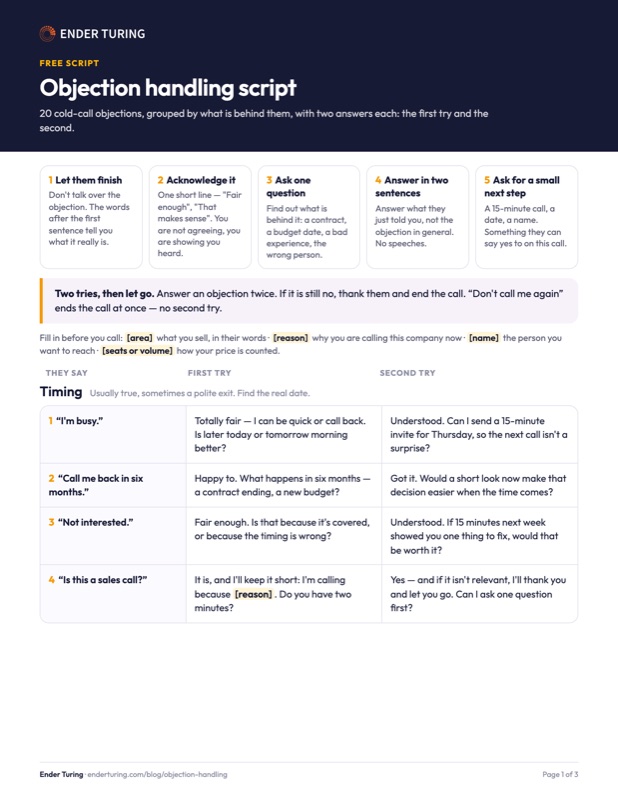
20 cold-call objections with two answers each — yours free when you subscribe to Buyer Insights.
The next buyer insight will come to your inbox.
Ender Turing transcribes and scores every outbound call automatically, on top of your CRM or dialer—agents keep dialing exactly as before. Here is what changes for the manager.
Listening to a sample of calls, days later.
Managers start from the finding, not the recording.
Coaching from memory.
Put the calls that booked a meeting next to the ones that didn’t—same agent, same list—and coach the difference from the exact transcript line and the audio behind it. See conversations ↗
Compliance by hope.
Recording disclosure, consent, mandatory opening—with a per-call adherence score and the evidence. See Compliance Rules ↗
“Didn’t convert.”
Gatekeeper, no need, decision-maker reached, meeting set. See which stage eats the most conversations—by agent and by client—and fix that one first. See Topics ↗
One report built by hand.
Filter by client, campaign, team, agent or topic—and walk each client through their own numbers: conversations, decision-makers reached, meetings set.
You define the stages and the required lines. Ender Turing does the listening and the analysis.
Where your CRM records the calls, Ender Turing captures both sides through a read-only connection and a browser extension on the agent’s workstation — agents change nothing. GoHighLevel has a dedicated page and guide.
Genesys and Five9 have documented connectors; browser-based calling on 18 platforms — RingCentral, Dialpad, Aircall, 8x8, Salesforce and more — is captured directly by the WebRTC call recorder. Any other system hands over recordings through an app, API, SFTP or upload—and those calls are analyzed alongside the rest.
Bring the quality criteria and required lines you already use. Configure them once; every call is scored against them, and every score links to the moment that earned it.
Post-call analysis: Ender Turing works on top of your stack after each call ends. It is not a dialer or a CRM and does not replace either.
What about the demos those calls create? The cold calls booked sales demos—run by a different manager, recorded in Fireflies. Two halves of one customer journey, in two tools, seen by two people.
Connecting the meetings to Ender Turing put the calling team, the demo team and management in front of the same journey: cold call → meeting booked → demo → outcome. What the agent says on the call shapes what happens in the demo. Now both are in one place.
Illustrative journey view—example labels, not customer data.
The center didn’t buy call analytics. It bought a way to book more meetings from the same dials. Outbound floors don’t run on handle time or CSAT; they run on meetings set and what converts. This is what the board shows every morning.
The number that matters, updated from the calls themselves instead of a report built a week later from a sample.
See which stage loses the most conversations, for which agent and which client, and fix that one first.
Put the calls that booked a meeting next to the ones that didn’t—same agent, same list—and coach from the exact moment that made the difference.
Once the demo meetings are connected, the same board follows each meeting the floor created into the demo and its outcome.
Every promise above is a documented function in the product. Here is what does what — and the guide for each.
Topics classify each call — by generative AI, rules or a human — into your stages: gatekeeper, no need, decision-maker reached, meeting set. Funnels count the conversion between them and show where calls drop.
Compliance rules hold the phrases agents must say — recording disclosure, consent, the mandatory opening — and produce a script-adherence score from 0 to 100% per call, filterable on the conversation list.
Scorecards carry your quality criteria; AutoQA answers them on every call. The accuracy of every automated point against your reviewers is shown, and the improvement workflow proposes better definitions from those reviews.
Enders (automations) — a call reaches decision-maker → notify the manager; a required line is missing → add the call to a reviewer's TODO; a new campaign → run its scorecard. Alerts arrive in-app and by email.
Chat with EnderGPT answers "which objections stopped us past the gatekeeper this week?" with citations to the exact calls. Scheduled chats run the same question every Monday, per team or per agent.
Pin the calls that set a meeting into Playlists, assign them with Training plans and quizzes, and let each agent see their own scores and feedback on My Dashboard.
Per client, per campaign: the Dashboard ↗ filters by client, campaign, team and agent; Charts ↗ and C-Level Boards ↗ build a board per client; Roles ↗ decide who sees which team. Brand, product and agent names are transcribed right with auto-corrections ↗.
B2B cold-calling teams: appointment-setting agencies and outsourced SDR shops running campaigns for several clients, and in-house outbound floors. In-house sales floors dialing from their CRM. Any team whose managers need to see the work without listening to all of it.
Not the fit if you are looking for a new dialer or CRM.
By reading every call, not a sample: Ender Turing classifies each outbound call by the stage it reached — gatekeeper, no need, decision-maker reached, meeting set — checks the required lines, and links every finding to the exact moment in the recording. Managers see which stage loses the most conversations per agent and per client, and coach from the calls that booked meetings next to the ones that didn't.
Yes, and it does not expire: up to 5 agents, 100 calls per agent a month (500 calls for five), calls up to 10 minutes — with standard funnel, required-line and coaching templates. Connecting your CRM or dialer takes about 15 minutes. When the floor or the volume grows, Team is $39 per agent per month with no limits, and Business is $79 per agent with advanced analytics and implementation engineers. See pricing.
Visibility into the calls themselves. Instead of opening recordings one by one, managers work from transcripts, funnel stages, required-line checks, quality scores, and the exact conversations behind each finding—across every agent, campaign, and client.
Meetings set is the number on the board; Ender Turing shows what moved it. Every call is scored and classified by funnel stage, so managers see which stage loses the most conversations, by agent and by client. They can put the calls that booked a meeting next to the ones that didn’t—same agent, same list—and coach the difference from the exact transcript moment. Read about Topics and conversation filters.
No. Your CRM stays your CRM and your dialer stays your dialer; agents keep working exactly where they work today. Ender Turing captures each call through a read-only connection — for GoHighLevel, the documented setup uses your Location ID, a read-only Private Integration Token and the Ender Turing browser extension on each agent workstation, which captures both sides of the call in Chrome or Microsoft Edge. Other platforms connect through a documented app, connector, API or upload. GoHighLevel page and extension requirements.
Yes. Compliance Rules let managers define required spoken phrases, including consent statements, disclosures, or mandatory openings. Ender Turing produces a per-call script-adherence score that managers can highlight in transcripts, filter, and report against. Read about Compliance Rules.
Yes. Teams configure Topics with generative AI, rules, or human labels, then use those topics across filters, dashboards, charts, and funnels. An outbound team can model stages such as gatekeeper reached, no need, decision-maker reached, or meeting created. Read about Topics.
GoHighLevel, Genesys Cloud, Five9, NICE CXone, Talkdesk, Amazon Connect, Zendesk and Fireflies today, with HubSpot, Pipedrive and Attio in early access — and any browser-based calling on the supported platforms is captured directly by the Ender Turing extension. Anything else hands over recordings through the REST API, SFTP or upload and is analyzed alongside the rest. The full list is under Integrations. All integrations.
Both, on the same calls. On the QA side — what the market calls call center QA software — it is scorecards, required lines with a script-adherence score, and AutoQA on 100% of calls with its accuracy against your reviewers visible. On the analytics side — what the market calls speech analytics — it is stages and funnels, dashboards per client and campaign, custom charts and executive boards, and EnderGPT questions across the calls. For an outbound floor the analytics question is why calls don't convert and the QA question is whether the required lines were said — one platform answers both from the same recordings. Scorecards, Funnels and Dashboard in the Help Center.
About 15 minutes to connect your CRM or dialer and up to five agents on the free plan, then the standard outbound template — funnel stages, required lines, coaching queue — is installed from the Templates Library and adjusted to your talk track. The first calls come back analyzed and scored the same day. Business plans add implementation engineers for connectors, your own scorecards and the rollout across the whole contact center. Templates Library.
Ender Turing has completed a SOC 2 Type II examination and handles data in a GDPR-compliant way on every plan; Enterprise adds private cloud and on-premise deployment. It works in any language: production speech recognition today covers English, Spanish, Portuguese, French, German, Polish, Ukrainian, Arabic, Chinese, Japanese and more; any other is added on request or connected through your own speech-recognition engine. Personal data in transcripts can be masked per language with the Anonymization feature on Business plans. Anonymization.
The ones a cold-calling team runs on: meetings set per agent, campaign and client; conversion by funnel stage (dials → conversations → past gatekeeper → decision-maker reached → meeting set) with the drop-off between stages; script adherence per call; and the coaching queue built from the calls that converted and the ones that did not. Handle time and CSAT are available too, but they are not what an outbound call center is managed by. Funnels and Dashboard.
Yes. Scorecards in Ender Turing hold your quality criteria in categories and points, and you can build one from scratch, copy an existing one, or import your current QA scorecard from an Excel file. Once marked automated, AutoQA answers every point on every call, and the accuracy of each point against your human reviewers is shown and improved from their reviews. Scorecards.
By scoring 100% of calls automatically instead of a 3–5% sample, and by reviewing where it matters: required lines checked on every call, the calls that missed one routed to a reviewer's queue by an automation, and the calls that booked meetings pinned for coaching. Reviewers calibrate the AI rather than replace it — automated scorecards typically reach 95%+ agreement with your reviewers, and the accuracy loop uses their reviews to improve the point definitions, so scorecard descriptions need minimal to no human work. Accuracy improvement.
Yes — the work is the same whatever it is called: B2B cold calling, telemarketing, appointment setting, outbound SDR. If agents dial from a CRM or dialer and the result is a meeting or a lead, Ender Turing scores every one of those calls by the stage it reached, checks the required lines and coaches from the calls that converted.
They come after the cold-call operation is visible. The documented Fireflies app imports completed meeting transcripts into Ender Turing. Fathom and other meeting platforms fill the same role when their recordings are supplied through an available app, connector, API, SFTP, or upload path; Zoom, Google Meet and Microsoft Teams meetings can also be recorded directly by the Ender Turing browser extension. Read the Fireflies guide.
Security, hosting regions, sub-processors and response times are documented on the Data Security page; SOC 2 Type II examination completed.
Start free with up to 5 agents—no expiry. See which stage loses your conversations, which calls booked meetings, what to coach, and whether the required lines were said—on your own calls.