Picture a consumer electronics company that has spent two years and several million dollars building what its marketing calls a “true omnichannel experience.” Customers can start in chat, switch to phone, follow up on email, check status in the mobile app, and return to chat — all backed by what is supposed to be a unified customer record.
Now ask its data a single question: when a customer issue touches more than one channel before resolution, how much does it cost compared to a single-channel resolution?
The answer is often uncomfortable. Cross-channel issues tend to take longer to resolve, generate more handle time across the involved channels combined, and produce lower CSAT scores than single-channel resolutions. When that happens, the omnichannel investment has succeeded in giving customers more ways to reach the company. It has largely failed at giving the company a way to handle them efficiently when they use multiple ways.
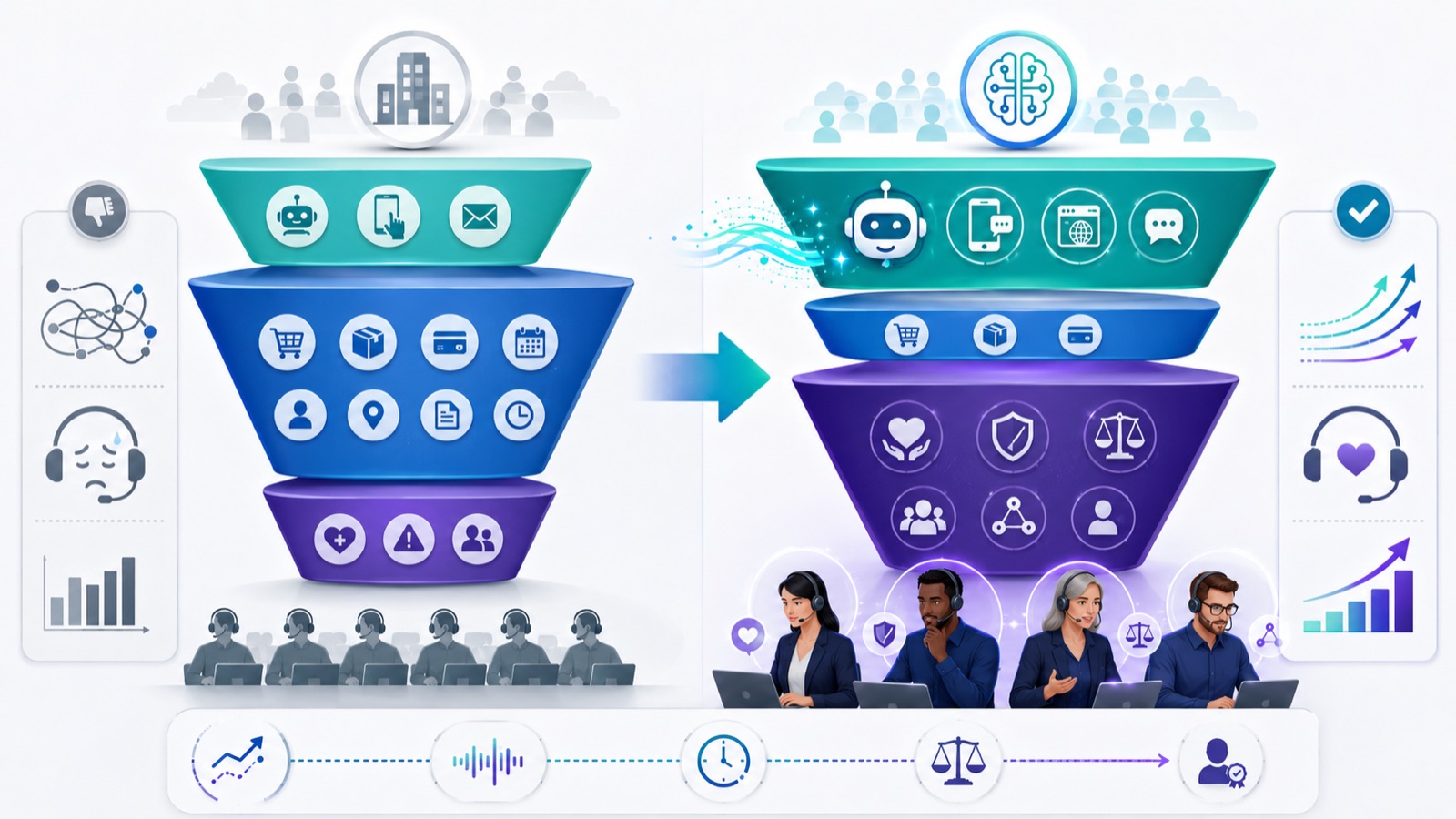
This is the structural reality of most omnichannel deployments and it’s the part nobody puts in the marketing brochure. Multi-channel availability is easy. True omnichannel resolution is hard. Most companies have deployed the first while telling themselves and their customers they’ve deployed the second.
What Omnichannel Was Supposed to Solve
The original promise of omnichannel was straightforward. A customer should be able to start an interaction in one channel and continue it in another without losing context, without re-explaining the issue, and without paying for that flexibility in service quality.
The reality in most deployments diverges from this in three specific ways.
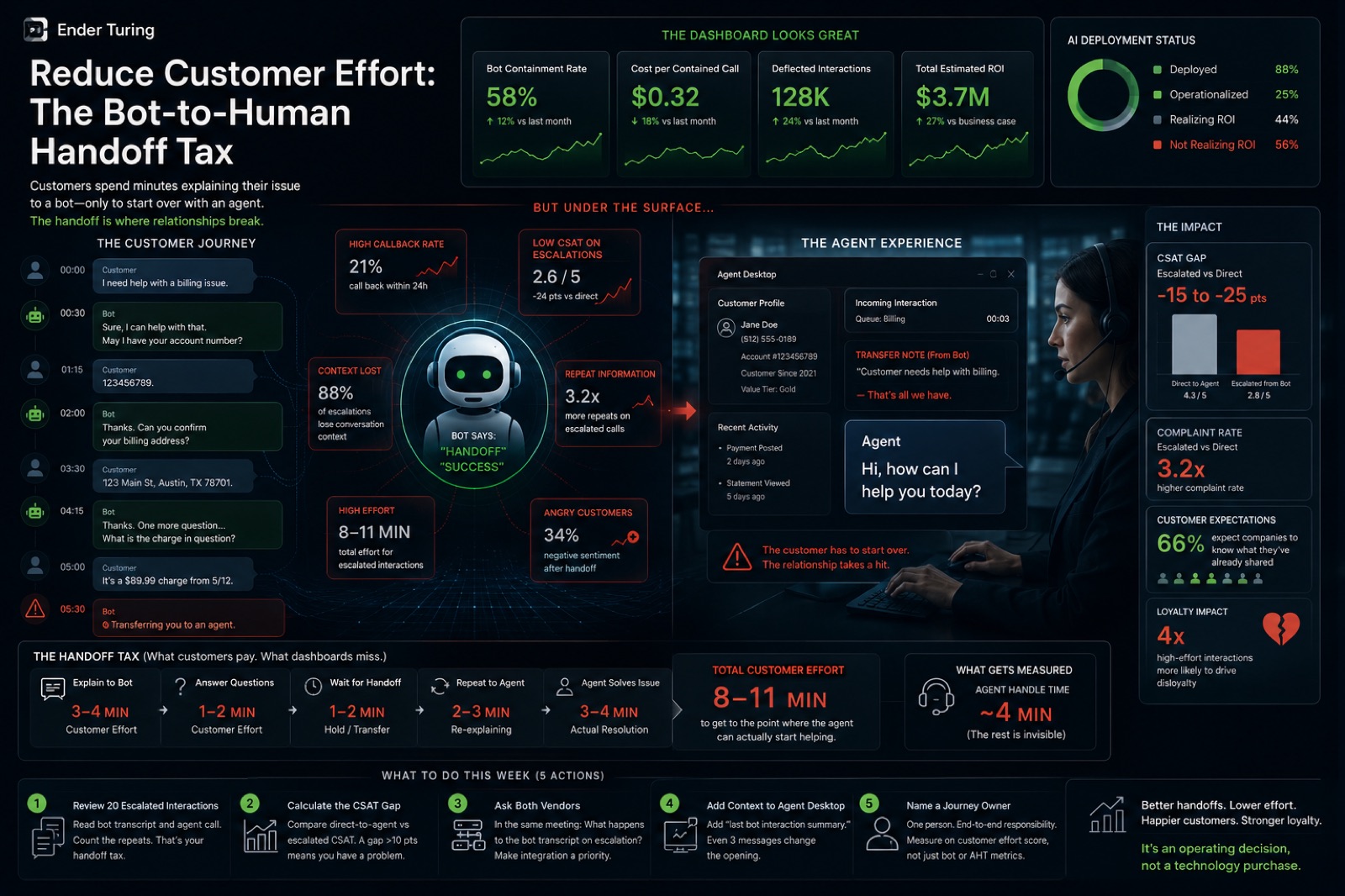
Context loss at handoff. When a customer moves from chat to phone, the agent receiving the call typically gets fragmentary or no information from the chat session. The customer has to re-explain. The agent has to re-diagnose. The work done in the previous channel is essentially discarded.
Channel-specific blind spots. The phone team can’t see what the customer did in the mobile app. The chat team can’t see what the customer wrote in email. Each channel has its own visibility window, and the unified customer view that was promised exists only on slides.
Resolution authority fragmentation. Different channels have different resolution authorities for different issues. A customer who can get a fee waived in a phone call cannot necessarily get the same waiver in chat. The customer doesn’t know this. They experience the channel choice as arbitrary friction.
The cumulative effect is that customers who use multiple channels for a single issue have systematically worse outcomes than customers who stick to one. This is the opposite of what omnichannel was supposed to deliver, and most contact centers are not measuring it.
The Channel-Switching Tax
We’ve started calling this pattern the channel-switching tax because the costs are real and they fall mostly on the company, with some spillover onto the customer.
The handle time tax. Cross-channel issues consume more total agent time than single-channel issues — usually 50-100% more, with significant variance by industry. This is pure operational cost that doesn’t appear in single-channel metrics because the time is distributed across teams.
The repeat contact tax. Customers who switch channels are more likely to make additional contacts before resolution. Each channel switch typically adds 0.5-1.5 additional contacts to the resolution pathway. These contacts are invisible to channel-specific FCR metrics because each channel measures its own first contact resolution rate independently.
The CSAT tax. Cross-channel issues produce systematically lower satisfaction scores even when they’re eventually resolved successfully. The customer experiences the channel switching as friction, regardless of whether the eventual outcome was correct.
The agent friction tax. Agents handling cross-channel issues report higher cognitive load and higher emotional labor than agents handling single-channel issues. Over time this contributes to attrition in ways that channel-specific staffing models don’t anticipate.
The compliance tax. In regulated industries, cross-channel interactions create documentation complexity. A disclosure made in chat may not be repeated in the subsequent phone call. The compliance record is fragmented across systems with different retention policies and different audit visibility.
What Customers Actually Want From Omnichannel
There’s a useful gap between what omnichannel implementations were built for and what customers actually need from them.
Customers don’t particularly want to switch channels mid-issue. When asked, the majority report a preference for completing an interaction in the channel they started in. They switch channels because the original channel failed them — usually because of long waits, perceived agent incompetence, or the company’s policies about which channels can resolve which issues.
What customers want is for the channel they’re currently using to work. The omnichannel investment that would deliver the most customer value is usually not “stitch channels together more seamlessly.” It’s “make the channel they chose actually resolve their issue.”
This reframes the omnichannel question. Instead of “how do we make handoffs invisible,” the better question is “why are handoffs happening in the first place, and which ones could be prevented.” Most could.
The Conversation Stitching Problem
True omnichannel resolution requires the company to understand that a single customer issue can span multiple touchpoints, even when those touchpoints come through different channels at different times.
This is harder than it sounds. The technical infrastructure for cross-channel data integration exists. The CRM platforms have unified customer profiles. The contact center platforms can route based on prior interaction history. The chat platforms can hand off transcripts. None of this is the bottleneck.
The bottleneck is conversation-level understanding. When a customer calls and says “I’m following up on the issue I had with my order,” the agent needs to know:
• What issue
• When it occurred
• What was promised
• What’s been done since
• What the customer is currently expecting
If the previous interactions are stored as text logs that the agent has to read while the customer waits, the omnichannel infrastructure has failed to deliver the experience it was designed for. The agent is going to skim, miss something, and the customer is going to have to fill in the gaps. The handoff cost gets paid.
Conversation analytics that can summarize and surface the relevant prior context in real time change this dynamic substantially. We’ve covered this in our work on real-time agent assist. The same architectural questions apply to omnichannel context.
The Mid-Market Implementation Gap
Enterprise omnichannel deployments have been running for years, with mixed but improving results. Mid-market deployments lag substantially. The reasons are economic: full omnichannel platforms have historically required enterprise budgets and enterprise IT capacity.
The result is a tier of contact centers (200-1,500 seats) that are running what we’d call partial omnichannel: multiple channels available to customers, but with weak integration on the back end. These centers are paying most of the channel-switching tax with little of the offsetting customer experience benefit.
The gap is closing as cloud-native contact center platforms bring omnichannel capabilities into mid-market price points. But there’s an interim period — happening right now — where the tooling exists and many centers haven’t deployed it, while the customer expectations have already shifted to assume seamless cross-channel resolution.
What Real Omnichannel Requires in 2026
Programs that deliver on the omnichannel promise tend to share four characteristics.
Channel-switching is measured as a primary metric. Not just channel availability, but the rate at which customers move between channels for a single issue, and the cost differential of those interactions versus single-channel resolutions.
Conversation context is surfaced, not stored. Prior interactions don’t appear as transcripts the agent has to read. They appear as summaries the agent can act on, with the specific commitments and unresolved issues highlighted.
Channel-specific friction is mapped. The reasons customers switch channels are systematically analyzed and reduced. Each prevented channel switch is a small operational win.
Resolution authority is consistent across channels. A customer issue resolvable in one channel should be resolvable in every channel. Where this isn’t possible, the limitations are explicit and the customer is told.
Five Things You Can Do This Week
1. Calculate your channel-switching rate. Pull a month of customer interactions. For how many customers did a single issue touch more than one channel? The number will be higher than your operational team estimates.
2. Compare cost-per-resolution across single-channel and multi-channel customers. This is the most important number you don’t currently track. The ratio between them tells you the size of the omnichannel tax you’re paying.
3. Listen to 10 calls that came from a chat handoff. How much time does the agent spend re-establishing context the chat agent already had? That time is the operational cost of your context loss.
4. Map your channel-specific resolution authority gaps. For each of your top five call types, list which channels can fully resolve them and which require escalation. The gaps are your highest-priority fix list.
5. Survey channel-switching customers separately. Customers who used multiple channels for a single issue have different CSAT drivers than single-channel customers. If your current survey treats them as a single population, you’re averaging two different patterns into one number that obscures both.
The omnichannel infrastructure most companies built was designed to give customers options. The omnichannel experience customers actually wanted was for one channel to work the first time. The gap between those two goals is where the channel-switching tax lives, and most contact centers are paying it without ever measuring how much it costs.