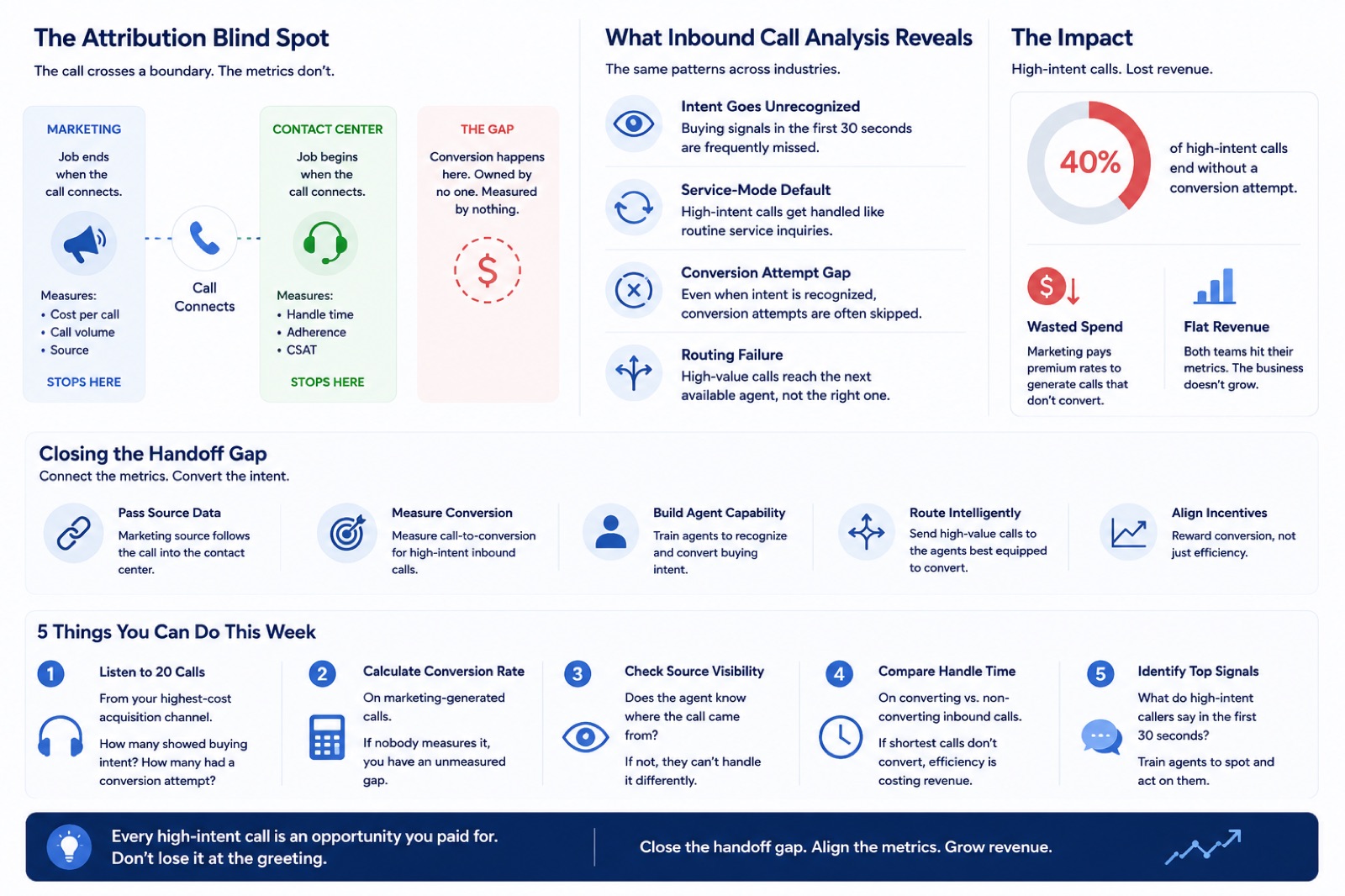
Probing questions are the questions an agent asks to find the real problem behind the one the customer states. Below are 32 of them for customer service and call centers — 16 by type and 16 by call type — with how to ask them without sounding scripted, and why the calls where nobody probes come back as repeat contacts.
What is probing in customer service?
Probing in customer service is the set of questions an agent asks to find the real problem behind the one the customer states. The customer says what they want; probing uncovers why they want it and what else the request touches, so the call resolves the underlying issue instead of producing a repeat contact a week later.
Here is how a missed probe turns into a repeat call. The agent answers exactly what the customer asks. The customer says "thank you" and ends the call. Two days later they call back, because the question they needed answered sat next to the one they asked, and nobody on the first call probed for it. The agent solved the question, not the problem.
The four types of probing questions at a glance
| Type | What it finds | Example |
|---|---|---|
| Open | What happened, in the customer's words | "Can you walk me through what happened, from the start?" |
| Clarifying | Why now, and what exactly | "When you say it isn't working, what do you see?" |
| Anticipatory | What else the request touches | "Is anything else changing on your side — your address, your plan, who uses the account?" |
| Confirming | Whether the agent understood before acting | "If we make this change, does that fully solve it for you?" |
Open questions invite the customer to talk; closed, yes-or-no questions confirm a detail. Good probing starts open and narrows — the funnel technique — and ends with a confirming question before the agent acts.
16 probing question examples for customer service
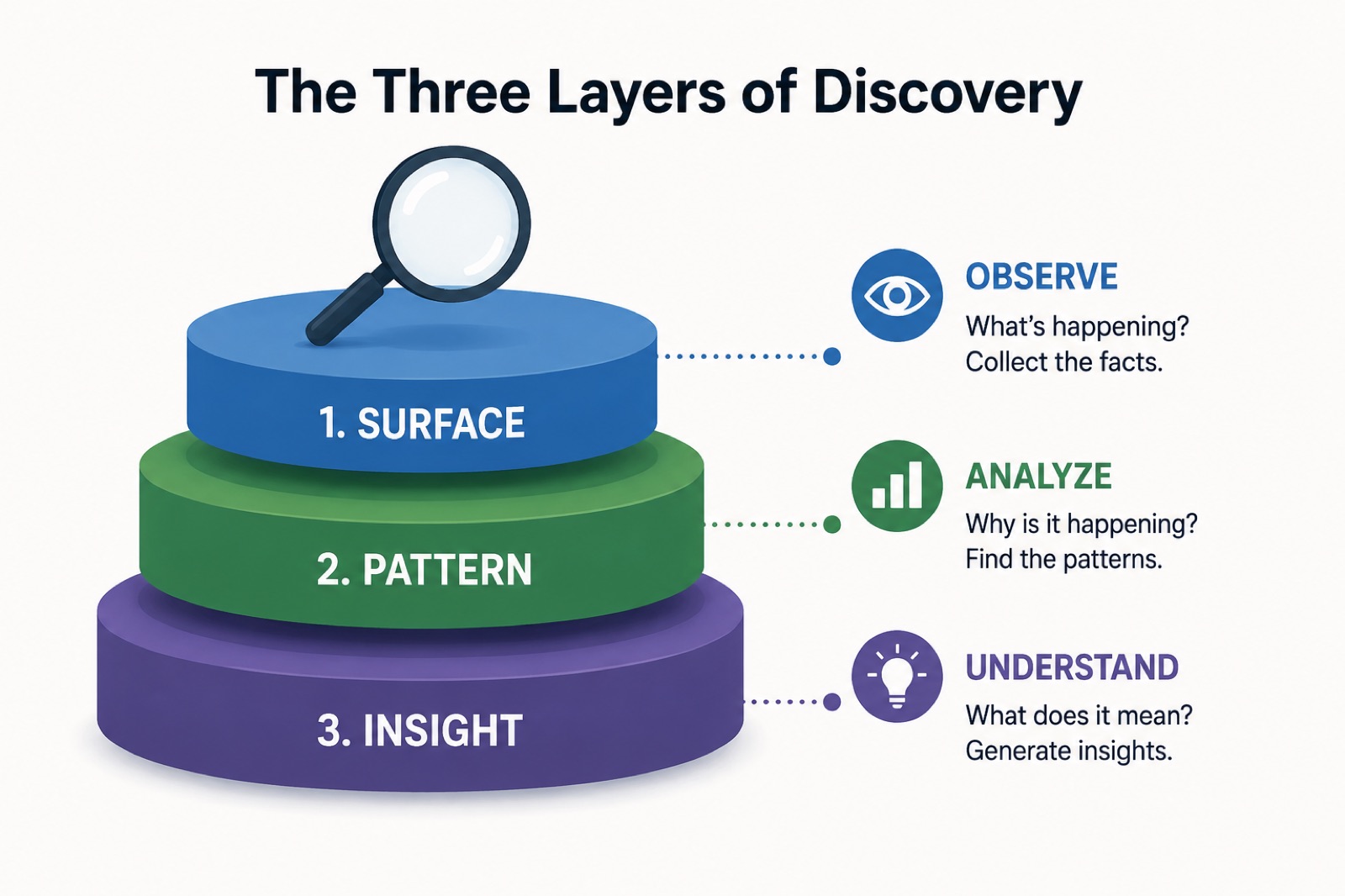
Four kinds of questions do most of the work. The first three follow the three layers of discovery below — what the customer is asking, why they are asking, and what they don't know they need — and the fourth closes the loop before the agent acts.
Open questions: what is happening?
- "Can you walk me through what happened, from the start?"
- "What were you trying to do when this came up?"
- "What have you tried so far?"
- "How is this affecting you right now?"
Clarifying questions: why now, and what exactly?
- "What made you call about this today?"
- "When you say it isn't working, what do you see?"
- "Is this the first time, or has it happened before?"
- "What would a good outcome look like for you?"
Anticipatory questions: what else does it touch?
- "Is anything else changing on your side — your address, your plan, who uses the account?"
- "Is there anything connected to this that you'll need to sort out next?"
- "Is there a deadline we should know about?"
- "Who else is affected if this isn't fixed today?"
Confirming questions: did I get it right?
- "So the main issue is the billing date, and the address needs updating too — is that right?"
- "If we make this change, does that fully solve it for you?"
- "Is there anything about this I haven't asked?"
- "Is there anything that would make you call back about this?"
Probing questions in a call center: 16 examples by call type
The same four types, applied to the calls a contact center takes every day. Each set opens, clarifies, looks ahead and confirms.
Billing and payments
- "Which charge on the bill are you calling about?"
- "How do you usually see your bill — in your online account, the app, by email or on paper?"
- "Has anything changed since your last bill — your plan, a discount, your payment method?"
- "So the charge on the 12th is the one you don't recognize, and autopay should stay on — is that right?"
Technical support
- "What were you doing just before the problem started?"
- "What do you see on the screen right now — is there an error message or a code?"
- "Does it happen on every device, or only on this one?"
- "Once this works again, is there anything else on the account that isn't working?"
Cancellation and retention
- "What made you decide to cancel now?"
- "What would have to change for the service to be worth keeping?"
- "Are you moving to another provider, or do you no longer need the service?"
- "Before I process it, is there anything on the account — a balance, a device, a contract end date — you'd like me to check?"
Appointments and account changes
- "What changed since the appointment was booked?"
- "Does the move affect anything else — your pickup location, your provider, your coverage?"
- "Who else on the account needs to know about this change?"
- "Should the new address apply to future appointments and mail as well?"
How to ask them without sounding like a script: start open, then narrow — an open question invites the context a yes/no question never reaches. Ask one question at a time and use the customer's own words. Say why you are asking when it isn't obvious ("I'm asking because a move usually changes your coverage too"). And earn the anticipatory questions: they land after 30–45 seconds of listening, not in the first breath.
The Three Layers of Discovery
Effective probing in customer service operates at three layers, and most agents only consistently work the first one.
Layer 1: What is the customer asking? This is the surface question. The customer says “I want to change my appointment.” The agent confirms the appointment change request and processes it. For a simple request this is the whole conversation, and it works fine.
Layer 2: Why is the customer asking? This is the situational question. The customer wants to change the appointment because their care coordinator scheduled it for the wrong location. Now the agent knows there’s a downstream coordination problem that will affect future appointments unless flagged. A two-second probe (“Is there anything we should update about your preferred location for future appointments?”) takes the call from a transactional resolution to a structural one.
Layer 3: What does the customer not know they need? This is the anticipatory question. The customer wants to change the appointment because they’re moving. The move affects in-network provider availability, prescription pickup locations, and possibly insurance coverage. A 10-second probe at the start of the call surfaces all of these. Without it, the customer will call back three more times over the next 30 days, each time discovering another consequence of the move.
Top-performing agents work all three layers consistently. Average agents work the first one well, the second one inconsistently, and the third one rarely. Layers 2 and 3 are also where repeat contacts come from: they are the questions that would have found the next call's reason.
What Probing Failure Looks Like at Scale
When you run speech analytics against discovery patterns across thousands of calls, the failure modes are remarkably consistent.
The over-fast confirmation. Agent confirms what the customer said and starts the resolution before checking if there’s adjacent context. Saves 30 seconds on the call. Produces a callback that costs five minutes of handle time within the week.
The closed-question funnel. Agent asks a series of yes/no questions that confirm the surface request but never opens the conversation for the customer to volunteer related information. Customer answers the questions, then ends the call without mentioning the thing they actually called about — because nobody asked an open question that invited it.
The assumption cascade. Agent assumes they understand the request from one or two pieces of information and skips clarifying questions. Resolves the call confidently. The resolution turns out to be wrong because the underlying assumption was wrong, and the customer calls back angry the second time.
The script-driven probe. Agent asks the right discovery questions but reads them mechanically from a script, which signals to the customer that the questions are procedural rather than substantive. Customer gives minimal answers and the probe surfaces nothing useful.
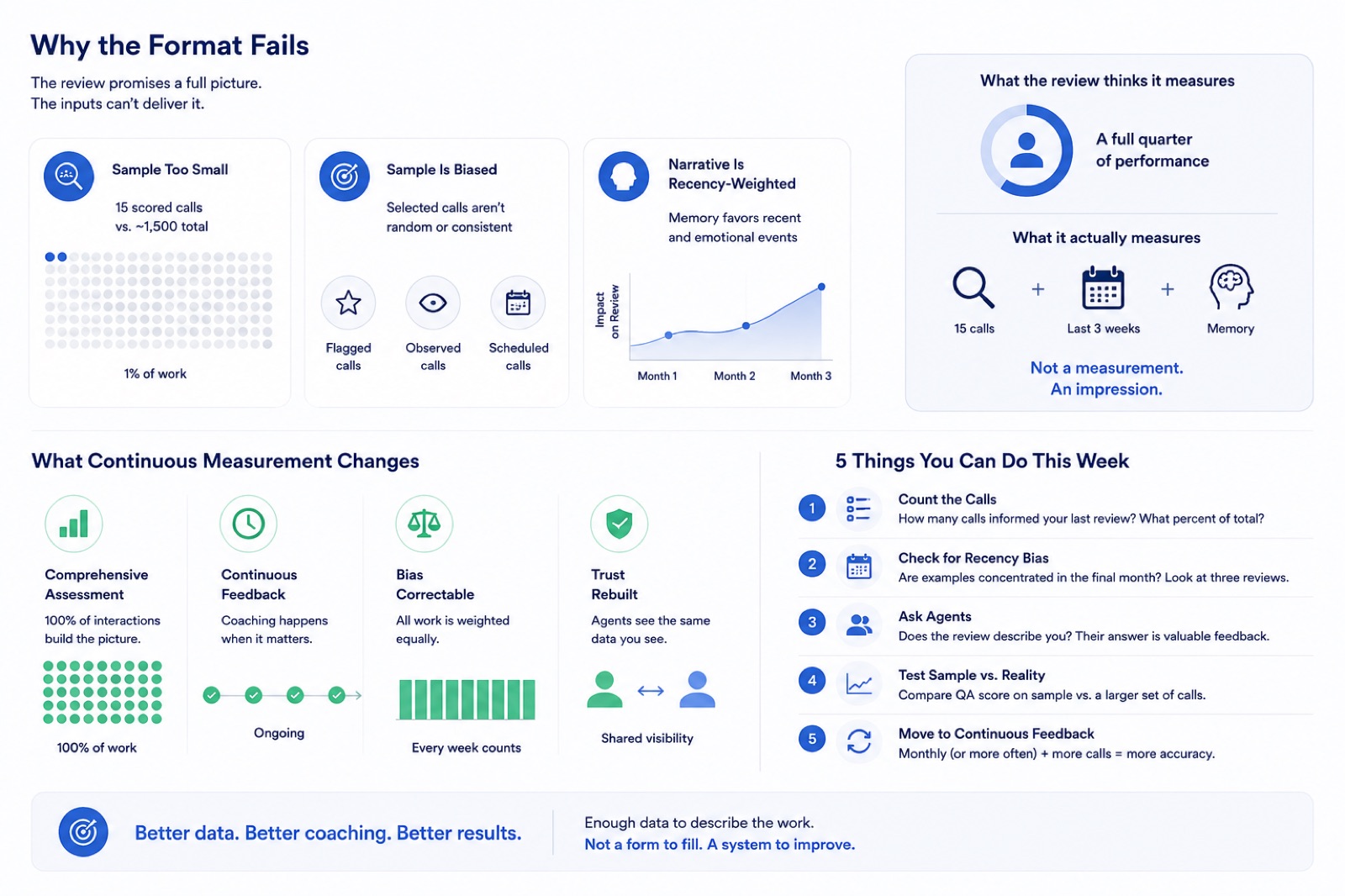
Each of these is detectable in conversation analytics and each of these is coachable. A scorecard with no line for probing depth catches none of them.
The FCR Connection Nobody Talks About
First Call Resolution is the dominant operational KPI in contact centers for good reason. SQM Group’s research ties it to both satisfaction and cost: every 1% improvement in FCR comes with a 1% improvement in customer satisfaction and a 1% cut in operating cost. But FCR is usually treated as a downstream outcome, measured at the end of a 7-day or 14-day window, with limited operational visibility into what produces it.
The conversation data tells a different story. FCR is largely produced or destroyed in the first 60-90 seconds of the call, in the depth of discovery the agent performs. After that window, the trajectory of the call is mostly set. The customer has either provided the information that allows full resolution, or they haven’t, and the post-call experience will reflect whichever happened.
This shifts the operational question from “how do we improve FCR” to “how do we improve probing.” The first version of the question doesn’t have an obvious intervention. The second version has a clear coaching path, a clear metric, and a clear correlation with the business outcome.
The Hidden Cost of Sales Probing Done Badly
Probing questions matter as much in sales-adjacent contact center work as they do in pure support. Cross-sell and upsell conversations live or die on discovery depth. The agent who confirms the customer’s primary need and immediately pitches an adjacent product converts at materially lower rates than the agent who probes for the underlying use case and then surfaces the product that actually fits.
But bad sales probing is its own problem. Agents who probe aggressively without rapport produce a different kind of failure — the customer experiences the probe as a sales pitch in interrogation form. The conversion rate drops. The customer satisfaction score drops. Both at the same time. The risk is highest for newly trained agents who were taught the framework of probing but not the timing.
The fix isn’t more probing or less probing. It’s calibrated probing — questions that earn the right to be asked through the preceding 30-45 seconds of conversation. This is exactly the kind of pattern that’s invisible to QA sampling and visible to 100% analytics.
What Good Probing Coaching Looks Like
Coaching probing skills from conversation data is structurally different from coaching them from role-plays.
The artifact is real. Agents review their own calls where probing succeeded or failed. The coaching conversation moves from “you should ask better discovery questions” (which produces nodding without behavior change) to “here are the three calls last week where the customer mentioned a relevant context cue and you didn’t follow up.” The specificity changes the coaching.
Self-review works because the conversation record is shared — here is how reviewing a conversation works.
The pattern is measurable. Each agent has a baseline probing depth score, calculated across hundreds of calls. Coaching shows up as a measurable shift in that score. When agents can see the data themselves, it removes the manager-as-judge dynamic that makes most coaching less effective.
The library is dynamic. Top-performing probing examples become teaching artifacts for the broader team. Instead of generic role-play scripts written by training designers, agents learn from actual conversations that succeeded, in their own contact center, with their own customer types. This makes the examples credible in a way that scripted role-plays never are.
Five Things You Can Do This Week
1. Pull 20 calls that produced a repeat contact within 7 days. Listen to the first 90 seconds of each. Identify the probing question that wasn’t asked. Look for the pattern across the 20 — there’s almost always a dominant gap.
2. Audit your existing QA scorecard. Count how many criteria measure probing depth versus how many measure script compliance, soft skills, and resolution. If probing depth doesn’t have its own scored line item, you’re not measuring the thing that produces FCR.
3. Identify your top three “adjacent question” patterns. For each major call type, list the one or two adjacent issues that frequently trigger repeat contacts. Build a 90-second discovery prompt that surfaces them.
4. Run a probing depth comparison between your top and bottom FCR agents. If you can do this manually on 10 calls per agent, the pattern will be visible. If you have behavior analytics running at 100% coverage, it will be statistically obvious.
5. Move probing depth onto the scorecard. Even a simple binary (“agent surfaced relevant context the customer hadn’t mentioned: yes/no”) will shift agent attention within a single quarter.
The customer who calls you back tomorrow isn’t calling because your agent did something wrong. They’re calling because nobody on the first call asked a question that would have surfaced the thing they actually needed. The cost of that missed question is showing up in your FCR, your AHT, your CSAT, and your agent attrition, all at the same time, all from the same root cause.
Probing questions: quick answers
What is probing in simple words?
Asking one more question before you act. The customer tells you what they want; probing asks why, and what else it affects, before you fix it.
What is an example of a probing question for customer service?
A customer asks to move an appointment. “Is there anything we should update about your preferred location for future appointments?” is a probing question: it takes two seconds and turns a one-off change into a fix for the reason behind it. Two more from the same call: “What changed since the appointment was booked?” and “Does the move affect anything else — pickup location, provider, coverage?”
What are the four types of probing questions?
Open questions (what happened), clarifying questions (why now, and what exactly), anticipatory questions (what else the request touches) and confirming questions (did I get it right before acting). The examples above show all four, by type and by call type.
What are good probing questions to ask in a call center?
Questions tied to the call type. On a billing call: "Which charge are you calling about?" and "Has anything changed since your last bill?" On a support call: "What were you doing just before the problem started?" On a cancellation: "What made you decide to cancel now?" Each finds the reason behind the request before the agent acts on it.
What is the difference between open and closed probing questions?
An open question asks the customer to explain ("Can you walk me through what happened?"); a closed question gets a yes, a no or one detail ("Is this the first time it happened?"). Start open to hear the whole problem, then use closed questions to confirm the details before you act.
What do probing questions do?
They decide First Call Resolution in the first 60–90 seconds. A call where the agent surfaces the adjacent context resolves once; a call where nobody asks produces the callback that shows up in FCR, AHT and CSAT at the same time. That is why probing depth belongs on the QA scorecard as its own line, scored on every call rather than a sample.