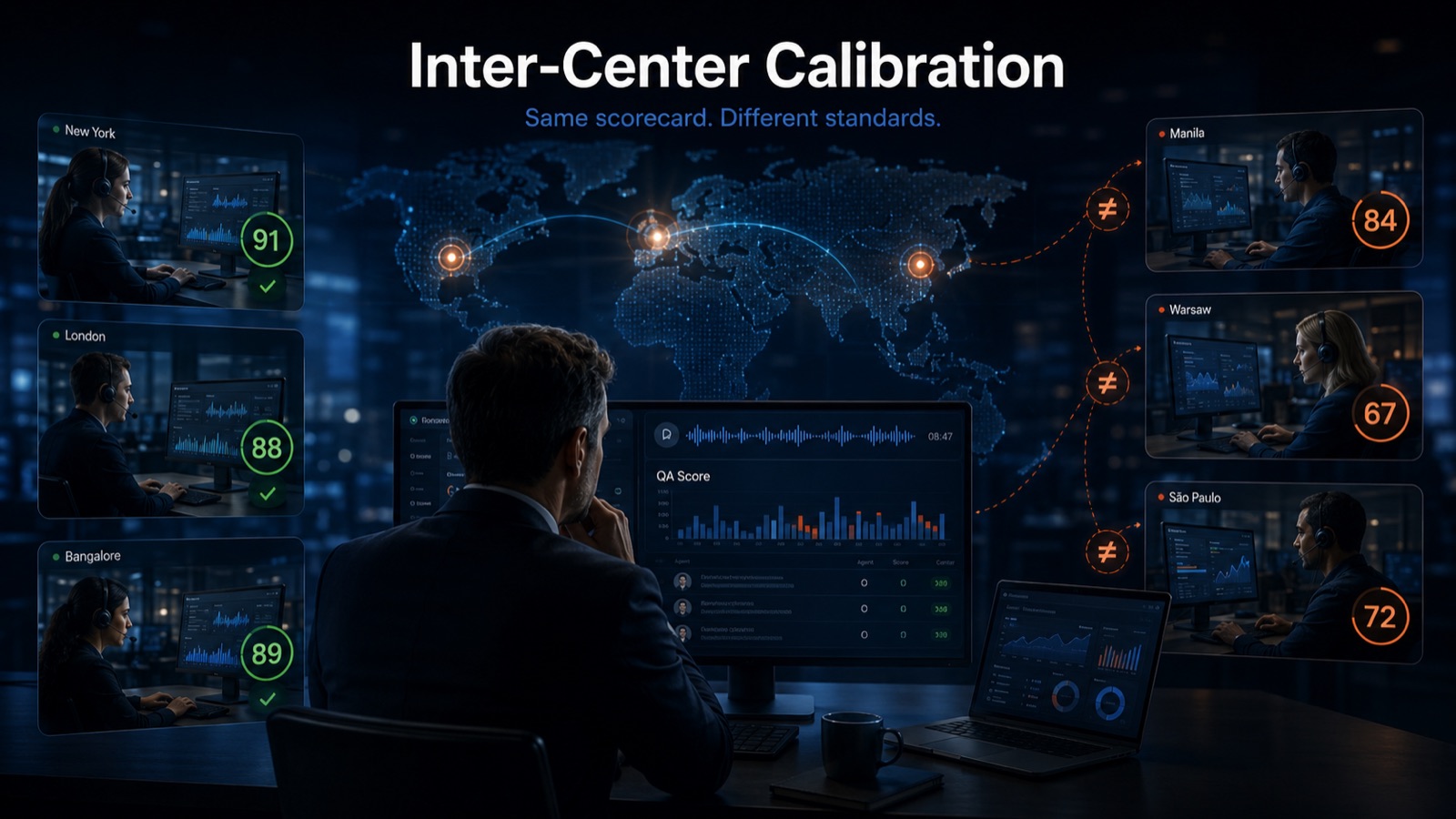
Picture a multinational BPO operating six contact centers across three continents, serving the same end-customer base. Each center runs its own QA program, uses the same scorecard, and has internal calibration practices. Each center’s manager reports their team as “well-calibrated.” The end-customer uses the aggregate QA scores to evaluate performance across centers.
Run a calibration test across those centers — same scorecard, same set of calls, ten QA analysts from each of the six centers scoring blind — and the results can be uncomfortable. Variance between centers is often larger than variance within them. The same call can score very differently from one center to the next, with both centers’ analysts confident their scoring is correct. Each center can be internally consistent while, across centers, they measure different things using identical criteria.
In a case like that, the end-customer’s performance evaluation compares centers on a basis that isn’t actually comparable. The center scoring highest isn’t necessarily performing best. It might just be scoring the same performance more leniently. The performance management decisions — incentives, capacity allocation, contract renewals — are all being made on data that isn’t comparable across the units it is comparing.
This is the structural problem with multi-site QA calibration. Within-team calibration is well-understood. Cross-team and cross-center calibration is significantly harder, much less commonly addressed, and almost universally weaker than the program documentation implies.
Why Inter-Center Calibration Is Harder
Within a single team, calibration can be maintained through regular sessions, shared coaching, and ongoing discussion of edge cases. The analysts work in the same building, talk to each other, build a shared interpretation of the scorecard through accumulated discussion.
Across centers, none of this happens organically. Each center develops its own shared interpretation, which is internally consistent but doesn’t align with what other centers have developed. The same criterion gets interpreted differently because no cross-center discussion is forcing alignment.
Several specific factors amplify this.
Cultural and language differences. What “empathy” sounds like in one cultural context is different from what it sounds like in another. The scorecard says “demonstrates empathy”; what counts as demonstration varies.
Manager influence. Each center’s QA lead shapes their team’s calibration. Different managers emphasize different aspects of the scorecard, and the team’s scoring reflects that emphasis.
Local context. A center handling a specific market segment develops scoring norms suited to that segment, which may not match scoring norms suited to other segments.
Tenure and training cohorts. Newer analysts at one center calibrate to the established analysts there; the same in another center. Both groups are calibrated locally and divergent globally.
The Implications for Performance Management
The cost of weak inter-center calibration shows up in several places.
Performance comparisons are not comparable. Center A’s 89 average isn’t comparable to Center B’s 84 average. The scoring difference may be entirely about calibration drift, not performance difference.
Best-practice transfer is corrupted. Identifying the best-performing center and trying to replicate its practices fails when the “best performance” was actually best scoring. The replication doesn’t produce the expected improvement.
Compensation and incentive systems become unfair. When centers compete for contract retention or capacity allocation based on QA scores, the centers with more lenient scoring have a systematic advantage that has nothing to do with the work being done.
Customer experience predictions are wrong. QA scores are often used to predict customer satisfaction outcomes. The prediction quality depends on calibration; weak inter-center calibration produces predictions that work locally but fail when aggregated.
What Cross-Center Calibration Requires
Programs that genuinely calibrate across centers tend to share four characteristics.
Regular cross-center calibration sessions. Not just within-center. Analysts from different centers score the same calls, discuss disagreements, and converge on shared interpretations of every criterion that produces disagreement. This is operationally expensive but essential.
Shared training and rotation. New QA analysts trained against a common standard, ideally with rotation across centers. Cross-center exposure prevents the local interpretation drift that produces calibration divergence.
Centralized calibration anchoring. A central QA function — small, expert, not site-based — that owns the canonical interpretation of every criterion and resolves edge cases. Without an anchor, sites drift.
Continuous inter-center reliability measurement. Not just annual or quarterly checks. Ongoing measurement of how scoring varies across centers, with intervention when drift is detected.
This is heavier than most multi-site QA programs operate. It’s also what’s required to make the aggregated QA data actually meaningful across sites.
The AI Calibration Shift in Multi-Site Programs
AI-driven QA changes inter-center calibration meaningfully. An AI scoring engine applies the same criteria the same way regardless of which center the call came from. Inter-rater reliability across centers becomes functionally automatic because the rater is the same engine.
This doesn’t eliminate the need for human QA judgment — context, edge cases, and coaching depth still require humans. But it shifts the calibration question from “are our analysts in different centers scoring consistently” to “is our AI scoring engine calibrated to our actual quality standards.” The second question has a different answer profile, and it’s a question that can be answered systematically rather than through ongoing inter-center meetings.
Multi-site contact center operations are some of the highest-value environments for AI-driven QA precisely because the calibration problem at scale is so structurally hard with humans alone.
Five Things You Can Do This Week
1. Run a cross-center calibration test. Same calls, multiple centers, blind scoring. The variance will tell you the actual state of your inter-center calibration.
2. Compare scoring distributions across centers. If center A’s median score differs materially from center B’s, ask why. Performance difference and calibration difference are very different problems.
3. Identify the criteria with the worst inter-center alignment. Some criteria calibrate naturally; others diverge. The divergent ones are your priority for shared training.
4. Audit your performance comparisons. If you compare centers on QA scores for compensation or contract purposes, the comparison may be measuring calibration variance rather than performance variance.
5. Centralize calibration anchoring. Designate one function — not one of the operating sites — as the authority on calibration questions. Sites can disagree with the anchor, but the anchor decides.
The “well-calibrated” QA programs in your multi-site operation are usually well-calibrated within their own walls and substantially divergent across centers. The aggregate scores you’re managing on aren’t comparable in the way the dashboard implies. The fix is heavier than most operations want — sustained cross-center calibration is real work — but it’s the difference between management based on data and management based on data that just happens to be wrong in the same way across reports.