Picture a SaaS sales organization with a star closer. She converts demos to deals at a rate far above the team average, consistently, across quarters. Leadership does the obvious thing: it has her run training sessions for the rest of the team. Six months later, the team average hasn’t moved. Her own numbers are still excellent. The training has transferred nothing.
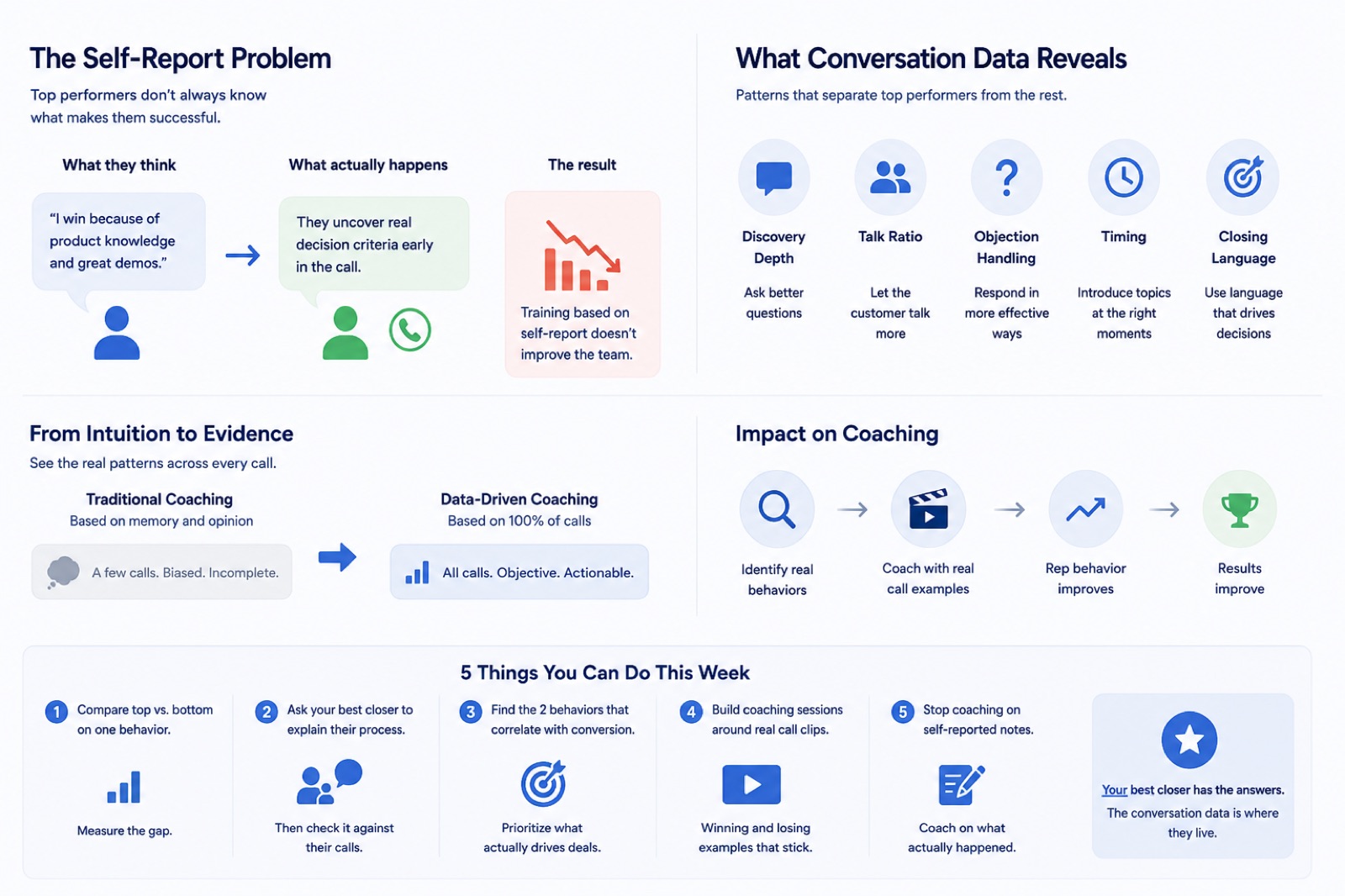
Compare her actual call recordings against the team’s, and the reason the training failed can become obvious. What she teaches in the sessions — her stated methodology — bears little resemblance to what she actually does on calls. She believes she wins deals through product knowledge and thorough demos. The recordings show she wins them through a specific discovery pattern in the first ten minutes that surfaces the customer’s real decision criteria before she ever shows a feature. She isn’t teaching this because she doesn’t know she does it. It’s unconscious competence.
This is the central problem with sales coaching: your best performers are usually the worst at explaining their own success. The technique that drives their results is automatic, invisible to them, and therefore absent from anything they teach. The conversation data has it. Their self-report doesn’t.
The Self-Report Problem
Traditional sales coaching is built almost entirely on self-report and observation. Managers ask reps what happened on calls. Reps describe what they remember, filtered through what they believe matters. Top performers describe a version of their process that’s plausible, coherent, and frequently wrong about what actually drives their results.
This isn’t dishonesty. It’s how expertise works. When someone becomes highly skilled at something, the skill becomes automatic and drops out of conscious awareness. Ask an expert driver how they handle a difficult merge and they’ll give you a simplified, partly inaccurate account, because the actual skill is running below the level they can introspect on.
The consequence for sales coaching is severe. The organization’s best knowledge about what works is locked inside performers who can’t accurately report it, and the coaching system is designed to extract that knowledge through exactly the channel — self-report — that can’t access it.
What Conversation Data Makes Coachable
Conversation analytics changes sales coaching by replacing self-report with observation of what actually happened.
The patterns that separate top from average performers become visible and specific. Discovery depth, talk ratio, question types, objection responses, the timing of when they introduce price, the language they use at the close. These are measurable across hundreds of calls, and the differences between performance tiers are usually concentrated in two or three specific behaviors rather than spread across a vague notion of “skill.”
The coaching artifact becomes real. Instead of “be more consultative” — advice that means nothing actionable — the coach can show the rep three of their own calls where a shallow discovery question led to a lost deal, alongside three of a top performer’s calls where a deeper question changed the trajectory. The specificity makes the coaching land.
The teaching library becomes evidence-based. The behaviors that actually correlate with conversion in your specific sales motion, with your specific customers, become the curriculum. Not a generic methodology from a sales book. Your own winning patterns, extracted from your own data.
The Scale Problem It Solves
Sales coaching has always faced an impossible math problem. A manager with eight reps can’t listen to enough of each rep’s calls to coach them well. Even one call per rep per week is eight hours of listening before any coaching happens, and one call per week is far too small a sample to see real patterns.
The result is that most sales coaching is based on a handful of cherry-picked or random calls, which is statistically inadequate to identify what’s actually driving each rep’s results. Managers coach on impressions rather than patterns, and the impressions are biased toward recent and memorable calls rather than representative ones.
Analytics across 100% of calls removes the sampling constraint. The manager can see each rep’s actual patterns across all their calls, identify the specific behaviors limiting their conversion, and coach on evidence rather than impression. The eight hours of listening becomes eight minutes of reviewing flagged patterns.
Five Things You Can Do This Week
1. Compare your top and bottom performer on one specific behavior. Pick talk ratio or discovery depth. Measure it across 10 calls each. The gap will likely be larger and more specific than you expected.
2. Ask your best closer to explain their process, then check it against their calls. The gap between what they say and what they do is the unconscious competence you need to extract.
3. Identify the two behaviors that correlate most with conversion. Across your team, which measurable call behaviors predict deals? Those are your coaching priorities.
4. Build one coaching session around real call clips. Replace methodology slides with actual recordings — winning and losing — from your own team. Watch how differently reps engage.
5. Stop coaching on self-reported call notes. They’re a record of what the rep believes happened, which is systematically different from what did. Coach on the recording.
Your best closer is a goldmine of sales knowledge that even they can’t access. The technique that drives their results is automatic, invisible, and absent from everything they’d teach you. The only place it exists in retrievable form is the conversation data — and that’s the one place most sales coaching never looks.