Picture a B2B technology company that has invested heavily in sales enablement infrastructure. A modern platform, a substantial content library — case studies, battle cards, objection-handling guides, ROI calculators, demo scripts — and a team dedicated to creating and maintaining it. The content is high-quality. The engagement data shows reps occasionally accessing it.
Compare the actual sales calls against the enablement library, and the picture is often discouraging. The objection-handling guides address objections that rarely come up in real conversations. The ROI calculators answer questions reps’ prospects aren’t asking. The battle cards focus on competitors that haven’t been mentioned in months of pipeline. The content is good. It just isn’t aimed at what is actually happening in the conversations the reps are having.
This is the dominant failure mode of sales enablement, and it’s structurally rather than tactically caused. The content gets built based on what marketing and product can articulate about the market. The conversations reveal what customers actually say. These two sources of input rarely agree, and most enablement programs run on the first source while the second source goes unused.
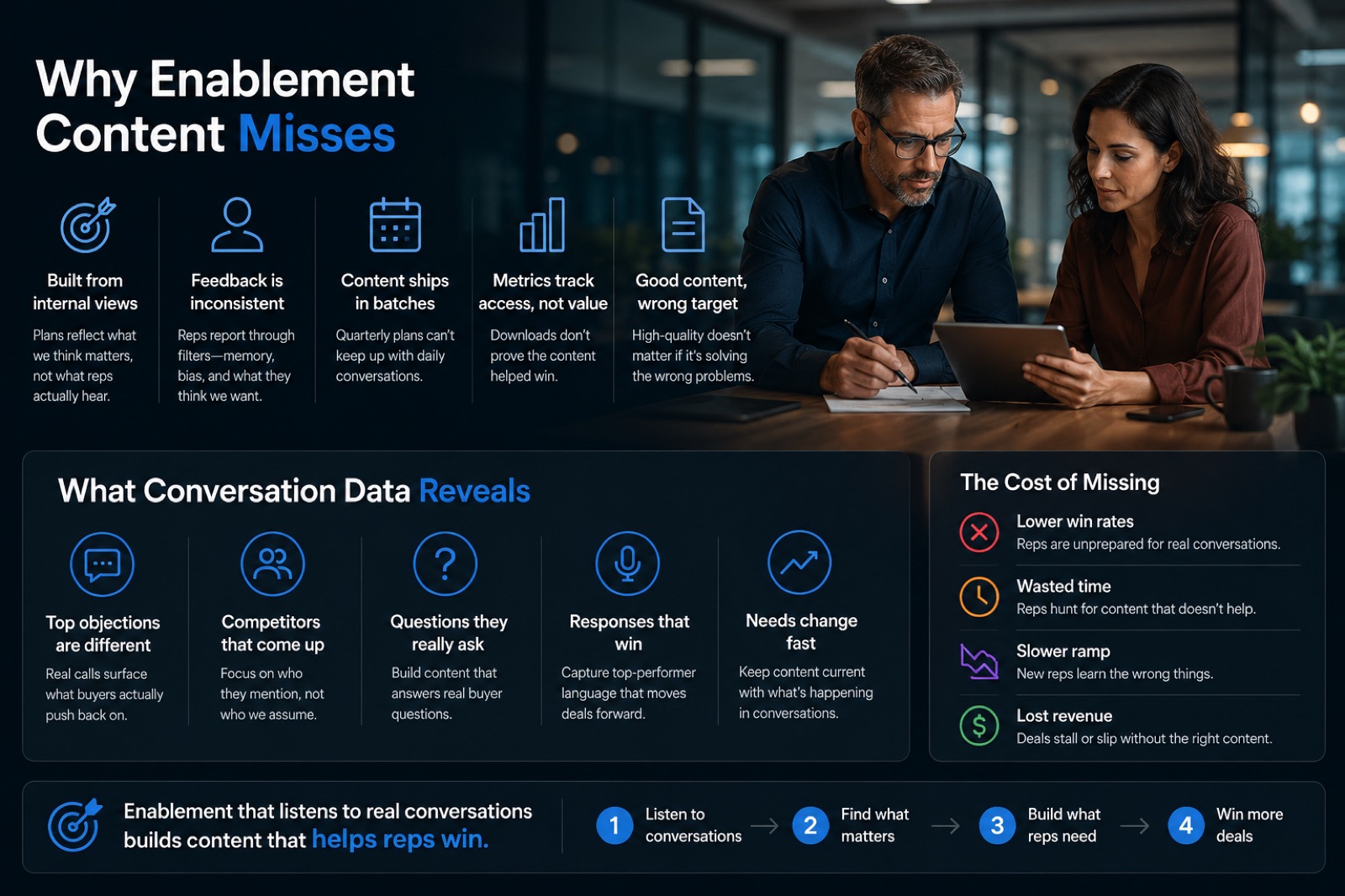
Why Enablement Content Misses
The misalignment between enablement content and conversation reality has predictable causes.
Content roadmaps are built from internal sources. Product launches, competitive intelligence from analyst reports, strategic positioning from marketing. None of these are wrong, but they’re not what customers are actually saying to your reps right now.
Feedback loops from sales are inconsistent. When marketing asks reps what they need, the answers are filtered through what reps think marketing wants to hear, what reps can articulate from their own self-report (which has the same biases as CRM notes), and what’s been most memorable recently.
Content gets created in batches. Quarterly content planning, monthly publishing cadences, periodic refresh cycles. None of these match the daily pace at which customer conversations evolve.
Engagement metrics measure access, not utility. A rep opening a battle card looks like engagement in the analytics. Whether the battle card was useful for the conversation that prompted the open is invisible.
The result is a content library that’s substantial, well-organized, and substantially mis-targeted relative to what’s happening in the actual sales motion.
What Conversation Data Reveals About Enablement Needs
When conversation analytics is applied to enablement, the gap between content and need becomes specific.
The top three objections in your actual deals can be identified empirically. They’re usually different from the top three the enablement team is building content for, and the gap is usually large.
The competitors actually mentioned in deals can be quantified. Battle cards for unmentioned competitors should be lower priority than battle cards for mentioned ones, regardless of who marketing thinks the strategic competition is.
The questions prospects actually ask can be cataloged. The content library should answer these, in language reps can use, with the depth the conversation actually requires.
The objection responses that work can be extracted from top performers’ calls and turned into evidence-based enablement. This replaces generic objection-handling theory with proven language from successful conversations.
The discovery questions that surface real buying intent can be identified. Enablement to teach these is dramatically more valuable than generic discovery training.
What Conversation-Informed Enablement Looks Like
Organizations using conversation data to drive enablement tend to make four shifts.
Content priority is data-driven. The objections most often raised, the competitors most often mentioned, the questions most often asked — these drive the content roadmap. Internal intuition about what reps need takes a back seat to evidence about what conversations actually require.
Content gets surfaced in context. Real-time agent assist systems can surface the right enablement content in the moment a rep needs it, rather than expecting the rep to remember it exists and to navigate to it. This dramatically increases the effective utility of the existing library.
Top performers’ actual approaches become content. Instead of marketing writing battle cards from product positioning, the actual responses from reps whose conversations win get extracted and packaged. This produces content that lands because it came from real conversations, not from theoretical positioning.
The content evolves with the data. Quarterly refresh cycles get replaced with continuous identification of new objections, new competitive mentions, and new question patterns as they emerge in conversations. The library stays current with reality.
The ROI Argument
Sales enablement ROI has historically been hard to measure because the link between content and deal outcomes is indirect. Conversation-informed enablement changes this.
When you can identify which conversations used which content, and you can track those deals’ outcomes, the ROI becomes measurable. Content that’s used in winning deals can be amplified. Content that’s accessed but doesn’t correlate with wins can be revised or retired. The library becomes a living asset whose performance is measured.
This isn’t a small change. It’s the difference between sales enablement as a cost center justified on faith and sales enablement as a measurable performance investment.
Five Things You Can Do This Week
1. Identify your top three actual objections. Listen to 20 recent calls and catalog the objections that came up. Compare against the content priorities of your enablement team. The gap will be informative.
2. Identify your top three actual competitors. Same exercise for competitive mentions. The list will probably surprise you.
3. Audit one battle card against real conversations. Pick a battle card that exists in your library. Find five calls where the relevant competitor came up. Did the battle card’s positioning match what was actually said? Usually no.
4. Extract one objection response from a top performer. Find a call where a top performer handled a difficult objection well. Package the response as enablement content. Compare its utility to the existing content on that objection.
5. Make content engagement tracking real. Don’t measure access. Measure correlation between content use and deal outcomes. The data will tell you what’s actually working.
The enablement library is mostly built on what marketing and product can articulate about the market. The conversations show what customers actually say. The reps live in the second world; the library lives in the first. The gap is where reps disengage from enablement — not because they don’t want help, but because the help on offer isn’t aimed at the conversations they’re actually having.