Picture a SaaS revenue leader with a forecast accuracy problem. The CRO commits a quarterly number to the board, the sales leadership team defends that number through the quarter, and the actual landing consistently differs by 8-15%. Some quarters higher, some lower. The variance is small in percentage terms but large enough in absolute dollars that the board is asking pointed questions.
Analyze the deals that missed forecast — both the deals weighted high that didn’t close and the deals weighted low that did — and a pattern tends to emerge. The pipeline stage and the engagement signals predicted poorly in both directions. The signals that the deal would or wouldn’t close were often audible in the calls. The forecast was built on data that systematically excluded those signals.
This is the dominant failure mode of pipeline-based forecasting. The signals that predict deal outcomes most reliably are in the conversations, and most forecasting systems were built before those conversations were systematically analyzable. The forecast accuracy gap is a forecasting-architecture problem more than a sales-execution problem.
What the Pipeline Number Actually Reflects
A typical pipeline-weighted forecast aggregates:
- Deals at various stages
- Each deal’s dollar value
- A weighting factor by stage (typically increasing as deals progress)
- Sometimes a rep-entered confidence modifier
- Sometimes an engagement-based modifier
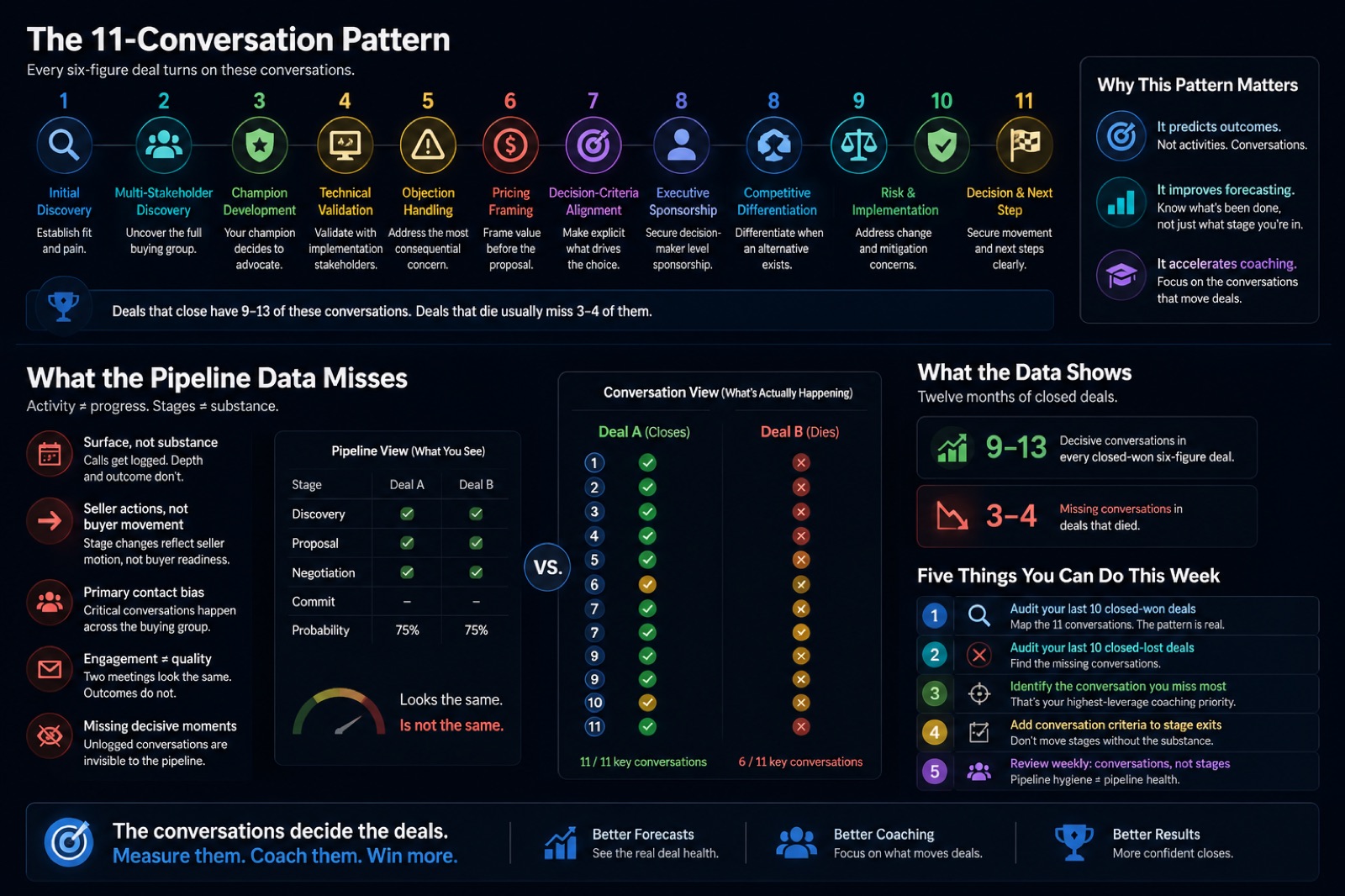
This produces a number that reflects pipeline shape and rep-reported deal state. What it doesn’t reflect is whether the conversations supporting the deals match the pipeline state. A deal sitting in proposal stage that has had no champion development is treated identically to a deal in proposal stage with strong multi-stakeholder buy-in. The pipeline number averages across both as if they were equivalent.
The forecast accuracy gap mostly lives here. The pipeline shape is correct. The deal-level reality underneath the shape is what’s hidden, and it’s where the surprises come from.
The Conversation Signals That Predict
When conversation analytics is applied to deal data with a feedback loop on actual outcomes, certain signals emerge as strong predictors.
Champion language quality. The way the primary contact talks about the deal in recent conversations. Confident advocacy (“we’re moving forward with…”) predicts close at much higher rates than tentative interest (“we’re still evaluating…”), even when both are logged in CRM as positive.
Decision-criteria specificity. Deals where the customer has articulated specific decision criteria are much more likely to close in forecasted timeframes than deals where criteria remain vague. The vagueness is a signal the prospect isn’t really ready to decide.
Stakeholder breadth in recent conversations. Deals where multiple stakeholders are participating in recent conversations close at higher rates than deals where engagement narrows to one or two contacts. Narrowing engagement is one of the strongest leading indicators of stall.
Competitive language. Mentions of competitors in late-stage conversations have a non-linear effect. Some competitive context is normal. Specific comparison work — pricing analysis, feature-by-feature evaluation — suggests the buyer is shopping, which extends cycles.
Future-pacing. When prospects start talking about implementation, training, and rollout in detail, they’re mentally past the decision. When prospects keep returning to “if we decide” language, they’re not.
These signals exist in the conversation data and almost nowhere else. Pipeline systems don’t capture them. Rep-entered notes capture them partially and inconsistently.
What Conversation-Informed Forecasting Looks Like
Organizations that incorporate conversation data into their forecasting tend to organize around a few principles.
Conversation signals supplement, don’t replace, stage data. Pipeline stage and conversation signals together produce better forecasts than either alone. The two data sources reinforce each other when they agree and flag uncertainty when they disagree.
Disagreement is the highest-value signal. When the pipeline says strong but the conversation says weak, that’s a deal to investigate. When the pipeline says weak but the conversation says strong, same thing. The deals where the two signals diverge are the deals where forecasts are most likely to be wrong.
Coaching gets calibrated by forecast accuracy. Reps whose deals consistently miss forecast in one direction have a specific bias that’s coachable. Reps who systematically overcall pipeline strength need different coaching than reps who undercall.
Forecast accuracy itself becomes a measured outcome. Quarter-over-quarter accuracy, by team and by rep, becomes a tracked metric. Improvement becomes possible because the gap is visible.
The Honest Constraint
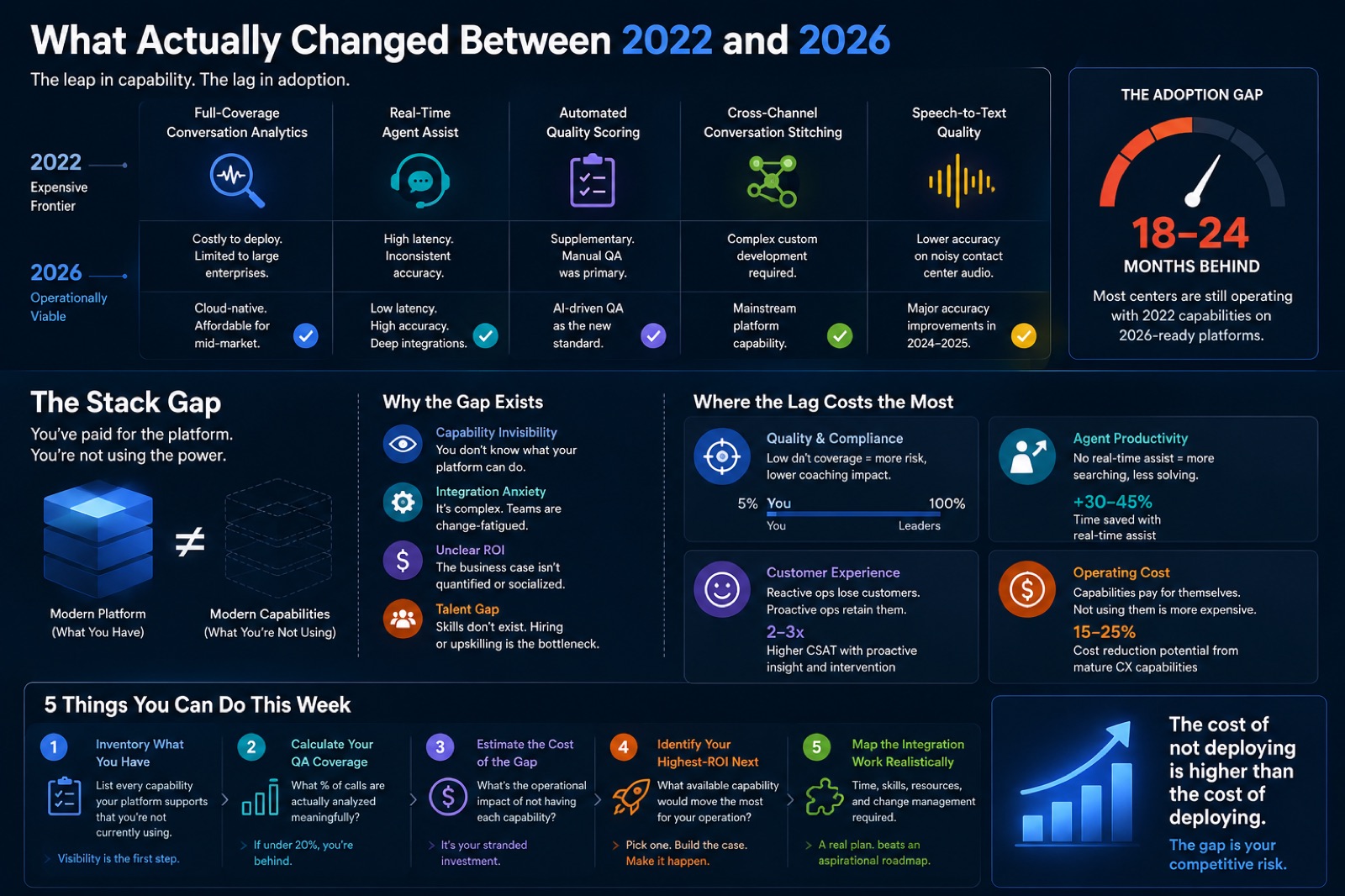
Conversation-informed forecasting requires the infrastructure to capture and analyze calls at scale. Organizations without that infrastructure can do some of this manually on the biggest deals, but the systematic version requires platform support.
This is one of the operational areas where the gap between leading and trailing companies is widening. Organizations with conversation analytics in their forecasting workflow are operating with substantially better information than organizations relying on pipeline data alone. The forecast accuracy improvement is real, the revenue impact is material, and it compounds quarterly.
Five Things You Can Do This Week
1. Pull your last quarter’s forecast misses. For the deals that surprised, listen to the recent conversations. The signal was usually there.
2. Identify your top three forecast-disagreement patterns. Where do pipeline and conversation say different things most often? That’s your highest-leverage place to add structured conversation signals.
3. Audit rep forecast accuracy individually. Some reps systematically overcall, others undercall. The pattern is coachable once it’s visible.
4. Add one conversation signal to your forecast process. Even something basic — “has there been multi-stakeholder engagement in the past 30 days?” — improves accuracy noticeably.
5. Make forecast accuracy a measured outcome. Track it, review it, improve it. Without measurement, the gap can’t close.
The pipeline number is built on stage data and rep judgment, both of which are systematically biased in predictable ways. The conversation data that would correct the bias usually isn’t in the forecast at all. The forecast accuracy gap your board keeps asking about isn’t an execution problem. It’s an information problem, and the information has been sitting in the calls all along.