Picture a B2B SaaS company with a thoroughly documented sales process. MEDDPICC qualification, structured discovery, multi-threaded engagement, mutual action plans, and a five-stage pipeline with explicit exit criteria. The process is trained twice a year, reinforced in pipeline reviews, and embedded in the CRM. Leadership treats it as the foundation of the sales motion.
Analyze six months of its actual sales calls against the documented process, and two patterns often emerge. The first is that compliance with the documented methodology is lower than leadership assumes: reps do most stages, but skip or shortcut some of them in many deals. The second is that the deals that follow the methodology closely tend to close at a higher rate than the deals that don’t. The methodology is working — for the deals where it is actually being executed.
Leadership’s response to data like this is instructive. The first reaction is often to question the analysis. Once it is validated, the next reaction is to plan more methodology training. Neither response is the correct one. The real question is: why are reps skipping a methodology that works, and what does the conversation data tell us about the gap.
This is the central paradox of sales process documentation. The methodology that gets written down is rarely the methodology that gets executed, and the gap between them is the highest-leverage place to look for revenue improvement.
Why Documented Methodologies Get Skipped
Sales methodologies fail to be followed for predictable reasons that show up consistently in conversation data.
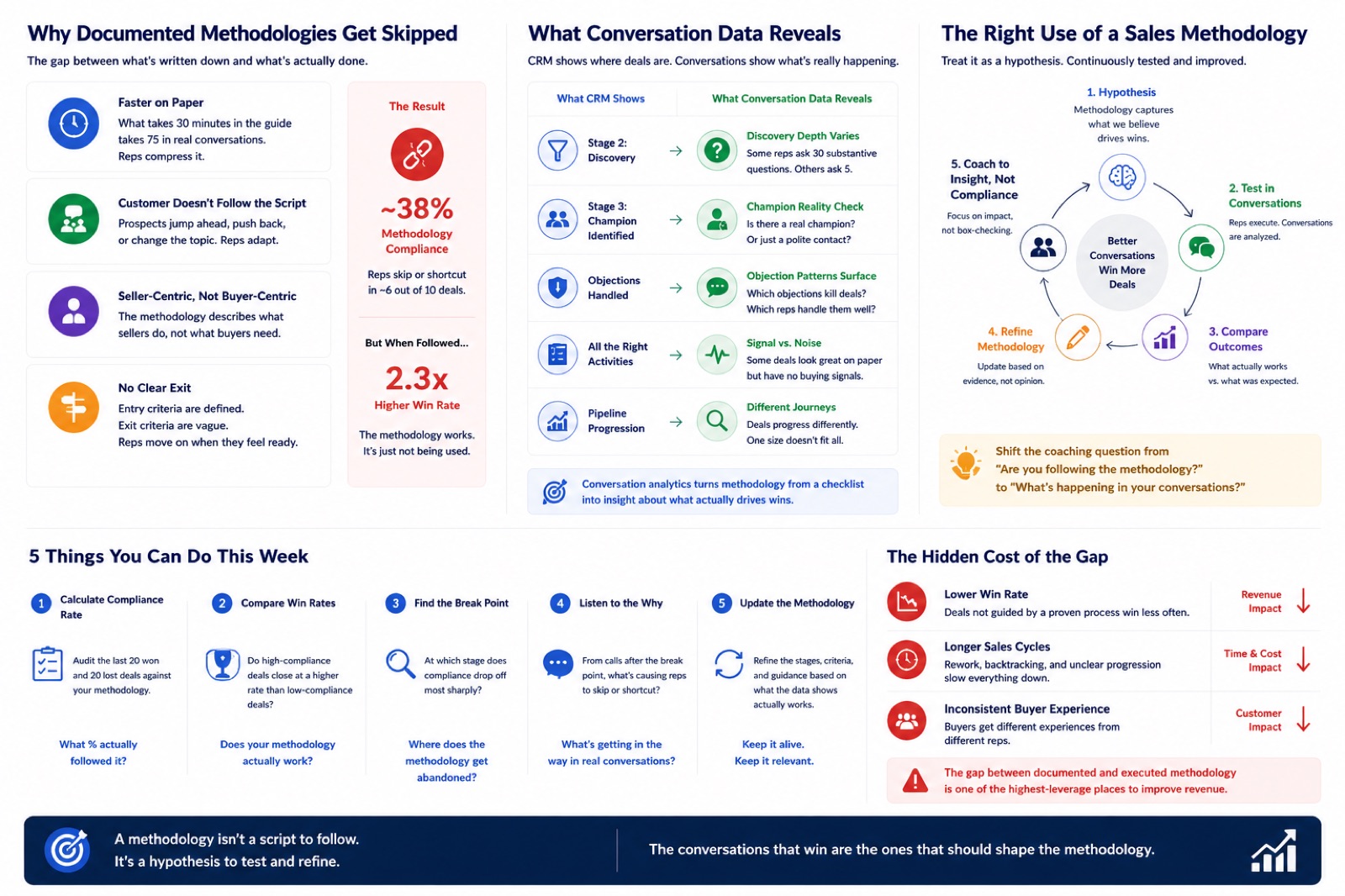
The methodology is faster on paper than in practice. A discovery stage that takes 30 minutes in the documented version takes 75 minutes in real conversations with real customers who interrupt, deflect, and need rapport-building. Reps under pipeline pressure compress the long version into the short version.
The customer doesn’t follow the script. Documented methodologies assume cooperative conversations. Real conversations have prospects who jump ahead, push back, or want to talk about something the methodology doesn’t address. Reps adapt; the methodology often doesn’t.
The methodology is structured around the seller, not the buyer. Many documented processes describe what the seller should do at each stage rather than what the buyer needs at each stage. When these diverge — which is often — reps follow the buyer’s lead and the methodology gets abandoned.
The methodology can’t tell when it’s done. Stages have entry criteria but vague exit criteria. Reps move deals to the next stage when they feel ready rather than when the methodology says they’re ready. This compounds — by stage three or four, the methodology has been left behind.
What Conversation Data Reveals That CRM Doesn’t
CRM stage data tells you where reps say deals are. Conversation data tells you what’s actually happening in them. The gap is consistently large.
Discovery depth varies dramatically. Two reps with deals in the same pipeline stage may have run completely different discovery conversations. One asked thirty substantive questions about the prospect’s situation. The other asked five. CRM treats them identically. Conversion outcomes show they’re not.
Champion development is patchy. The methodology says a champion must be identified by stage three. The conversation data shows whether the champion actually exists, what they’ve committed to, and whether they’re real or a polite contact who’ll quietly disappear at decision time.
Objection handling is where the methodology breaks. Most documented methodologies devote little space to specific objection responses. The conversation data shows exactly which objections are derailing deals and which reps handle them well. This is one of the highest-ROI gaps to close.
The signal of a real deal versus a false positive. Some deals have all the surface attributes of progression — meetings booked, materials sent, stakeholders identified — but the conversations contain no real buying signals. Other deals look quiet in CRM but have clear progression in the actual dialogue. Conversation analytics catches both patterns; CRM stage tracking catches neither reliably.
The Right Use of a Sales Methodology
The methodology isn’t the problem. The misuse of the methodology as a compliance artifact is.
A good sales methodology should function as a hypothesis about what produces wins, continuously tested against actual outcomes. Not a script reps are graded on. Not a CRM workflow they navigate. A working hypothesis that adapts as the data accumulates.
The conversation data is what makes this possible. When you can see what was actually said in deals that closed and deals that didn’t, the methodology stops being something prescribed from above and becomes something derived from what works. The reps who follow it best aren’t the ones with the cleanest CRM hygiene — they’re the ones whose conversation patterns most closely match the patterns that produce wins.
This shifts the coaching question from “are you following the methodology” to “your conversations in stage two look very different from the ones that close in stage four — let’s look at why.” The first question produces defensiveness. The second produces curiosity, which is the only state in which methodology actually transfers.
Five Things You Can Do This Week
1. Calculate your methodology compliance rate. For the last 20 closed-won and 20 closed-lost deals, audit the conversation data against your documented stages. The compliance rate will probably be lower than you assumed.
2. Compare win rates between high-compliance and low-compliance deals. If high-compliance deals close materially better, your methodology works and the gap is execution. If they don’t, your methodology is wrong.
3. Identify the stage where methodology compliance breaks down. Almost always one specific stage is the cliff — usually around mid-funnel. That’s your highest-priority intervention.
4. Find your top three skipped activities. Which methodology requirements are reps most often shortcutting? The pattern reveals which parts of the methodology feel like overhead to the people executing it.
5. Run one coaching session built on real call clips, not slides. Three deals that closed, three that didn’t, all your reps in the room, watching what actually happened. The methodology either reveals itself in the conversation, or doesn’t, and the discussion writes itself from there.
The sales process document on your wiki describes a methodology. The conversation data shows you the methodology that’s actually executing. The deals get closed in the second one. Most sales organizations spend their improvement effort trying to make the first one stick when they should be studying the second one to figure out what works.