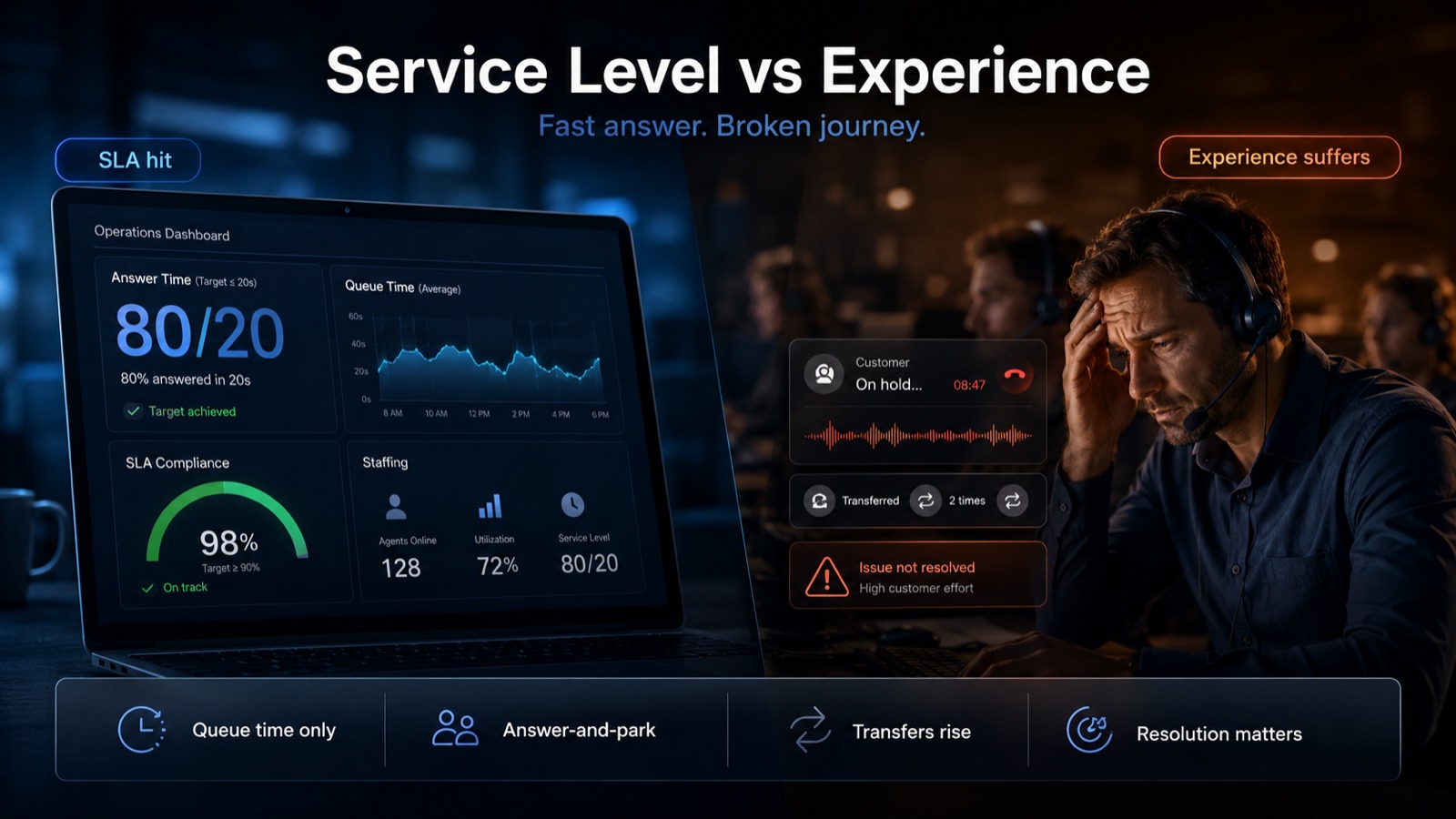
Take a telecom contact center hitting its service level agreement consistently. The standard target — 80% of calls answered within 20 seconds — is being met at 81.7% over the most recent quarter. The director of operations cites the SLA in monthly reviews as evidence the center is operationally healthy. CSAT has been drifting downward. Nobody in operations can explain why an organization meeting its service level is producing declining customer satisfaction.
Analyze the calls answered “within SLA,” and a pattern can explain the paradox. Hitting the 20-second answer target requires staffing levels that are tight on the talk side. Once answered, calls are handled by agents under cumulative pressure, with limited time for full resolution, with frequent transfers to manage queue depth elsewhere. The customer’s experience of “being answered within 20 seconds” is followed by a call that doesn’t resolve, that includes a long hold, or that ends with an unsatisfying handoff. The SLA is satisfied at the expense of the service it was supposed to represent.
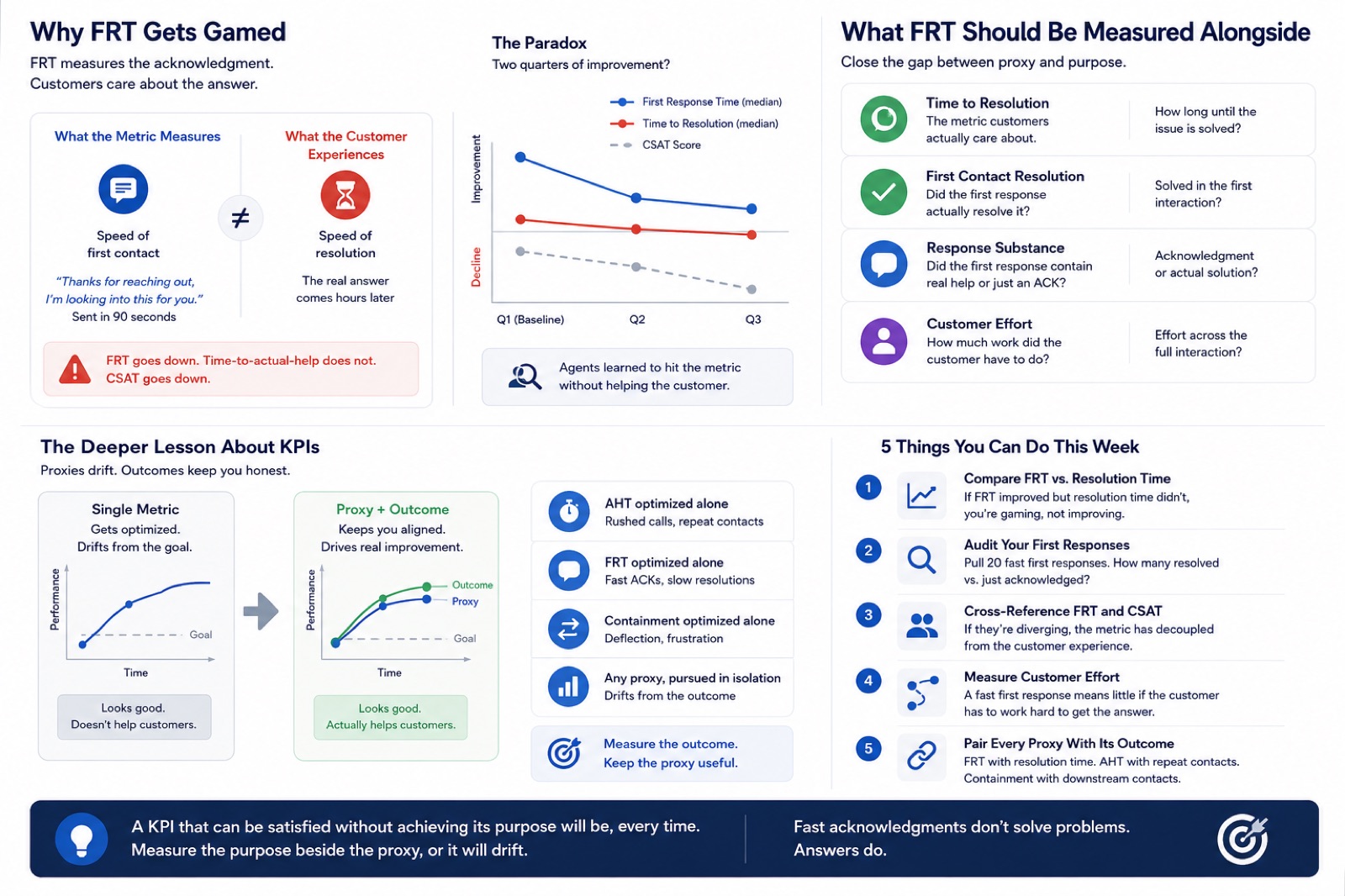
This is the structural problem with traditional service level metrics. They measure one specific aspect of the customer experience — speed of initial answer — and treat it as a proxy for service quality. The proxy and the reality diverge as soon as the operations team is incentivized to hit the proxy at the cost of the reality.
What “Service Level” Actually Measures
The dominant contact center SLA — variants of X% of calls answered within Y seconds — has been the industry standard for decades. Its origins are operational: it gives workforce management a clear target, it’s easy to measure, and it correlates loosely with customer experience.
What it actually measures is queue time on the inbound side, which is one component of the customer experience and not the most important one. A customer answered in 18 seconds who then has a 4-minute hold mid-call and an unresolved outcome had a worse experience than a customer answered in 35 seconds whose call resolved in 90 seconds total. The SLA scores the first interaction better than the second, even though the customer would describe the second as the better experience.
The metric optimizes the wrong thing. Or more precisely, it optimizes a thing that used to correlate with the experience but has stopped correlating as the failure modes have shifted.
The Common Gaming Patterns
When SLA is the dominant operational metric, predictable behavior emerges to satisfy it.
Answer-and-park. Calls get answered quickly to satisfy SLA, then customers get put on hold while agents handle other work. The answer time is good. The customer’s experience is bad.
Transfer-to-survive. When queue depth threatens SLA, calls get transferred between teams to clear the front-line queue. The receiving team becomes the customer’s actual experience, which is now arriving from a different queue with different staffing.
Short staffing tolerated. Operations leaders willing to accept tight staffing on the talk side to maintain answer-side metrics. Customers experience this as rushed agents and unresolved issues.
Selective metric reporting. SLA reported on the calls that count (e.g., excluding calls abandoned within the first 5 seconds, excluding calls routed to overflow). The numerator gets cleaner; the customer experience doesn’t change.
Each of these is technically rational under SLA-dominant measurement. Each of them degrades the experience the metric was supposed to represent.
What Better Measurement Looks Like
Service level isn’t useless. It’s just insufficient as a primary metric. Organizations that take customer experience seriously have moved toward composite measurement that includes service level but doesn’t lead with it.
Time-to-resolution as a primary metric. How long from first contact to actual resolution, not from first ring to first hello. This captures the experience the customer actually has.
First-call resolution as a peer metric. Whether the customer’s issue was actually resolved on the first call. SLA without FCR is hollow.
Customer effort score. How much work the customer had to do across the full interaction. This directly captures the experience the SLA fails to represent.
Composite service experience score. Combining answer time, hold time during call, transfer count, and resolution outcome into a single number that reflects the customer’s actual journey. More complex to compute, much more aligned with experience.
Organizations using composite measurement still track SLA — it remains useful for workforce planning — but they don’t lead with it and they don’t reward operations leaders primarily for hitting it.
The Workforce Management Implication
The shift away from SLA-dominance changes workforce management substantially. Staffing models built to optimize answer time produce different schedules than staffing models built to optimize resolution outcomes.
Optimizing for SLA tends to produce thin staffing with high adherence requirements. Agents need to be available exactly when calls are expected. Cycle slack is minimal.
Optimizing for resolution outcomes tends to produce slightly heavier staffing with more flexibility. Agents need bandwidth to complete calls properly rather than being optimized for queue management.
The cost difference is real but smaller than operations leaders often assume, and the customer experience difference is substantial. The trade is usually worth it for any organization where customer experience materially affects retention or revenue.
Five Things You Can Do This Week
1. Cross-reference your SLA performance with CSAT. If they’re diverging — SLA good, CSAT declining — the metric has decoupled from the experience.
2. Measure your hold time within calls, not just queue time. The hold time after the answer is often longer than the queue time before it, and far less visible.
3. Calculate time-to-resolution as a primary metric. From first contact to issue actually closed. The number will probably be higher than expected.
4. Audit your transfer rate. High transfer rates correlate with SLA optimization at the cost of resolution. The pattern is usually visible.
5. Add at least one experience-based metric to operations leaders’ compensation. As long as SLA is the only metric that matters for compensation, the optimization will continue regardless of what other metrics get reported.
The 80/20 service level was designed to ensure customers got answered promptly. Pursued in isolation, it teaches operations to optimize for the answer at the cost of the service. The customer experience that the SLA was supposed to represent gets worse while the SLA itself gets better, and the metric will keep saying everything is fine until someone measures the things it was always missing.