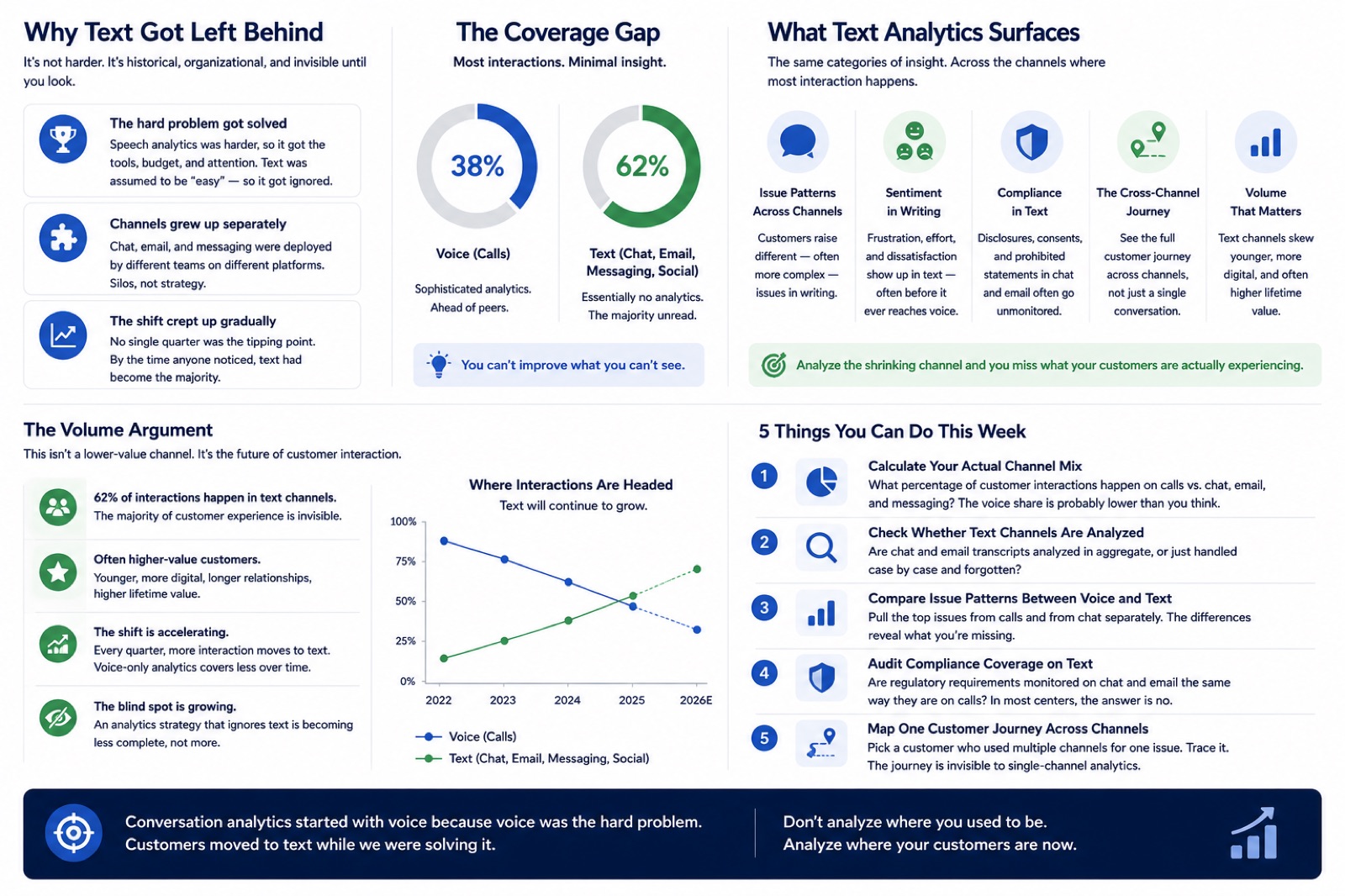
Take a retail bank with a sophisticated speech analytics program. Every call analyzed, sentiment tracked, compliance screened, topics categorized. It is genuinely ahead of its peers on voice. Then ask a simple question: what percentage of your customer interactions happen on calls? The answer can be well under half. The rest — chat, email, secure messaging, social — flows through channels with essentially no analytics at all.
If so, it has built an excellent analytics capability over a minority of its customer conversations and left the majority unread. The chat transcripts are stored and never analyzed. The email threads are handled and forgotten. The messaging conversations are resolved case by case with no aggregate view. A bank like that can tell you the sentiment trajectory of its phone customers in real time and has no idea what its chat customers are experiencing.
This is the current state of many contact center analytics programs. Voice got the investment because voice was where analytics started. The shift of customer interaction toward text-based channels happened faster than the analytics followed, and many contact centers are now analyzing the shrinking channel while ignoring the growing ones.
Why Text Got Left Behind
The analytics gap between voice and text isn’t because text is harder to analyze. It’s largely historical and organizational.
Speech analytics was a harder technical problem, so it attracted more dedicated investment and tooling. Text, being natively machine-readable, was assumed to be easy — which paradoxically meant it got no dedicated analytics attention at all. The hard problem got solved; the easy problem got ignored.
Text channels grew up separately. Chat, email, and messaging were often deployed by different teams, on different platforms, at different times, with no analytics layer built in. Each channel became its own silo, and no one owned the aggregate analytical view across them.
Where text has overtaken voice, the volume crept up gradually. No single quarter marked the change. The shift happened slowly enough that no one had a moment of recognizing that the analytics investment was now pointed at the minority channel.
What Text Analytics Surfaces
Conversation analytics applied to text channels reveals the same categories of insight as speech analytics, across the channels where most interaction now happens.
Issue patterns across channels. The same customer problem often appears differently in chat than on calls. Text analytics surfaces the issues customers prefer to raise in writing — frequently the more complex or sensitive ones — which are systematically absent from a voice-only analytics view.
Sentiment in writing. Customers express frustration differently in text than in speech, but they express it clearly. Sentiment analysis on chat and email captures dissatisfaction that never reaches the phone, including from the large population of customers who will never call but will abandon a chat in frustration.
Compliance in text. Regulatory requirements apply to written interactions as much as spoken ones, but most compliance monitoring is built for voice. Disclosures, consents, and prohibited statements in chat and email frequently go unmonitored entirely.
The cross-channel journey. Most importantly, text analytics combined with speech analytics reveals the full customer journey across channels. We covered the cost of channel-switching in our piece on the omnichannel tax. You can’t see that journey at all if you’re only analyzing one channel.
The Volume Argument
The case for text analytics is ultimately a coverage argument. If the goal of conversation analytics is to understand what customers are experiencing and to improve it, then analyzing calls alone can leave the majority of customer experience invisible.
What flows through text channels isn’t lower-value. In many businesses it’s higher-value — text channels skew toward younger, more digitally engaged customers, often with longer relationships and higher lifetime value. The analytics blind spot is concentrated exactly on the customer segment that matters most for future revenue.
And the channels keep shifting. Every quarter, more interaction moves to text. An analytics strategy that doesn’t cover text is becoming less complete over time, not more. The voice-only program that covered most interactions a few years ago covers fewer every year, and in many centers already a minority.
Five Things You Can Do This Week
1. Calculate your actual channel mix. What percentage of customer interactions happen on calls versus chat, email, and messaging? The voice share is probably lower than your analytics investment assumes.
2. Check whether your text channels are analyzed at all. Chat and email transcripts are usually stored. Are they analyzed in aggregate, or just handled case by case and forgotten?
3. Compare issue patterns between voice and text. Pull the top issues from calls and from chat separately. The differences reveal what your voice-only view has been missing.
4. Audit compliance coverage on text. Are regulatory requirements monitored on chat and email the way they are on calls? In most centers, the answer is no, and that’s an exposure.
5. Map one customer journey across channels. Pick a customer who used multiple channels for one issue. Trace it. The journey is invisible to single-channel analytics and it’s where the real experience lives.
The conversation analytics revolution started with voice because voice was the hard problem. While the industry was solving it, customers moved more and more of their interactions to text, and the analytics didn’t follow. The result is a generation of contact centers analyzing the channel they used to live in while more and more of the customer experience flows, unread, through the channels they live in now.