Picture a retail bank with a textbook Voice of Customer program. Monthly NPS surveys, quarterly relationship surveys, post-call CSAT, structured complaint coding, executive dashboards with traffic-light indicators. The whole apparatus. Its NPS has hovered at +34 for six quarters, slightly above its industry peers. The CX leadership team treats this as solid evidence that the program is working.
Then its product team launches a fee restructure that affects roughly 12% of the customer base. Within 30 days, fee-related call volume in the contact center surges. The NPS, when it lands two months later, has barely moved. The relationship survey, when it lands at the next quarterly cycle, shows mild dissatisfaction concentrated in segments that overlap imperfectly with the affected cohort.
The Voice of Customer program completely misses a Voice of Customer event. By the time the surveys can detect what has happened, the operational response window has closed. Complaints may already have reached the regulator, and large business customers may already have moved their primary banking relationships.
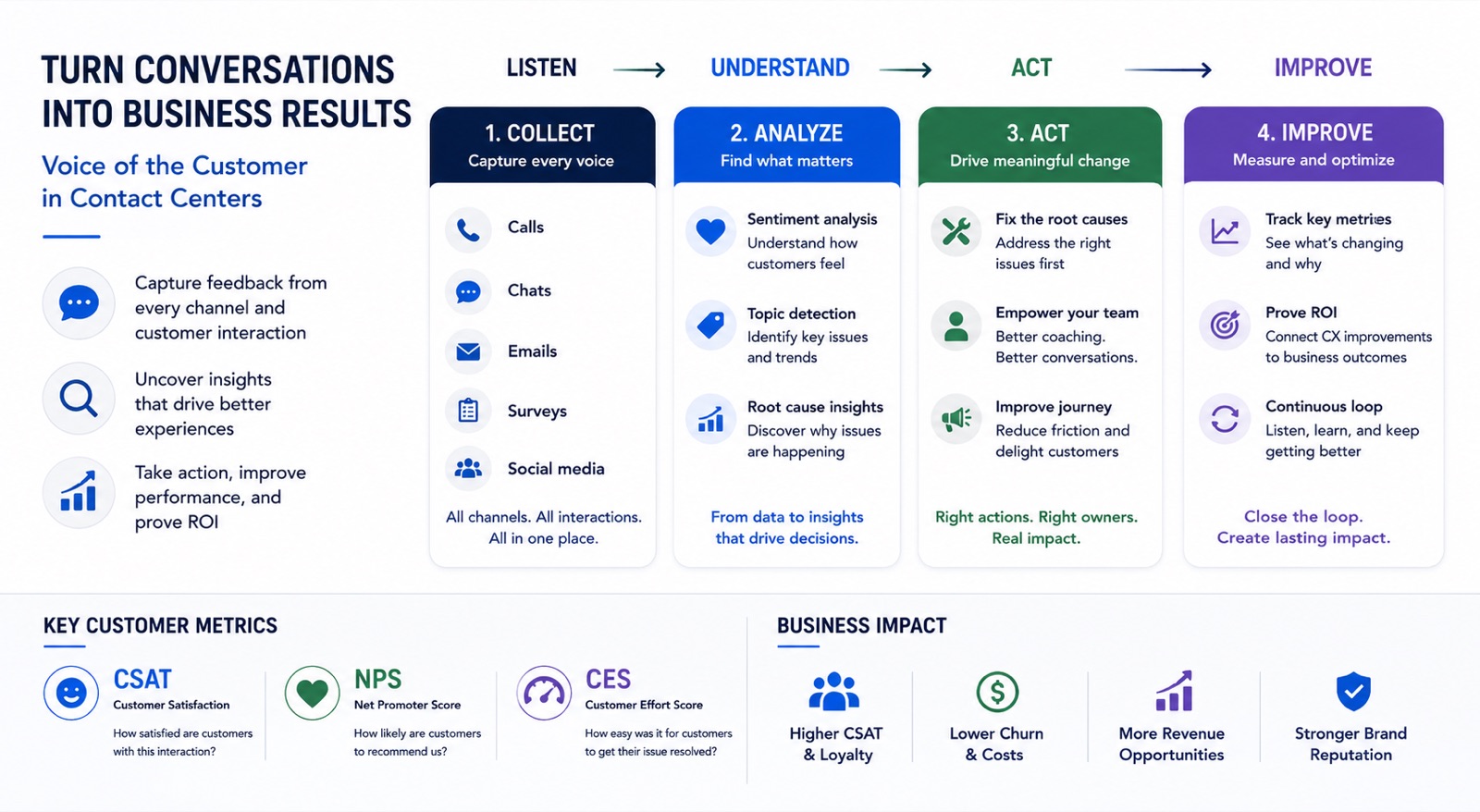
This is the structural problem with Voice of Customer programs as they’re typically built. They listen to customers through the slow, low-resolution channel of survey instruments and ignore the fast, high-resolution channel of the conversations customers are already having with the company every day. The actual voice of the customer is sitting in the contact center recordings. The VoC program is reading the postcards.
What Voice of Customer Programs Actually Capture
A typical enterprise VoC program collects data through four channels.
Solicited surveys. Post-interaction surveys, relationship surveys, NPS panels. Response rates run 8-15%. The respondents are systematically biased toward customers with strong opinions, either positive or negative, with the middle of the distribution under-represented.
Unsolicited feedback. Complaints, social media mentions, review site activity. This data is real and valuable, but it captures a tiny fraction of total customer sentiment — usually the most polarized customers, expressing themselves in channels they chose.
Operational metrics. Repeat contact rates, escalation rates, churn rates. These tell you something is wrong but provide no information on why.
Periodic research. Focus groups, customer interviews, panel studies. High-quality data, but expensive to collect, slow to deliver, and structurally lagging by 60-120 days.
Notice what’s missing. The 90% of customer interactions that happen in the contact center, are recorded by the contact center, and contain the most direct expression of customer needs and frustrations the company will ever capture — these don’t typically flow into the VoC program at all.
The Conversation Is the Feedback
Speech analytics at full coverage changes what a VoC program can be. Instead of asking customers to take a survey after the fact, the program listens to what they’re already saying during the interaction.
The signal density is dramatically higher. A 4-minute customer call typically contains more direct expression of customer needs, frustrations, and preferences than the entire response history of a typical NPS survey. The customer isn’t trying to score the company on a 0-10 scale. They’re telling you exactly what’s wrong, in their own words, in real time.
The coverage is dramatically wider. Every interaction with the contact center generates data. There’s no response bias, no recall bias, no selection bias. The customer who never fills out a survey is in the data because they called the company.
The latency is dramatically shorter. Conversation analytics surface emerging issues within hours of the call, not 60-120 days after the relationship survey. In the retail bank example above, the backlash would be visible to the VoC program in the first 48 hours of the fee restructure — if the program were listening to the contact center data.
What Conversation-Based VoC Surfaces That Surveys Miss
Several categories of customer signal are systematically invisible to survey-based programs.
Issue origination. Where exactly in the customer journey does friction first appear. Surveys ask about the experience after the fact, when the customer has already smoothed the narrative in their own memory. Conversation data captures the friction at the moment it occurs, with the specific product, the specific transaction, and the specific language the customer used to describe it.
Compound frustration. Customers who have called multiple times about related issues build up frustration that doesn’t necessarily produce a low survey score on any individual call, but accumulates into the decision to leave. The conversation data shows the compound pattern. Surveys show only the most recent snapshot.
Latent demand. Customers frequently mention adjacent needs during a contact center interaction — “while I have you, can I ask about…” — that never make it into the product roadmap because they’re not aggregated anywhere. At scale, these mentions are a high-value signal about product gaps and cross-sell opportunities. Surveys don’t capture them.
Language drift. How customers describe the company’s products changes over time, often in ways that signal product positioning issues, market education gaps, or competitive threats. Conversation data captures the actual vocabulary customers use. Surveys force customers to use the company’s vocabulary by structuring the questions in advance.
The unrecognized champion. Customers who give a 7 on NPS surveys (a “passive” by standard methodology) sometimes describe the company in their actual conversations as the best vendor they have. The disconnect is methodology — the customer doesn’t grade on a curve, so a 7 means “very good” to them. The NPS framework reads it as neutral. Conversation data shows the actual sentiment.
The Regulatory Pressure Is Real
Several regulatory frameworks have shifted in the past 24-36 months toward requiring evidence-based customer outcome assessment, which is harder to satisfy with traditional survey-based VoC.
The FCA’s Consumer Duty in the UK explicitly requires firms to demonstrate that they are achieving good outcomes for retail customers, including customers in vulnerable circumstances. The supervisory expectation is clear: collecting metrics, CSAT included, does not by itself show that customers are getting good outcomes. The FCA fined Lloyds Banking Group’s insurers £90.7 million for renewal letters that told customers they were getting a competitive price without checking it. Firms are expected to demonstrate they are monitoring actual customer outcomes across the relationship, with appropriate granularity by segment and circumstance.
In the US, customers take their complaints straight to the regulator: the CFPB received about 6.6 million in 2025, and companies answered 99.6% of those sent to them on time.
Under the EU AI Act, a bank or insurer that uses AI for credit scoring or insurance pricing must monitor how the system works and keep its logs — something a 10% survey response sample cannot show.
The common theme: regulators are pushing toward broader, deeper, more granular evidence of customer outcomes. VoC programs built on survey samples alone are becoming structurally insufficient.
What Modern Voice of Customer Looks Like
Programs that combine traditional survey instruments with conversation analytics typically run four parallel data streams.
Survey channels continue, but with reduced weight. They serve as benchmark and as a check on the conversation-derived data, rather than as the primary source.
Conversation analytics provide the wide-coverage signal. Topic detection, sentiment trajectory, escalation patterns, language drift, and emerging issue identification all run continuously on the full call volume.
Cross-channel integration stitches conversation data together with email, chat, and self-service interactions to produce a customer-level view rather than a channel-level view. We wrote about this in conversation analytics across voice, chat and email.
Operational feedback loops route emerging issues to the relevant business owners within hours rather than quarters. Product issues to product. Process issues to operations. Policy issues to compliance. The lag between customer voice and organizational response collapses from months to days.
Five Things You Can Do This Week
1. Audit your VoC response rate at the segment level. Pull last quarter’s NPS data. Calculate response rate by customer tenure, by product, by geography. The variance will show you which customer voices are systematically absent from your current program.
2. Listen to 20 random recent calls without an agenda. No coding framework, no scorecard, no specific question. Just listen. Document the issues, frustrations, and unprompted suggestions that come up. Compare against what your current VoC dashboard shows. The gap is your blind spot.
3. Identify your three most frequently complained-about topics. Cross-reference between your complaint coding, your contact center call categorization, and your social media mentions. If the three sources don’t align, you have a data integration problem in the VoC architecture.
4. Calculate the latency of your current VoC. From the moment a customer experiences an issue to the moment that issue surfaces in your executive VoC dashboard, how many days elapse? If the answer exceeds 30, you have a structural responsiveness gap.
5. Pilot conversation-based VoC on one product line. Pick a product with high contact center volume and clear strategic importance. Run conversation analytics against 30 days of call data. The findings will give you a business case for the wider deployment that no vendor pitch could match.
The customer’s voice has been in your contact center recordings all along. The Voice of Customer program built on top of it should probably listen to those recordings before it sends out another survey. A bank that misses a fee restructure backlash like that has all the data it needs to see it coming. The data is simply in the wrong format, in the wrong system, on the wrong side of the analytics pipeline. Most VoC programs have the same structural gap, and most of them don’t know it yet.