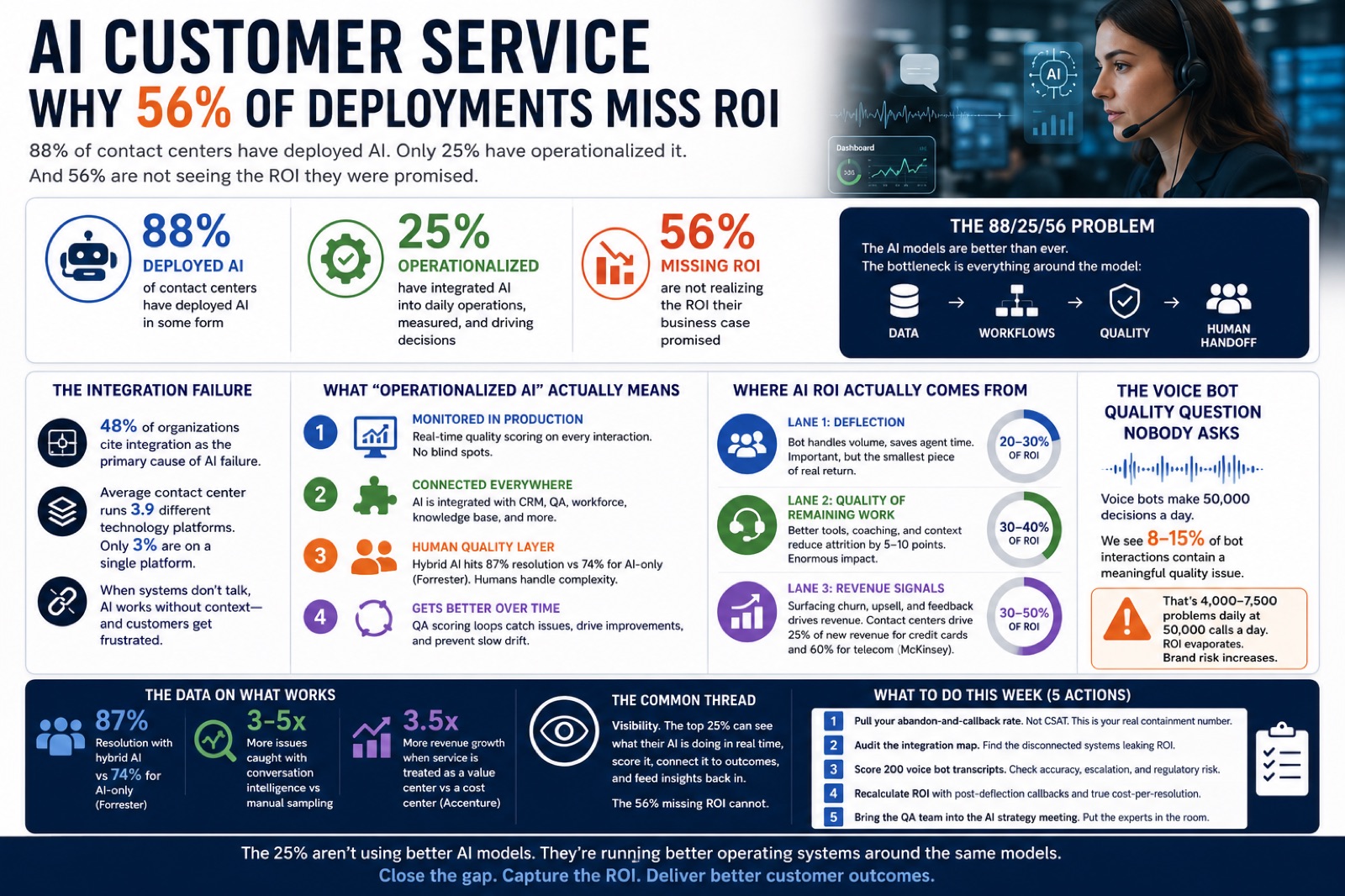
88% of contact centers have deployed AI. Only 25% have operationalized it. And 56% are not seeing the ROI they were promised.
We’ve been inside dozens of these projects across banking, lending, and medical labs. The pattern is almost identical every time. The pilot looks great. The vendor demo crushes. The board approves the budget. Twelve months later, the workflow is running, the dashboard is green, and nobody can answer a basic question: is this actually working?
The gap between “deployed” and “delivering” is where most of the money goes. Below is what we see causing it, what the data says, and what to do about it before your next renewal cycle.
The 88/25/56 Problem
Three numbers tell the story. COPC’s 2025 research found that 88% of contact centers have deployed AI in some form. Voice bots. Chat assistants. Automated QA. Agent assist. Only 25% have operationalized it (meaning: integrated into daily operations, measured, and driving decisions). And 56% are explicitly failing to realize the ROI their business case promised.
That is not a model problem. The underlying language models are better than they have ever been. Generic large language model quality is no longer the bottleneck for most contact center use cases. The bottleneck is everything around the model: the data flowing in, the workflows hooked to the output, the quality monitoring on what the AI actually says, and the human handoff when it goes wrong.
We had a banking client last quarter pull their voice bot logs for a week. The bot was rated 4.6/5 in CSAT. The catch: only 9% of customers stayed long enough to be surveyed. The other 91% either hung up, hit zero for an agent, or called back within 24 hours. The CSAT score was measuring the happy path of a system that was failing 91% of users. Nobody had connected the survey data to the abandon-and-callback data. Two separate dashboards. Two separate teams. One enormous blind spot.
The AI Customer Service Integration Failure
48% of organizations cite integration as the primary cause of AI failure (COPC). The average contact center runs 3.9 different technology platforms. Only 3% operate on a single platform. That is the real story of why these deployments miss ROI: the AI is processing conversations in one system, the CRM holds customer history in another, the QA team scores calls in a third, and the workforce platform schedules agents in a fourth.
When those systems do not talk to each other, the AI is essentially working without context. A voice bot that does not know the customer called yesterday about the same issue is going to fail. An AI QA tool that scores calls in isolation, without account-level context, will mark a frustrated venting customer the same as a confused one, and miss the churn signal entirely. We see this every week.
The integration tax also shows up in measurement. Most contact centers we audit cannot answer “what is our bot containment rate by customer segment, by time of day, by issue type, and what happens after a bot session ends?” The data exists in four systems. Nobody owns the join. Without that join, there is no way to know what the AI is actually doing.
What “Operationalized AI Customer Service” Actually Means
There is a real difference between deployed AI and operationalized AI. Deployed means the system runs. Operationalized means four conditions are true:
The AI’s outputs are monitored in production. Not pilot QA. Not vendor reports. Real-time quality scoring on every voice bot conversation, every chatbot transcript, every agent-assist suggestion. Without this, you are flying blind on a system that is making customer-facing decisions thousands of times a day.
The AI is connected to the rest of the contact center. The bot knows the customer’s account state. The QA AI knows what good looks like for this specific vertical. The agent assist tool knows what the team’s top performers actually say. Connection is the whole game.
There is a human quality layer. Hybrid AI customer service deployments hit 87% resolution rates versus 74% for AI-only systems (Forrester). The 13-point gap is the human quality layer. The agents who handle escalations. The QA team that scores both human and AI conversations. The supervisors who coach based on actual data. Pure AI is cheaper per interaction and worse per outcome.
The system gets better over time. AI QA tools like our AI Quality Assurance Specialist score every interaction, including the ones the bots handle. That scoring loop is what catches voice bot regressions, hallucinated answers, and the slow drift that happens when prompts get tweaked without anyone testing the downstream effect. No scoring loop, no improvement. Just deployment that decays.
Where AI Customer Service ROI Actually Comes From
We’ve seen real returns on these deployments when the numbers add up across three lanes, not one. Most projects only measure the first lane and call it a day.
Lane one: deflection. The standard ROI story. Bot handles X% of conversations, removes X minutes of agent time, saves X dollars. This is the easy number to show a CFO. It is also the smallest piece of the actual return, and the most prone to inflation. A “contained” bot session that produces a callback the next day is a cost, not a saving.
Lane two: quality of remaining work. When AI removes the simple repetitive volume, what is left is harder. Agents need better tools, better coaching, better context. Companies that invest here see agent attrition drop by 5-10 points, which is enormous money. A 1,000-seat center at 40% attrition is burning $16M a year. Automation that pulls easy calls without supporting the agents on the hard ones makes attrition worse, not better.
Lane three: revenue signals. This is the lane most companies miss entirely. Conversation data contains churn warnings, upsell opportunities, and product feedback that nobody else in the company has access to. Contact centers drive 25% of new revenue for credit card companies and 60% for telecom (McKinsey). AI that surfaces those signals, through conversation analytics tied to CRM, pays for itself before deflection numbers even come into the conversation.
When AI deployments fail to deliver ROI, it is almost always because the project was scoped to lane one only. The agency selling the bot promised deflection. The CFO approved deflection. The retrospective measured deflection. The other two lanes were never instrumented, so they never showed up in the numbers.
The Voice Bot Quality Question Nobody Asks
The single most underweighted area in AI customer service today is voice bot quality. Companies will run a 6-week pilot, measure containment, then deploy at scale and never look at the actual conversations again. Not at sample. Not at full. Not at all.
A voice bot is making 50,000 customer-facing decisions a day. Some of those decisions are wrong. Some are dangerously wrong: citing the wrong policy, misquoting prices, sending the customer down a path that ends in escalation or, worse, a complaint to a regulator. If you would not let a new agent handle 50,000 calls a day with zero QA review, you should not be letting your voice bot do it either.
Voice bot quality assurance is the missing layer. The same scoring system that catches a human agent saying the wrong thing should be running on every bot conversation. We see consistent patterns when companies start scoring bot output: about 8-15% of bot interactions contain a meaningful quality issue (wrong answer, missed escalation trigger, regulatory exposure). At 50,000 calls a day, that is 4,000-7,500 problems daily that nobody was catching. That is where the ROI evaporates, and it is also where the brand risk lives.
The Data On What Works
Where companies have closed the ROI gap, the playbook looks similar. They run hybrid, not pure-AI. They integrate at the data layer, not just the workflow layer. They QA both humans and bots on the same rubric. They measure across deflection, agent experience, and revenue signals. Not just deflection. And they invest in the human side of the operation while AI takes the simple work.
The numbers back it up. Hybrid AI customer service hits 87% resolution versus 74% for AI-only (Forrester). Contact centers that operationalize conversation intelligence see 3-5x more issues caught than manual sampling. Companies treating service as a value center see 3.5x more revenue growth than those treating it purely as a cost center (Accenture). The operating model matters more than the AI model.
There is one common thread: visibility. The operationalized 25% can see what their AI is doing in real time, score it, connect it to outcomes, and feed insights back into the system. The unoperationalized 63% (88% deployed minus 25% operationalized) cannot. The 56% missing ROI live in that gap.
What To Do This Week
Five specific things you can do in the next five working days without buying anything new.
Pull your AI customer service abandon-and-callback rate. Not your CSAT. The percentage of bot sessions that end in hangup, transfer to agent, or a callback within 24 hours. This is the real containment number. If you do not have it, that is your number one problem.
Audit the integration map. List every system the AI touches: CRM, QA platform, workforce, BI, knowledge base. Mark which are read-only, which are write-back, and which are not connected at all. The disconnected ones are where ROI is leaking.
Score a random sample of 200 voice bot transcripts. By hand if you have to. Score on accuracy, escalation handling, and regulatory exposure. The result will tell you what percentage of bot interactions contain a quality issue. If it is above 8%, you have a measurement problem and a quality problem at the same time.
Compare your AI deflection cost-per-call to your post-deflection callback cost. If 20% of “contained” sessions trigger callbacks, your real cost-per-resolution is much higher than the bot vendor’s slide deck shows. Recalculate ROI with this number.
Bring the QA team into the AI strategy meeting. Most AI customer service projects are run by IT, product, or operations. The QA team, the people who actually understand what good and bad customer interactions look like, are usually not in the room. Put them there. They will catch things nobody else does.
The companies in the 25% are not running better AI models. They are running better operating systems around the same models. That is the gap. Closing it is what separates the contact centers winning with AI from the 56% wondering where their money went.
We wrote more on the splitting of contact center work (easy versus hard) in AI in Contact Centers Is Splitting Them, Not Replacing Them. The two pieces fit together. Splitting tells you where the work is going. Operationalizing tells you why most companies are not capturing the value when it gets there.