Your contact center probably has an AI chatbot. Maybe a voice bot too. Maybe both, handling thousands of interactions a day.
Here’s the question nobody seems to be asking: who’s checking their work?
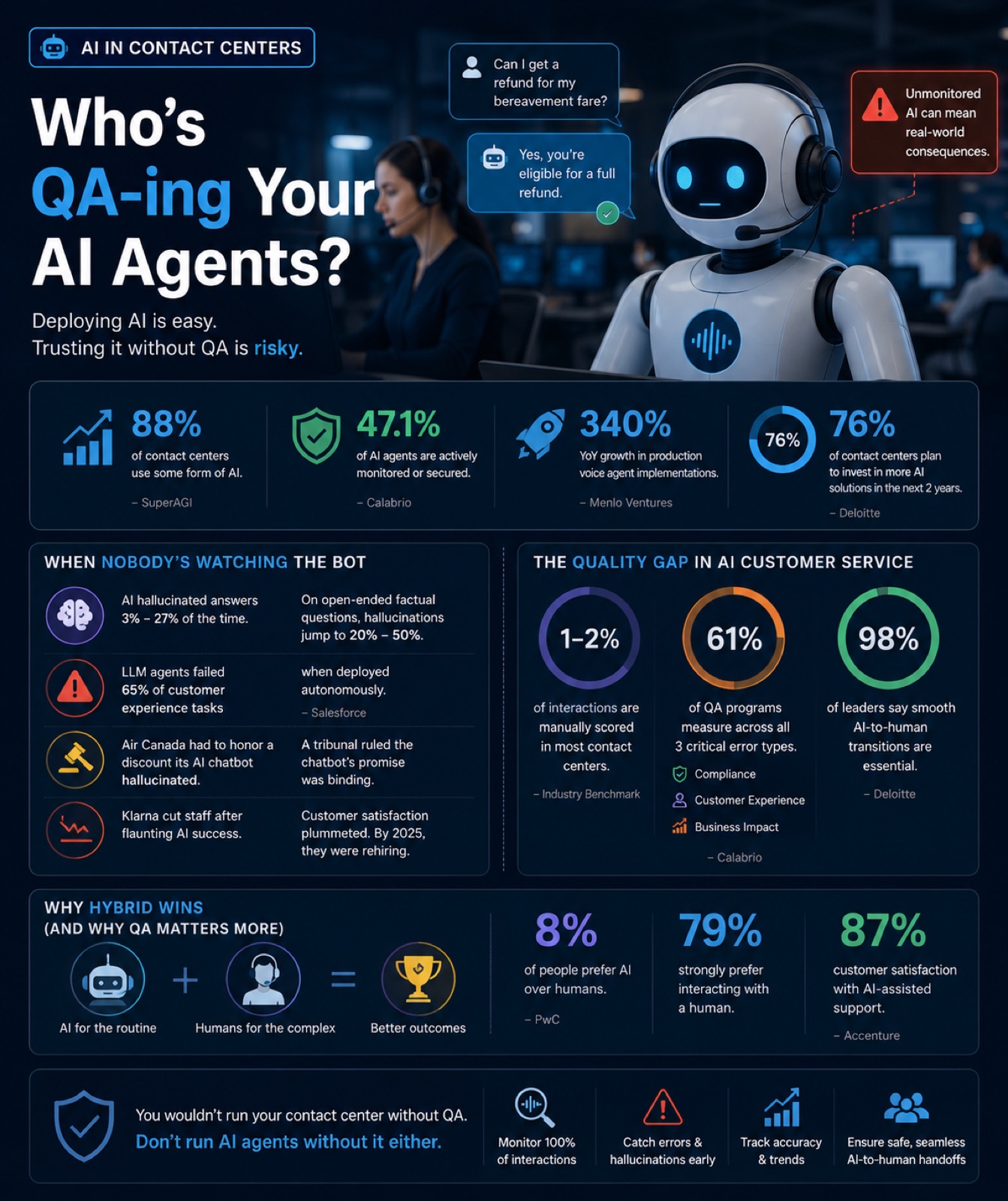
We’ve spent years building quality assurance systems for human agents. Scorecards. Call monitoring. Coaching sessions. And yet, as organizations race to deploy AI across customer service, the quality layer has gone missing. 79% of organizations now use AI in customer care, according to COPC. But Gravitee’s 2026 survey found that only 47.1% of an organization’s AI agents are actively monitored or secured. More than half operate without consistent oversight.
That gap between deployment and monitoring isn’t just a quality problem. With the EU AI Act’s transparency rules in effect since August 2026, it’s becoming a regulatory one.
AI in Contact Centers: The Deployment Explosion Nobody Prepared For
The numbers are staggering. Production voice agent implementations grew 340% year-over-year across 500+ organizations. 78% of the top 50 banks now run production voice agents for at least one customer-facing use case, up from 34% in 2024. And 76% of contact centers plan to invest in more AI solutions in the next two years.
Gartner predicts agentic AI will autonomously resolve 80% of common customer service issues by 2029. That’s not a future projection from a sci-fi conference. It’s a four-year timeline with billions of dollars behind it.
But here’s what happened along the way: organizations deployed AI agents the way they’d deploy a new phone system. Plug it in, test the basics, launch it. Nobody built the equivalent of a QA scorecard for bots. Nobody hired the equivalent of a QA analyst to listen to what the AI is actually saying.
Only 25% of call centers have successfully integrated AI automation into their daily operations. The other 75% own AI tools they haven’t fully operationalized. They turned the bot on. They didn’t build the feedback loop.
What Happens When Nobody’s Watching the Bot
When a human agent makes a mistake, someone eventually catches it. A QA review flags the error. A supervisor pulls the call. The agent gets coached.
When an AI agent makes a mistake, the odds of anyone noticing are much lower. And the mistakes AI makes are different. Stranger. Sometimes more damaging.
AI chatbots hallucinate between 3% and 27% of the time, even on an easy task. That is Vectara’s 2023 test, which asked leading models only to summarize a short news story. Harder questions are worse: on OpenAI’s own test of questions about people, its o3 model hallucinated on 33% of them and o4-mini on 48%. That means your chatbot might be making up policies, inventing discounts, or providing compliance-violating guidance.
Salesforce AI Research tested LLM agents on customer relationship tasks: the best of them completed only about 35% of the tasks that needed a multi-turn conversation.
And these aren’t hypothetical risks. Air Canada found out the hard way when a Canadian tribunal ruled the airline had to honor a discount its AI chatbot hallucinated. The bot told a customer they could get a bereavement fare refund. The airline’s actual policy said otherwise. The tribunal sided with the customer. The chatbot’s promise was binding.
Klarna’s story is even more instructive. In February 2024, the Swedish fintech announced that its AI assistant was doing the equivalent work of 700 full-time agents. In May 2025, CEO Sebastian Siemiatkowski told Bloomberg that cost had been “a too predominant evaluation factor” and that “what you end up having is lower quality,” and Klarna started hiring people for customer service again.
The pattern is consistent: deploy fast, monitor never, scramble when it breaks.
The Quality Gap in AI Customer Service
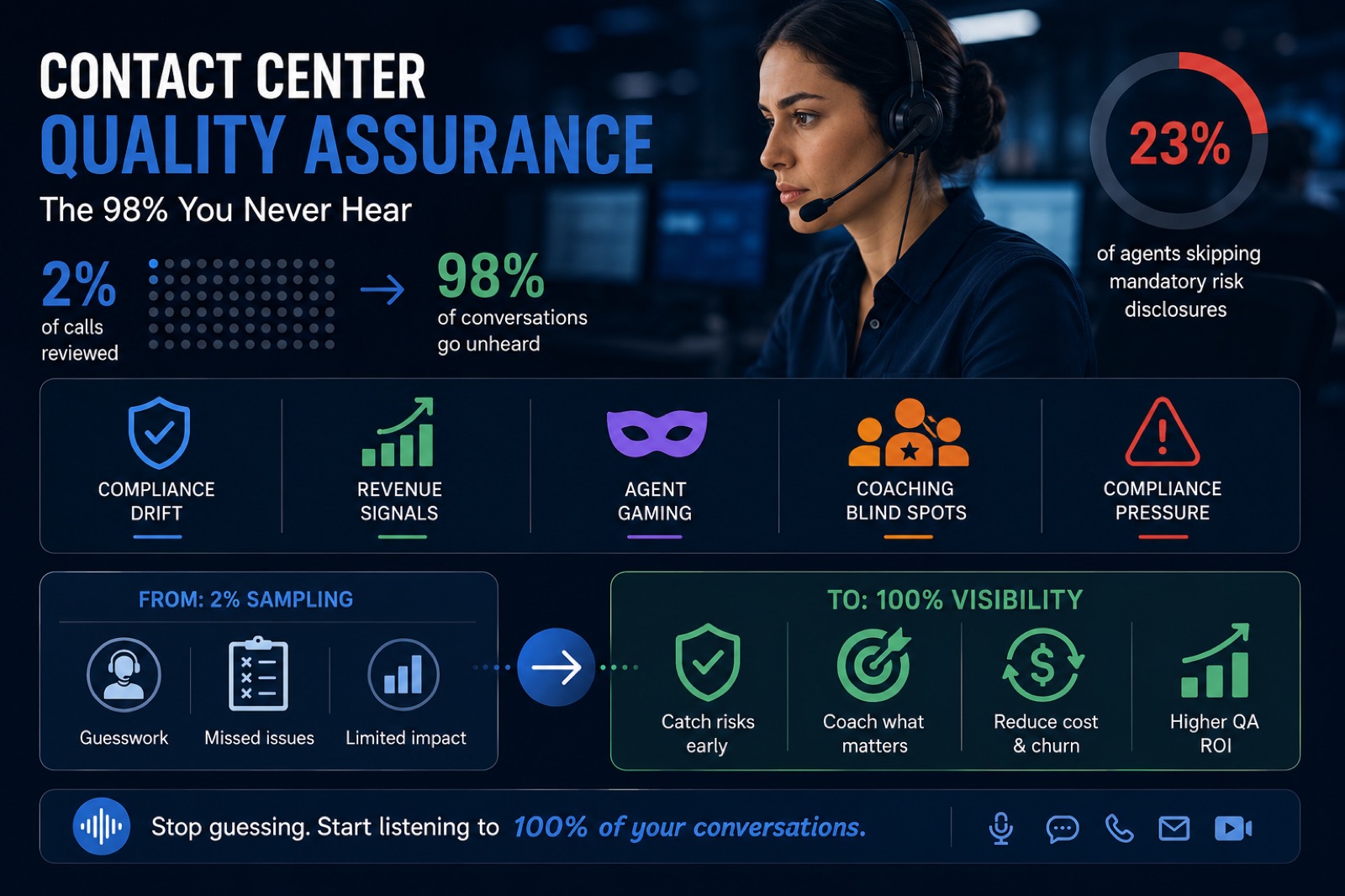
Traditional QA was already thin. Most contact centers score just 1-2% of customer interactions through manual methods. We’ve written extensively about why 2% sampling fails for human agents. For AI agents, the situation is worse.
92% of contact centers have QA programs. But only 61% measure across all three critical error types: compliance, customer experience, and business impact. And those programs were designed for humans. They don’t account for the specific failure modes of AI.
Human agents rarely invent policies that don’t exist. AI agents do it regularly.
Human agents don’t usually promise discounts they’re not authorized to give. AI agents have done it on live customer interactions.
Human agents might say something rude. AI agents might say something legally binding that contradicts the company’s terms of service.
The scoring rubrics, coaching frameworks, and escalation triggers built for human QA don’t transfer. AI needs its own quality layer. One that monitors 100% of interactions, flags hallucinations in real time, catches compliance violations before they become tribunal cases, and tracks accuracy trends over time.
Why Hybrid Beats Pure AI (And Why That Makes QA Harder)
The data on customer preferences is unambiguous. Just 8% of respondents prefer AI over humans in customer service. 79% of Americans strongly prefer interacting with a human. And 78% say it’s important to be able to switch from an AI agent to a human when they need to.
But here’s the thing: hybrid AI-human models dramatically outperform pure AI. Customer satisfaction with AI-assisted support has reached 87% globally when combined with human oversight, up from 73% in 2023. When AI enables personalized service by human agents, satisfaction gains reach 27%.
The winning model isn’t AI replacing humans. It’s AI handling the routine while humans handle the complex, with a quality layer monitoring both.
And that’s where most organizations are stuck. 98% of leaders say smooth AI-to-human transitions are essential. 90% admit they struggle to make those handoffs work.
The handoff problem is also a QA problem. When a chatbot transfers a frustrated customer to a human agent, who checks whether the bot’s summary was accurate? When a voice bot captures customer intent before routing to a specialist, who verifies the intent classification was correct? When AI generates after-call notes for the CRM, who confirms they reflect what actually happened?
At Ender Turing, we built voice bot quality assurance for exactly this gap. The AI agent’s conversation needs the same scrutiny as the human agent’s conversation. More, actually, because AI fails differently and at scale.
The Regulatory Clock Is Ticking
If the quality argument doesn’t move budget, the regulatory one will.
The EU AI Act’s rules for high-risk AI systems apply from 2 December 2027. The requirements aren’t optional suggestions. They’re legal obligations with fines of up to €15 million or 3% of worldwide turnover.
Organizations must establish post-market monitoring systems proportionate to the AI technology and its risks, collecting and analyzing data on performance throughout the system’s operational life. Not a sample. Not a quarterly audit. Ongoing, systematic monitoring.
Serious incidents must be reported to market surveillance authorities within 15 days. And transparency obligations, requiring users to be clearly informed they’re interacting with an AI system, are already in effect.
For contact centers operating in the EU, this means any AI system the Act classes as high-risk needs documentation, monitoring, and performance tracking.
Gartner predicted in July 2024 that at least 30% of generative AI projects would be abandoned after proof of concept by the end of 2025. And over 40% of agentic AI projects will be canceled by end of 2027. A big reason: organizations that can’t prove compliance and quality outcomes will pull the plug rather than accept the regulatory risk.
Forrester predicts 30% of enterprises will create parallel AI functions that mirror human service roles by 2026, including managers to onboard and coach AI agents. The concept of “AI agent management” is emerging precisely because the monitoring gap can’t be ignored anymore.
What AI QA Actually Looks Like
Monitoring AI agents isn’t just running a human QA scorecard against bot transcripts. It requires a different approach.
Coverage has to be 100%. Human QA can get away with sampling because agents have broadly consistent behavior. AI agents don’t drift gradually. They fail suddenly and at scale. One bad model update, one misconfigured intent, and thousands of customers get wrong answers simultaneously. Sampling won’t catch that. You need 100% automated quality monitoring across every AI interaction.
Hallucination detection needs to be real-time. When a chatbot invents a refund policy, catching it in a weekly QA review means 500 customers already received the wrong information. Real-time monitoring flags the hallucination on the first occurrence, triggers an alert, and can automatically escalate to a human.
Compliance monitoring can’t be manual. Regulators don’t care that you sampled 50 bot conversations this month. They care about the one where your AI told a customer in Germany that their data wouldn’t be stored, when it actually was. Automated speech analytics catches compliance language violations across all channels, whether the speaker is human or AI.
Handoff quality needs its own scorecard. When the bot transfers to a human, did the context transfer accurately? Did the customer have to repeat themselves? Did the human agent receive a correct summary of the issue? These handoff moments are where most hybrid systems break down, and where customer frustration spikes hardest.
Accuracy trends need tracking over time. AI models degrade. Training data goes stale. Customer language evolves. Without longitudinal tracking, you won’t notice your bot’s accuracy dropping from 94% to 82% over three months until customer complaints spike.
The Cost of AI in Contact Centers: Getting It Right vs. Wrong
Companies that implement proper AI monitoring are seeing strong returns. Organizations report an average 340% first-year ROI from AI in contact centers, with $3.50 returned for every $1 invested. AI-driven QA reduces manual review time by nearly 50% while boosting overall agent performance by 20%.
But those numbers come from organizations that operationalized AI properly, the 25%, not from the 75% that just turned it on and hoped for the best.
The cost of getting it wrong is equally concrete. When Air Canada’s chatbot invented a bereavement-fare refund, the tribunal ordered the airline to pay CA$812.02 and held that it is responsible for all the information on its website, chatbot included. The bill was small; the precedent was not. IBM’s 2025 breach report found that a high level of shadow AI added $670,000 to the average cost of a data breach.
The math isn’t complicated. Building a quality layer for your AI agents costs a fraction of one regulatory incident or one Air Canada-style tribunal ruling.
Five Things to Do Now
If you’re running AI agents in customer-facing roles, here’s what should be on your Q2 priority list:
- Audit your AI monitoring coverage. What percentage of AI interactions are being reviewed? If the answer is “we check some transcripts weekly,” you’re not monitoring. You’re hoping.
- Build hallucination detection into your QA workflow. Identify your highest-risk categories: policy statements, pricing, refund eligibility, compliance disclosures. Flag any AI response that contradicts your source of truth in those areas.
- Score your handoff quality. Track what happens when AI transfers to humans. Does context transfer? Does the customer repeat themselves? Is the AI’s issue summary accurate? This is where hybrid models succeed or fail.
- Map your AI interactions to EU AI Act requirements. If you serve EU customers, determine whether your AI customer service qualifies as high-risk. Establish the post-market monitoring system before the high-risk rules apply in December 2027, not after.
- Treat AI agents like new hires, not software. They need onboarding (testing against real scenarios), ongoing performance reviews (accuracy tracking), coaching (model updates based on failure patterns), and termination criteria (when to pull them offline).
The contact centers winning with AI aren’t the ones deploying fastest. They’re the ones building the quality infrastructure to know when their AI is helping and when it’s hurting. Speed without monitoring isn’t innovation. It’s liability.