Picture a budget review where the CFO describes the call center as “necessary overhead.” Three weeks later, the same finance team approves a price increase that triggers the worst churn month in two years. Nobody connects the two events. The call center had already heard it coming: customers had been raising pricing concerns in inbound calls for weeks. None of that signal reached finance.
This is the gap. A call center profit center isn’t a slogan you put on a slide. It’s what happens when conversation data stops dying inside support tickets and starts reaching the people who make revenue decisions. McKinsey put hard numbers on the opportunity: inbound service call centers generated up to 25% of new revenue at some credit card companies and up to 60% at some telecom companies. Yet 98% of the conversations that produce that signal go unreviewed.
Why The CFO Sees Cost Center, Not Profit Center
Most finance teams inherit a default model: customer service is a cost-per-contact problem. Average handle time goes up, cost goes up. Average handle time goes down, cost goes down. That’s the entire dashboard. The CFO has no view into what a 4-minute call produced beyond a resolved ticket.
Look at how the cost line is actually built. A 1,000-seat center running at 40% annual attrition burns roughly $4M to $8M a year in replacement cost alone (McKinsey’s $10,000–$20,000 per agent, applied to 40% turnover). On top of that sit licenses, real estate, telecom, and supervisor overhead. When the CFO looks at the P&L, all of that is visible. None of the revenue is.
Compare it to outbound sales. Sales has a CRM. Every conversation gets logged, attributed, and pipelined. A rep who books 12 demos a quarter has 12 line items the CFO can audit. A support agent who saves an at-risk customer worth $40K ARR by handling one call well in March has zero line items. The save shows up (eventually) as “no churn this quarter” in a different team’s report. The agent gets no credit. Finance has no evidence the call mattered.
This is why service stays a cost center on most balance sheets. Not because it isn’t generating revenue. Because nobody is measuring the revenue it generates.
The Data: Service-Led Companies Outperform By Multiples
The pattern is consistent across every major study run in the last five years.
- Forrester found that CX leaders’ revenue growth was 5.1 times that of CX laggards (2010–2015 data).
- Accenture measured that companies treating service as a value center deliver 3.5x more revenue growth than peers treating it entirely as a cost center.
- Bain & Company documented the retention math: a 5% lift in retention drives 25-95% profit increase depending on industry.
- Forrester’s 2023 analysis found that a one-point CX Index gain is worth more than $1 billion in revenue to the largest mass-market auto manufacturer and about $370 million to the largest auto and home insurer.
These aren’t soft numbers. They’re the kind of multiples that should change capital allocation. They don’t, because most finance teams can’t trace the chain of evidence from “we listened to this call differently” to “the customer renewed at a higher tier.” The data is there. The plumbing isn’t.
Compare that to the cost numbers, which are pristine. Average cost per contact is benchmarked across every BPO. Attrition is reported quarterly. AHT is tracked to the second. The asymmetry (perfect cost data, missing revenue data) is what produces the cost-center frame. The CFO isn’t wrong to use the model they have. They just have an incomplete one.
There’s a second pattern worth noting. COPC research found that 56% of contact centers are not realizing the return they expected from AI, and 48% name integration challenges as the main cause. Most of those AI projects were sold to finance on cost-reduction stories. Replace agents, save money. The ones that actually delivered ROI were the ones that found revenue, not the ones that found savings. The CFO who funded “AI to cut headcount” usually got neither.
What Drives Contact Center ROI: The Trapped Signals
Every conversation a contact center handles produces four kinds of revenue signal. None of them show up in a ticket.
1. Churn signals before churn. Customers almost never cancel without warning. They mention competitors, raise pricing concerns, complain about a specific feature, ask about contract end dates. If the CFO had a churn-risk pipeline built from conversation data, the save team could intervene while there’s still time. Without it, churn shows up as a number on a deck three months too late.
2. Upsell signals nobody routes. A customer calling about a transaction limit is signaling they need a higher-tier account. A customer asking why their report won’t export is signaling they need a feature in a premium plan. McKinsey’s finding (up to 25% of new revenue at some credit card companies came from inbound service calls) is built on exactly this. Most centers either don’t catch these signals, or catch them and have no workflow to convert them.
3. Product feedback that should reach the roadmap. The third time a customer says “I wish your app did X,” it stops being one customer and starts being a product priority. But product teams rarely sit in call queues. They look at NPS surveys and feature request forms, both of which capture maybe 1% of what customers actually said.
4. Pricing pressure before it becomes a campaign. The opening scenario isn’t unusual. Pricing teams often discover their changes were the wrong move only after the churn report lands. The signal was already in the calls. Finance never saw it because finance doesn’t listen to calls.
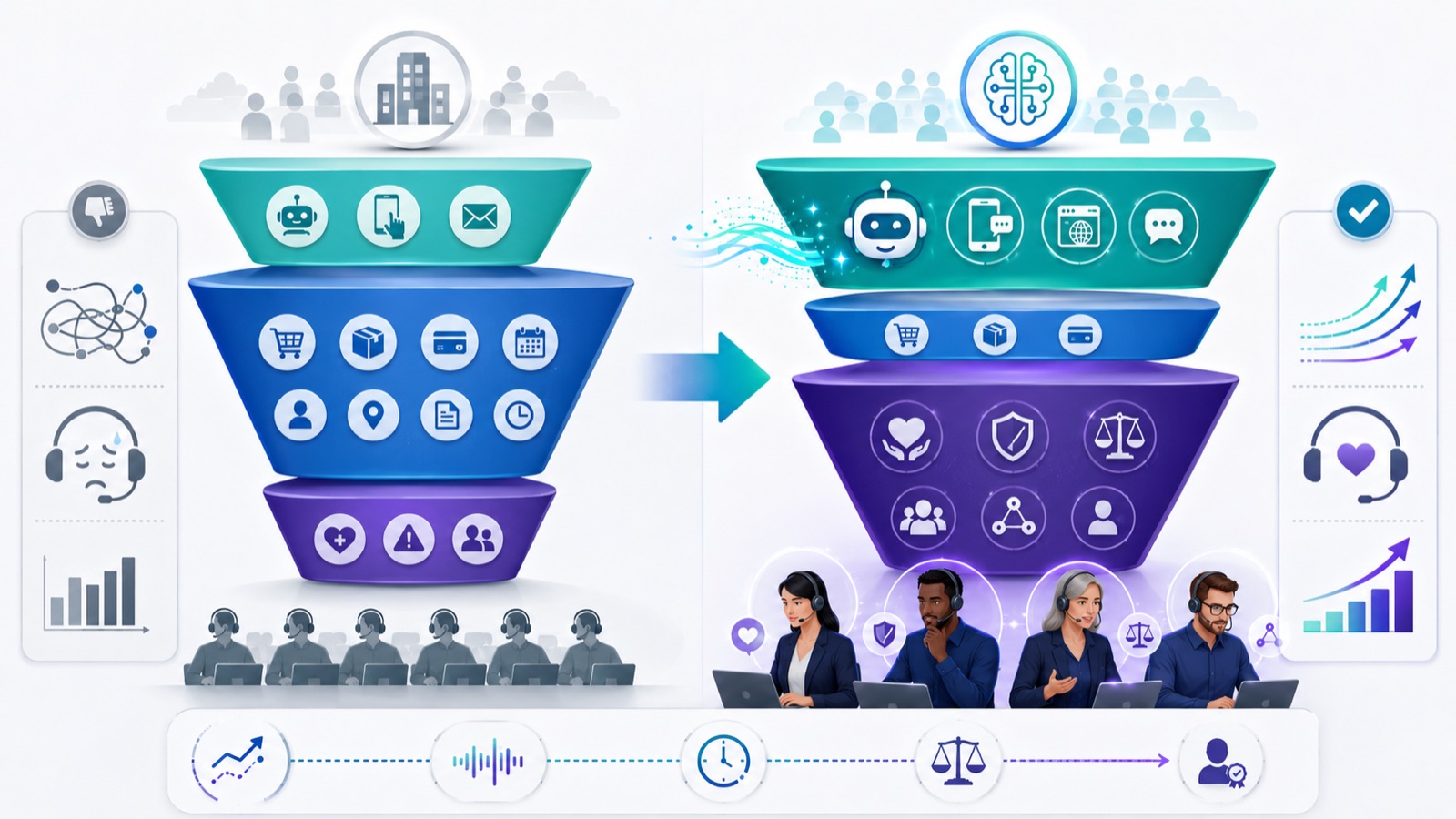
The reason these signals stay trapped is structural. The average organization manages 3.9 different contact center technologies (CCaaS, ticketing, knowledge base, QA tool, WFM, recording, CRM, sentiment, dialer), and only 3% of contact centers run on a single platform (Puzzel’s State of Contact Centres 2026, via CX Today). The signal exists across all those systems. Nobody can see all of it.
This is where conversation intelligence platforms change the math. Not because they automate handle time. Because they make 100% of conversations addressable as data. Finance can finally build a revenue model on the actual signal, not on a 2% sample.
Building The Call Center Profit Center: Three Shifts
Three shifts turn the conversation. Each one is concrete and measurable.
Shift one: build a revenue dashboard from conversation data, not from tickets. Tickets capture what the agent typed. Conversations capture what the customer said. The two are different. Companies using automated quality assurance across 100% of calls catch the revenue-relevant signals that random sampling misses. Track these signals weekly: upsell mentions per 1,000 calls, churn-risk markers per 1,000 calls, product feature requests by frequency, pricing-objection rate. Show the CFO the trend. Now they have a leading indicator, not a lagging one.
Shift two: attribute saves and conversions back to the agent. When an agent handles a churn-risk call well and the customer doesn’t cancel within 90 days, that’s a save. Attach a dollar value to it (ARR, LTV, contract value, whatever your finance team uses). Show it on the agent’s scorecard, on the manager’s dashboard, and on the CFO’s monthly P&L. Suddenly the call center has a revenue column. The agents see they’re contributing to the top line. Attrition drops. Performance improves. Both effects compound. And lower attrition pays back on its own: Metrigy’s research shows that when agent turnover stays below 15%, customer satisfaction increases by 26%.
Shift three: kill the after-call paperwork tax. Agents spend 30-40% of their shift on after-call notes, CRM logging, ticket categorization. That’s time not spent on the next customer, or on the call they’re currently on, because they’re typing instead of listening. AI-generated CRM summaries from the call itself, paired with agent performance management tooling, take that typing off the agent. The math is direct: a 1,000-seat center that recovers 30% of agent time can either handle 30% more volume at flat cost, or reduce headcount need by 30% at flat volume. The CFO can model that on a napkin.
The bigger point: each of these shifts is independently fundable. You don’t have to convince the board to rebuild the contact center. You convince them to fund a single revenue-attribution pilot, prove the model, then scale. Run a 90-day pilot on one queue. Track the signals. Show the saves. That becomes the case for the next year’s budget.
Once the CFO has a number to defend, they defend it.
What To Do This Week
Five concrete actions. None of them require a budget cycle to start.
- Pull one week of calls and tag them for revenue signal. Even by hand. Look for: competitor mentions, pricing objections, upsell opportunities, churn cues, product feature requests. Count them. That count is the start of a revenue dashboard.
- Calculate your current save value. Pick 10 customers your team prevented from cancelling in the last quarter. Multiply by ARR or LTV. That number (usually in the high six or low seven figures for a mid-size B2B) is the floor of what service is contributing. Show it to finance.
- Audit your AI investment against ROI, not cost. If you have AI in the center, ask one question: did it find revenue, or did it cut cost? If the answer is “cut cost” and you can’t show the revenue side, you’re in the 56% not getting the return they expected. Reframe before the next budget review.
- Map the after-call work tax. Time-track three agents for one shift. How much of their time is talk vs. typing? If typing is over 25%, that’s a real cost line and a real recoverable revenue lever. AI summaries solve it.
- Get the CFO into a call queue for one hour. Not a recording. A live queue. Most finance leaders have never sat in one. An hour of listening will do more for the cost-vs-profit conversation than any deck.
The shift from cost center to profit center isn’t a transformation project. It’s a measurement problem solved with conversation data that already exists. The center is already producing the revenue signal. The only question is whether finance is going to look at it.