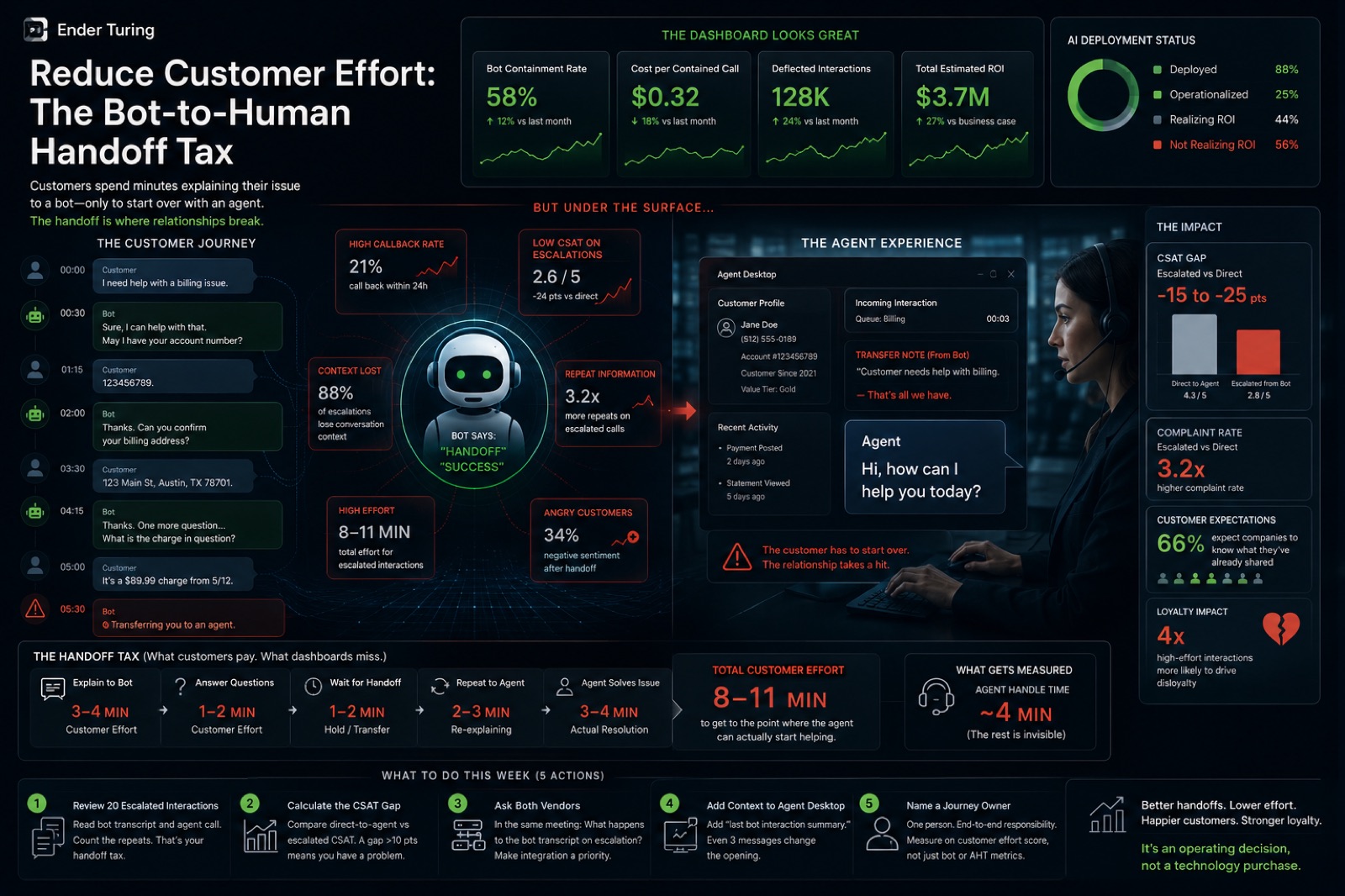
A customer types their account number into your chatbot. They explain their issue in two paragraphs. The bot asks three clarifying questions. Then it transfers them to an agent. The agent says: “Hi, how can I help you today?”
That moment, that single sentence, is where the relationship breaks. Not the wait time. Not the bot itself. The handoff. The customer just spent four to seven minutes proving who they are and what they need, and the system delivered them to a human who knows none of it.
Listen to escalated bot sessions and you can hear it. The customer’s voice changes the moment they realize they have to start over. It goes flat. Sometimes it goes sharp. Either way, the call is already lost before the agent gets a chance.
The Handoff Is The Whole Problem
Most contact centers measure customer effort in the wrong place. They count bot containment. They count average handle time. They count first-call resolution. What they do not count is the dead air between channels: the seconds and minutes a customer spends repeating what they already told the system.
Vonage research found that 61% of consumers feel IVR technology makes for a poor customer experience. The follow-up question, which most surveys skip, is even more revealing: what happens when a self-service tool fails and a customer escalates to a human? Often the full conversation context stays behind, and the agent gets a transfer note like “customer needs help with billing” and nothing else.
Four minutes of customer effort. Zero seconds of agent context. The handoff tax.
Why The Bot-to-Human Handoff Breaks
The handoff fails for three reasons.
First, the bot and the contact center platform are on different systems. The bot vendor sold the chatbot. The CCaaS vendor sold the agent desktop. Neither system was designed to pass a structured conversation transcript to the other. So when the bot escalates, it sends a routing flag (route to billing) and maybe a short summary string. The full conversation history stays trapped in the bot logs.
Second, the agent desktop was built for inbound calls, not warm handoffs. The agent sees a phone number, sometimes a CRM card, and a queue ticket. There is no window for “what the customer just told the bot.” Even when the data is technically available via API, the desktop UX does not surface it in the first three seconds, which is the only window that matters for a live customer.
Third, the QA team is not measuring the handoff. They score the bot session in isolation (using bot analytics) and the agent call in isolation (using call recordings). Nobody scores the handoff as a single customer journey. So the failure mode is invisible. The bot metrics look fine. The agent metrics look fine. The customer hates the experience.
The Customer Effort Math Nobody Calculates
Customer effort is a measurable score (CES, customer effort score), and Gartner research has shown for years that 96% of customers with a high-effort service interaction become more disloyal, against 9% after a low-effort one. What contact center teams rarely do is decompose effort into the channels that produced it.
Add up a typical escalated-from-bot interaction — the bot loop, the transfer, the wait, the re-explanation — and the customer can spend several minutes of effort before the agent can actually start solving the issue. The agent’s handle time, the one number the contact center actually measures, captures only part of it. The rest is invisible to the dashboard but completely visible to the customer.
This is why CSAT scores on escalated-from-bot interactions tend to run lower than on direct-to-agent interactions, even when the same agent resolves the same type of issue. The customer is not unhappy with the agent. They are exhausted by the path that got them there.
What Recovery Takes
Recovery is possible, but it takes work. Companies that lower their effort scores on escalated interactions tend to do three things.
They pass the full conversation transcript to the agent. Not a summary. Not a routing flag. The actual exchange. The agent reads the last 30 seconds of the bot conversation before opening with “I can see you’ve been trying to update your billing address. Let me take care of that for you.” The customer hears “I can see” and exhales.
They score the handoff as a single journey, not two sessions. The QA team, using conversation analytics tied to bot logs, reviews escalated interactions end to end. It can catch patterns such as bot intents that always escalate, agents who handle handoffs noticeably better, or time-of-day bot failures that produce angrier downstream calls. None of that is visible when the bot and agent sessions are measured separately.
They retrain the bot based on agent-side failures. When the agent has to ask a question the bot should have collected, that becomes a bot training signal. When the customer arrives frustrated because the bot looped them in a misunderstanding, that bot intent gets fixed. The feedback loop closes.
Companies that operationalize this loop can lift CSAT on escalated interactions, and the lift comes from fixing a handoff, not from buying new software.
The Repeat-Yourself Cost To Call Center Customer Satisfaction
There is a customer truth that contact center leaders often miss because they do not personally use their own self-service tools. The single most enraging moment in a customer service interaction is not waiting on hold. It is being asked for information you have already provided.
The “what is your account number” question, asked by a human agent ten seconds after the customer typed it into the bot, is a brand event. The customer does not log it as “minor inconvenience.” They log it as “this company doesn’t care enough to share information between its own systems.” That perception costs more than the call.
Picture a lending company that tracks complaint frequency by interaction type. Escalated-from-bot calls can produce complaints at a higher rate than direct-to-agent calls for the same issue types. The customers are not angrier going in. The handoff makes them angry. Conversation intelligence that captures the full journey and surfaces the bot-to-agent gap in real time shows a team like that where the handoff breaks.
Reducing Customer Effort Is An Operating Decision, Not A Technology Purchase
The temptation when reading a piece like this is to assume the answer is a new vendor. It is not. Most contact centers already own most of the tools they need. The bot vendor has APIs that expose conversation transcripts. The CCaaS platform has screen-pop fields that can hold context. The CRM has space for the customer’s recent interaction history. The QA platform can be configured to score journeys.
The reason the handoff still breaks is that no one owns the journey end to end. The bot team owns the bot. The agent operations team owns the agent. The IT team owns the integrations. The CX team owns the CSAT survey. Nobody owns the seven minutes in between.
This is why the most effective intervention is organizational, not technical. Assign a single owner for the bot-to-human journey. Give them access to both bot analytics and agent call analytics. Give them authority over the handoff design across both systems. Then measure them on customer effort score for escalated interactions, not on bot containment or agent AHT in isolation.
AI-powered quality assurance makes this owner role possible because it can score every interaction (bot and human) on the same rubric. Without that consistent scoring layer, the journey owner has nothing to manage against. They have two sets of numbers from two sets of tools, with no way to know if the handoff itself is improving.
This shift can pay off beyond CSAT, too. Agents can start to like handoffs more. The hostile-customer-on-arrival pattern, the one that drives so much agent burnout in escalation queues, tends to fade. Agents who used to dread the bot transfers can handle them confidently because they know what the customer needs before they say hello.
What To Do This Week
Five steps you can take in the next five working days. None of them require a new vendor.
Pull twenty escalated-from-bot interactions from last week and read them end to end. Read the bot transcript. Then listen to the agent call. Count how many times the customer repeats information. The first time you do this, the number will shock you. That number is your handoff tax.
Calculate the CSAT gap. Pull CSAT scores for two cohorts: direct-to-agent and escalated-from-bot. If the gap is over 10 points, you have a handoff problem. If it is over 20 points, you have a CX crisis hiding inside metrics that look fine.
Ask your bot vendor and your CCaaS vendor in the same meeting: what happens to the bot conversation transcript when a session escalates to a human agent? You will likely discover the answer is “it goes nowhere useful.” Make this the next quarter’s integration priority.
Add one field to your agent desktop screen-pop: “last bot interaction summary.” Even a basic implementation (just the last three bot messages) will transform agent opens. Agents who can lead with “I see you’ve been working on X” change the entire emotional trajectory of the call.
Name a journey owner. One person responsible for the bot-to-human handoff across departments. Give them the authority and the data to make the journey work. Without an owner, every individual team will continue to optimize their slice while the customer experiences the whole.
The customer who calls you today is not asking for new technology. They are asking your two systems to remember what they just said to one of them. Reducing the effort it takes to do business with you is the single most leveraged investment in customer service improvement available right now. It costs almost nothing. It changes everything about how the customer feels when they hang up.
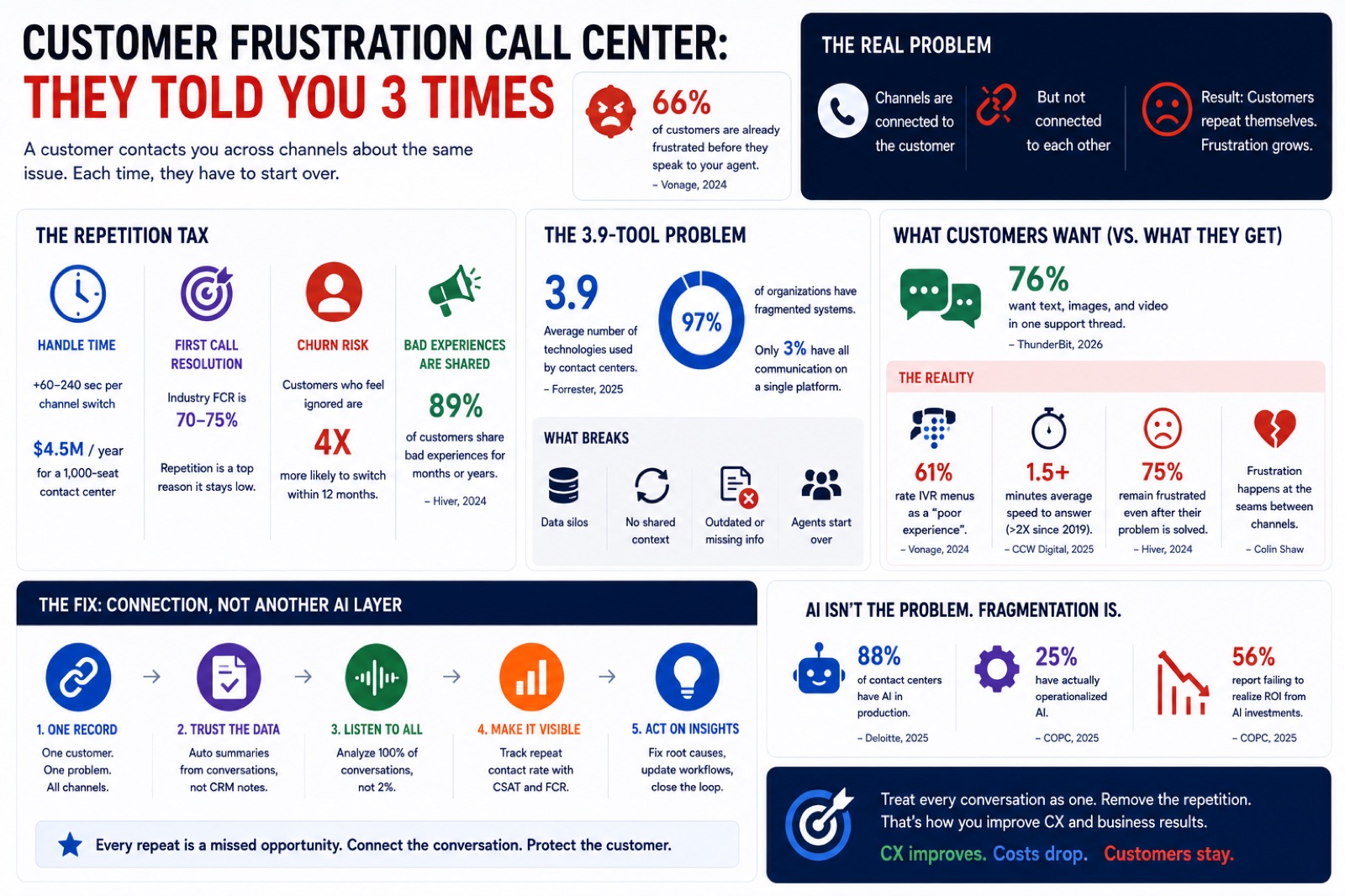
We wrote earlier on the related pattern of customers repeating themselves inside a single call in Customer Frustration Call Center: They Told You 3 Times. The handoff tax is the cross-channel version of the same disease, and it is the one most contact centers have not yet started measuring.